
transfluthrin (ISO); 2,3,5,6-tetrafluorobenzyl (1R,3S)-3-(2,2-dichlorovinyl)-2,2-dimethylcyclopropanecarboxylate
transfluthrin (ISO); 2,3,5,6-tetrafluorobenzyl (1R,3S)-3-(2,2-dichlorovinyl)-2,2-dimethylcyclopropanecarboxylate figure à l’annexe II en tant que substance interdite dans les produits cosmétiques mis sur le marché de l’UE.
Détails de la fiche
Nom chimique
transfluthrin (ISO); 2,3,5,6-tetrafluorobenzyl (1R,3S)-3-(2,2-dichlorovinyl)-2,2-dimethylcyclopropanecarboxylate
Informations réglementaires
Données clés
Identité et propriétés chimiques
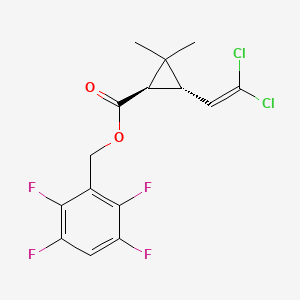
Transfluthrin
Transfluthrin is a carboxylic ester obtained by formal condensation of 3-(2,2-dichlorovinyl)-2,2-dimethylcyclopropanecarboxylic acid and 2,3,5,6-tetrafluorobenzyl alcohol. It has a role as a pyrethroid ester insecticide. It is a carboxylic ester, an organochlorine compound, an organofluorine compound and a member of cyclopropanes. It is functionally related to a 3-(2,2-dichlorovinyl)-2,2-dimethylcyclopropanecarboxylic acid. — ChEBI
- Nom IUPAC
- cis-(2,3,5,6-tetrafluorophenyl)methyl (1R,3S)-3-(2,2-dichloroethenyl)-2,2-dimethylcyclopropane-1-carboxylate
- Formule moléculaire
- C15H12Cl2F4O2
- Masse moléculaire
- 371.2 g/mol
- Masse exacte
- 370.0150477 Da
- XLogP3
- 5,0
- Surface polaire topologique
- 26,3 Ų
- Donneurs de liaisons hydrogène
- 0
- Accepteurs de liaisons hydrogène
- 6
- Unités covalentes
- 1
- Stéréocentres définis
- 2
Également connu sous le nom de
16 autres noms signalés
Identifiants de bases de données externes
- ChEBI:CHEBI:32253
- ChEMBL:CHEMBL3184657
- EPA DTXSID:DTXSID4046812
- PubMed:36868382
- PubMed:33822518
- PubMed:29064635
- PubMed:22538777
- PubMed:22433128
- PubMed:22155319
- PubMed:22080754
- PubMed:22043174
- PubMed:21736273
- PubMed:21377505
- PubMed:20410569
- PubMed:19875265
Preuves issues de bases de données scientifiques complémentaires
NIH PubChem PUG-View
Attributed physical-property, hazard, environmental and use annotations.
- Signal: Warning Source: Regulation (EC) No 1272/2008 of the European Parliament and of the Council
- GHS Hazard Statements: H302: Harmful if swallowed [Warning Acute toxicity, oral]; H351: Suspected of causing cancer [Warning Carcinogenicity]; H370: Causes damage to organs [Danger Specific target organ toxicity, single exposure]; H400: Very toxic to aquatic life [Warning Hazardous to the aquatic environment, acute hazard]; H410: Very toxic to aquatic life with long lasting effects [Warning Hazardous to the aquatic environment, long-term hazard] Source: Regulation (EC) No 1272/2008 of the European Parliament and of the Council
- Precautionary Statement Codes: P203, P260, P264, P270, P273, P280, P301+P317, P308+P316, P318, P321, P330, P391, P405, and P501 (click each P-code to see the statement) Source: Regulation (EC) No 1272/2008 of the European Parliament and of the Council
- Signal: Danger Source: European Chemicals Agency (ECHA)
- GHS Hazard Statements: H302 (49.2%): Harmful if swallowed [Warning Acute toxicity, oral]; H315 (50.8%): Causes skin irritation [Warning Skin corrosion/irritation]; H351 (49.2%): Suspected of causing cancer [Warning Carcinogenicity]; H370 (49.2%): Causes damage to organs [Danger Specific target organ toxicity, single exposure]; H400 (74.6%): Very toxic to aquatic life [Warning Hazardous to the aquatic environment, acute hazard]; H410 (100%): Very toxic to aquatic life with long lasting effects [Warning Hazardous to the aquatic environment, long-term hazard] Source: European Chemicals Agency (ECHA)
- Precautionary Statement Codes: P203, P260, P264, P270, P273, P280, P301+P317, P302+P352, P308+P316, P318, P321, P330, P332+P317, P362+P364, P391, P405, and P501 (click each P-code to see the statement) Source: European Chemicals Agency (ECHA)
- ECHA C&L Notifications Summary: Aggregated GHS information provided per 59 reports by companies from 5 notifications to the ECHA C&L Inventory. Each notification may be associated with multiple companies.; Information may vary between notifications depending on impurities, additives, and other factors. The percentage value in parenthesis indicates the notified classification ratio from companies that provide hazard codes. Only hazard codes with percentage values above 10% are shown. For more detailed information, please visit ECHA C&L website. Source: European Chemicals Agency (ECHA)
- Signal: Warning Source: European Chemicals Agency (ECHA)
- GHS Hazard Statements: H315 (100%): Causes skin irritation [Warning Skin corrosion/irritation]; H400 (100%): Very toxic to aquatic life [Warning Hazardous to the aquatic environment, acute hazard]; H410 (100%): Very toxic to aquatic life with long lasting effects [Warning Hazardous to the aquatic environment, long-term hazard] Source: European Chemicals Agency (ECHA)
- Precautionary Statement Codes: P264, P273, P280, P302+P352, P321, P332+P317, P362+P364, P391, and P501 (click each P-code to see the statement) Source: European Chemicals Agency (ECHA)
- ECHA C&L Notifications Summary: Aggregated GHS information provided per 53 reports by companies from 2 notifications to the ECHA C&L Inventory. Each notification may be associated with multiple companies.; Information may vary between notifications depending on impurities, additives, and other factors. The percentage value in parenthesis indicates the notified classification ratio from companies that provide hazard codes. Only hazard codes with percentage values above 10% are shown. For more detailed information, please visit ECHA C&L website. Source: European Chemicals Agency (ECHA)
- Signal: Warning Source: NITE-CMC
Mis en correspondance par: Existing checksum-valid CAS to unique PubChem CID match. Récupéré le: 2026-08-31. Ouvrir la fiche source
Les classifications scientifiques et les annotations de danger apportent du contexte et ne remplacent pas la décision réglementaire propre au marché indiquée ci-dessus.
Couverture des sources complémentaires et état des correspondances
| Source | Résultat | Vérifié |
|---|---|---|
| NIH PubChem PUG-View | Correspondance exacte | 2026-08-31 |
Une absence de correspondance enregistrée est une preuve utile que la source a été vérifiée ; ce n’est pas l’affirmation que la substance n’existe pas ailleurs.
Récupéré depuis NIH PubChem le 2026-08-31 par correspondance CAS à somme de contrôle valide. Les propriétés chimiques ne remplacent pas la décision réglementaire de cette page.
Fiches associées pour transfluthrin (ISO); 2,3,5,6-tetrafluorobenzyl (1R,3S)-3-(2,2-dichlorovinyl)-2,2-dimethylcyclopropanecarboxylate
Les correspondances directes sont limitées pour cette fiche ; des entrées voisines de l’annexe II sont donc également affichées.
2,2',6,6'-tetrabromo-4,4'-isopropylidenediphenol; tetrabromobisphenol-A
clothianidin (ISO); (E)-1-(2-chloro-1,3-thiazol-5-ylmethyl)-3-methyl-2-nitroguanidine
diphenyl(2,4,6-trimethylbenzoyl)phosphine oxide; INCI: Trimethylbenzoyl Diphenylphosphine Oxide
benzyl(diethylamino)diphenylphosphonium 4-[1,1,1,3,3,3-hexafluoro-2-(4-hydroxyphenyl)propan-2-yl]ph…
3-(4'-methylbenzylidene)-camphor; [INCI: 4-Methylbenzylidene Camphor]
benzyltriphenylphosphonium, salt with 4,4'-[2,2,2-trifluoro-1-(trifluoromethyl)ethylidene]bis[pheno…
Platinum (nano) [INCI], Colloidal Platinum (nano) [INCI] [1] Acetyl tetrapeptide-17 Colloidal Plati…
reaction mass of 4,4'-[2,2,2-trifluoro-1-(trifluoromethyl)ethylidene]diphenol and benzyl(diethylami…
Gold (nano) [INCI], Colloidal Gold (nano) [INCI] [1] Gold Thioethylamino Hyaluronic Acid (nano) [IN…
reaction mass of 4,4'-[2,2,2-trifluoro-1-(trifluoromethyl)ethylidene]diphenol and benzyltriphenylph…
Silver (nano) [1 nm < particle diameter ≤ 100 nm] Silver (massive) [particle diameter ≥ 1 mm]
dimethyl propylphosphonate
Ce que signifie l’annexe II pour transfluthrin (ISO); 2,3,5,6-tetrafluorobenzyl (1R,3S)-3-(2,2-dichlorovinyl)-2,2-dimethylcyclopropanecarboxylate
transfluthrin (ISO); 2,3,5,6-tetrafluorobenzyl (1R,3S)-3-(2,2-dichlorovinyl)-2,2-dimethylcyclopropanecarboxylate figure comme substance interdite à l’annexe II du règlement (CE) n° 1223/2009 relatif aux produits cosmétiques et ne doit pas être ajouté intentionnellement. L’article 17 traite séparément des traces involontaires, techniquement inévitables dans le respect des bonnes pratiques de fabrication et compatibles avec l’exigence de sécurité de l’article 3.
Les formulateurs doivent contrôler leurs ingrédients et matières premières afin de s’assurer qu’aucun ne contient cette substance. Les fournisseurs doivent fournir, sur demande, une documentation confirmant son absence.
La page fait également apparaître 12 fiches d’annexe associées présentant des identifiants, une logique d’annexe ou des schémas de dénomination qui se recoupent.
Liste de contrôle de conformité
- Vérifiez que cette substance est absente de toutes les matières premières et formulations finies.
- Demandez aux fournisseurs de matières premières une attestation d’absence ou un certificat d’analyse.
- Consignez le résultat du contrôle dans le dossier d’information produit (DIP).
Questions fréquentes
Note de source pour la fiche transfluthrin (ISO); 2,3,5,6-tetrafluorobenzyl (1R,3S)-3-(2,2-dichlorovinyl)-2,2-dimethylcyclopropanecarboxylate de l’annexe II
Cette page résume une fiche de l’annexe II pour transfluthrin (ISO); 2,3,5,6-tetrafluorobenzyl (1R,3S)-3-(2,2-dichlorovinyl)-2,2-dimethylcyclopropanecarboxylate à partir de documents publics de la Commission européenne sur les cosmétiques et ajoute les correspondances d’inventaire ou d’identifiants associées lorsqu’elles sont disponibles.
Utilisez cette page de fiche pour examiner les conditions de l’annexe II pour transfluthrin (ISO); 2,3,5,6-tetrafluorobenzyl (1R,3S)-3-(2,2-dichlorovinyl)-2,2-dimethylcyclopropanecarboxylate, mais confirmez toute décision réglementaire finale auprès du libellé officiel en vigueur de l’annexe et des fichiers sources.
Outils et étapes suivantes
Vérifiez votre formule
Collez une liste INCI complète pour détecter transfluthrin (ISO); 2,3,5,6-tetrafluorobenzyl (1R,3S)-3-(2,2-dichlorovinyl)-2,2-dimethylcyclopropanecarboxylate et d’autres fiches d’annexe de l’UE signalées en une seule passe.
Vérificateur INCIComparer des entrées
Comparez transfluthrin (ISO); 2,3,5,6-tetrafluorobenzyl (1R,3S)-3-(2,2-dichlorovinyl)-2,2-dimethylcyclopropanecarboxylate côte à côte avec une autre fiche d’annexe pour examiner les différences de restrictions, de concentrations et d’annexe.
ComparerParcourir l’annexe
Consultez toutes les fiches de l’annexe II et comparez les conditions réglementaires entre les substances de cette annexe.
Ouvrir l’annexe II