
Cinchonan-9-ol, 6'-methoxy-, (8.alpha.,9R)- its salts
Listed by the Saudi Food and Drug Authority as restricted in cosmetic products; open the cited detail for the current conditions.
Regulatorische Entscheidung und vollständige Bedingungen
- Status
- Restricted
- Rechtsrolle
- Binding rule
- Regulatorische Zusammenfassung
- Listed by the Saudi Food and Drug Authority as restricted in cosmetic products; open the cited detail for the current conditions.
- Bedingungen und Beschränkungen
- If this row does not reproduce conditions, open the cited official detail because omission does not mean unrestricted use. Öffnen Sie die zitierte Quelle und wenden Sie die unten genannten marktweiten Anforderungen an.
Stoffidentität
- Name in der amtlichen Quelle
- Cinchonan-9-ol, 6'-methoxy-, (8.alpha.,9R)- its salts
- CAS
- 130-95-0
- EC
- 205-003-2
- Identitätszuordnung
- cas_number
- Verknüpfter Inhaltsstoff
- QUININE
Verknüpfte CosIng-Identitätsdaten
Namen und Aliase
CosIng-Beschreibung: Cinchonan-9-ol, 6'-methoxy-, (8.alpha., 9R)-
Beschränkungshinweis aus dem EU-Verzeichnis: III/21
Erfasste kosmetische Funktion: DENATURANT, FRAGRANCE, HAIR CONDITIONING
Funktionsseiten:DENATURANT, FRAGRANCE, HAIR CONDITIONING
Das vollständige Inhaltsstoffprofil ansehenMarktübergreifende Übersicht zu dieser Identität
Exakte verknüpfte Einträge, die derzeit auf dieser Website vorhanden sind. Ein fehlender Markt bedeutet, dass kein exakter Treffer importiert wurde, nicht dass der Stoff verwendet werden darf.
European Union
1 verknüpfter Eintrag · 1 mit besonderen Bedingungen
Unterstützenden Eintrag öffnenGreat Britain
1 verknüpfter Eintrag · 1 mit besonderen Bedingungen
Unterstützenden Eintrag öffnenNew Zealand
1 verknüpfter Eintrag · 1 mit besonderen Bedingungen
Unterstützenden Eintrag öffnenASEAN
1 verknüpfter Eintrag · 1 mit besonderen Bedingungen
Unterstützenden Eintrag öffnenSouth Korea
1 verknüpfter Eintrag · 1 mit besonderen Bedingungen
Unterstützenden Eintrag öffnenAustralia
1 verknüpfter Eintrag · 1 mit besonderen Bedingungen
Unterstützenden Eintrag öffnenIndia
1 verknüpfter Eintrag · 1 mit besonderen Bedingungen
Unterstützenden Eintrag öffnenSaudi Arabia
Aktueller Eintrag1 verknüpfter Eintrag
Unterstützenden Eintrag öffnen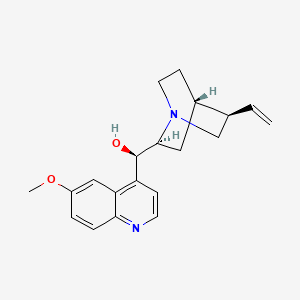
Verifizierte Chemie für CAS 130-95-0
Quinine
Quinine is a cinchona alkaloid that is cinchonidine in which the hydrogen at the 6-position of the quinoline ring is substituted by methoxy. It has a role as a non-narcotic analgesic, an antimalarial and a muscle relaxant. It is a conjugate base of a quinine(1+). It derives from a hydride of an (8S)-cinchonan. — ChEBI
- IUPAC-Name
- (R)-[(2S,4S,5R)-5-ethenyl-1-azabicyclo[2.2.2]octan-2-yl]-(6-methoxyquinolin-4-yl)methanol
- Summenformel
- C20H24N2O2
- Molekulargewicht
- 324.4 g/mol
- Exakte Masse
- 324.183778013 Da
- Monoisotopische Masse
- 324.183778013 Da
- XLogP3
- 2,9
- Topologische polare Oberfläche
- 45,6 Ų
- Molekulare Komplexität
- 457,0
- Formale Ladung
- 0
- Wasserstoffbrücken-Donoren
- 1
- Wasserstoffbrücken-Akzeptoren
- 4
- Drehbare Bindungen
- 4
- Schweratome
- 24
- Kovalente Einheiten
- 1
An PubChem gemeldete Namen und Synonyme
16 weitere gemeldete Namen
Kennungen in externen Datenbanken
Erweiterte Strukturstatistik
- Definierte Atom-Stereozentren
- 4
- Nicht definierte Atom-Stereozentren
- 0
- Definierte Bindungs-Stereozentren
- 0
- Nicht definierte Bindungs-Stereozentren
- 0
- 3D-Pharmakophormerkmale
- 9
- 3D-Ringe
- 3
- 3D-Hydrophobe
- 1
- 3D-Akzeptormerkmale
- 3
- 3D-Donormerkmale
- 1
- 3D-Anionenzentren
- 0
- 3D-Kationenzentren
- 1
- 3D-Konformere
- 7
- Effektive 3D-Rotoren
- 5,2
Maschinenlesbare Strukturkennungen
- SMILES
COC1=CC2=C(C=CN=C2C=C1)[C@H]([C@@H]3C[C@@H]4CCN3C[C@@H]4C=C)O- InChI
InChI=1S/C20H24N2O2/c1-3-13-12-22-9-7-14(13)10-19(22)20(23)16-6-8-21-18-5-4-15(24-2)11-17(16)18/h3-6,8,11,13-14,19-20,23H,1,7,9-10,12H2,2H3/t13-,14-,19-,20+/m0/s1- InChIKey
LOUPRKONTZGTKE-WZBLMQSHSA-N
Belege aus weiteren wissenschaftlichen Datenbanken
NIH PubChem PUG-View
Attributed physical-property, hazard, environmental and use annotations.
- Color/Form: Triboluminescent, orthorhombic needles from absolute alcohol Quelle: Hazardous Substances Data Bank (HSDB)
- Color/Form: Bulky, white, amorphous powder or crystalline alkaloid Quelle: Hazardous Substances Data Bank (HSDB)
- Color/Form: CRYSTALS TURN BROWN ON EXPOSURE TO AIR Quelle: Hazardous Substances Data Bank (HSDB)
- Basic pKa: 8.56 Quelle: ChEMBL
- Basic pKa: 8.55 Quelle: ChEMBL
- Dissociation Constants: pK1 (18 °C) = 5.07; pK2 = 9.7 Quelle: Hazardous Substances Data Bank (HSDB)
- LogP: 3.44 Quelle: DrugBank
- LogP: log Kow = 3.44 Quelle: Hazardous Substances Data Bank (HSDB)
- LogP: 2.6 Quelle: Human Metabolome Database (HMDB)
- Melting Point: 57 °C Quelle: DrugBank
- Melting Point: 177 °C (some decomposition) Quelle: Hazardous Substances Data Bank (HSDB)
- Melting Point: Microcrystalline powder; mp: 57 °C; efflorescent; loses one water molecule in air, two water molecules over sulfuric acid; anhydrous at 125 °C /Quinine trihydrate/ Quelle: Hazardous Substances Data Bank (HSDB)
- Melting Point: 57 °C Quelle: Human Metabolome Database (HMDB)
- Odor: ODORLESS Quelle: Hazardous Substances Data Bank (HSDB)
- Physical Description: Solid Quelle: Human Metabolome Database (HMDB)
- Refractive Index: INDEX OF REFRACTION: 1.625 Quelle: Hazardous Substances Data Bank (HSDB)
- Solubility: 500 mg/L (at 15 °C) Quelle: DrugBank
- Solubility: In water, 500 mg/L at 15 °C Quelle: Hazardous Substances Data Bank (HSDB)
- Solubility: 1 g dissolves in: 1900 mL water, 760 mL boiling water Quelle: Hazardous Substances Data Bank (HSDB)
- Solubility: 1 g dissolves in: 80 mL benzene (18 mL at 50 °C), 1.2 mL chloroform, 250 mL dry ether, 20 mL glycerol, 0.8 mL alcohol, 1900 mL of 10% ammonia water; almost insoluble in petroleum ether Quelle: Hazardous Substances Data Bank (HSDB)
- Solubility: Soluble in ether, chloroform, carbon disulfide, glycerol, alkalies, and acids (with formation of salts) Quelle: Hazardous Substances Data Bank (HSDB)
- Solubility: Sol in pyrimidine Quelle: Hazardous Substances Data Bank (HSDB)
- Solubility: 3.34e-01 g/L Quelle: Human Metabolome Database (HMDB)
- pH: pH of saturated aqueous solution = 8.8 Quelle: Hazardous Substances Data Bank (HSDB)
- Carcinogen Classification: No indication of carcinogenicity to humans (not listed by IARC). Quelle: Toxin and Toxin Target Database (T3DB)
- Exposure Routes: Oral Quelle: Toxin and Toxin Target Database (T3DB)
- Signal: Danger Quelle: European Chemicals Agency (ECHA)
- GHS Hazard Statements: H302 (22.9%): Harmful if swallowed [Warning Acute toxicity, oral]; H315 (28.4%): Causes skin irritation [Warning Skin corrosion/irritation]; H317 (99.5%): May cause an allergic skin reaction [Warning Sensitization, Skin]; H319 (28.4%): Causes serious eye irritation [Warning Serious eye damage/eye irritation]; H334 (83.1%): May cause allergy or asthma symptoms or breathing difficulties if inhaled [Danger Sensitization, respiratory] Quelle: European Chemicals Agency (ECHA)
- Precautionary Statement Codes: P233, P260, P261, P264, P264+P265, P270, P271, P272, P280, P284, P301+P317, P302+P352, P304+P340, P305+P351+P338, P321, P330, P332+P317, P333+P317, P337+P317, P342+P316, P362+P364, P403, and P501 (click each P-code to see the statement) Quelle: European Chemicals Agency (ECHA)
- ECHA C&L Notifications Summary: Aggregated GHS information provided per 201 reports by companies from 10 notifications to the ECHA C&L Inventory. Each notification may be associated with multiple companies.; Information may vary between notifications depending on impurities, additives, and other factors. The percentage value in parenthesis indicates the notified classification ratio from companies that provide hazard codes. Only hazard codes with percentage values above 10% are shown. For more detailed information, please visit ECHA C&L website. Quelle: European Chemicals Agency (ECHA)
- Signal: Warning Quelle: Hazardous Chemical Information System (HCIS), Safe Work Australia
- GHS Hazard Statements: H302: Harmful if swallowed [Warning Acute toxicity, oral]; H317: May cause an allergic skin reaction [Warning Sensitization, Skin] Quelle: Hazardous Chemical Information System (HCIS), Safe Work Australia
- Precautionary Statement Codes: P261, P264, P270, P272, P280, P301+P317, P302+P352, P321, P330, P333+P317, P362+P364, and P501 (click each P-code to see the statement) Quelle: Hazardous Chemical Information System (HCIS), Safe Work Australia
- Signal: Danger Quelle: Hazardous Substances Data Bank (HSDB)
- GHS Hazard Statements: H315: Causes skin irritation [Warning Skin corrosion/irritation]; H317: May cause an allergic skin reaction [Warning Sensitization, Skin]; H319: Causes serious eye irritation [Warning Serious eye damage/eye irritation]; H334: May cause allergy or asthma symptoms or breathing difficulties if inhaled [Danger Sensitization, respiratory] Quelle: Hazardous Substances Data Bank (HSDB)
- Precautionary Statement Codes: P233, P260, P261, P264, P264+P265, P271, P272, P280, P284, P302+P352, P304+P340, P305+P351+P338, P321, P332+P317, P333+P317, P337+P317, P342+P316, P362+P364, P403, and P501 (click each P-code to see the statement) Quelle: Hazardous Substances Data Bank (HSDB)
- Health Effects: It is usual for quinine in therapeutic doses to cause cinchonism; in rare cases, it may even cause death (usually by pulmonary edema). Quinine can worsen hemoglobinuria, myasthenia gravis and optic neuritis. It can cause paralysis if accidentally injected into a nerve, and is extremely toxic in overdose[Wikipedia] Quelle: Toxin and Toxin Target Database (T3DB)
- Toxicity Summary: IDENTIFICATION AND USE: Quinine is a bulky, white, amorphous powder or crystalline alkaloid, used as medication: non-narcotic analgesics; antimalarial; central muscle relaxants. It is also used as flavor in carbonated beverages. HUMAN EXPOSURE AND TOXICITY: Serious hypersensitivity reactions, including anaphylactic shock, anaphylactoid reactions, urticaria, serious skin rashes, angioedema, facial edema, bronchospasm, and pruritus, have been reported with quinine. In addition, thrombocytopenia, hemolytic uremic syndrome/thrombotic thrombocytopenic purpura (HUS/TTP), immune thrombocytopenic purpura, blackwater fever, disseminated intravascular coagulation, leukopenia, neutropenia, granulomatous hepatitis, and acute interstitial nephritis have been reported and may also be due to hypersensitivity reactions to the drug. Potentially fatal cardiac arrhythmias, including torsades de pointes and ventricular fibrillation, have been reported rarely during quinine therapy. At least 1 case of fatal ventricular arrhythmia has been reported in a geriatric patient with preexisting prolonged QT interval treated with IV quinine sulfate for Plasmodium falciparum malaria. Visual impairment can range Quelle: Hazardous Substances Data Bank (HSDB)
- Toxicity Summary: The theorized mechanism of action for quinine and related anti-malarial drugs is that these drugs are toxic to the malaria parasite. Specifically, the drugs interfere with the parasite's ability to break down and digest hemoglobin. Consequently, the parasite starves and/or builds up toxic levels of partially degraded hemoglobin in itself. Quelle: Toxin and Toxin Target Database (T3DB)
- Uses: Medicine (antimalarial) as the alkaloid or as numerous salts and derivatives; flavoring in carbonated beverages Quelle: Hazardous Substances Data Bank (HSDB)
- Uses: Flavor in carbonated beverages. Quelle: Hazardous Substances Data Bank (HSDB)
- Uses: MEDICATION Quelle: Hazardous Substances Data Bank (HSDB)
- Uses: MEDICATION (VET) Quelle: Hazardous Substances Data Bank (HSDB)
- Uses: For more Uses (Complete) data for QUININE (8 total), please visit the HSDB record page. Quelle: Hazardous Substances Data Bank (HSDB)
- Uses: Use (kg; approx.) in Germany (2009): >5000; Use (kg) in USA (2002): 56800; Consumption (g per capita; approx.) in Germany (2009): 0.0611; Consumption (g per capita) in the USA (2002): 0.201; Calculated removal (%): 41.8 Quelle: NORMAN Suspect List Exchange
- Uses: For the treatment of malaria and leg cramps. Used as an antipyretic (fever-reducing), antimalarial, analgesic (painkilling), and anti-inflammatory. It is also used as a flavor component of tonic water and bitter lemon. Quelle: Toxin and Toxin Target Database (T3DB)
Zugeordnet durch: Existing checksum-valid CAS to unique PubChem CID match. Abgerufen: 2026-08-31. Quelleneintrag öffnen
Wissenschaftliche Klassifizierungen und Gefahrenannotationen liefern Kontext und ersetzen nicht die oben gezeigte marktspezifische regulatorische Entscheidung.
Weitere Quellenabdeckung und Trefferstatus
| Quelle | Ergebnis | Geprüft |
|---|---|---|
| NIH PubChem PUG-View | Exakter Treffer | 2026-08-31 |
Ein erfasster Nicht-Treffer ist ein nützlicher Beleg dafür, dass die Quelle geprüft wurde; er ist keine Behauptung, dass der Stoff anderswo nicht existiert.
Am 2026-08-31 von NIH PubChem durch prüfsummengültigen CAS-Abgleich abgerufen. Chemische Eigenschaften ersetzen nicht die regulatorische Entscheidung auf dieser Seite.
Amtliche Quelle und Herkunft
- Registrierte Quelle
- Saudi SFDA prohibited and restricted ingredient lists
- Quellenverweis
- SFDA restricted list, page 2, row 4
- Eintrags-ID der Quelle
restricted-1-4- Quellenversion
- live-snapshot-2026-08-30
- Quellsprache
- English
- Übersetzungsstatus
- Original is English
- Stand geprüft
- 2026-08-30 05:18 UTC
- Validierungsmethode
- complete SFDA paginated HTML snapshot; strict page/row counts
- SHA-256
ceb6cc636e6b1f4b3013f88ce0297217b49d6194342c6ece5c03b1e04256d71a
Hinweise zum registrierten Datensatz
- Datensatzabdeckung
- Prohibited and restricted substances with CAS, EC and conditions
- Hinweis zur Behörde
- Official SFDA dated lists; version and hash each release
Wie dieser Eintrag in den Marktdatensatz passt
Statusverteilung
Bedingungstext ist bei 0 von 2090 aktuellen Einträgen vorhanden. Ein leeres Bedingungsfeld wird entsprechend der oben genannten Eintragsart interpretiert; es wird niemals in die Aussage einer uneingeschränkten Verwendung umgedeutet.
Saudi Arabia Marktkontext
Complete official list index
Abdeckungsversion: SFDA live prohibited/restricted lists, snapshot 30 August 2026
Every page and entry in the public SFDA prohibited and restricted ingredient indexes; restricted detail pages remain the source for conditions.
Verifizierungs-Checkliste
- Search names and CAS across both SFDA lists.
- Open the cited restricted-entry detail and apply every condition.
- Check current SFDA/GSO technical regulations and updates.
- Complete eCosma notification, label and responsible-party requirements.
Amtliche Marktquellen
- Saudi SFDA prohibited and restricted ingredient listsOfficial SFDA dated lists; version and hash each release
Verifizierungsablauf und Vollständigkeit des Eintrags
Bevor Sie dieses Ergebnis für eine Compliance-Entscheidung verwenden
- Bestätigen Sie, dass „Cinchonan-9-ol, 6'-methoxy-, (8.alpha.,9R)- its salts“ und jede CAS-/EC-Kennung sich auf das Material in Ihrer Lieferantenspezifikation beziehen.
- Search names and CAS across both SFDA lists.
- Open the cited restricted-entry detail and apply every condition.
- Check current SFDA/GSO technical regulations and updates.
- Complete eCosma notification, label and responsible-party requirements.
- Dokumentieren Sie die Quellenversion und prüfen Sie die Behörde vor Herstellung, Notifizierung oder Inverkehrbringen erneut.
In diesem Eintrag verfügbare Felder
- Amtlicher StoffnameVerfügbar
- CASVerfügbar
- ECVerfügbar
- Gesonderter BedingungstextIn der Quellzeile nicht vorhanden
- Datum des InkrafttretensNicht angegeben
- Snapshot-Hash und MethodeVerfügbar
Fragen, die diese Seite beantwortet
Dauerhafte Zitierweise
Cinchonan-9-ol, 6'-methoxy-, (8.alpha.,9R)- its salts. SFDA restricted list, page 2, row 4. Saudi Arabia. Source version live-snapshot-2026-08-30. CosIng Checker regulatory record: https://cosingchecker.com/de/regulations/sa/records/11339/
Zitieren Sie die Aufsichtsbehörde als rechtliche Autorität. Diese Seite ist ein strukturierter Belegindex und eine Verifizierungshilfe, kein Ersatz für den amtlichen Text oder eine fachkundige rechtliche Bewertung.
Auslegung und Grenzen für Saudi Arabia
This substance is not unrestricted: cosmetic use is subject to the conditions in the cited official record.
Check product type, body area, concentration, purity and warning requirements before deciding whether a formulation is compliant.
Wie die Rechtsrolle auszulegen ist
The cited row forms part of a binding rule or legally incorporated list for this market.
Belege auf dieser Seite
- Erfasstes Ergebnis: Restricted
- Rechtsrolle: Binding rule
- Quellenversion: live-snapshot-2026-08-30
Was es nicht beweist
No list match is not permission; Gulf/SFDA product, claim, notification and technical requirements still apply.
Weitere maßgebliche Stoffrecherche
Keine dieser Quellen hebt die oben genannte Marktentscheidung auf.
Cosmetic Ingredient Review safety assessments
Expert Panel conclusions, assessed ingredient groups, use conditions, dates and report documents
Independent expert review considered by FDA; not a government approval or binding market rule
Diese Identität bei der Quelle recherchierenFDA Global Substance Registration System
UNII identifiers, preferred names, substance types, codes and public substance relationships
Identity registry only; UNII availability does not imply FDA review or approval
Diese Identität bei der Quelle recherchierenILO/WHO International Chemical Safety Cards
Hazards, symptoms, first aid, storage, incompatibilities and physical properties for covered chemicals
International occupational chemical-safety reference; not cosmetic-use approval
Diese Identität bei der Quelle recherchierenJapan NITE-CHRIP
Chemical identity, Japanese and foreign legal lists, GHS hazards and exposure-related information
Chemical-management evidence; cosmetic status remains governed by the applicable MHLW standard and market rules
Diese Identität bei der Quelle recherchierenNIOSH Pocket Guide to Chemical Hazards
REL, PEL, IDLH, properties, exposure routes, symptoms, target organs, first aid and measurement methods for covered workplace chemicals
US occupational-health guidance and limits; not a cosmetic ingredient decision
Diese Identität bei der Quelle recherchierenOECD eChemPortal
Gateway to authority-owned physical-property, fate, ecotoxicity, toxicity, exposure and GHS records
Discovery gateway; each linked authority remains responsible for its data
Diese Identität bei der Quelle recherchierenUS EPA CompTox CTX APIs
Für den Import ist ein API-Schlüssel erforderlichDTXSID identity, experimental and predicted properties, toxicity, bioactivity, exposure and environmental data
Scientific and computational evidence; predictions must remain labelled and do not determine cosmetic legality
Diese Identität bei der Quelle recherchieren