
Sais de [Oxalilbis (iminoetileno)] bis [(o- clorobenzil) dietilamônio], por exemplo Cloreto de Ambenônio*
ANVISA lists this substance among materials that may not be used in personal-hygiene products, cosmetics or perfumes in Brazil.
Regulatorische Entscheidung und vollständige Bedingungen
- Status
- Prohibited
- Rechtsrolle
- Binding rule
- Regulatorische Zusammenfassung
- ANVISA lists this substance among materials that may not be used in personal-hygiene products, cosmetics or perfumes in Brazil.
- Bedingungen und Beschränkungen
Sais de [Oxalilbis (iminoetileno)] bis [(o- clorobenzil) dietilamônio], por exemplo Cloreto de Ambenônio*
Stoffidentität
- Name in der amtlichen Quelle
- Sais de [Oxalilbis (iminoetileno)] bis [(o- clorobenzil) dietilamônio], por exemplo Cloreto de Ambenônio*
- CAS
- 115-79-7
- EC
- 204-107-5
- Identitätszuordnung
- standalone:official_anvisa_record
Marktübergreifende Übersicht zu dieser Identität
Exakte verknüpfte Einträge, die derzeit auf dieser Website vorhanden sind. Ein fehlender Markt bedeutet, dass kein exakter Treffer importiert wurde, nicht dass der Stoff verwendet werden darf.
European Union
1 verknüpfter Eintrag
Unterstützenden Eintrag öffnenGreat Britain
1 verknüpfter Eintrag
Unterstützenden Eintrag öffnenNew Zealand
1 verknüpfter Eintrag
Unterstützenden Eintrag öffnenASEAN
1 verknüpfter Eintrag
Unterstützenden Eintrag öffnenChina
1 verknüpfter Eintrag · 1 mit besonderen Bedingungen
Unterstützenden Eintrag öffnenSouth Korea
1 verknüpfter Eintrag · 1 mit besonderen Bedingungen
Unterstützenden Eintrag öffnenBrazil
Aktueller Eintrag1 verknüpfter Eintrag · 1 mit besonderen Bedingungen
Unterstützenden Eintrag öffnenIndia
1 verknüpfter Eintrag · 1 mit besonderen Bedingungen
Unterstützenden Eintrag öffnenSaudi Arabia
1 verknüpfter Eintrag
Unterstützenden Eintrag öffnen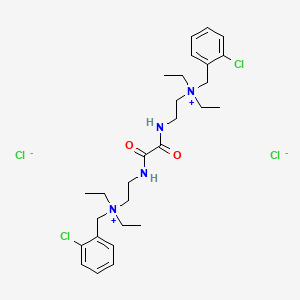
Verifizierte Chemie für CAS 115-79-7
Ambenonium Chloride
Ambenonium chloride is a symmetrical oxalamide-based bis-quaternary ammonium salt having ethyl and 2-chlorobenzyl groups attached to the nitrogens. It has a role as a neurotransmitter agent and an EC 3.1.1.8 (cholinesterase) inhibitor. It is a quaternary ammonium salt and an organic chloride salt. — ChEBI
- IUPAC-Name
- (2-chlorophenyl)methyl-[2-[[2-[2-[(2-chlorophenyl)methyl-diethylazaniumyl]ethylamino]-2-oxoacetyl]amino]ethyl]-diethylazanium dichloride
- Summenformel
- C28H42Cl4N4O2
- Molekulargewicht
- 608.5 g/mol
- Exakte Masse
- 608.203237 Da
- Monoisotopische Masse
- 606.206187 Da
- Topologische polare Oberfläche
- 58,2 Ų
- Molekulare Komplexität
- 614,0
- Formale Ladung
- 0
- Wasserstoffbrücken-Donoren
- 2
- Wasserstoffbrücken-Akzeptoren
- 4
- Drehbare Bindungen
- 14
- Schweratome
- 38
- Kovalente Einheiten
- 3
An PubChem gemeldete Namen und Synonyme
16 weitere gemeldete Namen
Kennungen in externen Datenbanken
- ChEBI:CHEBI:2628
- ChEMBL:CHEMBL1200541
- EPA DTXSID:DTXSID3022582
- PubMed:33844597
- PubMed:11132996
- PubMed:11099780
- PubMed:8010419
- PubMed:3912090
Erweiterte Strukturstatistik
- Definierte Atom-Stereozentren
- 0
- Nicht definierte Atom-Stereozentren
- 0
- Definierte Bindungs-Stereozentren
- 0
- Nicht definierte Bindungs-Stereozentren
- 0
- 3D-Konformere
- 0
Maschinenlesbare Strukturkennungen
- SMILES
CC[N+](CC)(CCNC(=O)C(=O)NCC[N+](CC)(CC)CC1=CC=CC=C1Cl)CC2=CC=CC=C2Cl.[Cl-].[Cl-]- InChI
InChI=1S/C28H40Cl2N4O2.2ClH/c1-5-33(6-2,21-23-13-9-11-15-25(23)29)19-17-31-27(35)28(36)32-18-20-34(7-3,8-4)22-24-14-10-12-16-26(24)30;;/h9-16H,5-8,17-22H2,1-4H3;2*1H- InChIKey
DXUUXWKFVDVHIK-UHFFFAOYSA-N
Belege aus weiteren wissenschaftlichen Datenbanken
NIH PubChem PUG-View
Attributed physical-property, hazard, environmental and use annotations.
- Carcinogen Classification: No indication of carcinogenicity to humans (not listed by IARC). Quelle: Toxin and Toxin Target Database (T3DB)
- Exposure Routes: Oral - poorly absorbed from the gastrointestinal tract. Quelle: Toxin and Toxin Target Database (T3DB)
- Signal: Danger Quelle: European Chemicals Agency (ECHA)
- GHS Hazard Statements: H300 (100%): Fatal if swallowed [Danger Acute toxicity, oral] Quelle: European Chemicals Agency (ECHA)
- Precautionary Statement Codes: P264, P270, P301+P316, P321, P330, P405, and P501 (click each P-code to see the statement) Quelle: European Chemicals Agency (ECHA)
- ECHA C&L Notifications Summary: Aggregated GHS information provided per 38 reports by companies from 1 notifications to the ECHA C&L Inventory.; Information may vary between notifications depending on impurities, additives, and other factors. The percentage value in parenthesis indicates the notified classification ratio from companies that provide hazard codes. Only hazard codes with percentage values above 10% are shown. For more detailed information, please visit ECHA C&L website. Quelle: European Chemicals Agency (ECHA)
- Health Effects: Acute exposure to cholinesterase inhibitors can cause a cholinergic crisis characterized by severe nausea/vomiting, salivation, sweating, bradycardia, hypotension, collapse, and convulsions. Increasing muscle weakness is a possibility and may result in death if respiratory muscles are involved. Accumulation of ACh at motor nerves causes overstimulation of nicotinic expression at the neuromuscular junction. When this occurs symptoms such as muscle weakness, fatigue, muscle cramps, fasciculation, and paralysis can be seen. When there is an accumulation of ACh at autonomic ganglia this causes overstimulation of nicotinic expression in the sympathetic system. Symptoms associated with this are hypertension, and hypoglycemia. Overstimulation of nicotinic acetylcholine receptors in the central nervous system, due to accumulation of ACh, results in anxiety, headache, convulsions, ataxia, depression of respiration and circulation, tremor, general weakness, and potentially coma. When there is expression of muscarinic overstimulation due to excess acetylcholine at muscarinic acetylcholine receptors symptoms of visual disturbances, tightness in chest, wheezing due to bronchoconstriction, incre Quelle: Toxin and Toxin Target Database (T3DB)
- Toxicity Summary: Ambenonium is a cholinesterase or acetylcholinesterase (AChE) inhibitor. A cholinesterase inhibitor (or 'anticholinesterase') suppresses the action of acetylcholinesterase. Because of its essential function, chemicals that interfere with the action of acetylcholinesterase are potent neurotoxins, causing excessive salivation and eye-watering in low doses, followed by muscle spasms and ultimately death. Nerve gases and many substances used in insecticides have been shown to act by binding a serine in the active site of acetylcholine esterase, inhibiting the enzyme completely. Acetylcholine esterase breaks down the neurotransmitter acetylcholine, which is released at nerve and muscle junctions, in order to allow the muscle or organ to relax. The result of acetylcholine esterase inhibition is that acetylcholine builds up and continues to act so that any nerve impulses are continually transmitted and muscle contractions do not stop. Among the most common acetylcholinesterase inhibitors are phosphorus-based compounds, which are designed to bind to the active site of the enzyme. The structural requirements are a phosphorus atom bearing two lipophilic groups, a leaving group (such as a hal Quelle: Toxin and Toxin Target Database (T3DB)
- Uses: Ambenonium is used to treat muscle weakness due to muscle disease (myasthenia gravis). Quelle: Toxin and Toxin Target Database (T3DB)
Zugeordnet durch: Existing checksum-valid CAS to unique PubChem CID match. Abgerufen: 2026-08-31. Quelleneintrag öffnen
Wissenschaftliche Klassifizierungen und Gefahrenannotationen liefern Kontext und ersetzen nicht die oben gezeigte marktspezifische regulatorische Entscheidung.
Weitere Quellenabdeckung und Trefferstatus
| Quelle | Ergebnis | Geprüft |
|---|---|---|
| NIH PubChem PUG-View | Exakter Treffer | 2026-08-31 |
Ein erfasster Nicht-Treffer ist ein nützlicher Beleg dafür, dass die Quelle geprüft wurde; er ist keine Behauptung, dass der Stoff anderswo nicht existiert.
Am 2026-09-02 von NIH PubChem durch prüfsummengültigen CAS-Abgleich abgerufen. Chemische Eigenschaften ersetzen nicht die regulatorische Entscheidung auf dieser Seite.
Amtliche Quelle und Herkunft
- Registrierte Quelle
- Brazil ANVISA consolidated prohibited substances — RDC 529/2021 through RDC 1.030/2026
- Quellenverweis
- RDC 529/2021 consolidated annex, entry 132 (through RDC 1.030/2026)
- Eintrags-ID der Quelle
annex:132- Quellenversion
- RDC 529/2021 consolidated through RDC 1.030/2026
- Quellsprache
- Portuguese with official English identity where published
- Übersetzungsstatus
- Official English translation · Englische Übersetzung
- Datum des Inkrafttretens
- 2026-06-15
- Quelle aktualisiert
- 2026-06-15
- Stand geprüft
- 2026-08-31 15:26 UTC
- Validierungsmethode
- pdfplumber government baseline + 4 RDC 1.030 exclusions + 15 additions; 1,387 substantive rows
- SHA-256
a212e85540a186a842664fbdd4f351af0b1b4baeeb0c4765b9b52c6ce91c1e84
Hinweise zum registrierten Datensatz
- Datensatzabdeckung
- All 1,387 substantive current prohibited rows after applying RDC 1.030/2026 additions, amendments and exclusions to RDC 529/2021
- Hinweis zur Behörde
- Binding consolidated prohibited list for personal-hygiene products, cosmetics and perfumes
Wie dieser Eintrag in den Marktdatensatz passt
Statusverteilung
Bedingungstext ist bei 1387 von 1387 aktuellen Einträgen vorhanden. Ein leeres Bedingungsfeld wird entsprechend der oben genannten Eintragsart interpretiert; es wird niemals in die Aussage einer uneingeschränkten Verwendung umgedeutet.
Brazil Marktkontext
Complete prohibited dataset plus current restricted-list workflow
Abdeckungsversion: ANVISA RDC 1.029/2026 and RDC 1.030/2026, published 15 June 2026
All 1,387 substantive current prohibited rows in RDC 529/2021 consolidated through RDC 1.030/2026, plus the current RDC 1.029 restricted-list and identity workflow.
Verifizierungs-Checkliste
- Resolve Portuguese, INCI and CAS identity with the ANVISA crosswalk.
- Check the consolidated prohibited list including RDC 1.030/2026 changes.
- Apply RDC 1.029/2026 restrictions and the still-effective complementary rules.
- Verify Mercosur incorporation, regularisation, labelling and transition periods.
Amtliche Marktquellen
- Brazil ANVISA INCI translation panelIdentity and labelling crosswalk only; regulatory lists must be sourced separately
- Brazil ANVISA restricted substances — RDC 1.029/2026Binding ANVISA resolution effective on publication; replaced RDC 530/2021 for this list part
- Brazil ANVISA consolidated prohibited substances — RDC 529/2021 through RDC 1.030/2026Binding consolidated prohibited list for personal-hygiene products, cosmetics and perfumes
Verifizierungsablauf und Vollständigkeit des Eintrags
Bevor Sie dieses Ergebnis für eine Compliance-Entscheidung verwenden
- Bestätigen Sie, dass „Sais de [Oxalilbis (iminoetileno)] bis [(o- clorobenzil) dietilamônio], por exemplo Cloreto de Ambenônio*“ und jede CAS-/EC-Kennung sich auf das Material in Ihrer Lieferantenspezifikation beziehen.
- Resolve Portuguese, INCI and CAS identity with the ANVISA crosswalk.
- Check the consolidated prohibited list including RDC 1.030/2026 changes.
- Apply RDC 1.029/2026 restrictions and the still-effective complementary rules.
- Verify Mercosur incorporation, regularisation, labelling and transition periods.
- Dokumentieren Sie die Quellenversion und prüfen Sie die Behörde vor Herstellung, Notifizierung oder Inverkehrbringen erneut.
In diesem Eintrag verfügbare Felder
- Amtlicher StoffnameVerfügbar
- CASVerfügbar
- ECVerfügbar
- Gesonderter BedingungstextVerfügbar
- Datum des InkrafttretensVerfügbar
- Snapshot-Hash und MethodeVerfügbar
Fragen, die diese Seite beantwortet
Dauerhafte Zitierweise
Sais de [Oxalilbis (iminoetileno)] bis [(o- clorobenzil) dietilamônio], por exemplo Cloreto de Ambenônio*. RDC 529/2021 consolidated annex, entry 132 (through RDC 1.030/2026). Brazil. Source version RDC 529/2021 consolidated through RDC 1.030/2026. CosIng Checker regulatory record: https://cosingchecker.com/de/regulations/br/records/13339/
Zitieren Sie die Aufsichtsbehörde als rechtliche Autorität. Diese Seite ist ein strukturierter Belegindex und eine Verifizierungshilfe, kein Ersatz für den amtlichen Text oder eine fachkundige rechtliche Bewertung.
Auslegung und Grenzen für Brazil
This official record identifies the substance as prohibited for cosmetic use in the stated market scope.
Do not rely on a formulation containing this identity until the cited source, effective date and exact substance match have been verified.
Wie die Rechtsrolle auszulegen ist
The cited row forms part of a binding rule or legally incorporated list for this market.
Belege auf dieser Seite
- Erfasstes Ergebnis: Prohibited
- Rechtsrolle: Binding rule
- Quellenversion: RDC 529/2021 consolidated through RDC 1.030/2026
- Datum des Inkrafttretens: 2026-06-15
Was es nicht beweist
RDC 1.030/2026 amends rather than replaces the prohibited baseline, and the second restricted-list revision was still under consultation in July 2026.
Weitere maßgebliche Stoffrecherche
Keine dieser Quellen hebt die oben genannte Marktentscheidung auf.
Cosmetic Ingredient Review safety assessments
Expert Panel conclusions, assessed ingredient groups, use conditions, dates and report documents
Independent expert review considered by FDA; not a government approval or binding market rule
Diese Identität bei der Quelle recherchierenFDA Global Substance Registration System
UNII identifiers, preferred names, substance types, codes and public substance relationships
Identity registry only; UNII availability does not imply FDA review or approval
Diese Identität bei der Quelle recherchierenILO/WHO International Chemical Safety Cards
Hazards, symptoms, first aid, storage, incompatibilities and physical properties for covered chemicals
International occupational chemical-safety reference; not cosmetic-use approval
Diese Identität bei der Quelle recherchierenJapan NITE-CHRIP
Chemical identity, Japanese and foreign legal lists, GHS hazards and exposure-related information
Chemical-management evidence; cosmetic status remains governed by the applicable MHLW standard and market rules
Diese Identität bei der Quelle recherchierenNIOSH Pocket Guide to Chemical Hazards
REL, PEL, IDLH, properties, exposure routes, symptoms, target organs, first aid and measurement methods for covered workplace chemicals
US occupational-health guidance and limits; not a cosmetic ingredient decision
Diese Identität bei der Quelle recherchierenOECD eChemPortal
Gateway to authority-owned physical-property, fate, ecotoxicity, toxicity, exposure and GHS records
Discovery gateway; each linked authority remains responsible for its data
Diese Identität bei der Quelle recherchierenUS EPA CompTox CTX APIs
Für den Import ist ein API-Schlüssel erforderlichDTXSID identity, experimental and predicted properties, toxicity, bioactivity, exposure and environmental data
Scientific and computational evidence; predictions must remain labelled and do not determine cosmetic legality
Diese Identität bei der Quelle recherchieren