
DIACETONE ALCOHOL
4-Hydroxy-4-methylpentan-2-one
DIACETONE ALCOHOL ist im EU-CosIng-Verzeichnis aufgeführt, aber auf dieser Seite sind noch keine direkten Anhangseinträge verknüpft.
Auf einen Blick
- Funktion
- Fragrance, solvent
- CAS
- 123-42-2
- EC
- 204-626-7
- EU-Anhänge
- Nicht aufgeführtEs ist kein EU-Anhangseintrag verknüpft. Das ist keine Zulassung.
Regulatorische Belege nach Markt
Für keinen der hier erfassten 13 Märkte wurde eine Vorschrift zu diesem Inhaltsstoff importiert.
Das beschreibt dieses Verzeichnis, nicht das Recht. Eine fehlende importierte Vorschrift ist kein Beleg dafür, dass ein Inhaltsstoff zulässig ist: Eine Vorschrift kann unter einem anderen Namen oder einer anderen Kennung oder in einem hier noch nicht importierten Datensatz existieren.
Verzeichnisangaben zu DIACETONE ALCOHOL
INCI-Name
DIACETONE ALCOHOL
Beschreibung
4-Hydroxy-4-methylpentan-2-one
Herkunft des Eintrags
- Verzeichnisverweis
- 75628
- Importierte Identität
- DIACETONE ALCOHOL
- Quellenaktualisierung
- 15/10/2010
Anhangseinträge für DIACETONE ALCOHOL
Kerndaten
Chemische Identität und Eigenschaften
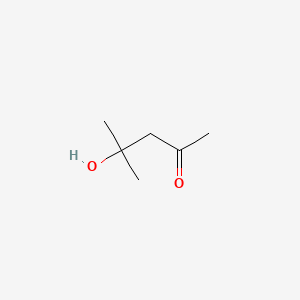
Diacetone Alcohol
Diacetone alcohol appears as a clear colorless liquid with a pleasant odor. Flash point below 141 °F. Less dense than water. Vapors heavier than air. — CAMEO Chemicals
- IUPAC-Name
- 4-hydroxy-4-methylpentan-2-one
- Summenformel
- C6H12O2
- Molekulargewicht
- 116.16 g/mol
- Exakte Masse
- 116.083729621 Da
- XLogP3
- -0,2
- Topologische polare Oberfläche
- 37,3 Ų
- Wasserstoffbrücken-Donoren
- 1
- Wasserstoffbrücken-Akzeptoren
- 2
- Kovalente Einheiten
- 1
- Definierte Stereozentren
- 0
Auch bekannt als
16 weitere gemeldete Namen
Kennungen in externen Datenbanken
- ChEBI:CHEBI:55381
- ChEMBL:CHEMBL3182048
- EPA DTXSID:DTXSID6024917
- PubMed:22426231
- PubMed:22416247
- PubMed:21702740
- PubMed:21075070
- PubMed:20379812
- PubMed:20188896
- PubMed:19570608
- PubMed:18585296
- PubMed:18372139
- PubMed:18155147
- PubMed:18031025
- PubMed:17722281
Belege aus weiteren wissenschaftlichen Datenbanken
NIH PubChem PUG-View
Attributed physical-property, hazard, environmental and use annotations.
- Autoignition Temperature: 1118 °F (USCG, 1999) Quelle: CAMEO Chemicals
- Autoignition Temperature: ACETONE-FREE 603 °C (1118 °F); COMMERCIAL 643 °C (1190 °F) Quelle: Hazardous Substances Data Bank (HSDB)
- Autoignition Temperature: 640 °C Quelle: ILO-WHO International Chemical Safety Cards (ICSCs)
- Boiling Point: 328 °F at 760 mmHg (USCG, 1999) Quelle: CAMEO Chemicals
- Boiling Point: 167.9 °C AT 760 MM HG; 108.2 °C AT 100 MM HG; 72.0 °C AT 20 MM HG; 58.8 °C AT 10 MM HG; 22.0 °C AT 1.0 MM HG Quelle: Hazardous Substances Data Bank (HSDB)
- Boiling Point: 164.00 to 166.00 °C. @ 760.00 mm Hg Quelle: Human Metabolome Database (HMDB)
- Boiling Point: 169-171 °C Quelle: ILO-WHO International Chemical Safety Cards (ICSCs)
- Boiling Point: 334 °F Quelle: Occupational Safety and Health Administration (OSHA)
- Boiling Point: 167.9 °C @760 [mm Hg] Quelle: PAC Chemical Database, U.S. Department of Energy
- Boiling Point: 334 °F Quelle: The National Institute for Occupational Safety and Health (NIOSH)
- Color/Form: COLORLESS LIQUID Quelle: Hazardous Substances Data Bank (HSDB)
- Color/Form: Colorless liquid. Quelle: Hazardous Substances Data Bank (HSDB)
- Color/Form: Faint, minty odor. Quelle: Hazardous Substances Data Bank (HSDB)
- Density: 0.938 at 68 °F (USCG, 1999) - Less dense than water; will float Quelle: CAMEO Chemicals
- Density: 0.9306 @ 25 °C/4 °C (0.940 FOR TECHNICAL GRADE) Quelle: Hazardous Substances Data Bank (HSDB)
- Density: PERCENT IN SATURATED AIR: 0.13 (20 °C); DENSITY OF SATURATED AIR: 1.005 (AIR= 1) Quelle: Hazardous Substances Data Bank (HSDB)
- Density: Relative density (water = 1): 0.93 Quelle: ILO-WHO International Chemical Safety Cards (ICSCs)
- Density: 0.94 Quelle: Occupational Safety and Health Administration (OSHA)
- Density: 0.9306 @ 20°C Quelle: PAC Chemical Database, U.S. Department of Energy
- Density: 0.94 Quelle: The National Institute for Occupational Safety and Health (NIOSH)
- Flash Point: 125 °F (USCG, 1999) Quelle: CAMEO Chemicals
- Flash Point: 66 °C Quelle: Haz-Map, Information on Hazardous Chemicals and Occupational Diseases
- Flash Point: 66 °C (OPEN CUP); COMMERCIAL GRADE IS 8 °C (CLOSED CUP) & 13 °C (OPEN CUP) Quelle: Hazardous Substances Data Bank (HSDB)
- Flash Point: 58 °C c.c. Quelle: ILO-WHO International Chemical Safety Cards (ICSCs)
- Flash Point: 125 °F Quelle: Occupational Safety and Health Administration (OSHA)
- Flash Point: 125 °F Quelle: The National Institute for Occupational Safety and Health (NIOSH)
- LogP: -0.14 - 1.03 (calculated) Quelle: ILO-WHO International Chemical Safety Cards (ICSCs)
- Melting Point: -45 °F (USCG, 1999) Quelle: CAMEO Chemicals
- Melting Point: -44 °C Quelle: Hazardous Substances Data Bank (HSDB)
- Melting Point: -44 °C Quelle: Human Metabolome Database (HMDB)
- Melting Point: -47 °C Quelle: ILO-WHO International Chemical Safety Cards (ICSCs)
- Melting Point: -47 °F Quelle: Occupational Safety and Health Administration (OSHA)
- Melting Point: -44 °C Quelle: PAC Chemical Database, U.S. Department of Energy
- Melting Point: -47 °F Quelle: The National Institute for Occupational Safety and Health (NIOSH)
- Odor: FAINT PLEASANT ODOR Quelle: Hazardous Substances Data Bank (HSDB)
- Odor: Minty odor Quelle: Hazardous Substances Data Bank (HSDB)
- Physical Description: Diacetone alcohol appears as a clear colorless liquid with a pleasant odor. Flash point below 141 °F. Less dense than water. Vapors heavier than air. Quelle: CAMEO Chemicals
- Physical Description: CBI; Liquid Quelle: EPA Chemical Data Reporting (CDR)
- Physical Description: Colorless liquid with a faint, minty odor; [NIOSH] Quelle: Haz-Map, Information on Hazardous Chemicals and Occupational Diseases
- Physical Description: Liquid Quelle: Human Metabolome Database (HMDB)
- Physical Description: COLOURLESS LIQUID WITH CHARACTERISTIC ODOUR. Quelle: ILO-WHO International Chemical Safety Cards (ICSCs)
- Physical Description: Colorless liquid with a faint, minty odor. Quelle: Occupational Safety and Health Administration (OSHA)
- Physical Description: Colorless liquid with a faint, minty odor. Quelle: The National Institute for Occupational Safety and Health (NIOSH)
- Refractive Index: INDEX OF REFRACTION: 1.4232 AT 20 °C/D Quelle: Hazardous Substances Data Bank (HSDB)
- Solubility: Miscible (NIOSH, 2024) Quelle: CAMEO Chemicals
- Solubility: MISCIBLE WITH WATER, ALCOHOL, ETHER, OTHER SOLVENTS Quelle: Hazardous Substances Data Bank (HSDB)
- Solubility: Water solubility of 1.0X10+6 mg/l Quelle: Hazardous Substances Data Bank (HSDB)
- Solubility: 1000 mg/mL at 25 °C Quelle: Human Metabolome Database (HMDB)
- Solubility: Solubility in water: miscible Quelle: ILO-WHO International Chemical Safety Cards (ICSCs)
- Solubility: Miscible Quelle: The National Institute for Occupational Safety and Health (NIOSH)
- Vapor Pressure: 3.62 mmHg (USCG, 1999) Quelle: CAMEO Chemicals
- Vapor Pressure: 1.71 [mmHg] Quelle: Haz-Map, Information on Hazardous Chemicals and Occupational Diseases
- Vapor Pressure: 0.97 MM HG AT 20 °C Quelle: Hazardous Substances Data Bank (HSDB)
- Vapor Pressure: Vapor pressure, kPa at 20 °C: 0.108 Quelle: ILO-WHO International Chemical Safety Cards (ICSCs)
- Vapor Pressure: 1 mmHg Quelle: Occupational Safety and Health Administration (OSHA)
- Vapor Pressure: 1.1 [mm Hg] @20 °C Quelle: PAC Chemical Database, U.S. Department of Energy
- Vapor Pressure: 1 mmHg Quelle: The National Institute for Occupational Safety and Health (NIOSH)
- Exposure Routes: The substance can be absorbed into the body by inhalation of its vapour, through the skin and by ingestion. Quelle: ILO-WHO International Chemical Safety Cards (ICSCs)
- Exposure Routes: inhalation, ingestion, skin and/or eye contact Quelle: The National Institute for Occupational Safety and Health (NIOSH)
- First Aid: Excerpt from NIOSH Pocket Guide for Diacetone alcohol:; Eye: IRRIGATE IMMEDIATELY - If this chemical contacts the eyes, immediately wash (irrigate) the eyes with large amounts of water, occasionally lifting the lower and upper lids. Get medical attention immediately.; Skin: WATER FLUSH PROMPTLY - If this chemical contacts the skin, flush the contaminated skin with water promptly. If this chemical penetrates the clothing, immediately remove the clothing and flush the skin with water promptly. If irritation persists after washing, get medical attention.; Breathing: RESPIRATORY SUPPORT - If a person breathes large amounts of this chemical, move the exposed person to fresh air at once. If breathing has stopped, perform artificial respiration. Keep the affected person warm and at rest. Get medical attention as soon as possible.; Swallow: MEDICAL ATTENTION IMMEDIATELY - If this chemical has been swallowed, get medical attention immediately. (NIOSH, 2024) Quelle: CAMEO Chemicals
- ERG2024, Guide 129 (Diacetone alcohol): General First Aid:; · Call 911 or emergency medical service.; · Ensure that medical personnel are aware of the material(s) involved, take precautions to protect themselves and avoid contamination.; · Move victim to fresh air if it can be done safely.; · Administer oxygen if breathing is difficult.; · If victim is not breathing:; -- DO NOT perform mouth-to-mouth resuscitation; the victim may have ingested or inhaled the substance.; -- If equipped and pulse detected, wash face and mouth, then give artificial respiration using a proper respiratory medical device (bag-valve mask, pocket mask equipped with a one-way valve or other device).; -- If no pulse detected or no respiratory medical device available, provide continuous compressions. Conduct a pulse check every two minutes or monitor for any signs of spontaneous respirations.; · Remove and isolate contaminated clothing and shoes.; · For minor skin contact, avoid spreading material on unaffected skin.; · In case of contact with substance, remove immediately by flushing skin or eyes with running water for at least 20 minutes.; · For severe burns, immediate medical attention is required.; · Effects of exposure (inhalation, ingestion, Quelle: Emergency Response Guidebook (ERG)
- First Aid: (General first aid procedures); Eye: Irrigate immediately - If this chemical contacts the eyes, immediately wash (irrigate) the eyes with large amounts of water, occasionally lifting the lower and upper lids. Get medical attention immediately.; Skin: Water flush promptly - If this chemical contacts the skin, flush the contaminated skin with water promptly. If this chemical penetrates the clothing, immediately remove the clothing and flush the skin with water promptly. If irritation persists after washing, get medical attention.; Breathing: Respiratory support; Swallow: Medical attention immediately - If this chemical has been swallowed, get medical attention immediately. Quelle: The National Institute for Occupational Safety and Health (NIOSH)
- Signal: Warning Quelle: Regulation (EC) No 1272/2008 of the European Parliament and of the Council
- GHS Hazard Statements: H319: Causes serious eye irritation [Warning Serious eye damage/eye irritation] Quelle: Regulation (EC) No 1272/2008 of the European Parliament and of the Council
- Precautionary Statement Codes: P264+P265, P280, P305+P351+P338, and P337+P317 (click each P-code to see the statement) Quelle: Regulation (EC) No 1272/2008 of the European Parliament and of the Council
- Note: This chemical does not meet GHS hazard criteria for < 0.1% (1 of 1556) of reports. Quelle: European Chemicals Agency (ECHA)
- Signal: Warning Quelle: European Chemicals Agency (ECHA)
- GHS Hazard Statements: H226 (32.3%): Flammable liquid and vapor [Warning Flammable liquids]; H319 (99.9%): Causes serious eye irritation [Warning Serious eye damage/eye irritation]; H335 (31.1%): May cause respiratory irritation [Warning Specific target organ toxicity, single exposure; Respiratory tract irritation]; H361d (16.5%): Suspected of damaging the unborn child [Warning Reproductive toxicity] Quelle: European Chemicals Agency (ECHA)
- Precautionary Statement Codes: P203, P210, P233, P240, P241, P242, P243, P261, P264+P265, P271, P280, P303+P361+P353, P304+P340, P305+P351+P338, P318, P319, P337+P317, P370+P378, P403+P233, P403+P235, P405, and P501 (click each P-code to see the statement) Quelle: European Chemicals Agency (ECHA)
- ECHA C&L Notifications Summary: Aggregated GHS information provided per 1556 reports by companies from 53 notifications to the ECHA C&L Inventory. Each notification may be associated with multiple companies.; Reported as not meeting GHS hazard criteria per 1 of 1556 reports by companies.; There are 52 notifications provided by 1555 of 1556 reports by companies with hazard statement code(s).; Information may vary between notifications depending on impurities, additives, and other factors. The percentage value in parenthesis indicates the notified classification ratio from companies that provide hazard codes. Only hazard codes with percentage values above 10% are shown. For more detailed information, please visit ECHA C&L website. Quelle: European Chemicals Agency (ECHA)
- Signal: Danger Quelle: NITE-CMC
- GHS Hazard Statements: H226: Flammable liquid and vapor [Warning Flammable liquids]; H319: Causes serious eye irritation [Warning Serious eye damage/eye irritation]; H335: May cause respiratory irritation [Warning Specific target organ toxicity, single exposure; Respiratory tract irritation]; H336: May cause drowsiness or dizziness [Warning Specific target organ toxicity, single exposure; Narcotic effects]; H360: May damage fertility or the unborn child [Danger Reproductive toxicity]; H371: May cause damage to organs [Warning Specific target organ toxicity, single exposure] Quelle: NITE-CMC
- Precautionary Statement Codes: P203, P210, P233, P240, P241, P242, P243, P260, P261, P264, P264+P265, P270, P271, P280, P303+P361+P353, P304+P340, P305+P351+P338, P308+P316, P318, P319, P337+P317, P370+P378, P403+P233, P403+P235, P405, and P501 (click each P-code to see the statement) Quelle: NITE-CMC
- Signal: Warning Quelle: NITE-CMC
- NFPA Health Rating: 1 - Materials that, under emergency conditions, can cause significant irritation. Quelle: Hazardous Substances Data Bank (HSDB)
- NFPA Fire Rating: 2 - Materials that must be moderately heated or exposed to relatively high ambient temperatures before ignition can occur. Materials would not under normal conditions form hazardous atmospheres with air, but under high ambient temperatures or under moderate heating could release vapor in sufficient quantities to produce hazardous atmospheres with air. Quelle: Hazardous Substances Data Bank (HSDB)
- NFPA Instability Rating: 0 - Materials that in themselves are normally stable, even under fire conditions. Quelle: Hazardous Substances Data Bank (HSDB)
- Target Organs: Eyes, skin, respiratory system, central nervous system, liver Quelle: The National Institute for Occupational Safety and Health (NIOSH)
- Cosmetic Ingredient Review Finding(s): Safe in the present practices of use and concentration. Ingredient, concentration, and use information are available in documents discoverable at https://cir-reports.cir-safety.org Quelle: Cosmetic Ingredient Review (CIR)
- Environmental Bioconcentration: An estimated BCF of 0.50 can be calculated(SRC) from an estimated log Kow of -0.098(2) using a recommended regression equation(1). Based upon the estimated BCF and the reported infinite solubility of the compound in water(3), 4-hydroxy-4-methyl-2-pentanone will not be expected to significantly bioconcentrate in aquatic organisms(SRC). Quelle: Hazardous Substances Data Bank (HSDB)
- Environmental Fate: TERRESTRIAL FATE: If 4-hydroxy-4-methyl-2-pentanone is released to soil, it will be expected to exhibit very high mobility(1), based upon the reported infinite solubility of the compound in water(2) and an estimated Koc of 21 calculated(3,SRC) from a measured log Kow(4). The compound may, therefore, leach through soil to groundwater if it does not biodegrade first(SRC). It may be subject to biodegradation in soil based upon results observed in laboratory biodegradation aqueous aerobic screening tests using acclimated mixed microbial cultures as inoculums(5,6) provided suitably acclimated microbial populations are present(7,SRC). It should not be subject to volatilization from moist near surface soil based upon(3,SRC) an estimated Henry's Law constant of 4.24X10⁻⁹ atm-cu m/mole(9,SRC). However, it may volatilize from dry near-surface soil and other dry surfaces based upon its vapor pressure of 1.71 mm Hg at 25 °C(8). Quelle: Hazardous Substances Data Bank (HSDB)
- Environmental Fate: AQUATIC FATE: If 4-hydroxy-4-methyl-2-pentanone is released to water, it will not be expected to adsorb to sediment or suspended particulate matter or to bioconcentrate in aquatic organisms based upon its estimated Koc and BCF, respectively, calculated(1,SRC) from the measured log Kow(2), and its high solubility in water(3). Although no data were found regarding biodegradation in environmental media, the compound may be subject to biodegradation in natural waters based upon results observed in laboratory aqueous aerobic biodegradation screening tests using acclimated mixed microbial cultures as inoculums(4,5) provided suitably acclimated microbial populations are present(6,SRC). It should not be subject to volatilization from surface waters based upon(1,SRC) an estimated Henry's Law constant of 4.24X10⁻⁹ atm-cu m/mole(7,SRC) Hydrolysis should not be an important removal process since aliphatic alcohols and ketones (the two functional groups that 4-hydroxy-4-methyl-2-pentanone contains) generally are resistant to hydrolysis(1). Quelle: Hazardous Substances Data Bank (HSDB)
- Environmental Fate: ATMOSPHERIC FATE: If 4-hydroxy-4-methyl-2-pentanone is released to the atmosphere, it can be expected to exist mainly in the vapor-phase in the ambient atmosphere(1,SRC) based upon an experimental vapor pressure of 1.71 mm Hg at 25 °C(2). The estimated rate constant for vapor-phase reaction with photochemically produced hydroxyl radicals is 1.34X10⁻¹² cu cm/molecule-sec at 25 °C(3) which corresponds to an atmospheric half-life of 12 days at an atmospheric concentration of 5X10+5 hydroxyl radicals per cu cm(SRC). 4-Hydroxy-4-methyl-2-pentanone may be susceptible to direct photolysis in the atmosphere(SRC) based upon its possible absorption(SRC) of light at wavelengths >290 nm(4). Based upon its high water solubility(5), the compound may be susceptible to removal from the atmosphere by washout(SRC). Quelle: Hazardous Substances Data Bank (HSDB)
- Consumer Uses: Not Known or Reasonably Ascertainable; Flux agent; Pigment; Solvent Quelle: EPA Chemical Data Reporting (CDR)
- Industry Uses: Cleaning agent; Not Known or Reasonably Ascertainable; Intermediate; Pigment; Solvent Quelle: EPA Chemical Data Reporting (CDR)
- Cosmetic Ingredient Review Link: CIR ingredient: Diacetone Alcohol Quelle: Cosmetic Ingredient Review (CIR)
- Sources/Uses: Used in antifreeze and brake fluids; also used as a solvent to make nitrocellulose, cellulose acetate, celluloid, pigments, waxes, and oils; [ACGIH] Quelle: Haz-Map, Information on Hazardous Chemicals and Occupational Diseases
- Industrial Processes with risk of exposure: Painting (Solvents) [Category: Paint] Quelle: Haz-Map, Information on Hazardous Chemicals and Occupational Diseases
- Uses: INT IN SYNTH OF MESITYL OXIDE, HEXALENE GLYCOL AND OTHER ORG CHEMS Quelle: Hazardous Substances Data Bank (HSDB)
- Uses: SOLVENT FOR CELLULOSE ACETATE, NITROCELLULOSE, CELLULOID, FATS, OILS, WAXES, RESINS; IN SOME ANTIFREEZE SOLUTIONS & HYDRAULIC FLUIDS; PRESERVATIVE IN PHARMACEUTICAL PREPN Quelle: Hazardous Substances Data Bank (HSDB)
- Uses: COATING COMPOSITIONS & MERCERIZATIONS; SOLVENT FOR CERTAIN PIGMENTS; MANUFACTURE OF QUICK DRYING INKS, PHOTOGRAPHIC FILM, METAL CLEANING CMPD Quelle: Hazardous Substances Data Bank (HSDB)
- Uses: MAKING ARTIFICIAL SILK & LEATHER Quelle: Hazardous Substances Data Bank (HSDB)
Zugeordnet durch: Existing checksum-valid CAS to unique PubChem CID match. Abgerufen: 2026-08-31. Quelleneintrag öffnen
Wissenschaftliche Klassifizierungen und Gefahrenannotationen liefern Kontext und ersetzen nicht die oben gezeigte marktspezifische regulatorische Entscheidung.
Weitere Quellenabdeckung und Trefferstatus
| Quelle | Ergebnis | Geprüft |
|---|---|---|
| NIH PubChem PUG-View | Exakter Treffer | 2026-08-31 |
Ein erfasster Nicht-Treffer ist ein nützlicher Beleg dafür, dass die Quelle geprüft wurde; er ist keine Behauptung, dass der Stoff anderswo nicht existiert.
Am 2026-08-31 von NIH PubChem durch prüfsummengültigen CAS-Abgleich abgerufen. Chemische Eigenschaften ersetzen nicht die regulatorische Entscheidung auf dieser Seite.
Belege zum amtlichen EU-Inhaltsstoffnamen
Der Inhaltsstoffname stimmt exakt mit dem amtlichen EU-Glossar 2025 der gebräuchlichen Inhaltsstoffnamen überein.
Verwandte Belege aus dem Verzeichnis
Inhaltsstoffe mit sich überschneidenden Rezepturfunktionen
Weitere amtliche und wissenschaftliche Quellen
11 externe Datenbanken zur Prüfung dieser Identität
Jeder Link durchsucht die jeweilige Quelle nach dieser Identität. Was jede Quelle ist und welches rechtliche Gewicht sie hat
Wie DIACETONE ALCOHOL im CosIng-Verzeichnis erscheint
Das CosIng-Verzeichnis führt DIACETONE ALCOHOL als kosmetischen Inhaltsstoff, und diese Seite verknüpft ihn mit 0 Anhangseinträgen. Der Verzeichniseintrag erfasst Namen und Kennungen, während die Anhangseinträge zeigen, wo der Stoff im EU-Kosmetikrecht verboten, beschränkt oder positiv gelistet ist.
DIACETONE ALCOHOL ist in den amtlichen Daten außerdem mit 2 kosmetischen Funktionen gekennzeichnet. Funktionsbezeichnungen beschreiben die beabsichtigte Verwendung, ersetzen aber nicht die regulatorische Prüfung verknüpfter Anhangseinträge vor der Rezeptierung oder Kennzeichnung.
Häufig gestellte Fragen
Quellenhinweis zu DIACETONE ALCOHOL
Diese Seite gibt den CosIng-Verzeichniseintrag für DIACETONE ALCOHOL aus öffentlichen Materialien der Europäischen Kommission zu kosmetischen Inhaltsstoffen wieder und zeigt verknüpfte Kennungen auch dann, wenn derzeit kein direkter Anhangstreffer zugeordnet ist.
Nutzen Sie diese Verzeichnisseite, um DIACETONE ALCOHOL zu recherchieren und verknüpfte Einträge zu vergleichen; verifizieren Sie Beschränkungen und Rechtsstatus jedoch anhand des aktuellen amtlichen Quellentextes und Rechts, bevor Sie regulatorische Entscheidungen treffen.
Werkzeuge und nächste Schritte
Rezeptur prüfen
Eine vollständige INCI-Liste prüfen, um DIACETONE ALCOHOL und etwaige verknüpfte EU-Anhangsbeschränkungen oder Allergenmarkierungen zu erkennen.
INCI-CheckerÄhnliche Inhaltsstoffe suchen
Weitere Inhaltsstoffe aus dem Verzeichnis und Anhangseinträge finden, die mit DIACETONE ALCOHOL, seinen Kennungen oder nahen Namensvarianten zusammenhängen.
Suche