
BENZOPHENONE-2
2,2',4,4'-Tetrahydroxybenzophenone
BENZOPHENONE-2 ist im EU-CosIng-Verzeichnis aufgeführt, aber auf dieser Seite sind noch keine direkten Anhangseinträge verknüpft.
Auf einen Blick
- Funktion
- Fragrance, uv absorber
- CAS
- 131-55-5
- EC
- 205-028-9
- EU-Anhänge
- Nicht aufgeführtEs ist kein EU-Anhangseintrag verknüpft. Das ist keine Zulassung.
Regulatorische Belege nach Markt
Für keinen der hier erfassten 13 Märkte wurde eine Vorschrift zu diesem Inhaltsstoff importiert.
Das beschreibt dieses Verzeichnis, nicht das Recht. Eine fehlende importierte Vorschrift ist kein Beleg dafür, dass ein Inhaltsstoff zulässig ist: Eine Vorschrift kann unter einem anderen Namen oder einer anderen Kennung oder in einem hier noch nicht importierten Datensatz existieren.
Verzeichnisangaben zu BENZOPHENONE-2
INCI-Name
BENZOPHENONE-2
Beschreibung
2,2',4,4'-Tetrahydroxybenzophenone
Herkunft des Eintrags
- Verzeichnisverweis
- 74472
- Importierte Identität
- BENZOPHENONE-2
- Quellenaktualisierung
- 15/10/2010
Anhangseinträge für BENZOPHENONE-2
Kerndaten
- FRAGRANCE
Imparting an odour or taste. Creating a perceivable pleasant smell and/or masking a bad smell.
- UV ABSORBER
Protecting the cosmetic product from the effects of UV-light.
Chemische Identität und Eigenschaften
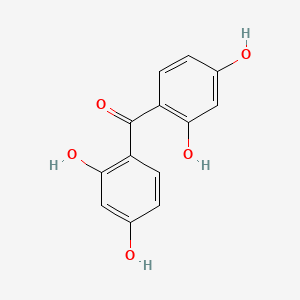
2,2',4,4'-Tetrahydroxybenzophenone
- IUPAC-Name
- bis(2,4-dihydroxyphenyl)methanone
- Summenformel
- C13H10O5
- Molekulargewicht
- 246.21 g/mol
- Exakte Masse
- 246.05282342 Da
- XLogP3
- 2,4
- Topologische polare Oberfläche
- 98,0 Ų
- Wasserstoffbrücken-Donoren
- 4
- Wasserstoffbrücken-Akzeptoren
- 5
- Kovalente Einheiten
- 1
- Definierte Stereozentren
- 0
Auch bekannt als
16 weitere gemeldete Namen
Kennungen in externen Datenbanken
Belege aus weiteren wissenschaftlichen Datenbanken
NIH PubChem PUG-View
Attributed physical-property, hazard, environmental and use annotations.
- Boiling Point: 491 °C Quelle: Hazardous Substances Data Bank (HSDB)
- Color/Form: Yellow needles Quelle: Hazardous Substances Data Bank (HSDB)
- Color/Form: Light yellow powder Quelle: Hazardous Substances Data Bank (HSDB)
- Density: 1.21 g/cu cm at 25 °C Quelle: Hazardous Substances Data Bank (HSDB)
- Melting Point: 198.8 °C Quelle: Hazardous Substances Data Bank (HSDB)
- Solubility: In water, 8,821 mg/L at 24.99 °C Quelle: Hazardous Substances Data Bank (HSDB)
- Solubility: In water, <1 g/100 mL at 30 °C Quelle: Hazardous Substances Data Bank (HSDB)
- Solubility: Very soluble in acetone, diethyl ether, ethanol Quelle: Hazardous Substances Data Bank (HSDB)
- Solubility: Ethyl acetate 10, methanol 50, methyl ethyl ketone 22, toluene < 1 (all g/100 ml at 25 °C) Quelle: Hazardous Substances Data Bank (HSDB)
- Note: This chemical does not meet GHS hazard criteria for 3.3% (13 of 393) of reports. Quelle: European Chemicals Agency (ECHA)
- Signal: Warning Quelle: European Chemicals Agency (ECHA)
- GHS Hazard Statements: H302 (96.4%): Harmful if swallowed [Warning Acute toxicity, oral]; H315 (33.8%): Causes skin irritation [Warning Skin corrosion/irritation]; H317 (32.1%): May cause an allergic skin reaction [Warning Sensitization, Skin]; H319 (60.6%): Causes serious eye irritation [Warning Serious eye damage/eye irritation]; H335 (32.6%): May cause respiratory irritation [Warning Specific target organ toxicity, single exposure; Respiratory tract irritation]; H412 (26.5%): Harmful to aquatic life with long lasting effects [Hazardous to the aquatic environment, long-term hazard] Quelle: European Chemicals Agency (ECHA)
- Precautionary Statement Codes: P261, P264, P264+P265, P270, P271, P272, P273, P280, P301+P317, P302+P352, P304+P340, P305+P351+P338, P319, P321, P330, P332+P317, P333+P317, P337+P317, P362+P364, P403+P233, P405, and P501 (click each P-code to see the statement) Quelle: European Chemicals Agency (ECHA)
- ECHA C&L Notifications Summary: Aggregated GHS information provided per 393 reports by companies from 13 notifications to the ECHA C&L Inventory. Each notification may be associated with multiple companies.; Reported as not meeting GHS hazard criteria per 13 of 393 reports by companies.; There are 12 notifications provided by 380 of 393 reports by companies with hazard statement code(s).; Information may vary between notifications depending on impurities, additives, and other factors. The percentage value in parenthesis indicates the notified classification ratio from companies that provide hazard codes. Only hazard codes with percentage values above 10% are shown. For more detailed information, please visit ECHA C&L website. Quelle: European Chemicals Agency (ECHA)
- Signal: Warning Quelle: Hazardous Substances Data Bank (HSDB)
- GHS Hazard Statements: H302: Harmful if swallowed [Warning Acute toxicity, oral]; H315: Causes skin irritation [Warning Skin corrosion/irritation]; H319: Causes serious eye irritation [Warning Serious eye damage/eye irritation]; H335: May cause respiratory irritation [Warning Specific target organ toxicity, single exposure; Respiratory tract irritation] Quelle: Hazardous Substances Data Bank (HSDB)
- Precautionary Statement Codes: P261, P264, P264+P265, P270, P271, P280, P301+P317, P302+P352, P304+P340, P305+P351+P338, P319, P321, P330, P332+P317, P337+P317, P362+P364, P403+P233, P405, and P501 (click each P-code to see the statement) Quelle: Hazardous Substances Data Bank (HSDB)
- Cosmetic Ingredient Review Finding(s): Safe in the present practices of use and concentration. Ingredient, concentration, and use information are available in documents discoverable at https://cir-reports.cir-safety.org Quelle: Cosmetic Ingredient Review (CIR)
- Toxicity Summary: IDENTIFICATION AND USE: Benzophenone-2 (BP2) is used as UV filter in a personal care products. Benzophenone-2 is commonly used in cosmetic products and food container plastics to filter out ultraviolet light. HUMAN STUDIES: Sensitization against benzophenone-2 has been reported. BP2, may disturb thyroid hormone homeostasis by inhibiting or inactivating thyroid peroxidase, effects that are even more pronounced in the absence of iodide. ANIMAL STUDIES: Benzophenone-2 was estrogenic in vitro and in the rat uterotropic assay. BP2 was shown to bind to the estrogen receptors. Benzophenone-2 was reported to be positive for mutagenicity using Salmonella typhimurium strains TA98, TA100, TA1535, and TA1537 with metabolic activation. An in vitro cytogenic assay was used to evaluate the ability of Benzophenone-2 to induce sister chromatid exchange (SCE) and chromosome aberrations (CA) in L5178Y mouse lymphoma cells. Benzophenone-2 does not directly induce significant SCE or CA increases but does, under metabolic activation, induce these changes. Benzophenone-2 induced an increase in mutations at the TK locus in L5178Y mouse lymphoma cells only for highly toxic doses with or without metabolic a Quelle: Hazardous Substances Data Bank (HSDB)
- Environmental Bioconcentration: An average BCF of 1.9 was calculated in fish for benzophenone-2, using fathead minnows (Pimephales promelas) which were exposed over 15-day period to 0.01-3.1 ug/g body weight(1). According to a classification scheme(2), this BCF suggests that bioconcentration in aquatic organisms is low(SRC). Quelle: Hazardous Substances Data Bank (HSDB)
- Environmental Fate: TERRESTRIAL FATE: Based on a classification scheme(1), an estimated Koc value of 3200(SRC), determined from a structure estimation method(2), indicates that benzophenone-2 is expected to have slight mobility in soil(SRC). The estimated pKa1 and pKa2 values of benzophenone-2 are 7.1 and 7.9, respectively(3), indicating that this compound will exist partially in the anion form in the environment and anions generally do not adsorb more strongly to soils containing organic carbon and clay than their neutral counterparts(4). Volatilization of the neutral species of benzophenone-2 from moist soil surfaces is not expected to be an important fate process(SRC) given an estimated Henry's Law constant of 3.6X10⁻¹⁶ atm-cu m/mole(SRC), using a fragment constant estimation method(5). Benzophenone-2 is not expected to volatilize from dry soil surfaces(SRC) based upon an estimated vapor pressure of 1.6X10⁻¹¹ mm Hg at 25 °C(SRC), determined from a fragment constant method(2). Biodegradation data in soil were not available(SRC, 2017) Quelle: Hazardous Substances Data Bank (HSDB)
- Environmental Fate: AQUATIC FATE: Based on a classification scheme(1), an estimated Koc value of 3200(SRC), determined from a structure estimation method(2), indicates that benzophenone-2 is expected to adsorb to suspended solids and sediment(SRC). Volatilization of teh neutral species from water surfaces is not expected(3) based upon an estimated Henry's Law constant of 3.6X10⁻¹⁶ atm-cu m/mole(SRC), developed using a fragment constant estimation method(4). The estimated pKa1 and pKa2 values of benzophenone-2 are 7.1 and 7.9, respectively(5) indicate benzophenone-2 will exist partially in the anion form at pH values of 5 to 9 and, therefore, volatilization from water surfaces is not expected to be an important fate process(SRC). According to a classification scheme(6), a BCF of 1.9(7) suggests that bioconcentration in aquatic organisms is low(SRC). Biodegradation data in water were not available(SRC, 2017). Quelle: Hazardous Substances Data Bank (HSDB)
- Environmental Fate: ATMOSPHERIC FATE: According to a model of gas/particle partitioning of semivolatile organic compounds in the atmosphere(1), benzophenone-2, which has an estimated vapor pressure of 1.6X10⁻¹¹ mm Hg at 25 °C(SRC), determined from a fragment constant method(2), is expected to exist solely in the particulate phase in the ambient atmosphere. Particulate-phase benzophenone-2 may be removed from the air by wet and dry deposition(SRC). Benzophenone-2 absorbs UV light at wavelengths approximately 350 nm(3) and, therefore, may be susceptible to direct photolysis by sunlight(SRC). Quelle: Hazardous Substances Data Bank (HSDB)
- Cosmetic Ingredient Review Link: CIR ingredient: Benzophenone-2 Quelle: Cosmetic Ingredient Review (CIR)
- Uses: Additives such as benzophenone-2 are commonly used in cosmetic products and food container plastics to filter out ultraviolet light... Quelle: Hazardous Substances Data Bank (HSDB)
Zugeordnet durch: Existing checksum-valid CAS to unique PubChem CID match. Abgerufen: 2026-08-31. Quelleneintrag öffnen
Wissenschaftliche Klassifizierungen und Gefahrenannotationen liefern Kontext und ersetzen nicht die oben gezeigte marktspezifische regulatorische Entscheidung.
Weitere Quellenabdeckung und Trefferstatus
| Quelle | Ergebnis | Geprüft |
|---|---|---|
| NIH PubChem PUG-View | Exakter Treffer | 2026-08-31 |
Ein erfasster Nicht-Treffer ist ein nützlicher Beleg dafür, dass die Quelle geprüft wurde; er ist keine Behauptung, dass der Stoff anderswo nicht existiert.
Am 2026-08-31 von NIH PubChem durch prüfsummengültigen CAS-Abgleich abgerufen. Chemische Eigenschaften ersetzen nicht die regulatorische Entscheidung auf dieser Seite.
Belege zum amtlichen EU-Inhaltsstoffnamen
Der Inhaltsstoffname stimmt exakt mit dem amtlichen EU-Glossar 2025 der gebräuchlichen Inhaltsstoffnamen überein.
Verwandte Belege aus dem Verzeichnis
Inhaltsstoffe mit sich überschneidenden Rezepturfunktionen
Weitere amtliche und wissenschaftliche Quellen
11 externe Datenbanken zur Prüfung dieser Identität
Jeder Link durchsucht die jeweilige Quelle nach dieser Identität. Was jede Quelle ist und welches rechtliche Gewicht sie hat
Wie BENZOPHENONE-2 im CosIng-Verzeichnis erscheint
Das CosIng-Verzeichnis führt BENZOPHENONE-2 als kosmetischen Inhaltsstoff, und diese Seite verknüpft ihn mit 0 Anhangseinträgen. Der Verzeichniseintrag erfasst Namen und Kennungen, während die Anhangseinträge zeigen, wo der Stoff im EU-Kosmetikrecht verboten, beschränkt oder positiv gelistet ist.
BENZOPHENONE-2 ist in den amtlichen Daten außerdem mit 2 kosmetischen Funktionen gekennzeichnet. Funktionsbezeichnungen beschreiben die beabsichtigte Verwendung, ersetzen aber nicht die regulatorische Prüfung verknüpfter Anhangseinträge vor der Rezeptierung oder Kennzeichnung.
Häufig gestellte Fragen
Quellenhinweis zu BENZOPHENONE-2
Diese Seite gibt den CosIng-Verzeichniseintrag für BENZOPHENONE-2 aus öffentlichen Materialien der Europäischen Kommission zu kosmetischen Inhaltsstoffen wieder und zeigt verknüpfte Kennungen auch dann, wenn derzeit kein direkter Anhangstreffer zugeordnet ist.
Nutzen Sie diese Verzeichnisseite, um BENZOPHENONE-2 zu recherchieren und verknüpfte Einträge zu vergleichen; verifizieren Sie Beschränkungen und Rechtsstatus jedoch anhand des aktuellen amtlichen Quellentextes und Rechts, bevor Sie regulatorische Entscheidungen treffen.
Werkzeuge und nächste Schritte
Rezeptur prüfen
Eine vollständige INCI-Liste prüfen, um BENZOPHENONE-2 und etwaige verknüpfte EU-Anhangsbeschränkungen oder Allergenmarkierungen zu erkennen.
INCI-CheckerÄhnliche Inhaltsstoffe suchen
Weitere Inhaltsstoffe aus dem Verzeichnis und Anhangseinträge finden, die mit BENZOPHENONE-2, seinen Kennungen oder nahen Namensvarianten zusammenhängen.
Suche