
METHYL ACETOACETATE
Methyl acetoacetate
METHYL ACETOACETATE ist im EU-CosIng-Verzeichnis aufgeführt, aber auf dieser Seite sind noch keine direkten Anhangseinträge verknüpft.
Auf einen Blick
- Funktion
- Perfuming
- CAS
- 105-45-3
- EC
- 203-299-8
- EU-Anhänge
- Nicht aufgeführtEs ist kein EU-Anhangseintrag verknüpft. Das ist keine Zulassung.
Regulatorische Belege nach Markt
Für keinen der hier erfassten 13 Märkte wurde eine Vorschrift zu diesem Inhaltsstoff importiert.
Das beschreibt dieses Verzeichnis, nicht das Recht. Eine fehlende importierte Vorschrift ist kein Beleg dafür, dass ein Inhaltsstoff zulässig ist: Eine Vorschrift kann unter einem anderen Namen oder einer anderen Kennung oder in einem hier noch nicht importierten Datensatz existieren.
Verzeichnisangaben zu METHYL ACETOACETATE
INCI-Name
METHYL ACETOACETATE
Beschreibung
Methyl acetoacetate
Herkunft des Eintrags
- Verzeichnisverweis
- 40438
- Importierte Identität
- METHYL ACETOACETATE
- Quellenaktualisierung
- 02/03/2011
Anhangseinträge für METHYL ACETOACETATE
Kerndaten
Chemische Identität und Eigenschaften
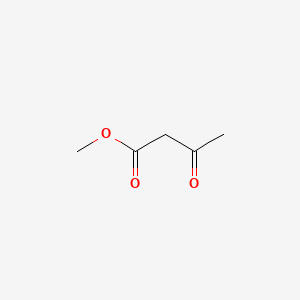
Methyl acetoacetate
Methyl acetoacetate appears as a clear colorless liquid. Flash point 158 °F. Denser than water and slightly soluble in water. Vapors heavier than air. — CAMEO Chemicals
- IUPAC-Name
- methyl 3-oxobutanoate
- Summenformel
- C5H8O3
- Molekulargewicht
- 116.11 g/mol
- Exakte Masse
- 116.047344113 Da
- XLogP3
- 0,0
- Topologische polare Oberfläche
- 43,4 Ų
- Wasserstoffbrücken-Donoren
- 0
- Wasserstoffbrücken-Akzeptoren
- 3
- Kovalente Einheiten
- 1
- Definierte Stereozentren
- 0
Auch bekannt als
16 weitere gemeldete Namen
Kennungen in externen Datenbanken
- ChEBI:CHEBI:166454
- ChEMBL:CHEMBL3186053
- EPA DTXSID:DTXSID9026716
- PubMed:22852822
- PubMed:22841059
- PubMed:22649326
- PubMed:22506389
- PubMed:22454614
- PubMed:22414680
- PubMed:22412624
- PubMed:22065500
- PubMed:22064645
- PubMed:22002070
- PubMed:21839549
- PubMed:21754804
Belege aus weiteren wissenschaftlichen Datenbanken
EMBL-EBI ChEBI
Methylacetoacetic acid
- Rezeptur
- C5H8O3
- Durchschnittsmasse
- 116.116 g/mol
- Monoisotopische Masse
- 116.04734 Da
- Formale Ladung
- 0
- oxo carboxylic acid — is a (CHEBI:25754)
- oxo carboxylic acid — is a (CHEBI:25754)
Weitere kuratierte Namen
Querverweise aus dieser Quelle
- CAS: 105-45-3 — ChemIDplus
- MANUAL_X_REF: 13874867 — ChemSpider
- MANUAL_X_REF: C02233 — KEGG COMPOUND
- MANUAL_X_REF: HMDB0000310 — HMDB
- MANUAL_X_REF: LMFA01060005 — LIPID MAPS
Zugeordnet durch: Exact CAS cross-reference in the ChEBI compound record. Abgerufen: 2026-08-31. Quelleneintrag öffnen
NIH PubChem PUG-View
Attributed physical-property, hazard, environmental and use annotations.
- Autoignition Temperature: 536 °F (USCG, 1999) Quelle: CAMEO Chemicals
- Autoignition Temperature: 536 °F (280 °C) Quelle: Hazardous Substances Data Bank (HSDB)
- Autoignition Temperature: 280 °C Quelle: ILO-WHO International Chemical Safety Cards (ICSCs)
- Boiling Point: 336 to 338 °F at 760 mmHg (USCG, 1999) Quelle: CAMEO Chemicals
- Boiling Point: 171.7 °C Quelle: Hazardous Substances Data Bank (HSDB)
- Boiling Point: 169.00 °C. @ 760.00 mm Hg Quelle: Human Metabolome Database (HMDB)
- Boiling Point: 171.7 °C Quelle: ILO-WHO International Chemical Safety Cards (ICSCs)
- Color/Form: Colorless liquid Quelle: Hazardous Substances Data Bank (HSDB)
- Density: 1.076 (USCG, 1999) - Denser than water; will sink Quelle: CAMEO Chemicals
- Density: 1.0762 g/cu cm at 20 °C Quelle: Hazardous Substances Data Bank (HSDB)
- Density: Bulk density: 9 lb/gal at 20 °C Quelle: Hazardous Substances Data Bank (HSDB)
- Density: Relative density (water = 1): 1.08 Quelle: ILO-WHO International Chemical Safety Cards (ICSCs)
- Flash Point: 158 °F (USCG, 1999) Quelle: CAMEO Chemicals
- Flash Point: 170 °F (77 °C) (open cup) Quelle: Hazardous Substances Data Bank (HSDB)
- Flash Point: 77 °C c.c. Quelle: ILO-WHO International Chemical Safety Cards (ICSCs)
- LogP: log Kow = -0.69 /Estimated/ Quelle: Hazardous Substances Data Bank (HSDB)
- LogP: -0.26 Quelle: ILO-WHO International Chemical Safety Cards (ICSCs)
- Melting Point: -112 °F (USCG, 1999) Quelle: CAMEO Chemicals
- Melting Point: -80 °C Quelle: Hazardous Substances Data Bank (HSDB)
- Melting Point: -80 °C Quelle: Human Metabolome Database (HMDB)
- Melting Point: -27 °C Quelle: ILO-WHO International Chemical Safety Cards (ICSCs)
- Odor: Agreeable odor Quelle: Hazardous Substances Data Bank (HSDB)
- Physical Description: Methyl acetoacetate appears as a clear colorless liquid. Flash point 158 °F. Denser than water and slightly soluble in water. Vapors heavier than air. Quelle: CAMEO Chemicals
- Physical Description: Liquid Quelle: EPA Chemical Data Reporting (CDR)
- Physical Description: Colorless liquid; [Hawley] Quelle: Haz-Map, Information on Hazardous Chemicals and Occupational Diseases
- Physical Description: Liquid Quelle: Human Metabolome Database (HMDB)
- Physical Description: COLOURLESS LIQUID WITH CHARACTERISTIC ODOUR. Quelle: ILO-WHO International Chemical Safety Cards (ICSCs)
- Refractive Index: Index of refraction: 1.4184 at 20 °C/D Quelle: Hazardous Substances Data Bank (HSDB)
- Solubility: Soluble in 2 parts water; miscible with alcohol and ether Quelle: Hazardous Substances Data Bank (HSDB)
- Solubility: SOLUBILITY IN WATER: 38 G/100 ML Quelle: Hazardous Substances Data Bank (HSDB)
- Solubility: 500.0 mg/mL Quelle: Human Metabolome Database (HMDB)
- Solubility: Solubility in water, g/100ml: 50 Quelle: ILO-WHO International Chemical Safety Cards (ICSCs)
- Vapor Pressure: 0.89 [mmHg] Quelle: Haz-Map, Information on Hazardous Chemicals and Occupational Diseases
- Vapor Pressure: 0.892 mm Hg at 25 °C /Extrapolated/ Quelle: Hazardous Substances Data Bank (HSDB)
- Vapor Pressure: Vapor pressure, kPa at 20 °C: 0.17 Quelle: ILO-WHO International Chemical Safety Cards (ICSCs)
- Viscosity: 1.704 cPa at 20 °C Quelle: Hazardous Substances Data Bank (HSDB)
- Exposure Routes: The substance can be absorbed into the body by inhalation of its vapour. Quelle: ILO-WHO International Chemical Safety Cards (ICSCs)
- First Aid: INHALATION: Call for medical aid. Remove to fresh air. If not breathing, give aritificial respiration. If breathing is difficult, give oxygen.; EYES: Flush eyes with copious amounts of water for at least 15 minutes.; SKIN: Wash with soap and copious amounts of water. (USCG, 1999) Quelle: CAMEO Chemicals
- Signal: Warning Quelle: Regulation (EC) No 1272/2008 of the European Parliament and of the Council
- GHS Hazard Statements: H319: Causes serious eye irritation [Warning Serious eye damage/eye irritation] Quelle: Regulation (EC) No 1272/2008 of the European Parliament and of the Council
- Precautionary Statement Codes: P264+P265, P280, P305+P351+P338, and P337+P317 (click each P-code to see the statement) Quelle: Regulation (EC) No 1272/2008 of the European Parliament and of the Council
- Note: This chemical does not meet GHS hazard criteria for 0.6% (12 of 1934) of reports. Quelle: European Chemicals Agency (ECHA)
- Signal: Warning Quelle: European Chemicals Agency (ECHA)
- GHS Hazard Statements: H319 (95.7%): Causes serious eye irritation [Warning Serious eye damage/eye irritation] Quelle: European Chemicals Agency (ECHA)
- Precautionary Statement Codes: P264+P265, P280, P305+P351+P338, and P337+P317 (click each P-code to see the statement) Quelle: European Chemicals Agency (ECHA)
- ECHA C&L Notifications Summary: Aggregated GHS information provided per 1934 reports by companies from 8 notifications to the ECHA C&L Inventory.; Reported as not meeting GHS hazard criteria per 12 of 1934 reports by companies.; There are 7 notifications provided by 1922 of 1934 reports by companies with hazard statement code(s).; Information may vary between notifications depending on impurities, additives, and other factors. The percentage value in parenthesis indicates the notified classification ratio from companies that provide hazard codes. Only hazard codes with percentage values above 10% are shown. For more detailed information, please visit ECHA C&L website. Quelle: European Chemicals Agency (ECHA)
- Signal: Warning Quelle: NITE-CMC
- GHS Hazard Statements: H227: Combustible liquid [Warning Flammable liquids]; H319: Causes serious eye irritation [Warning Serious eye damage/eye irritation]; H336: May cause drowsiness or dizziness [Warning Specific target organ toxicity, single exposure; Narcotic effects] Quelle: NITE-CMC
- Precautionary Statement Codes: P210, P261, P264+P265, P271, P280, P304+P340, P305+P351+P338, P319, P337+P317, P370+P378, P403, P403+P233, P405, and P501 (click each P-code to see the statement) Quelle: NITE-CMC
- Signal: Warning Quelle: Hazardous Chemical Information System (HCIS), Safe Work Australia
- NFPA Health Rating: 2 - Materials that, under emergency conditions, can cause temporary incapacitation or residual injury. Quelle: Hazardous Substances Data Bank (HSDB)
- NFPA Fire Rating: 2 - Materials that must be moderately heated or exposed to relatively high ambient temperatures before ignition can occur. Materials would not under normal conditions form hazardous atmospheres with air, but under high ambient temperatures or under moderate heating could release vapor in sufficient quantities to produce hazardous atmospheres with air. Quelle: Hazardous Substances Data Bank (HSDB)
- NFPA Instability Rating: 0 - Materials that in themselves are normally stable, even under fire conditions. Quelle: Hazardous Substances Data Bank (HSDB)
- Environmental Bioconcentration: An estimated BCF of 3.1 was calculated for methyl acetatoactate(SRC), using an estimated log Kow of -0.69(1) and a regression-derived equation(2). According to a classification scheme(3), this BCF suggests the potential for bioconcentration in aquatic organisms is low(SRC). Quelle: Hazardous Substances Data Bank (HSDB)
- Environmental Fate: TERRESTRIAL FATE: Based on a classification scheme(1), an estimated Koc value of 1.0(SRC), determined from a structure estimation method(2), indicates that methyl acetoacetate is expected to have very high mobility in soil(SRC). Volatilization of methyl acetoacetate from moist soil surfaces is expected to be slow(SRC) given an estimated Henry's Law constant of 2.7X10⁻⁷ atm-cu m/mole(SRC), derived from its vapor pressure of 0.892 mm Hg(3), and water solubility, 5X10+5 mg/L(4). A base-catalyzed second-order hydrolysis rate constant of 0.57 L/mole-sec(SRC) was estimated using a structure estimation method(5); this corresponds to half-lives of 140 and 14 days at pH values of 7 and 8, respectively(5). Methyl acetoacetate would be expected to hydrolyze in moist soil under basic conditions(SRC). Methyl acetoacetate is not expected to volatilize from dry soil surfaces(SRC) based upon a vapor pressure of 0.892 mm Hg(3). One screening test observed 78% biodegradation of methyl acetoacetate in 14 days(6); although this study was not specific to soil, it suggests that biodegradation in soil may be rapid(SRC). Quelle: Hazardous Substances Data Bank (HSDB)
- Environmental Fate: AQUATIC FATE: Based on a classification scheme(1), an estimated Koc value of 1.0(SRC), determined from a structure estimation method(2), indicates that methyl acetoacetate is not expected to adsorb to suspended solids and sediment(SRC). Volatilization from water surfaces is expected to be slow(3) based upon an estimated Henry's Law constant of 2.7X10⁻⁷ atm-cu m/mole(SRC), derived from its vapor pressure of 0.892 mm Hg(4), and water solubility, 5X10+5 mg/L(5). A base-catalyzed second-order hydrolysis rate constant of 0.57 L/mole-sec(SRC) was estimated using a structure estimation method(6); this corresponds to half-lives of 140 and 14 days at pH values of 7 and 8, respectively(6). According to a classification scheme(7), an estimated BCF of 3.1(SRC), from an estimated log Kow of -0.69(8) and a regression-derived equation(9), suggests the potential for bioconcentration in aquatic organisms is low(SRC). Quelle: Hazardous Substances Data Bank (HSDB)
- Environmental Fate: ATMOSPHERIC FATE: According to a model of gas/particle partitioning of semivolatile organic compounds in the atmosphere(1), methyl acetoacetate, which has a vapor pressure of 0.892 mm Hg at 25 °C(2), is expected to exist solely as a vapor in the ambient atmosphere. Vapor-phase methyl acetoacetate is degraded in the atmosphere by reaction with photochemically-produced hydroxyl radicals(SRC); the half-life for this reaction in air is estimated to be 5 days(SRC), calculated from its rate constant of 3.25X10⁻¹³ cu cm/molecule-sec at 25 °C(3). Methyl acetoacetate does not absorb light with wavelengths >290 nm(4) and is not expected to be susceptible to direct photolysis by sunlight(SRC). Quelle: Hazardous Substances Data Bank (HSDB)
- Consumer Uses: Insulators; Intermediate; Cleaning agent Quelle: EPA Chemical Data Reporting (CDR)
- Industry Uses: Intermediate Quelle: EPA Chemical Data Reporting (CDR)
- Sources/Uses: Used for organic synthesis and as solvent for cellulose ethers; [HSDB] Quelle: Haz-Map, Information on Hazardous Chemicals and Occupational Diseases
- Uses: Solvent for cellulose ethers; component of solvent mixtures for cellulose esters; chemical intermediate for org compounds. Quelle: Hazardous Substances Data Bank (HSDB)
- Uses: Used in synthesis of nifedipine. Quelle: Hazardous Substances Data Bank (HSDB)
- Uses: Principal Uses: herbicides, pesticides, chemical synthesis, protection of NH2 groups. /From table/ Quelle: Hazardous Substances Data Bank (HSDB)
- Uses: Principal outlets for MAA are the manufacture of the organophosphorus insecticide diazinon and the uracil herbicides bromacil and terbacil. Quelle: Hazardous Substances Data Bank (HSDB)
- Uses: ... Amine protecting agent in the manufacture of antibiotics and synthetic sweeteners. Quelle: Hazardous Substances Data Bank (HSDB)
Zugeordnet durch: Existing checksum-valid CAS to unique PubChem CID match. Abgerufen: 2026-08-31. Quelleneintrag öffnen
Wissenschaftliche Klassifizierungen und Gefahrenannotationen liefern Kontext und ersetzen nicht die oben gezeigte marktspezifische regulatorische Entscheidung.
Weitere Quellenabdeckung und Trefferstatus
| Quelle | Ergebnis | Geprüft |
|---|---|---|
| EMBL-EBI ChEBI | Exakter Treffer | 2026-08-31 |
| NIH PubChem PUG-View | Exakter Treffer | 2026-08-31 |
Ein erfasster Nicht-Treffer ist ein nützlicher Beleg dafür, dass die Quelle geprüft wurde; er ist keine Behauptung, dass der Stoff anderswo nicht existiert.
Am 2026-08-31 von NIH PubChem durch prüfsummengültigen CAS-Abgleich abgerufen. Chemische Eigenschaften ersetzen nicht die regulatorische Entscheidung auf dieser Seite.
Verwandte Belege aus dem Verzeichnis
Inhaltsstoffe mit sich überschneidenden Rezepturfunktionen
Weitere amtliche und wissenschaftliche Quellen
11 externe Datenbanken zur Prüfung dieser Identität
Jeder Link durchsucht die jeweilige Quelle nach dieser Identität. Was jede Quelle ist und welches rechtliche Gewicht sie hat
Wie METHYL ACETOACETATE im CosIng-Verzeichnis erscheint
Das CosIng-Verzeichnis führt METHYL ACETOACETATE als kosmetischen Inhaltsstoff, und diese Seite verknüpft ihn mit 0 Anhangseinträgen. Der Verzeichniseintrag erfasst Namen und Kennungen, während die Anhangseinträge zeigen, wo der Stoff im EU-Kosmetikrecht verboten, beschränkt oder positiv gelistet ist.
METHYL ACETOACETATE ist in den amtlichen Daten außerdem mit 1 kosmetischen Funktion gekennzeichnet. Funktionsbezeichnungen beschreiben die beabsichtigte Verwendung, ersetzen aber nicht die regulatorische Prüfung verknüpfter Anhangseinträge vor der Rezeptierung oder Kennzeichnung.
Häufig gestellte Fragen
Quellenhinweis zu METHYL ACETOACETATE
Diese Seite gibt den CosIng-Verzeichniseintrag für METHYL ACETOACETATE aus öffentlichen Materialien der Europäischen Kommission zu kosmetischen Inhaltsstoffen wieder und zeigt verknüpfte Kennungen auch dann, wenn derzeit kein direkter Anhangstreffer zugeordnet ist.
Nutzen Sie diese Verzeichnisseite, um METHYL ACETOACETATE zu recherchieren und verknüpfte Einträge zu vergleichen; verifizieren Sie Beschränkungen und Rechtsstatus jedoch anhand des aktuellen amtlichen Quellentextes und Rechts, bevor Sie regulatorische Entscheidungen treffen.
Werkzeuge und nächste Schritte
Rezeptur prüfen
Eine vollständige INCI-Liste prüfen, um METHYL ACETOACETATE und etwaige verknüpfte EU-Anhangsbeschränkungen oder Allergenmarkierungen zu erkennen.
INCI-CheckerÄhnliche Inhaltsstoffe suchen
Weitere Inhaltsstoffe aus dem Verzeichnis und Anhangseinträge finden, die mit METHYL ACETOACETATE, seinen Kennungen oder nahen Namensvarianten zusammenhängen.
Suche