
N-PHENYL-P-PHENYLENEDIAMINE
N-(4-Aminophenyl)aniline (CI 76085)
N-PHENYL-P-PHENYLENEDIAMINE ist auf dieser Seite mit 1 EU-Anhangseintrag verknüpft. Hinweis aus dem Verzeichnis: III/8.
Auf einen Blick
- Funktion
- Hair dyeing
- CAS
- 101-54-2
- EC
- 202-951-9
- EU-Anhänge
- Anhang III/8
- Anhang III/8:
max. · Hair dye substance in oxidative hair dye products · Warnhinweis:
(a) To be printed on the label: The mixing ratio. “ Hair colourants can cause severe allergic reactions. Read and follo…
Wissenschaftliche Grundlage: 9 SCCS-Stellungnahmen
Der Wissenschaftliche Ausschuss „Verbrauchersicherheit“ (SCCS) der EU hat diesen Stoff bewertet. Seine Stellungnahmen sind die wissenschaftliche Grundlage des Anhangeintrags.
- Updated Recommended Strategy for Testing Hair Dyes for Their Potential Genotoxicity/Mutagenicity/Carcinogenicity
- Opinion concerning Use of Permanent Hair Dyes and Bladder Cancer - Updated 2004
- Opinion on Personal Use of Hair Dyes and Cancer Risk
- Opinion on the Use of Permanent Hair Dyes and Bladder Cancer Risk
- Assessment Strategies for Hair Dyes
- Opinion concerning p-Phenylenediamine
Regulatorische Belege nach Markt
Diese Matrix trennt verifizierte Vorschriften zu Inhaltsstoffen von Quellen, die zwar erfasst, aber noch nicht importiert sind. Eine fehlende importierte Vorschrift bedeutet nicht, dass der Inhaltsstoff zulässig ist.
Wischen oder scrollen Sie horizontal, um alle Spalten zu sehen.
| Markt | Belegstatus | Einträge | Quellsprache |
|---|---|---|---|
| European Union | Beleg verknüpft Restricted entry found Diesen Beleg öffnen | 1 | English and EU languages |
| Great Britain | Quelle erfasst Official source mapped; ingredient rule not imported | 0 | English |
| Canada | Quelle erfasst Official source mapped; ingredient rule not imported | 0 | English and French |
| New Zealand | Quelle erfasst Official source mapped; ingredient rule not imported | 0 | English |
| ASEAN | Quelle erfasst Official source mapped; ingredient rule not imported | 0 | English and national languages |
| China | Quelle erfasst Official source mapped; ingredient rule not imported | 0 | Chinese with selected English material |
| Japan | Quelle erfasst Official source mapped; ingredient rule not imported | 0 | Japanese; official English translation available |
| South Korea | Beleg verknüpft Prohibited + Restricted Diesen Beleg öffnen | 2 | Korean with some English names |
| United States | Quelle erfasst Official source mapped; ingredient rule not imported | 0 | English |
| Australia | Quelle erfasst Official source mapped; ingredient rule not imported | 0 | English |
| Brazil | Quelle erfasst Official source mapped; ingredient rule not imported | 0 | Portuguese with INCI crosswalks |
| India | Quelle erfasst Official source mapped; ingredient rule not imported | 0 | English and Hindi |
| Saudi Arabia | Quelle erfasst Official source mapped; ingredient rule not imported | 0 | Arabic and English |
Verzeichnisangaben zu N-PHENYL-P-PHENYLENEDIAMINE
INCI-Name
N-PHENYL-P-PHENYLENEDIAMINE
Beschreibung
N-(4-Aminophenyl)aniline (CI 76085)
Herkunft des Eintrags
- Verzeichnisverweis
- 35561
- Importierte Identität
- N-PHENYL-P-PHENYLENEDIAMINE
- Quellenaktualisierung
- 14/02/2014
Anhangseinträge für N-PHENYL-P-PHENYLENEDIAMINE
N-substituted derivatives of p- Phenylenediamine and their salts; N- substituted derivatives of o-P…
Kerndaten
- HAIR DYEING
Imparting color to hair. Hair dyeing preparations may be temporary, semi-permanent, or permanent, depending on the length of time the colorant remains on the hair.
Chemische Identität und Eigenschaften
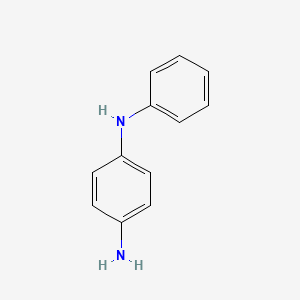
N-Phenyl-p-phenylenediamine
P-aminodiphenylamine is an aromatic amine that is the 4-amino derivative of diphenylamine. It has a role as an allergen. It is an aromatic amine and a secondary amino compound. It is functionally related to a diphenylamine. — ChEBI
- IUPAC-Name
- 4-N-phenylbenzene-1,4-diamine
- Summenformel
- C12H12N2
- Molekulargewicht
- 184.24 g/mol
- Exakte Masse
- 184.100048391 Da
- XLogP3
- 2,5
- Topologische polare Oberfläche
- 38,1 Ų
- Wasserstoffbrücken-Donoren
- 2
- Wasserstoffbrücken-Akzeptoren
- 2
- Kovalente Einheiten
- 1
- Definierte Stereozentren
- 0
Auch bekannt als
16 weitere gemeldete Namen
Kennungen in externen Datenbanken
- ChEBI:CHEBI:59038
- ChEMBL:CHEMBL572203
- EPA DTXSID:DTXSID7025895
- PubMed:22624827
- PubMed:22567565
- PubMed:22344700
- PubMed:21969747
- PubMed:21901562
- PubMed:21636315
- PubMed:21586810
- PubMed:20734014
- PubMed:19463000
- PubMed:19338586
- PubMed:19073047
- PubMed:18489148
Belege aus weiteren wissenschaftlichen Datenbanken
EMBL-EBI ChEBI
p-aminodiphenylamine
An aromatic amine that is the 4-amino derivative of diphenylamine.
- Rezeptur
- C12H12N2
- Durchschnittsmasse
- 184.242 g/mol
- Monoisotopische Masse
- 184.10005 Da
- Formale Ladung
- 0
- secondary amino compound — is a (CHEBI:50995)
- aromatic amine — is a (CHEBI:33860)
- allergen — has role (CHEBI:50904)
- diphenylamine — has functional parent (CHEBI:4640)
- allergen — has role (CHEBI:50904)
- secondary amino compound — is a (CHEBI:50995)
- aromatic amine — is a (CHEBI:33860)
Weitere kuratierte Namen
Querverweise aus dieser Quelle
Zugeordnet durch: Exact CAS cross-reference in the ChEBI compound record. Quelle aktualisiert: 2019-03-12. Abgerufen: 2026-08-31. Quelleneintrag öffnen
NIH PubChem PUG-View
Attributed physical-property, hazard, environmental and use annotations.
- Boiling Point: 669 °F at 760 mmHg (NTP, 1992) Quelle: CAMEO Chemicals
- Boiling Point: 354 °C Quelle: Hazardous Substances Data Bank (HSDB)
- Boiling Point: 354 °C Quelle: ILO-WHO International Chemical Safety Cards (ICSCs)
- Color/Form: Needles (alcohol) Quelle: Hazardous Substances Data Bank (HSDB)
- Color/Form: Purple powder Quelle: Hazardous Substances Data Bank (HSDB)
- Color/Form: Purple needles Quelle: Hazardous Substances Data Bank (HSDB)
- Density: 1.15 (NTP, 1992) - Denser than water; will sink Quelle: CAMEO Chemicals
- Density: 1.1 at 100 °C Quelle: Hazardous Substances Data Bank (HSDB)
- Density: 1.09 g/cm³ Quelle: ILO-WHO International Chemical Safety Cards (ICSCs)
- Dissociation Constants: pKa = 5.20 (conjugate acid) Quelle: Hazardous Substances Data Bank (HSDB)
- Flash Point: 380 °F (NTP, 1992) Quelle: CAMEO Chemicals
- Flash Point: 380 °F' Quelle: Haz-Map, Information on Hazardous Chemicals and Occupational Diseases
- Flash Point: 193 °C Quelle: ILO-WHO International Chemical Safety Cards (ICSCs)
- LogP: 2.4 (calculated) Quelle: ILO-WHO International Chemical Safety Cards (ICSCs)
- Melting Point: 163 to 167 °F (NTP, 1992) Quelle: CAMEO Chemicals
- Melting Point: 75 °C Quelle: Hazardous Substances Data Bank (HSDB)
- Melting Point: 75 °C Quelle: ILO-WHO International Chemical Safety Cards (ICSCs)
- Physical Description: N-phenyl-p-phenylenediamine appears as odorless purple-black solid or flake or dark purple chips. (NTP, 1992) Quelle: CAMEO Chemicals
- Physical Description: Dry Powder; Liquid Quelle: EPA Chemical Data Reporting (CDR)
- Physical Description: Purple powder or needles; [HSDB] Quelle: Haz-Map, Information on Hazardous Chemicals and Occupational Diseases
- Physical Description: PURPLE CRYSTALLINE POWDER OR NEEDLES Quelle: ILO-WHO International Chemical Safety Cards (ICSCs)
- Solubility: less than 1 mg/mL at 66 °F (NTP, 1992) Quelle: CAMEO Chemicals
- Solubility: Slightly soluble in water, chloroform; very soluble in ethanol; soluble in diethyl ether, ligroin Quelle: Hazardous Substances Data Bank (HSDB)
- Solubility: Soluble in alcohol and acetone Quelle: Hazardous Substances Data Bank (HSDB)
- Solubility: Insoluble in water; soluble in oxygenated solvents Quelle: Hazardous Substances Data Bank (HSDB)
- Solubility: Solubility: 500 mg/L at 20 °C and pH 8.9 Quelle: Hazardous Substances Data Bank (HSDB)
- Solubility: Solubility in water, g/100ml at 20 °C: 0.05 Quelle: ILO-WHO International Chemical Safety Cards (ICSCs)
- Vapor Pressure: 0.0000121 [mmHg] Quelle: Haz-Map, Information on Hazardous Chemicals and Occupational Diseases
- Vapor Pressure: 1.21X10⁻⁵ mm Hg at 25 °C (extrapolated) Quelle: Hazardous Substances Data Bank (HSDB)
- Vapor Pressure: Vapor pressure, Pa at 20 °C: 0.000076 Quelle: ILO-WHO International Chemical Safety Cards (ICSCs)
- Viscosity: 1.76X10⁻² Pa.s at 25 °C Quelle: Hazardous Substances Data Bank (HSDB)
- Substance: N-phenyl-p-phenylenediamine Quelle: NTP Technical Reports
- NTP Technical Report: TR-082: Bioassay of N-Phenyl-p-phenylenediamine for Possible Carcinogenicity (CASRN 101-54-2) (1978 ) Quelle: NTP Technical Reports
- Peer Review Date: 03/06/78 Quelle: NTP Technical Reports
- Conclusion for Male Rat: No Evidence Quelle: NTP Technical Reports
- Conclusion for Female Rat: No Evidence Quelle: NTP Technical Reports
- Conclusion for Male Mice: No Evidence Quelle: NTP Technical Reports
- Conclusion for Female Mice: No Evidence Quelle: NTP Technical Reports
- Summary: It is concluded that under the conditions of this bioassay, N-phenyl-p-phenylenediamine was not carcinogenic for Fischer 344 rats or for B6C3F1 mice. Quelle: NTP Technical Reports
- Exposure Routes: The substance can be absorbed into the body by inhalation and by ingestion. Quelle: ILO-WHO International Chemical Safety Cards (ICSCs)
- First Aid: EYES: First check the victim for contact lenses and remove if present. Flush victim's eyes with water or normal saline solution for 20 to 30 minutes while simultaneously calling a hospital or poison control center. Do not put any ointments, oils, or medication in the victim's eyes without specific instructions from a physician. IMMEDIATELY transport the victim after flushing eyes to a hospital even if no symptoms (such as redness or irritation) develop.; SKIN: IMMEDIATELY flood affected skin with water while removing and isolating all contaminated clothing. Gently wash all affected skin areas thoroughly with soap and water. If symptoms such as redness or irritation develop, IMMEDIATELY call a physician and be prepared to transport the victim to a hospital for treatment.; INHALATION: IMMEDIATELY leave the contaminated area; take deep breaths of fresh air. If symptoms (such as wheezing, coughing, shortness of breath, or burning in the mouth, throat, or chest) develop, call a physician and be prepared to transport the victim to a hospital. Provide proper respiratory protection to rescuers entering an unknown atmosphere. Whenever possible, Self-Contained Breathing Apparatus (SCBA) shou Quelle: CAMEO Chemicals
- Signal: Warning Quelle: European Chemicals Agency (ECHA)
- GHS Hazard Statements: H302 (97.2%): Harmful if swallowed [Warning Acute toxicity, oral]; H317 (97.4%): May cause an allergic skin reaction [Warning Sensitization, Skin]; H319 (31.6%): Causes serious eye irritation [Warning Serious eye damage/eye irritation]; H400 (90.9%): Very toxic to aquatic life [Warning Hazardous to the aquatic environment, acute hazard]; H410 (93.2%): Very toxic to aquatic life with long lasting effects [Warning Hazardous to the aquatic environment, long-term hazard] Quelle: European Chemicals Agency (ECHA)
- Precautionary Statement Codes: P261, P264, P264+P265, P270, P272, P273, P280, P301+P317, P302+P352, P305+P351+P338, P321, P330, P333+P317, P337+P317, P362+P364, P391, and P501 (click each P-code to see the statement) Quelle: European Chemicals Agency (ECHA)
- ECHA C&L Notifications Summary: Aggregated GHS information provided per 680 reports by companies from 21 notifications to the ECHA C&L Inventory. Each notification may be associated with multiple companies.; Information may vary between notifications depending on impurities, additives, and other factors. The percentage value in parenthesis indicates the notified classification ratio from companies that provide hazard codes. Only hazard codes with percentage values above 10% are shown. For more detailed information, please visit ECHA C&L website. Quelle: European Chemicals Agency (ECHA)
- Signal: Warning Quelle: NITE-CMC
- GHS Hazard Statements: H302: Harmful if swallowed [Warning Acute toxicity, oral]; H317: May cause an allergic skin reaction [Warning Sensitization, Skin]; H320: Causes eye irritation [Warning Serious eye damage/eye irritation]; H361: Suspected of damaging fertility or the unborn child [Warning Reproductive toxicity]; H371: May cause damage to organs [Warning Specific target organ toxicity, single exposure] Quelle: NITE-CMC
- Precautionary Statement Codes: P203, P260, P261, P264, P264+P265, P270, P272, P280, P301+P317, P302+P352, P305+P351+P338, P308+P316, P318, P321, P330, P333+P317, P337+P317, P362+P364, P405, and P501 (click each P-code to see the statement) Quelle: NITE-CMC
- Signal: Warning Quelle: Hazardous Chemical Information System (HCIS), Safe Work Australia
- GHS Hazard Statements: H302: Harmful if swallowed [Warning Acute toxicity, oral]; H317: May cause an allergic skin reaction [Warning Sensitization, Skin] Quelle: Hazardous Chemical Information System (HCIS), Safe Work Australia
- Precautionary Statement Codes: P261, P264, P270, P272, P280, P301+P317, P302+P352, P321, P330, P333+P317, P362+P364, and P501 (click each P-code to see the statement) Quelle: Hazardous Chemical Information System (HCIS), Safe Work Australia
- Cosmetic Ingredient Review Conclusion: On the basis of the data included in this report, the CIR Expert Panel concludes that N-Phenyl-p-Phenylenediamine... safe for use in hair dyes at concentrations up to 1.7% (as the free base). Quelle: Cosmetic Ingredient Review (CIR)
- Cosmetic Ingredient Review Finding(s): Safe for use in cosmetics, with qualifications Quelle: Cosmetic Ingredient Review (CIR)
- Environmental Bioconcentration: An estimated BCF of 5.1 was calculated for p-aminodiphenylamine(SRC), using an estimated log Kow of 1.82(1) and a regression-derived equation(2). According to a classification scheme(3), this BCF suggests the potential for bioconcentration in aquatic organisms is low(SRC). Quelle: Hazardous Substances Data Bank (HSDB)
- Environmental Fate: TERRESTRIAL FATE: Based on a classification scheme(1), an estimated Koc value of 3.1X10+3(SRC), determined from a structure estimation method(2), indicates that p-aminodiphenylamine is expected to have slight mobility in soil(SRC). The pKa of p-aminodiphenylamine is 5.20(3), indicating that this compound will partially exist in cation form in the environment and cations generally adsorb more strongly to soils containing organic carbon and clay than their neutral counterparts(4). Volatilization of p-aminodiphenylamine from moist soil surfaces is not expected to be an important fate process(SRC) given an estimated Henry's Law constant of 3.7X10⁻¹⁰ atm-cu m/mole(SRC), using a fragment constant estimation method(5). p-Aminodiphenylamine is not expected to volatilize from dry soil surfaces(SRC) based upon a vapor pressure of 1.21X10⁻⁵ mm Hg at 25 °C(6). Reported inherent biodegradation values of 28% after 20 days in an adapted activated sludge and 58% after 3 hours in a mixed, non-adapted activated sludge inoculum(7) suggest that biodegradation in the aquatic environment may be an important fate process(SRC). Quelle: Hazardous Substances Data Bank (HSDB)
- Environmental Fate: AQUATIC FATE: Based on a classification scheme(1), an estimated Koc value of 3.1X10+3(SRC), determined from a structure estimation method(2), indicates that p-aminodiphenylamine is expected to adsorb to suspended solids and sediment(SRC). Volatilization from water surfaces is not expected(3) based upon an estimated Henry's Law constant of 3.7X10⁻¹⁰ atm-cu m/mole(SRC), developed using a fragment constant estimation method(4). A pKa of 5.20(5) indicates p-aminodiphenylamine will exist partially in the cation form at pH values of 5 to 9 and therefore volatilization from water surfaces is not expected to be an important fate process(6). According to a classification scheme(7), an estimated BCF of 5.1(SRC), from an estimated log Kow of 1.82(8) and a regression-derived equation(9), suggests the potential for bioconcentration in aquatic organisms is low. Reported inherent biodegradation values of 28% after 20 days in an adapted activated sludge and 58% after 3 hours in a mixed, non-adapted activated sludge inoculum(10) suggest that biodegradation in the aquatic environment may be an important fate process(SRC). Quelle: Hazardous Substances Data Bank (HSDB)
- Environmental Fate: ATMOSPHERIC FATE: According to a model of gas/particle partitioning of semivolatile organic compounds in the atmosphere(1), p-aminodiphenylamine, which has a vapor pressure of 1.21X10⁻⁵ mm Hg at 25 °C(2), will exist in both the vapor and particulate phases in the ambient atmosphere. Vapor-phase p-aminodiphenylamine is degraded in the atmosphere by reaction with photochemically-produced hydroxyl radicals(SRC); the half-life for this reaction in air is estimated to be 1.9 hours(SRC), calculated from its rate constant of 2.0X10⁻¹⁰ cu cm/molecule-sec at 25 °C(SRC) that was derived using a structure estimation method(3). Particulate-phase p-aminodiphenylamine may be removed from the air by wet or dry deposition(SRC). p-Aminodiphenylamine contains chromophores that absorb at wavelengths >290 nm(4) and therefore may be susceptible to direct photolysis by sunlight(SRC). Quelle: Hazardous Substances Data Bank (HSDB)
- Industry Uses: Intermediate Quelle: EPA Chemical Data Reporting (CDR)
- Cosmetic Ingredient Review Link: CIR ingredient: N-Phenyl-p-Phenylenediamine Quelle: Cosmetic Ingredient Review (CIR)
- Sources/Uses: Used to produce dyes, pharmaceuticals, and photographic chemicals; [HSDB] Formerly used as a hair dye; [Kanerva, p. 1749] Quelle: Haz-Map, Information on Hazardous Chemicals and Occupational Diseases
- Industrial Processes with risk of exposure: Dressing Hair [Category: Other] Quelle: Haz-Map, Information on Hazardous Chemicals and Occupational Diseases
- Uses: Dye intermediate, pharmaceuticals, photographic chemicals. Quelle: Hazardous Substances Data Bank (HSDB)
- Uses: Azoic dye, diazo component Quelle: Hazardous Substances Data Bank (HSDB)
- Uses: Oxidation dye color in hair dyes Quelle: Hazardous Substances Data Bank (HSDB)
- Uses: Rubber additive Quelle: Hazardous Substances Data Bank (HSDB)
Zugeordnet durch: Existing checksum-valid CAS to unique PubChem CID match. Abgerufen: 2026-08-31. Quelleneintrag öffnen
Wissenschaftliche Klassifizierungen und Gefahrenannotationen liefern Kontext und ersetzen nicht die oben gezeigte marktspezifische regulatorische Entscheidung.
Weitere Quellenabdeckung und Trefferstatus
| Quelle | Ergebnis | Geprüft |
|---|---|---|
| EMBL-EBI ChEBI | Exakter Treffer | 2026-08-31 |
| NIH PubChem PUG-View | Exakter Treffer | 2026-08-31 |
Ein erfasster Nicht-Treffer ist ein nützlicher Beleg dafür, dass die Quelle geprüft wurde; er ist keine Behauptung, dass der Stoff anderswo nicht existiert.
Am 2026-09-02 von NIH PubChem durch prüfsummengültigen CAS-Abgleich abgerufen. Chemische Eigenschaften ersetzen nicht die regulatorische Entscheidung auf dieser Seite.
Belege zum amtlichen EU-Inhaltsstoffnamen
Der Inhaltsstoffname stimmt exakt mit dem amtlichen EU-Glossar 2025 der gebräuchlichen Inhaltsstoffnamen überein.
Die Märkte sind sich bei diesem Stoff nicht einig: In einigen ist er verboten, in anderen unter Bedingungen zulässig, über die 2 Märkte hinweg, die dafür eine Vorschrift führen.
- verboten
- South Korea
- beschränkt
- European Union
South Korea führt für diesen Stoff mehr als eine Vorschrift, sodass seine Position dort von der Verwendung abhängt.
Alle Stoffe ansehen, bei denen die Märkte voneinander abweichen
Verwandte Belege aus dem Verzeichnis
Inhaltsstoffe mit sich überschneidenden Rezepturfunktionen
Weitere amtliche und wissenschaftliche Quellen
11 externe Datenbanken zur Prüfung dieser Identität
Jeder Link durchsucht die jeweilige Quelle nach dieser Identität. Was jede Quelle ist und welches rechtliche Gewicht sie hat
Wie N-PHENYL-P-PHENYLENEDIAMINE im CosIng-Verzeichnis erscheint
Das CosIng-Verzeichnis führt N-PHENYL-P-PHENYLENEDIAMINE als kosmetischen Inhaltsstoff, und diese Seite verknüpft ihn mit 1 Anhangseintrag. Der Verzeichniseintrag erfasst Namen und Kennungen, während der Anhangseintrag zeigt, wo der Stoff im EU-Kosmetikrecht verboten, beschränkt oder positiv gelistet ist.
N-PHENYL-P-PHENYLENEDIAMINE ist in den amtlichen Daten außerdem mit 1 kosmetischen Funktion gekennzeichnet. Funktionsbezeichnungen beschreiben die beabsichtigte Verwendung, ersetzen aber nicht die regulatorische Prüfung verknüpfter Anhangseinträge vor der Rezeptierung oder Kennzeichnung.
Häufig gestellte Fragen
Quellenhinweis zu N-PHENYL-P-PHENYLENEDIAMINE
Diese Seite verbindet den CosIng-Verzeichniseintrag für N-PHENYL-P-PHENYLENEDIAMINE mit 1 verknüpften Eintrag aus den Anhängen II–VI aus unserem Datenbestand, der aus öffentlichen Materialien der Europäischen Kommission zu kosmetischen Inhaltsstoffen aufgebaut ist.
Nutzen Sie diese Verzeichnisseite, um N-PHENYL-P-PHENYLENEDIAMINE zu recherchieren und verknüpfte Einträge zu vergleichen; verifizieren Sie Beschränkungen und Rechtsstatus jedoch anhand des aktuellen amtlichen Quellentextes und Rechts, bevor Sie regulatorische Entscheidungen treffen.
Werkzeuge und nächste Schritte
Rezeptur prüfen
Eine vollständige INCI-Liste prüfen, um N-PHENYL-P-PHENYLENEDIAMINE und etwaige verknüpfte EU-Anhangsbeschränkungen oder Allergenmarkierungen zu erkennen.
INCI-CheckerÄhnliche Inhaltsstoffe suchen
Weitere Inhaltsstoffe aus dem Verzeichnis und Anhangseinträge finden, die mit N-PHENYL-P-PHENYLENEDIAMINE, seinen Kennungen oder nahen Namensvarianten zusammenhängen.
Suche