
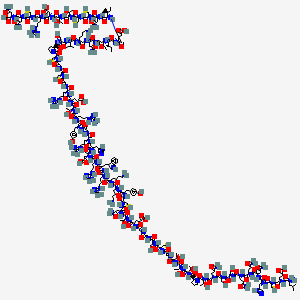
Cobrotoxin
alpha-Cobratoxin is a peptide toxin produced by certain cobras of the Naja genus, such as the Monocled cobra (Naja kaouthia). It is a muscle-type nicotinic acetylcholine receptor (nAChR) antagonist, which causes paralysis by preventing the binding of acetylcholine to the nAChR. (L1046) — Toxin and Toxin Target Database (T3DB)
- IUPAC-Name
- (4S)-5-[[(2S,3R)-1-[[(2S)-4-amino-1-[[(2R)-1-[[(2S)-1-[[(2S)-6-amino-1-[[(2S)-6-amino-1-[[(2S)-1-[[(2S)-1-[[(2S)-1-[[(2S)-1-[[(2S)-1-[[(2S)-1-[[2-[[(2S)-1-[[(2S)-1-[[(2S,3R)-1-[[(2S)-1-[[(2S)-1-[[2-[[(2R)-1-[[2-[[(2R)-1-[(2S)-2-[[(2S)-1-[[(2S)-1-[[(2S)-6-amino-1-[[(2S)-4-amino-1-[[2-[[(2S,3S)-1-[[(2S)-1-[[(2S,3S)-1-[[(2S)-4-amino-1-[[(2R)-1-[[(2R)-1-[[(2S,3R)-1-[[(2S,3R)-1-[[(2S)-1-[[(2S)-1-[[(2R)-1-[[(2S)-4-amino-1-[[(1S)-3-amino-1-carboxy-3-oxopropyl]amino]-1,4-dioxobutan-2-yl]amino]-1-oxo-3-sulfanylpropan-2-yl]amino]-5-carbamimidamido-1-oxopentan-2-yl]amino]-3-carboxy-1-oxopropan-2-yl]amino]-3-hydroxy-1-oxobutan-2-yl]amino]-3-hydroxy-1-oxobutan-2-yl]amino]-1-oxo-3-sulfanylpropan-2-yl]amino]-1-oxo-3-sulfanylpropan-2-yl]amino]-1,4-dioxobutan-2-yl]amino]-3-methyl-1-oxopentan-2-yl]amino]-4-carboxy-1-oxobutan-2-yl]amino]-3-methyl-1-oxopentan-2-yl]amino]-2-oxoethyl]amino]-1,4-dioxobutan-2-yl]amino]-1-oxohexan-2-yl]amino]-3-methyl-1-oxobutan-2-yl]amino]-3-hydroxy-1-oxopropan-2-yl]carbamoyl]pyrrolidin-1-yl]-1-oxo-3-sulfanylpropan-2-yl]amino]-2-oxoethyl]amino]-1-oxo-3-sulfanylpropan-2-yl]amino]-2-oxoethyl]amino]-5-carbamimidamido-1-oxopentan-2-yl]amino]-4-carboxy-1-oxobutan-2-yl]amino]-3-hydroxy-1-oxobutan-2-yl]amino]-5-carbamimidamido-1-oxopentan-2-yl]amino]-3-(4-hydroxyphenyl)-1-oxopropan-2-yl]amino]-2-oxoethyl]amino]-5-carbamimidamido-1-oxopentan-2-yl]amino]-3-(1H-imidazol-5-yl)-1-oxopropan-2-yl]amino]-3-carboxy-1-oxopropan-2-yl]amino]-5-carbamimidamido-1-oxopentan-2-yl]amino]-3-(1H-indol-3-yl)-1-oxopropan-2-yl]amino]-5-carbamimidamido-1-oxopentan-2-yl]amino]-1-oxohexan-2-yl]amino]-1-oxohexan-2-yl]amino]-3-(4-hydroxyphenyl)-1-oxopropan-2-yl]amino]-1-oxo-3-sulfanylpropan-2-yl]amino]-1,4-dioxobutan-2-yl]amino]-3-hydroxy-1-oxobutan-2-yl]amino]-4-[[2-[[2-[[(2S)-2-[[(2R)-2-[[2-[[(2S,3R)-2-[[(2S,3R)-2-[[(2S,3R)-2-[[(2S)-1-[(2S,3R)-2-[[(2S)-5-amino-2-[[(2S)-2-[[(2S)-2-[[(2S)-5-amino-2-[[(2S)-5-amino-2-[[(2S)-4-amino-2-[[(2S)-2-[[(2R)-2-[[(2S)-2-[[(2S)-2-amino-4-methylpentanoyl]amino]-4-carboxybutanoyl]amino]-3-sulfanylpropanoyl]amino]-3-(1H-imidazol-5-yl)propanoyl]amino]-4-oxobutanoyl]amino]-5-oxopentanoyl]amino]-5-oxopentanoyl]amino]-3-hydroxypropanoyl]amino]-3-hydroxypropanoyl]amino]-5-oxopentanoyl]amino]-3-hydroxybutanoyl]pyrrolidine-2-carbonyl]amino]-3-hydroxybutanoyl]amino]-3-hydroxybutanoyl]amino]-3-hydroxybutanoyl]amino]acetyl]amino]-3-sulfanylpropanoyl]amino]-3-hydroxypropanoyl]amino]acetyl]amino]acetyl]amino]-5-oxopentanoic acid
- Summenformel
- C277H443N97O98S8
- Molekulargewicht
- 6957 g/mol
- Exakte Masse
- 6954.0495793 Da
- XLogP3
- -50,6
- Topologische polare Oberfläche
- 3250,0 Ų
- Wasserstoffbrücken-Donoren
- 122
- Wasserstoffbrücken-Akzeptoren
- 118
- Kovalente Einheiten
- 1
- Definierte Stereozentren
- 65
Auch bekannt als
Belege aus weiteren wissenschaftlichen Datenbanken
NIH PubChem PUG-View
Attributed physical-property, hazard, environmental and use annotations.
- Carcinogen Classification: No indication of carcinogenicity to humans (not listed by IARC). Quelle: Toxin and Toxin Target Database (T3DB)
- Exposure Routes: Injection (sting/bite) (L1814) Quelle: Toxin and Toxin Target Database (T3DB)
- Health Effects: Naja cobras have a strongly neurotoxic venom, which attacks the nervous system, causing paralysis, and many also have hemotoxic features which causes swelling, necrosis and has a significant anticoagulant effect. Naja bites can be fatal to humans. (L1047) Quelle: Toxin and Toxin Target Database (T3DB)
- Toxicity Summary: alpha-Cobratoxin is a muscle-type nicotinic acetylcholine receptor (nAChR) antagonist. It causes paralysis by preventing the binding of acetylcholine to the nAChR, as the nAChR is needed for synaptic transmission both in the central nervous system and at the neuromuscular junction. (L1046) Quelle: Toxin and Toxin Target Database (T3DB)
- Uses: alpha-Cobratoxin is a peptide toxin produced by certain cobras of the Naja genus, such as the Monocled cobra (Naja kaouthia). (L1046) Quelle: Toxin and Toxin Target Database (T3DB)
Zugeordnet durch: Existing checksum-valid CAS to unique PubChem CID match. Abgerufen: 2026-08-31. Quelleneintrag öffnen
Wissenschaftliche Klassifizierungen und Gefahrenannotationen liefern Kontext und ersetzen nicht die oben gezeigte marktspezifische regulatorische Entscheidung.
Weitere Quellenabdeckung und Trefferstatus
| Quelle | Ergebnis | Geprüft |
|---|---|---|
| NIH PubChem PUG-View | Exakter Treffer | 2026-08-31 |
Ein erfasster Nicht-Treffer ist ein nützlicher Beleg dafür, dass die Quelle geprüft wurde; er ist keine Behauptung, dass der Stoff anderswo nicht existiert.
Am 2026-08-31 von NIH PubChem durch prüfsummengültigen CAS-Abgleich abgerufen. Chemische Eigenschaften ersetzen nicht die regulatorische Entscheidung auf dieser Seite.