
Amtlicher EU-KennzeichnungsnameGlossareintrag 28210
TAFLUPROST
Dieser Eintrag bestätigt einen amtlichen gebräuchlichen Inhaltsstoffnamen für die EU-Kennzeichnung kosmetischer Mittel. Er bestätigt für sich genommen nicht, dass der Stoff zulässig, unbeschränkt oder sicher ist.
Globale Belegübersicht
Die ermittelte Identität hat übereinstimmende regulatorische Belege in 1 von 13 indizierten Marktdatensätzen: 1 Ländereinträge und 0 EU-Anhangseinträge. Jedes Ergebnis und jede Belegslücke ist unten aufgeführt.
Geprüfte Märkte
13
Märkte mit Belegen
1
Belegslücken
12
Ermittelte Kennungen
15
Ermittelte Stoffidentität
CAS:209860-87-7745-65-3155206-00-140665-92-7363-24-635121-78-940666-16-8130209-82-459122-46-2157283-68-681846-19-7120373-36-6130209-76-61005193-64-5157283-66-4
Einträge im Inhaltsstoffindex:
TAFLUPROST
Kosmetische Funktionen: HAIR CONDITIONING
Isopropyl (5Z)-7-{(1R,2R,3R,5S)-2-((1E)-3,3-difluoro-4-phenoxybut-1- enyl)-3,5-dihydroxycyclopentyl}hept-5-enoate
3 übereinstimmende oder gemeldete Namen
TAFLUPROSTtafluprostProstaglandins, their salts and derivatives and their analogs
Regulatorische Belege in allen 13 Märkten
Öffnen Sie jeden übereinstimmenden Eintrag, um Geltungsbereich, Konzentration, Bedingungen, Warnhinweise und die Version der amtlichen Quelle zu sehen.
Wischen oder scrollen Sie horizontal, um Datenabdeckung und nächste Schritte zu sehen.
| Markt | Ergebnis | Einträge | Datensatz | Bedeutung / nächster Schritt |
|---|---|---|---|---|
| European Union EU | Kein Treffer gefunden | 0 | Complete annex dataset Regulation (EC) 1223/2009 consolidated to 1 May 2026 | No annex match only means that these five annexes did not return a match; CosIng identity data and other EU obligations still need review. |
| Great Britain GB | Kein Treffer gefunden | 0 | Complete consolidated annex dataset GB retained Regulation 1223/2009 schedules, effective 15 August 2026 | No annex match is not approval and does not cover Northern Ireland, which follows the applicable EU framework. |
| Canada CA | Prohibited | 1Eintrag öffnen 1 | Complete Hotlist snapshot Health Canada Cosmetic Ingredient Hotlist, 13 August 2025 | Prüfen Sie jeden verknüpften Eintrag und die genauen Bedingungen. |
| New Zealand NZ | Kein Treffer gefunden | 0 | Complete schedules dataset Cosmetic Products Group Standard schedules effective 1 January 2026 | The searchable spreadsheet is an aid; the legal Group Standard and incorporated notices remain authoritative. |
| ASEAN ASEAN | Kein Treffer gefunden | 0 | Complete regional annex dataset ASEAN Cosmetic Directive annexes 2026-1, 22 June 2026 | Regional annex coverage does not replace member-state implementation dates, notifications or national deviations. |
| China CN | Kein Treffer gefunden | 0 | Complete prohibited catalogues plus official-source workflow NMPA 2021 banned catalogues plus dynamic IECIC List I/List II system current since 2025 | IECIC listing is not blanket approval; absence may require the new cosmetic ingredient route, and restrictions are checked separately. |
| Japan JP | Kein Treffer gefunden | 0 | Complete Standards appendices dataset MHLW Standards for Cosmetics official English source and Japanese amendments checked for the imported snapshot | The Japanese text and subsequent notices are canonical; no local match is not a product-compliance conclusion. |
| South Korea KR | Kein Treffer gefunden | 0 | Complete current appendix dataset MFDS Notice 2026-19, effective 18 March 2026 | Korean source wording is canonical and other positive lists/notices may still apply to the formulation. |
| United States US | Kein Treffer gefunden | 0 | Complete enumerated federal ingredient rules eCFR Title 21 issue date 27 August 2026 | FDA has no general approved-cosmetic-ingredient catalogue; absence from these sections is not approval or proof of safety. |
| Australia AU | Kein Treffer gefunden | 0 | Complete cosmetic-relevant Poisons Standard subset plus official workflow Therapeutic Goods (Poisons Standard—June 2026) Instrument 2026 | An AICIS Inventory match is not cosmetic approval; no Inventory match can indicate a new, exempted, reported or confidential introduction. |
| Brazil BR | Kein Treffer gefunden | 0 | Complete prohibited dataset plus current restricted-list workflow ANVISA RDC 1.029/2026 and RDC 1.030/2026, published 15 June 2026 | RDC 1.030/2026 amends rather than replaces the prohibited baseline, and the second restricted-list revision was still under consultation in July 2026. |
| India IN | Kein Treffer gefunden | 0 | Complete current Part 2 dataset plus official workflow for Parts 1, 3 and 4 Cosmetics Rules 2020 plus current BIS IS 4707 parts (1:2020, 2:2025, 3:2025, 4:2022) | The standards are separate controlled publications; absence from a locally indexed excerpt is not permission. |
| Saudi Arabia SA | Kein Treffer gefunden | 0 | Complete official list index SFDA live prohibited/restricted lists, snapshot 30 August 2026 | No list match is not permission; Gulf/SFDA product, claim, notification and technical requirements still apply. |
Keine Marktzeilen entsprechen diesem Filter.
Übereinstimmende Markteinträge und Bedingungen
Chemische Identität und Eigenschaften
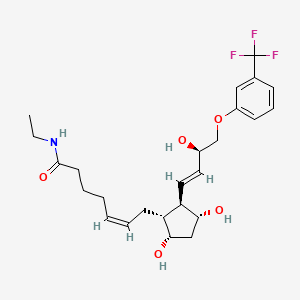
CAS 1005193-64-5PubChem CID 50940350
TrifluoroMethyl Dechloro
- IUPAC-Name
- (Z)-7-[(1R,2R,3R,5S)-3,5-dihydroxy-2-[(E,3R)-3-hydroxy-4-[3-(trifluoromethyl)phenoxy]but-1-enyl]cyclopentyl]-N-ethylhept-5-enamide
- Summenformel
- C25H34F3NO5
- Molekulargewicht
- 485.5 g/mol
- Exakte Masse
- 485.23890767 Da
- XLogP3
- 3,0
- Topologische polare Oberfläche
- 99,0 Ų
- Wasserstoffbrücken-Donoren
- 4
- Wasserstoffbrücken-Akzeptoren
- 8
- Kovalente Einheiten
- 1
- Definierte Stereozentren
- 5
Auch bekannt als
N-Ethyl Fluprostenol Carboxamide(5Z)-7-[(1R,2R,3R,5S)-3,5-Dihydroxy-2-[(1E,3R)-3-hydroxy-4-[3-(trifluoromethyl)phenoxy]-1-buten-1-yl]cyclopentyl]-N-ethyl-5-heptenamideTrifluoroMethylDechloroC25H34F3NO5Trifluoromethyl Dechloro Ethylcloprostenolamide(Z)-7-((1R,2R,3R,5S)-3,5-Dihydroxy-2-((R,E)-3-hydroxy-4-(3-(trifluoromethyl)phenoxy)but-1-en-1-yl)cyclopentyl)-N-ethylhept-5-enamide(Z)-7-[(1R,2R,3R,5S)-3,5-dihydroxy-2-[(E,3R)-3-hydroxy-4-[3-(trifluoromethyl)phenoxy]but-1-enyl]cyclopentyl]-N-ethyl-hept-5-enamide
Belege aus weiteren wissenschaftlichen Datenbanken
NIH PubChem PUG-View
Exakter Kennungstreffer50940350
Attributed physical-property, hazard, environmental and use annotations.
Zugeordnet durch: Existing checksum-valid CAS to unique PubChem CID match. Abgerufen: 2026-08-31. Quelleneintrag öffnen
Wissenschaftliche Klassifizierungen und Gefahrenannotationen liefern Kontext und ersetzen nicht die oben gezeigte marktspezifische regulatorische Entscheidung.
Weitere Quellenabdeckung und Trefferstatus
| Quelle | Ergebnis | Geprüft |
|---|---|---|
| EMBL-EBI ChEBI | Kein exakter Eintrag | 2026-08-31 |
| NIH PubChem PUG-View | Exakter Treffer | 2026-08-31 |
Ein erfasster Nicht-Treffer ist ein nützlicher Beleg dafür, dass die Quelle geprüft wurde; er ist keine Behauptung, dass der Stoff anderswo nicht existiert.
Am 2026-09-02 von NIH PubChem durch prüfsummengültigen CAS-Abgleich abgerufen. Chemische Eigenschaften ersetzen nicht die regulatorische Entscheidung auf dieser Seite.
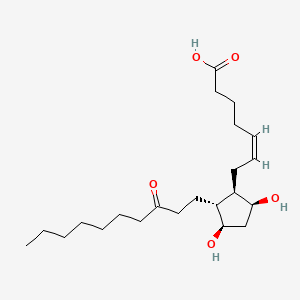
CAS 120373-36-6PubChem CID 5311236
Unoprostone
Unoprostone is a ketone, an oxo monocarboxylic acid and a prostaglandins Falpha. It has a role as an antihypertensive agent and an antiglaucoma drug. — ChEBI
- IUPAC-Name
- (Z)-7-[(1R,2R,3R,5S)-3,5-dihydroxy-2-(3-oxodecyl)cyclopentyl]hept-5-enoic acid
- Summenformel
- C22H38O5
- Molekulargewicht
- 382.5 g/mol
- Exakte Masse
- 382.27192431 Da
- XLogP3
- 3,7
- Topologische polare Oberfläche
- 94,8 Ų
- Wasserstoffbrücken-Donoren
- 3
- Wasserstoffbrücken-Akzeptoren
- 5
- Kovalente Einheiten
- 1
- Definierte Stereozentren
- 4
Auch bekannt als
unoprostona13,14-dihydro-15-keto-20-ethyl PGF2alpha6X4F561V3W(5Z)-7-[(1R,2R,3R,5S)-3,5-dihydroxy-2-(3-oxodecyl)cyclopentyl]hept-5-enoic acidCHEBI:39455(+)-(Z)-7-((1R,2R,3R,5S)-3,5-dihydroxy-2-(3-oxodecyl)cyclopentyl)-5-heptenoic acid9,11-dihydroxy-15-oxo-20a,20b-dihomoprost-5Z-en-1-oic acid(5Z)-7-((1R,2R,3R,5S)-3,5-dihydroxy-2-(3-oxodecyl)cyclopentyl)hept-5-enoic acid
16 weitere gemeldete Namen
unoprostonumRefChem:1100656S01EE02Unoprostone [MI]Unoprostone [INN]UnoprostaneUnoprostone (INN)13,14-Dihydro-15-keto-20-ethyl prostaglandin f2alphaUNII-6X4F561V3WUNOPROSTONE [VANDF]UNOPROSTONE [WHO-DD]HMS3648D22EBC-26874DA-68484HY-106916CS-0026907
Kennungen in externen Datenbanken
- ChEBI:CHEBI:39455
- ChEMBL:CHEMBL1201407
- EPA DTXSID:DTXSID80905120
- PubMed:14733708
Belege aus weiteren wissenschaftlichen Datenbanken
NIH PubChem PUG-View
Exakter Kennungstreffer5311236
Attributed physical-property, hazard, environmental and use annotations.
- Signal: Danger Quelle: European Chemicals Agency (ECHA)
- GHS Hazard Statements: H360 (100%): May damage fertility or the unborn child [Danger Reproductive toxicity] Quelle: European Chemicals Agency (ECHA)
- Precautionary Statement Codes: P203, P280, P318, P405, and P501 (click each P-code to see the statement) Quelle: European Chemicals Agency (ECHA)
- ECHA C&L Notifications Summary: The GHS information provided by 1 company from 1 notification to the ECHA C&L Inventory. Quelle: European Chemicals Agency (ECHA)
Zugeordnet durch: Existing checksum-valid CAS to unique PubChem CID match. Abgerufen: 2026-08-31. Quelleneintrag öffnen
Wissenschaftliche Klassifizierungen und Gefahrenannotationen liefern Kontext und ersetzen nicht die oben gezeigte marktspezifische regulatorische Entscheidung.
Weitere Quellenabdeckung und Trefferstatus
| Quelle | Ergebnis | Geprüft |
|---|---|---|
| NIH PubChem PUG-View | Exakter Treffer | 2026-08-31 |
Ein erfasster Nicht-Treffer ist ein nützlicher Beleg dafür, dass die Quelle geprüft wurde; er ist keine Behauptung, dass der Stoff anderswo nicht existiert.
Am 2026-08-31 von NIH PubChem durch prüfsummengültigen CAS-Abgleich abgerufen. Chemische Eigenschaften ersetzen nicht die regulatorische Entscheidung auf dieser Seite.
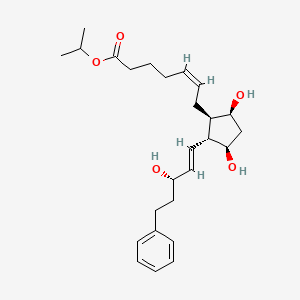
CAS 130209-76-6PubChem CID 5283107
17-phenyl-trinor-PGF2alpha isopropyl ester
17-phenyl-trinor-PGF2alpha isopropyl ester is a prostanoid. — ChEBI
- IUPAC-Name
- propan-2-yl (Z)-7-[(1R,2R,3R,5S)-3,5-dihydroxy-2-[(E,3S)-3-hydroxy-5-phenylpent-1-enyl]cyclopentyl]hept-5-enoate
- Summenformel
- C26H38O5
- Molekulargewicht
- 430.6 g/mol
- Exakte Masse
- 430.27192431 Da
- XLogP3
- 3,8
- Topologische polare Oberfläche
- 87,0 Ų
- Wasserstoffbrücken-Donoren
- 3
- Wasserstoffbrücken-Akzeptoren
- 5
- Kovalente Einheiten
- 1
- Definierte Stereozentren
- 5
Auch bekannt als
isopropyl 9S,11R,15S-trihydroxy-17-phenyl-18,19,20-trinor-5Z,13E-prostadienoateRefChem:1057638Bimatoprost isopropyl ester17-Phenyl trinor Pgf2alpha-IprdehydrolatanoprostPhDH 100A1IFH52MD8T17-Phenyl trinor PGF2|A isopropyl ester
16 weitere gemeldete Namen
17-Phenyl-18,19,20-trinor-pgf2alpha-1-isopropyl ester17-phenyl trinor PGF2alpha isopropyl esterisopropyl (Z)-7-((1R,2R,3R,5S)-3,5-dihydroxy-2-((S,E)-3-hydroxy-5-phenylpent-1-en-1-yl)cyclopentyl)hept-5-enoatePhdh100A5-Heptenoic acid, 7-[(1R,2R,3R,5S)-3,5-dihydroxy-2-[(1E,3S)-3-hydroxy-5-phenyl-1-penten-1-yl]cyclopentyl]-, 1-methylethyl ester, (5Z)-UNII-1IFH52MD8TBimatoprost Acid Isopropyl Ester5-HEPTENOIC ACID, 7-((1R,2R,3R,5S)-3,5-DIHYDROXY-2-((1E,3S)-3-HYDROXY-5-PHENYL-1-PENTEN-1-YL)CYCLOPENTYL)-, 1-METHYLETHYL ESTER, (5Z)-PGF2Alpha,17-phenylCHEBI:137717JGZRPRSJSQLFBO-FWPUOYPASA-NHMS3648J1817-Phenyl-18,19,20-trinor-prostaglandin F2alpha-1-isopropyl esterFA 26:7;O3HY-116161A(1R-(1alpha(Z),2beta(1E,3S*),3alpha,5alpha))-1-Methylethyl 7-(3,5-dihydroxy-2-(3-hydroxy-5-phenyl-1-pentenyl)cyclopentyl)-5-heptenoate
Kennungen in externen Datenbanken
- ChEBI:CHEBI:137717
- ChEMBL:CHEMBL2111623
- EPA DTXSID:DTXSID801365461
- PubMed:10634944
Belege aus weiteren wissenschaftlichen Datenbanken
NIH PubChem PUG-View
Exakter Kennungstreffer5283107
Attributed physical-property, hazard, environmental and use annotations.
- Signal: Danger Quelle: European Chemicals Agency (ECHA)
- GHS Hazard Statements: H302+H312+H332 (100%): Harmful if swallowed, in contact with skin or if inhaled [Warning Acute toxicity, oral; acute toxicity, dermal; acute toxicity, inhalation]; H302 (100%): Harmful if swallowed [Warning Acute toxicity, oral]; H312 (100%): Harmful in contact with skin [Warning Acute toxicity, dermal]; H332 (100%): Harmful if inhaled [Warning Acute toxicity, inhalation]; H360 (100%): May damage fertility or the unborn child [Danger Reproductive toxicity] Quelle: European Chemicals Agency (ECHA)
- Precautionary Statement Codes: P203, P261, P264, P270, P271, P280, P301+P317, P302+P352, P304+P340, P317, P318, P321, P330, P362+P364, P405, and P501 (click each P-code to see the statement) Quelle: European Chemicals Agency (ECHA)
- ECHA C&L Notifications Summary: The GHS information provided by 1 company from 1 notification to the ECHA C&L Inventory. Quelle: European Chemicals Agency (ECHA)
Zugeordnet durch: Existing checksum-valid CAS to unique PubChem CID match. Abgerufen: 2026-08-31. Quelleneintrag öffnen
Wissenschaftliche Klassifizierungen und Gefahrenannotationen liefern Kontext und ersetzen nicht die oben gezeigte marktspezifische regulatorische Entscheidung.
Weitere Quellenabdeckung und Trefferstatus
| Quelle | Ergebnis | Geprüft |
|---|---|---|
| NIH PubChem PUG-View | Exakter Treffer | 2026-08-31 |
Ein erfasster Nicht-Treffer ist ein nützlicher Beleg dafür, dass die Quelle geprüft wurde; er ist keine Behauptung, dass der Stoff anderswo nicht existiert.
Am 2026-09-02 von NIH PubChem durch prüfsummengültigen CAS-Abgleich abgerufen. Chemische Eigenschaften ersetzen nicht die regulatorische Entscheidung auf dieser Seite.
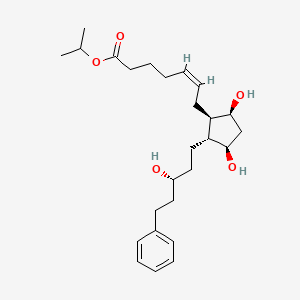
CAS 130209-82-4PubChem CID 5311221
Latanoprost
Latanoprost is a prostaglandin Falpha that is the isopropyl ester prodrug of latanoprost free acid. Used in the treatment of open-angle glaucoma and ocular hypertension. It has a role as an EC 4.2.1.1 (carbonic anhydrase) inhibitor, an antihypertensive agent, an antiglaucoma drug and a prodrug. It is a triol, an isopropyl ester and a prostaglandins Falpha. It is functionally related to a latanoprost free acid. — ChEBI
- IUPAC-Name
- propan-2-yl (Z)-7-[(1R,2R,3R,5S)-3,5-dihydroxy-2-[(3R)-3-hydroxy-5-phenylpentyl]cyclopentyl]hept-5-enoate
- Summenformel
- C26H40O5
- Molekulargewicht
- 432.6 g/mol
- Exakte Masse
- 432.28757437 Da
- XLogP3
- 4,3
- Topologische polare Oberfläche
- 87,0 Ų
- Wasserstoffbrücken-Donoren
- 3
- Wasserstoffbrücken-Akzeptoren
- 5
- Kovalente Einheiten
- 1
- Definierte Stereozentren
- 5
Auch bekannt als
XalatanPhXA41PHXA-41XA41PhXA 41XA-41IYUZEHlatanoprost (isopropyl ester)
16 weitere gemeldete Namen
latanoprostum6Z5B6HVF6OXELPROSIsopropyl (Z)-7-((1R,2R,3R,5S)-3,5-dihydroxy-2-((3R)-3-hydroxy-5-phenylpentyl)cyclopentyl)-5-heptenoateT-2345CHEBI:6384propan-2-yl (5Z)-7-{(1R,2R,3R,5S)-3,5-dihydroxy-2-[(3R)-3-hydroxy-5-phenylpentyl]cyclopentyl}hept-5-enoateT2345XALACOM COMPONENT LATANOPROSTpropan-2-yl (5Z)-7-[(1R,2R,3R,5S)-3,5-dihydroxy-2-[(3R)-3-hydroxy-5-phenylpentyl]cyclopentyl]hept-5-enoateLatanoprost PF5-Heptenoic acid, 7-(3,5-dihydroxy-2-(3-hydroxy-5-phenylpentyl)cyclopentyl)-, 1-methylethyl ester, (1R-(1-alpha(Z),2-beta(R*),3-alpha,5-alpha))-Monopostisopropyl (z)-7-[(1r,2r,3r,5s)-3,5-dihydroxy-2-[(3r)-3-hydroxy-5-phenylpentyl]cyclopentyl]-5-heptenoatepropan-2-yl (5Z)-7-((1R,2R,3R,5S)-3,5-dihydroxy-2-((3R)-3-hydroxy-5-phenylpentyl)cyclopentyl)hept-5-enoatepropan-2-yl (Z)-7-((1R,2R,3R,5S)-3,5-dihydroxy-2-((3R)-3-hydroxy-5-phenylpentyl)cyclopentyl)hept-5-enoate
Kennungen in externen Datenbanken
- ChEBI:CHEBI:6384
- ChEMBL:CHEMBL1051
- EPA DTXSID:DTXSID1041057
- PubMed:29921209
- PubMed:25811541
- PubMed:25328381
- PubMed:23956101
- PubMed:20019365
- PubMed:19403113
- PubMed:18721251
- PubMed:18166407
- PubMed:17539800
- PubMed:17459480
- PubMed:17416939
- PubMed:17102001
Belege aus weiteren wissenschaftlichen Datenbanken
NIH PubChem PUG-View
Exakter Kennungstreffer5311221
Attributed physical-property, hazard, environmental and use annotations.
- Boiling Point: 583.8 Quelle: DrugBank
- pKa: 4.88 Quelle: DrugBank
- LogP: 3.98 Quelle: DrugBank
- LogP: 4.4 Quelle: Human Metabolome Database (HMDB)
- Physical Description: Liquid Quelle: Human Metabolome Database (HMDB)
- Solubility: 1.29e-02 g/L Quelle: Human Metabolome Database (HMDB)
- Note: This chemical does not meet GHS hazard criteria for 0.7% (1 of 145) of reports. Quelle: European Chemicals Agency (ECHA)
- Signal: Danger Quelle: European Chemicals Agency (ECHA)
- GHS Hazard Statements: H300 (63.4%): Fatal if swallowed [Danger Acute toxicity, oral]; H301 (11%): Toxic if swallowed [Danger Acute toxicity, oral]; H361 (62.1%): Suspected of damaging fertility or the unborn child [Warning Reproductive toxicity] Quelle: European Chemicals Agency (ECHA)
- Precautionary Statement Codes: P203, P264, P270, P280, P301+P316, P318, P321, P330, P405, and P501 (click each P-code to see the statement) Quelle: European Chemicals Agency (ECHA)
- ECHA C&L Notifications Summary: Aggregated GHS information provided per 145 reports by companies from 16 notifications to the ECHA C&L Inventory. Each notification may be associated with multiple companies.; Reported as not meeting GHS hazard criteria per 1 of 145 reports by companies.; There are 15 notifications provided by 144 of 145 reports by companies with hazard statement code(s).; Information may vary between notifications depending on impurities, additives, and other factors. The percentage value in parenthesis indicates the notified classification ratio from companies that provide hazard codes. Only hazard codes with percentage values above 10% are shown. For more detailed information, please visit ECHA C&L website. Quelle: European Chemicals Agency (ECHA)
- Toxicity Summary: Researchers found no carcinogenesis or mutagenesis with latanoprost, and the drug did not affect fertility in animal studies. However, latanoprost was noted to cause a chromosomal aberration in treated human lymphocytes. Intravenous infusion of 3 μg/kg of latanoprost in healthy volunteers produced plasma concentrations 200 times higher than during clinical treatment with latanoprost ophthalmic solution, and researchers identified no ADR. There is no evidence to establish a correlation between latanoprost administration and ocular or cutaneous melanoma.; Intravenous infusion of 5.5 to 10 μg/kg resulted in fatigue, sweating, dizziness, nausea, and abdominal pain. According to the manufacturer's labeling, treatment should be symptomatic if there is an overdosage with latanoprost ophthalmic solution. Quelle: StatPearls
- Uses: Use (kg) in USA (2002): 1; Consumption (g per capita) in the USA (2002): 3.3e-06; Calculated removal (%): 100 Quelle: NORMAN Suspect List Exchange
Zugeordnet durch: Existing checksum-valid CAS to unique PubChem CID match. Abgerufen: 2026-08-31. Quelleneintrag öffnen
Wissenschaftliche Klassifizierungen und Gefahrenannotationen liefern Kontext und ersetzen nicht die oben gezeigte marktspezifische regulatorische Entscheidung.
Weitere Quellenabdeckung und Trefferstatus
| Quelle | Ergebnis | Geprüft |
|---|---|---|
| NIH PubChem PUG-View | Exakter Treffer | 2026-08-31 |
Ein erfasster Nicht-Treffer ist ein nützlicher Beleg dafür, dass die Quelle geprüft wurde; er ist keine Behauptung, dass der Stoff anderswo nicht existiert.
Am 2026-08-31 von NIH PubChem durch prüfsummengültigen CAS-Abgleich abgerufen. Chemische Eigenschaften ersetzen nicht die regulatorische Entscheidung auf dieser Seite.
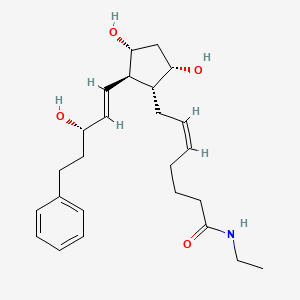
CAS 155206-00-1PubChem CID 5311027
Bimatoprost
Bimatoprost is a monocarboxylic acid amide. It has a role as an antihypertensive agent and an antiglaucoma drug. — ChEBI
- IUPAC-Name
- (Z)-7-[(1R,2R,3R,5S)-3,5-dihydroxy-2-[(E,3S)-3-hydroxy-5-phenylpent-1-enyl]cyclopentyl]-N-ethylhept-5-enamide
- Summenformel
- C25H37NO4
- Molekulargewicht
- 415.6 g/mol
- Exakte Masse
- 415.27225866 Da
- XLogP3
- 2,8
- Topologische polare Oberfläche
- 89,8 Ų
- Wasserstoffbrücken-Donoren
- 4
- Wasserstoffbrücken-Akzeptoren
- 4
- Kovalente Einheiten
- 1
- Definierte Stereozentren
- 5
Auch bekannt als
LumiganLatisseAGN 192024ProstamideAGN-192024bimatoprostumDURYSTA(Z)-7-((1R,2R,3R,5S)-3,5-Dihydroxy-2-((1E,3S)-3-hydroxy-5-phenyl-1-pentenyl)cyclopentyl)-N-ethyl-5-heptenamide
16 weitere gemeldete Namen
CHEBI:51230GANFORT COMPONENT BIMATOPROST5-Heptenamide, 7-(3,5-dihydroxy-2-(3-hydrdoxy-5-phenyl-1-pentenyl)cyclopentyl)-N-ethyl-, (1R-(1alpha(Z),2beta(1E,3S*),3alpha,5alpha))-(5Z)-7-[(1R,2R,3R,5S)-3,5-dihydroxy-2-[(1E,3S)-3-hydroxy-5-phenylpent-1-en-1-yl]cyclopentyl]-N-ethylhept-5-enamide(5Z)-7-{(1R,2R,3R,5S)-3,5-dihydroxy-2-[(1E,3S)-3-hydroxy-5-phenylpent-1-en-1-yl]cyclopentyl}-N-ethylhept-5-enamide(5Z)-7-((1R,2R,3R,5S)-3,5-dihydroxy-2-((1E,3S)-3-hydroxy-5-phenylpent-1-en-1-yl)cyclopentyl)-N-ethylhept-5-enamide(Z)-7-((1R,2R,3R,5S)-3,5-dihydroxy-2-((E,3S)-3-hydroxy-5-phenylpent-1-enyl)cyclopentyl)-N-ethylhept-5-enamide(Z)-7-[(1R,2R,3R,5S)-3,5-Dihydroxy-2-[(1E,3S)-3-hydroxy-5-phenyl-1-pentenyl]cyclopentyl]-N-ethyl-5-heptenamide192024, AGNRefChem:54542S01EE035-Heptenamide, 7-((1R,2R,3R,5S)-3,5-dihydroxy-2-((1E,3S)-3-hydroxy-5-phenyl-1-pentenyl)cyclopentyl)-N-ethyl-,(5Z)-(Z)-7-((1R,2R,3R,5S)-3,5-dihydroxy-2-((S,E)-3-hydroxy-5-phenylpent-1-en-1-yl)cyclopentyl)-N-ethylhept-5-enamide(E)-7-[3,5-dihydroxy-2-[(E)-3-hydroxy-5-phenylpent-1-enyl]cyclopentyl]-N-ethylhept-5-enamide5-Heptenamide, 7-[(1R,2R,3R,5S)-3,5-dihydroxy-2-[(1E,3S)-3-hydroxy-5-phenyl-1-penten-1-yl]cyclopentyl]-N-ethyl-, (5Z)-UNII-QXS94885MZ
Kennungen in externen Datenbanken
- ChEBI:CHEBI:51230
- ChEMBL:CHEMBL1200963
- EPA DTXSID:DTXSID30895042
- PubMed:29854658
- PubMed:20463804
- PubMed:19874254
- PubMed:19403113
- PubMed:18523093
- PubMed:18452763
- PubMed:17724194
- PubMed:17721551
- PubMed:17459480
- PubMed:16808680
- PubMed:16804825
- PubMed:16644608
Am 2026-09-02 von NIH PubChem durch prüfsummengültigen CAS-Abgleich abgerufen. Chemische Eigenschaften ersetzen nicht die regulatorische Entscheidung auf dieser Seite.
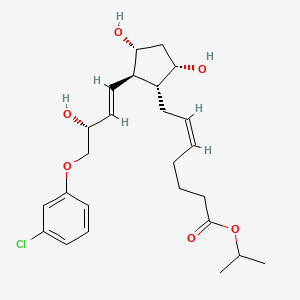
CAS 157283-66-4PubChem CID 59938277
Isopropyl Cloprostenate
- IUPAC-Name
- propan-2-yl (Z)-7-[(1R,2R,3R,5S)-2-[(E,3R)-4-(3-chlorophenoxy)-3-hydroxybut-1-enyl]-3,5-dihydroxycyclopentyl]hept-5-enoate
- Summenformel
- C25H35ClO6
- Molekulargewicht
- 467.0 g/mol
- Exakte Masse
- 466.2122165 Da
- XLogP3
- 3,8
- Topologische polare Oberfläche
- 96,2 Ų
- Wasserstoffbrücken-Donoren
- 3
- Wasserstoffbrücken-Akzeptoren
- 6
- Kovalente Einheiten
- 1
- Definierte Stereozentren
- 5
Auch bekannt als
Cloprostenol isopropyl esterIsopropyl cloprostenolUNII-765298537GCPG-6112955-Heptenoic acid, 7-((1R,2R,3R,5S)-2-((1E,3R)-4-(3-chlorophenoxy)-3-hydroxy-1-buten-1-yl)-3,5-dihydroxycyclopentyl)-, 1-methylethyl ester, (5Z)-5-Heptenoic acid, 7-((1R,2R,3R,5S)-2-((1E,3R)-4-(3-chlorophenoxy)-3-hydroxy-1-butenyl)-3,5-dihydroxycyclopentyl)-, 1-methylethyl ester, (5Z)-CPG-6112-955-Heptenoic acid, 7-(2-(4-(3-chlorophenoxy)-3-hydroxy-1-butenyl)-3,5-dihydroxycyclopentyl)-, 1-methylethyl ester, (1R-(1alpha(Z),2beta(1E,3R*),3alpha,5alpha))-
16 weitere gemeldete Namen
5-Heptenoic acid, 7-[(1R,2R,3R,5S)-2-[(1E,3R)-4-(3-chlorophenoxy)-3-hydroxy-1-buten-1-yl]-3,5-dihydroxycyclopentyl]-, 1-methylethyl ester, (5Z)-RefChem:149814ISOPROPYL CLOPROSTENATE [INCI]5-Heptenoic acid, 7-[(1R,2R,3R,5S)-2-[(1E,3R)-4-(3-chlorophenoxy)-3-hydroxy-1-butenyl]-3,5-dihydroxycyclopentyl]-, 1-methylethyl ester, (5Z)-(9CI)682-025-2(+)-Cloprostenol isopropyl esterisopropyl (Z)-7-((1R,2R,3R,5S)-2-((R,E)-4-(3-chlorophenoxy)-3-hydroxybut-1-en-1-yl)-3,5-dihydroxycyclopentyl)hept-5-enoate(+)-16-m-chlorophenoxy tetranor Prostaglandin F2alpha isopropyl esterISOPROPYL CLOPROSTENATC25H35ClO6D-cloprostenol isopropyl ester(+)-CloprostenolisopropylesterMSK2978CPG 6112-95HY-100571CS-0019712
Am 2026-09-02 von NIH PubChem durch prüfsummengültigen CAS-Abgleich abgerufen. Chemische Eigenschaften ersetzen nicht die regulatorische Entscheidung auf dieser Seite.
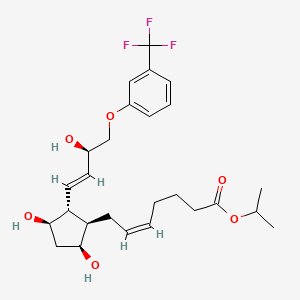
CAS 157283-68-6PubChem CID 5282226
Travoprost
Travoprost is the isopropyl ester of prostaglandin F2alpha in which the pentyl group is replaced by a 3-(trifluoromethyl)phenoxymethyl group. A synthetic analogue of prostaglandin F2alpha, ophthalmic solutions of travoprost are used as a topical medication for controlling the progression of open-angle glaucoma and ocular hypertension, by reducing intraocular pressure. It is a pro-drug; the isopropyl ester group is hydrolysed by esterases in the cornea to the biologically active free acid, fluprostenol. It has a role as an antihypertensive agent, an antiglaucoma drug, a prodrug, a prostaglandin receptor agonist and an ophthalmology drug. It is an isopropyl ester, a prostaglandins Falpha and a member of (trifluoromethyl)benzenes. It is functionally related to a fluprostenol. — ChEBI
- IUPAC-Name
- propan-2-yl (Z)-7-[(1R,2R,3R,5S)-3,5-dihydroxy-2-[(E,3R)-3-hydroxy-4-[3-(trifluoromethyl)phenoxy]but-1-enyl]cyclopentyl]hept-5-enoate
- Summenformel
- C26H35F3O6
- Molekulargewicht
- 500.5 g/mol
- Exakte Masse
- 500.23857332 Da
- XLogP3
- 4,1
- Topologische polare Oberfläche
- 96,2 Ų
- Wasserstoffbrücken-Donoren
- 3
- Wasserstoffbrücken-Akzeptoren
- 9
- Kovalente Einheiten
- 1
- Definierte Stereozentren
- 5
Auch bekannt als
TravatanTravatan ZIzbaAL-6221AL6221Otx-tptravoprostumIDOSE TR
16 weitere gemeldete Namen
WJ68R08KX9CHEBI:746859NSC-760366DUOTRAV COMPONENT TRAVOPROSTpropan-2-yl (5Z)-7-[(1R,2R,3R,5S)-3,5-dihydroxy-2-[(1E,3R)-3-hydroxy-4-[3-(trifluoromethyl)phenoxy]but-1-en-1-yl]cyclopentyl]hept-5-enoate5-Heptenoic acid, 7-((1R,2R,3R,5S)-3,5-dihydroxy-2-((1E,3R)-3-hydroxy-4-(3-(trifluoromethyl)phenoxy)-1-butenyl)cyclopentyl)-, 1-methylethyl ester, (5Z)-isopropyl (Z)-7-((1R,2R,3R,5S)-3,5-dihydroxy-2-{(1E,3R)-3-hydroxy-4-[(alpha,alpha,alpha-trifluoro-m-tolyl)oxy]-1-butenyl}cyclopentyl)-5-heptenoatepropan-2-yl (5Z)-7-[(1R,2R,3R,5S)-3,5-dihydroxy-2-{(1E,3R)-3-hydroxy-4-[3-(trifluoromethyl)phenoxy]but-1-en-1-yl}cyclopentyl]hept-5-enoateZ, TravatanAL 6221ISOPROPYL (Z)-7-((1R,2R,3R,5S)-3,5-DIHYDROXY-2-((1E,3R)-3-HYDROXY-4-((alpha,alpha,alpha-TRIFLUORO-M-TOLYL)OXY)-1-BUTENYL)CYCLOPENTYL)-5-HEPTENOATEpropan-2-yl (5Z)-7-((1R,2R,3R,5S)-3,5-dihydroxy-2-((1E,3R)-3-hydroxy-4-(3-(trifluoromethyl)phenoxy)but-1-en-1-yl)cyclopentyl)hept-5-enoateTravoprost OphthalmicTravoprost IntracameralRefChem:56256Travoprost (Isomer Free)
Kennungen in externen Datenbanken
- ChEBI:CHEBI:746859
- ChEMBL:CHEMBL1200799
- EPA DTXSID:DTXSID80896948
- PubMed:19929706
- PubMed:19403113
- PubMed:19038618
- PubMed:18983226
- PubMed:18837686
- PubMed:18452763
- PubMed:15321024
- PubMed:9038626
Am 2026-08-31 von NIH PubChem durch prüfsummengültigen CAS-Abgleich abgerufen. Chemische Eigenschaften ersetzen nicht die regulatorische Entscheidung auf dieser Seite.
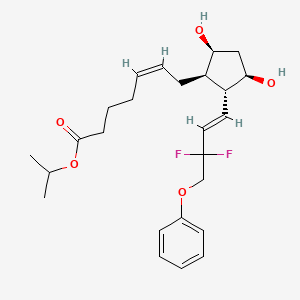
CAS 209860-87-7PubChem CID 9868491
Tafluprost
Tafluprost is a prostaglandin Falpha that is prostaglandin F2alpha in which the carboxylic acid function has been converted to the corresponding isopropyl ester and the 3-hydroxy-1-octenyl side-chain is substituted by 3,3-difluoro-4-phenoxybut-1-enyl. Used for treatment of elevated intraocular pressure in patients with open-angle glaucoma or ocular hypertension. It has a role as a prostaglandin receptor agonist. It is an isopropyl ester, a prostaglandins Falpha and an organofluorine compound. It is functionally related to a prostaglandin F2alpha. — ChEBI
- IUPAC-Name
- propan-2-yl (Z)-7-[(1R,2R,3R,5S)-2-[(E)-3,3-difluoro-4-phenoxybut-1-enyl]-3,5-dihydroxycyclopentyl]hept-5-enoate
- Summenformel
- C25H34F2O5
- Molekulargewicht
- 452.5 g/mol
- Exakte Masse
- 452.23743050 Da
- XLogP3
- 4,5
- Topologische polare Oberfläche
- 76,0 Ų
- Wasserstoffbrücken-Donoren
- 2
- Wasserstoffbrücken-Akzeptoren
- 7
- Kovalente Einheiten
- 1
- Definierte Stereozentren
- 4
Auch bekannt als
AFP-168TaflotanZioptanSaflutanMK-24521O6WQ6T7G3CHEBI:66899MK2452
16 weitere gemeldete Namen
propan-2-yl (5Z)-7-[(1R,2R,3R,5S)-2-[(1E)-3,3-difluoro-4-phenoxybut-1-en-1-yl]-3,5-dihydroxycyclopentyl]hept-5-enoatetafluprostumtafluprost opthalmic5-Heptenoic acid, 7-[(1R,2R,3R,5S)-2-[(1E)-3,3-difluoro-4-phenoxy-1-buten-1-yl]-3,5-dihydroxycyclopentyl]-, 1-methylethyl ester, (5Z)-ISOPROPYL (5Z)-7-((1R,2R,3R,5S)-2-((1E)-3,3-DIFLUORO-4-PHENOXYBUT-1-ENYL)-3,5-DIHYDROXYCYCLOPENTYL)HEPT-5-ENOATEIsopropyl (5Z)-7-{(1R,2R,3R,5S)-2-((1E)-3,3-difluoro-4-phenoxybut-1-enyl)-3,5-dihydroxycyclopentyl}hept-5-enoatepropan-2-yl (5Z)-7-((1R,2R,3R,5S)-2-((1E)-3,3-difluoro-4-phenoxybut-1-en-1-yl)-3,5-dihydroxycyclopentyl)hept-5-enoatepropan-2-yl (Z)-7-((1R,2R,3R,5S)-2-((E)-3,3-difluoro-4-(phenoxy)but-1-enyl)-3,5-dihydroxycyclopentyl)hept-5-enoatepropan-2-yl (Z)-7-[(1R,2R,3R,5S)-2-[(E)-3,3-difluoro-4-(phenoxy)but-1-enyl]-3,5-dihydroxycyclopentyl]hept-5-enoateTafluprost OphthalmicRefChem:57842S01EE055-Heptenoic acid, 7-((1R,2R,3R,5S)-2-((1E)-3,3-difluoro-4-phenoxy-1-buten-1-yl)-3,5-dihydroxycyclopentyl)-, 1-methylethyl ester, (5Z)-1-methylethyl (5Z)-7-((1R,2R, 3R,5S)-2-((1E)-3,3-difluoro-4-phenoxy-1-butenyl)-3,5-dihydroxycyclopentyl)-5-heptenoate(Z)-isopropyl 7-((1R,2R,3R,5S)-2-((E)-3,3-difluoro-4-phenoxybut-1-en-1-yl)-3,5-dihydroxycyclopentyl)hept-5-enoateC25H34F2O5
Kennungen in externen Datenbanken
- ChEBI:CHEBI:66899
- ChEMBL:CHEMBL1963683
- EPA DTXSID:DTXSID401021504
- PubMed:21916788
- PubMed:21858491
- PubMed:19477946
- PubMed:15037111
Am 2026-09-02 von NIH PubChem durch prüfsummengültigen CAS-Abgleich abgerufen. Chemische Eigenschaften ersetzen nicht die regulatorische Entscheidung auf dieser Seite.
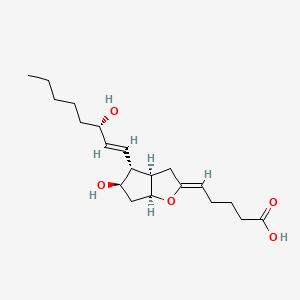
CAS 35121-78-9PubChem CID 5282411
Prostacyclin
Prostaglandin I2 is a prostaglandins I. It has a role as a mouse metabolite. It is a conjugate acid of a prostaglandin I2(1-). — ChEBI
- IUPAC-Name
- (5Z)-5-[(3aR,4R,5R,6aS)-5-hydroxy-4-[(E,3S)-3-hydroxyoct-1-enyl]-3,3a,4,5,6,6a-hexahydrocyclopenta[b]furan-2-ylidene]pentanoic acid
- Summenformel
- C20H32O5
- Molekulargewicht
- 352.5 g/mol
- Exakte Masse
- 352.22497412 Da
- XLogP3
- 2,9
- Topologische polare Oberfläche
- 87,0 Ų
- Wasserstoffbrücken-Donoren
- 3
- Wasserstoffbrücken-Akzeptoren
- 5
- Kovalente Einheiten
- 1
- Definierte Stereozentren
- 5
Auch bekannt als
epoprostenolprostaglandin I2PGI2VasocyclinProstaglandin XEpoprostenolumACT-385781ADCR9Z582X0
16 weitere gemeldete Namen
U-53217(5Z,9alpha,11alpha,13E,15S)-6,9-epoxy-11,15-dihydroxyprosta-5,13-dien-1-oic acidU-53,217CHEBI:155526,9S-epoxy-11R,15S-dihydoxy-5Z,13E-prostadienoic acidEpoprostanol(5Z,13E)-(15S)-6,9alpha-Epoxy-11alpha,15-dihydroxyprosta-5,13-dienoateProsta-5,13-dien-1-oic acid, 6,9-epoxy-11,15-dihydroxy-, (5Z,9alpha,11alpha,13E,15S)-Prostaglandin I(2)epoprostenolo(5Z)-5-((3aR,4R,5R,6aS)-5-hydroxy-4-((E,3S)-3-hydroxyoct-1-enyl)-3,3a,4,5,6,6a-hexahydrocyclopenta(b)furan-2-ylidene)pentanoic acid(5Z)-5-((3aR,4R,5R,6aS)-5-hydroxy-4-((E,3S)-3-hydroxyoct-1-enyl)-3,3a,4,5,6,6a-hexahydrocyclopenta(d)furan-2-ylidene)pentanoic acid(5Z)-5-[(3aR,4R,5R,6aS)-5-hydroxy-4-[(E,3S)-3-hydroxyoct-1-enyl]-3,3a,4,5,6,6a-hexahydrocyclopenta[d]furan-2-ylidene]pentanoic acidRefChem:57239B01AC09Epoprostenol Sodium Salt, (5Z,9alpha,11alpha,13E,15S)-
Kennungen in externen Datenbanken
- ChEBI:CHEBI:15552
- ChEMBL:CHEMBL1139
- EPA DTXSID:DTXSID5022988
- PubMed:15962942
- PubMed:11999132
- PubMed:10952683
- PubMed:372237
- PubMed:12538
Am 2026-08-31 von NIH PubChem durch prüfsummengültigen CAS-Abgleich abgerufen. Chemische Eigenschaften ersetzen nicht die regulatorische Entscheidung auf dieser Seite.
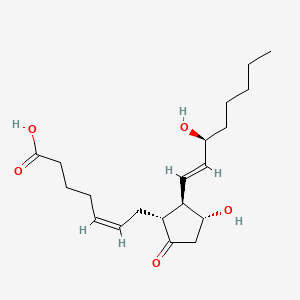
CAS 363-24-6PubChem CID 5280360
Prostaglandin E2
Prostaglandin E2 is prostaglandin F2alpha in which the hydroxy group at position 9 has been oxidised to the corresponding ketone. Prostaglandin E2 is the most common and most biologically potent of mammalian prostaglandins. It has a role as an oxytocic, a mouse metabolite and a human metabolite. It is a conjugate acid of a prostaglandin E2(1-). — ChEBI
- IUPAC-Name
- (Z)-7-[(1R,2R,3R)-3-hydroxy-2-[(E,3S)-3-hydroxyoct-1-enyl]-5-oxocyclopentyl]hept-5-enoic acid
- Summenformel
- C20H32O5
- Molekulargewicht
- 352.5 g/mol
- Exakte Masse
- 352.22497412 Da
- XLogP3
- 2,8
- Topologische polare Oberfläche
- 94,8 Ų
- Wasserstoffbrücken-Donoren
- 3
- Wasserstoffbrücken-Akzeptoren
- 5
- Kovalente Einheiten
- 1
- Definierte Stereozentren
- 4
Auch bekannt als
DinoprostonePGE2Prostin E2PrepidilCervidilMinprostin E2PropessMinprositin E2
16 weitere gemeldete Namen
DinoprostonDinoprostonumCerviprostDinoprostonaEnzaprost ECerviprimeProstenonePGE2alphaU-12062(5Z,11alpha,13E,15S)-11,15-dihydroxy-9-oxoprosta-5,13-dien-1-oic acidProstaglandin E2alpha(E,Z)-(1R,2R,3R)-7-(3-Hydroxy-2-((3S)-(3-hydroxy-1-octenyl))-5-oxocyclopentyl)-5-heptenoic acidU 12062K7Q1JQR04MProstaglandin E(2)(5Z,13E,15S)-11alpha,15-dihydroxy-9-oxoprosta-5,13-dien-1-oic acid
Kennungen in externen Datenbanken
Am 2026-08-31 von NIH PubChem durch prüfsummengültigen CAS-Abgleich abgerufen. Chemische Eigenschaften ersetzen nicht die regulatorische Entscheidung auf dieser Seite.
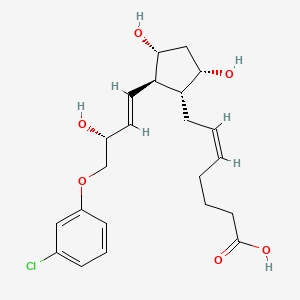
- IUPAC-Name
- (Z)-7-[(1R,2R,3R,5S)-2-[(E,3R)-4-(3-chlorophenoxy)-3-hydroxybut-1-enyl]-3,5-dihydroxycyclopentyl]hept-5-enoic acid
- Summenformel
- C22H29ClO6
- Molekulargewicht
- 424.9 g/mol
- Exakte Masse
- 424.1652663 Da
- XLogP3
- 2,7
- Topologische polare Oberfläche
- 107,0 Ų
- Wasserstoffbrücken-Donoren
- 4
- Wasserstoffbrücken-Akzeptoren
- 6
- Kovalente Einheiten
- 1
- Definierte Stereozentren
- 5
Auch bekannt als
CloprostenolumOestrophaneEstrofanEstrophanEstrophaneOestrophan5-Heptenoic acid, 7-((1R,2R,3R,5S)-2-((1E,3R)-4-(3-chlorophenoxy)-3-hydroxy-1-butenyl)-3,5-dihydroxycyclopentyl)-, (5Z)-rel-(5Z)-7-((1R,2R,3R,5S)-2-((1E,3R)-4-(3-chlorophenoxy)-3-hydroxybut-1-en-1-yl)-3,5-dihydroxycyclopentyl)hept-5-enoic acid
16 weitere gemeldete Namen
(5Z)-7-{(1R,2R,3R,5S)-2-[(1E,3R)-4-(3-Chlorophenoxy)-3-hydroxybut-1-en-1-yl]-3,5-dihydroxycyclopentyl}hept-5-enoic acid(Z)-7-((1R,2R,3R,5S)-2-((E,3R)-4-(3-chlorophenoxy)-3-hydroxybut-1-enyl)-3,5-dihydroxycyclopentyl)hept-5-enoic acidSodium, CloprostenolRefChem:56481Cloprostenol Monosodium SaltMonosodium Salt, CloprostenolSalt, Cloprostenol MonosodiumICI80,966ICI 80,966(Z)-7-((1R*,2R*,3R*,5S*)-2-((E)-(3R*)-4-(3-Chlorophenoxy)-3-hydroxy-1-butenyl)-3,5-dihydroxycyclopentyl)-5-heptensaeure255-028-8(+)-CloprostenolDalmazinR-CloprostenolDalmaprost DD-Cloprostenol
Kennungen in externen Datenbanken
- ChEBI:CHEBI:177470
- EPA DTXSID:DTXSID50860575
- EPA DTXSID:DTXSID7048372
- PubMed:11999132
- PubMed:10634944
- PubMed:9694973
- PubMed:1216432
- PubMed:574679
- PubMed:565969
- PubMed:504688
- PubMed:452355
- PubMed:433124
- PubMed:433123
- PubMed:433103
- PubMed:295100
Am 2026-08-31 von NIH PubChem durch prüfsummengültigen CAS-Abgleich abgerufen. Chemische Eigenschaften ersetzen nicht die regulatorische Entscheidung auf dieser Seite.
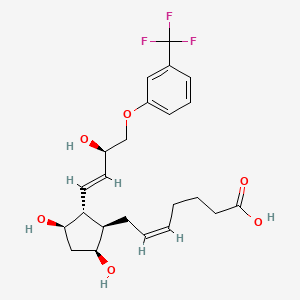
CAS 40666-16-8PubChem CID 5311100
Fluprostenol
Fluprostenol is an organofluorine compound that is racemic prostaglandin F2alpha in which the pentyl group is replaced by a 3-(trifluoromethyl)phenoxymethyl group. A synthetic analogue of prostaglandin F2alpha, ophthalmic solutions of its isopropyl ester prodrug, travoprost, are used as a topical medication for controlling the progression of open-angle glaucoma and ocular hypertension, by reducing intraocular pressure. The isopropyl ester group of travoprost is hydrolysed to the biologically active free acid by esterases in the cornea. It has a role as an antihypertensive agent, an antiglaucoma drug, a female contraceptive drug, an abortifacient and a prostaglandin receptor agonist. It is a hydroxy monocarboxylic acid, a prostaglandins Falpha and a member of (trifluoromethyl)benzenes. — ChEBI
- IUPAC-Name
- (Z)-7-[(1R,2R,3R,5S)-3,5-dihydroxy-2-[(E,3R)-3-hydroxy-4-[3-(trifluoromethyl)phenoxy]but-1-enyl]cyclopentyl]hept-5-enoic acid
- Summenformel
- C23H29F3O6
- Molekulargewicht
- 458.5 g/mol
- Exakte Masse
- 458.19162313 Da
- XLogP3
- 2,9
- Topologische polare Oberfläche
- 107,0 Ų
- Wasserstoffbrücken-Donoren
- 4
- Wasserstoffbrücken-Akzeptoren
- 9
- Kovalente Einheiten
- 1
- Definierte Stereozentren
- 5
Auch bekannt als
Fluprostenolumtravoprost free acidFluoprostenolICI 81,008358S7VUE5NCHEBI:60782ICI-80008 FREE ACIDICI 80,008 FREE ACID
16 weitere gemeldete Namen
ICI 81008ICI-81008rac-(5Z)-7-[(1R,2R,3R,5S)-3,5-dihydroxy-2-{(1E,3R)-3-hydroxy-4-[3-(trifluoromethyl)phenoxy]but-1-en-1-yl}cyclopentyl]hept-5-enoic acid(Z)-7-((1R,2R,3R,5S)-3,5-dihydroxy-2-((E,3R)-3-hydroxy-4-(3-(trifluoromethyl)phenoxy)but-1-enyl)cyclopentyl)hept-5-enoic acidrac-(5Z)-7-((1R,2R,3R,5S)-3,5-dihydroxy-2-((1E,3R)-3-hydroxy-4-(3-(trifluoromethyl)phenoxy)but-1-en-1-yl)cyclopentyl)hept-5-enoic acidRefChem:921725255-029-3(+)-fluprostenoltravoprost acidFluprostenol, (+)-EINECS 255-029-3(+/-)-FluprostenolMEH3MCE8X1AL-58485-Heptenoic acid, 7-((1R,2R,3R,5S)-3,5-dihydroxy-2-((1E,3R)-3-hydroxy-4-(3-(trifluoromethyl)phenoxy)-1-buten-1-yl)cyclopentyl)-, (5Z)-C23H29F3O6
Kennungen in externen Datenbanken
- ChEBI:CHEBI:60782
- ChEMBL:CHEMBL1201379
- EPA DTXSID:DTXSID7046122
- PubMed:33486071
- PubMed:21236357
- PubMed:16505027
- PubMed:15654655
- PubMed:11929662
- PubMed:11832489
- PubMed:10634944
- PubMed:9313928
- PubMed:8964835
- PubMed:7445532
- PubMed:6916556
- PubMed:6911921
Am 2026-08-31 von NIH PubChem durch prüfsummengültigen CAS-Abgleich abgerufen. Chemische Eigenschaften ersetzen nicht die regulatorische Entscheidung auf dieser Seite.
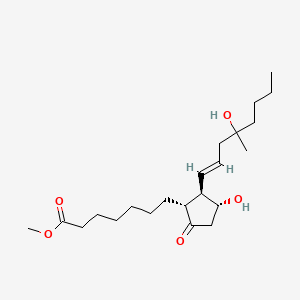
CAS 59122-46-2PubChem CID 5282381
Misoprostol
7-[(1R,2R,3R)-3-hydroxy-2-(4-hydroxy-4-methyloct-1-enyl)-5-oxocyclopentyl]heptanoic acid methyl ester is a prostanoid. — ChEBI
- IUPAC-Name
- methyl 7-[(1R,2R,3R)-3-hydroxy-2-[(E)-4-hydroxy-4-methyloct-1-enyl]-5-oxocyclopentyl]heptanoate
- Summenformel
- C22H38O5
- Molekulargewicht
- 382.5 g/mol
- Exakte Masse
- 382.27192431 Da
- XLogP3
- 3,7
- Topologische polare Oberfläche
- 83,8 Ų
- Wasserstoffbrücken-Donoren
- 2
- Wasserstoffbrücken-Akzeptoren
- 5
- Kovalente Einheiten
- 1
- Definierte Stereozentren
- 3
Auch bekannt als
CytotecMisoprostolumSC-29333SC 293330E43V0BB57ARTHROTEC COMPONENT MISOPROSTOLmethyl (11alpha,13E)-11,16-dihydroxy-16-methyl-9-oxoprost-13-en-1-oatemethyl 7-[(1R,2R,3R)-3-hydroxy-2-[(1E)-4-hydroxy-4-methyloct-1-en-1-yl]-5-oxocyclopentyl]heptanoate
16 weitere gemeldete Namen
Apo MisoprostolProst-13-en-1-oic acid, 11,16-dihydroxy-16-methyl-9-oxo-, methyl ester, (11alpha,13E)-misoprostoloMysodelleTopogyneNovo MisoprostolMisoprostol 1%methyl 7-((1R,2R,3R)-3-hydroxy-2-((1E)-4-hydroxy-4-methyloct-1-en-1-yl)-5-oxocyclopentyl)heptanoateRefChem:55654Misoprostol 1% DispersionCHEBI:63610A02BB01G02AD06SC 30249664-288-5Isprelor
Kennungen in externen Datenbanken
Am 2026-08-31 von NIH PubChem durch prüfsummengültigen CAS-Abgleich abgerufen. Chemische Eigenschaften ersetzen nicht die regulatorische Entscheidung auf dieser Seite.
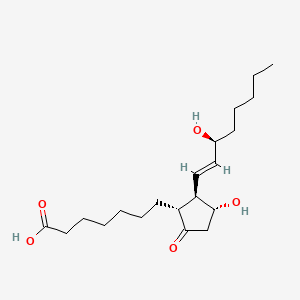
CAS 745-65-3PubChem CID 5280723
Alprostadil
Prostaglandin E1 is a prostaglandins E. It has a role as a vasodilator agent, an anticoagulant, a platelet aggregation inhibitor and a human metabolite. It is a conjugate acid of a prostaglandin E1(1-). — ChEBI
- IUPAC-Name
- 7-[(1R,2R,3R)-3-hydroxy-2-[(E,3S)-3-hydroxyoct-1-enyl]-5-oxocyclopentyl]heptanoic acid
- Summenformel
- C20H34O5
- Molekulargewicht
- 354.5 g/mol
- Exakte Masse
- 354.24062418 Da
- XLogP3
- 3,2
- Topologische polare Oberfläche
- 94,8 Ų
- Wasserstoffbrücken-Donoren
- 3
- Wasserstoffbrücken-Akzeptoren
- 5
- Kovalente Einheiten
- 1
- Definierte Stereozentren
- 4
Auch bekannt als
Prostaglandin E1PGE1CaverjectEdexMuseAlprostadilumBefarProstin VR Pediatric
16 weitere gemeldete Namen
VitarosPrinkPGE-1Prostavasin(11alpha,13E,15S)-11,15-dihydroxy-9-oxoprost-13-en-1-oic acidCaverject ImpulsePGE1alphaLipo PGE1Prostaglandin E1alpha11alpha,15alpha-Dihydroxy-9-oxo-13-trans-prostenoic acid(13E)-(15S)-11alpha,15-Dihydroxy-9-oxoprost-13-enoateU-101369-oxo-11R,15S-dihydroxy-13E-prostaenoic acidF5TD010360U-10,136CHEBI:15544
Kennungen in externen Datenbanken
Am 2026-08-31 von NIH PubChem durch prüfsummengültigen CAS-Abgleich abgerufen. Chemische Eigenschaften ersetzen nicht die regulatorische Entscheidung auf dieser Seite.
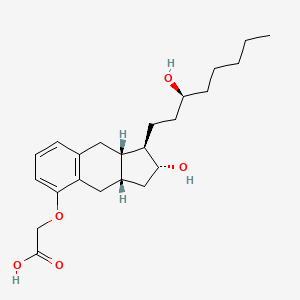
CAS 81846-19-7PubChem CID 6918140
Treprostinil
Treprostinil is a carboxylic acid and a carbotricyclic compound. It has a role as a cardiovascular drug, a vasodilator agent, an antihypertensive agent, a platelet aggregation inhibitor, a vitamin K antagonist and a human blood serum metabolite. — ChEBI
- IUPAC-Name
- 2-[[(1R,2R,3aS,9aS)-2-hydroxy-1-[(3S)-3-hydroxyoctyl]-2,3,3a,4,9,9a-hexahydro-1H-cyclopenta[g]naphthalen-5-yl]oxy]acetic acid
- Summenformel
- C23H34O5
- Molekulargewicht
- 390.5 g/mol
- Exakte Masse
- 390.24062418 Da
- XLogP3
- 4,5
- Topologische polare Oberfläche
- 87,0 Ų
- Wasserstoffbrücken-Donoren
- 3
- Wasserstoffbrücken-Akzeptoren
- 5
- Kovalente Einheiten
- 1
- Definierte Stereozentren
- 5
Auch bekannt als
UniprostRumodolinTyvasoUT-15LRX-15treprostinilo15AU81treprostinilum
16 weitere gemeldete Namen
Tyvaso dpiRUM6K67ESG15-AU-81CHEBI:50861L-606((1R,2R,3aS,9aS)-2-hydroxy-1-((3S)-3-hydroxyoctyl)-2,3,3a,4,9,9a-hexahydro-1H-cylopent(b)naphthalen-5-yl)oxy)acetate2-{[(1R,2R,3aS,9aS)-2-hydroxy-1-[(3S)-3-hydroxyoctyl]-1H,2H,3H,3aH,4H,9H,9aH-cyclopenta[b]naphthalen-5-yl]oxy}acetic acid({(1R,2R,3aS,9aS)-2-hydroxy-1-[(3S)-3-hydroxyoctyl]-2,3,3a,4,9,9a-hexahydro-1H-cyclopenta[b]naphthalen-5-yl}oxy)acetic acidAcetic acid, ((2,3,3a,4,9,9a-hexahydro-2-hydroxy-1-(3-hydroxyoctyl)-1H-benz(f)inden-5-yl)oxy)-, (1R-(1alpha(S*),2beta,3aalpha,9aalpha))-trepostinil sodium(((1R,2R,3aS,9aS)-2-hydroxy-1-((3S)-3-hydroxyoctyl)-2,3,3a,4,9,9a-hexahydro-1H-cyclopenta(b)naphthalen-5-yl)oxy)acetic acid[(1R,2R,3aS,9aS)-2-Hydroxy-1-((3S)-3-hydroxyoctyl)-2,3,3a,4,9,9a-hexahydro-1H-cylopent[b]naphthalen-5-yl]oxy]acetate2-(((1R,2R,3aS,9aS)-2-hydroxy-1-((3S)-3-hydroxyoctyl)-1H,2H,3H,3aH,4H,9H,9aH-cyclopenta(b)naphthalen-5-yl)oxy)acetic acid2-(((2R,3R,3aS,9aS)-2-hydroxy-3-((3S)-3-hydroxyoctyl)-2,3,3a,4,9,9a-hexahydro-1H-cyclopenta(g)naphthalen-8-yl)oxy)acetic acid2-[[(2R,3R,3aS,9aS)-2-hydroxy-3-[(3S)-3-hydroxyoctyl]-2,3,3a,4,9,9a-hexahydro-1H-cyclopenta[g]naphthalen-8-yl]oxy]acetic acidRefChem:56257
Kennungen in externen Datenbanken
- ChEBI:CHEBI:50861
- ChEMBL:CHEMBL1237119
- EPA DTXSID:DTXSID901021654
- PubMed:33440084
- PubMed:31917615
- PubMed:25542069
- PubMed:22480736
- PubMed:22291467
- PubMed:22114523
- PubMed:22055098
- PubMed:22043212
- PubMed:22034603
- PubMed:21988216
- PubMed:21606699
- PubMed:21280186
Am 2026-08-31 von NIH PubChem durch prüfsummengültigen CAS-Abgleich abgerufen. Chemische Eigenschaften ersetzen nicht die regulatorische Entscheidung auf dieser Seite.
Weitere maßgebliche Stoffrecherche
Jeder Link durchsucht die jeweilige Quelle nach dieser Identität. Ein Link ist ein Recherchepfad und keine Behauptung, dass die Quelle einen exakten Eintrag enthält. Was jede Quelle ist und welches rechtliche Gewicht sie hat
Diesen Eintrag weiterverwenden
Amtliche Quelle und Geltungsbereich
Importiert aus dem Durchführungsbeschluss (EU) 2025/1175 der Kommission (Datensatzversion EU 2025/1175). Das Glossar liefert gebräuchliche Inhaltsstoffnamen für die nach Artikel 19 Absatz 1 Buchstabe g vorgeschriebene Inhaltsstoffliste; es ist keine Zulassungs- oder Sicherheitsliste.
Amtlichen Beschluss öffnen