
Amtlicher EU-KennzeichnungsnameGlossareintrag 24145
RETINYL ACETATE
Dieser Eintrag bestätigt einen amtlichen gebräuchlichen Inhaltsstoffnamen für die EU-Kennzeichnung kosmetischer Mittel. Er bestätigt für sich genommen nicht, dass der Stoff zulässig, unbeschränkt oder sicher ist.
Globale Belegübersicht
Die ermittelte Identität hat übereinstimmende regulatorische Belege in 1 von 13 indizierten Marktdatensätzen: 1 Ländereinträge und 0 EU-Anhangseinträge. Jedes Ergebnis und jede Belegslücke ist unten aufgeführt.
Geprüfte Märkte
13
Märkte mit Belegen
1
Belegslücken
12
Ermittelte Kennungen
5
Ermittelte Stoffidentität
CAS:127-47-911103-57-468-26-879-81-2
EC:204-844-2
Einträge im Inhaltsstoffindex:
RETINYL ACETATE
Kosmetische Funktionen: SKIN CONDITIONING, SKIN CONDITIONING - MISCELLANEOUS
Retinyl acetate
2 übereinstimmende oder gemeldete Namen
RETINYL ACETATE(2E,4E,6E,8E)-3,7-dimethyl-9-(2,6,6-trimethylcyclohexen-1-yl)nona-2,4,6,8-tetraen-1-ol; [(2E,4E,6E,8E)-3,7-dimethyl-9-(2,6,6-trimethylcyclohexen-1-yl)nona-2,4,6,8-tetraenyl] acetate; [(2E,4E,6E,8E)-3,7-dimethyl-9-(2,6,6-trimethylcyclohexen-1-yl)nona-2,4,6,8-tetraenyl] hexadecanoate
Regulatorische Belege in allen 13 Märkten
Öffnen Sie jeden übereinstimmenden Eintrag, um Geltungsbereich, Konzentration, Bedingungen, Warnhinweise und die Version der amtlichen Quelle zu sehen.
Wischen oder scrollen Sie horizontal, um Datenabdeckung und nächste Schritte zu sehen.
| Markt | Ergebnis | Einträge | Datensatz | Bedeutung / nächster Schritt |
|---|---|---|---|---|
| European Union EU | Kein Treffer gefunden | 0 | Complete annex dataset Regulation (EC) 1223/2009 consolidated to 1 May 2026 | No annex match only means that these five annexes did not return a match; CosIng identity data and other EU obligations still need review. |
| Great Britain GB | Kein Treffer gefunden | 0 | Complete consolidated annex dataset GB retained Regulation 1223/2009 schedules, effective 15 August 2026 | No annex match is not approval and does not cover Northern Ireland, which follows the applicable EU framework. |
| Canada CA | Kein Treffer gefunden | 0 | Complete Hotlist snapshot Health Canada Cosmetic Ingredient Hotlist, 13 August 2025 | The Hotlist is an administrative compliance tool, not an exhaustive safety approval list. |
| New Zealand NZ | Kein Treffer gefunden | 0 | Complete schedules dataset Cosmetic Products Group Standard schedules effective 1 January 2026 | The searchable spreadsheet is an aid; the legal Group Standard and incorporated notices remain authoritative. |
| ASEAN ASEAN | Kein Treffer gefunden | 0 | Complete regional annex dataset ASEAN Cosmetic Directive annexes 2026-1, 22 June 2026 | Regional annex coverage does not replace member-state implementation dates, notifications or national deviations. |
| China CN | Kein Treffer gefunden | 0 | Complete prohibited catalogues plus official-source workflow NMPA 2021 banned catalogues plus dynamic IECIC List I/List II system current since 2025 | IECIC listing is not blanket approval; absence may require the new cosmetic ingredient route, and restrictions are checked separately. |
| Japan JP | Kein Treffer gefunden | 0 | Complete Standards appendices dataset MHLW Standards for Cosmetics official English source and Japanese amendments checked for the imported snapshot | The Japanese text and subsequent notices are canonical; no local match is not a product-compliance conclusion. |
| South Korea KR | Kein Treffer gefunden | 0 | Complete current appendix dataset MFDS Notice 2026-19, effective 18 March 2026 | Korean source wording is canonical and other positive lists/notices may still apply to the formulation. |
| United States US | Kein Treffer gefunden | 0 | Complete enumerated federal ingredient rules eCFR Title 21 issue date 27 August 2026 | FDA has no general approved-cosmetic-ingredient catalogue; absence from these sections is not approval or proof of safety. |
| Australia AU | Kein Treffer gefunden | 0 | Complete cosmetic-relevant Poisons Standard subset plus official workflow Therapeutic Goods (Poisons Standard—June 2026) Instrument 2026 | An AICIS Inventory match is not cosmetic approval; no Inventory match can indicate a new, exempted, reported or confidential introduction. |
| Brazil BR | Kein Treffer gefunden | 0 | Complete prohibited dataset plus current restricted-list workflow ANVISA RDC 1.029/2026 and RDC 1.030/2026, published 15 June 2026 | RDC 1.030/2026 amends rather than replaces the prohibited baseline, and the second restricted-list revision was still under consultation in July 2026. |
| India IN | Kein Treffer gefunden | 0 | Complete current Part 2 dataset plus official workflow for Parts 1, 3 and 4 Cosmetics Rules 2020 plus current BIS IS 4707 parts (1:2020, 2:2025, 3:2025, 4:2022) | The standards are separate controlled publications; absence from a locally indexed excerpt is not permission. |
| Saudi Arabia SA | Restricted | 1Eintrag öffnen 1 | Complete official list index SFDA live prohibited/restricted lists, snapshot 30 August 2026 | Prüfen Sie jeden verknüpften Eintrag und die genauen Bedingungen. |
Keine Marktzeilen entsprechen diesem Filter.
Übereinstimmende Markteinträge und Bedingungen
Chemische Identität und Eigenschaften
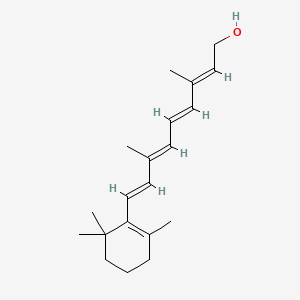
CAS 11103-57-4CAS 68-26-8PubChem CID 445354
Retinol
All-trans-retinol is a retinol in which all four exocyclic double bonds have E- (trans-) geometry. It has a role as a mouse metabolite, a plant metabolite and a human metabolite. It is a vitamin A and a retinol. — ChEBI
- IUPAC-Name
- (2E,4E,6E,8E)-3,7-dimethyl-9-(2,6,6-trimethylcyclohexen-1-yl)nona-2,4,6,8-tetraen-1-ol
- Summenformel
- C20H30O
- Molekulargewicht
- 286.5 g/mol
- Exakte Masse
- 286.229665576 Da
- XLogP3
- 5,7
- Topologische polare Oberfläche
- 20,2 Ų
- Wasserstoffbrücken-Donoren
- 1
- Wasserstoffbrücken-Akzeptoren
- 1
- Kovalente Einheiten
- 1
- Definierte Stereozentren
- 0
Auch bekannt als
all-trans-Retinol68-26-8Agoncaltrans-retinolVeroftalBentavit AHomagenets AoralSehkraft A
16 weitere gemeldete Namen
Testavol Sall-trans-Vitamin AAll-trans retinolSuper AAxerophtholumWachstumsvitaminVitaminum AVitamine ARetinoloRetinolumRetinol, all trans-(2E,4E,6E,8E)-3,7-dimethyl-9-(2,6,6-trimethylcyclohex-1-en-1-yl)nona-2,4,6,8-tetraen-1-olRo-a-vitAntixerophthalmisches Vitamin(all-E)-3,7-Dimethyl-9-(2,6,6-trimethyl-1-cyclohexen-1-yl)-2,4,6,8-nonatetraen-1-olG2SH0XKK91
Kennungen in externen Datenbanken
Belege aus weiteren wissenschaftlichen Datenbanken
NIH PubChem PUG-View
Exakter Kennungstreffer445354
Attributed physical-property, hazard, environmental and use annotations.
- Boiling Point: 279 to 280 °F at 1e-06 mmHg (NTP, 1992) Quelle: CAMEO Chemicals
- Boiling Point: 137-138 °C at 1X10⁻⁶ mm Hg Quelle: Hazardous Substances Data Bank (HSDB)
- Color/Form: Solvated crystals from polar solvents, such as methanol or ethyl formate Quelle: Hazardous Substances Data Bank (HSDB)
- LogP: 5.68 Quelle: DrugBank
- LogP: log Kow = 5.68 Quelle: Hazardous Substances Data Bank (HSDB)
- LogP: 5.68 Quelle: Human Metabolome Database (HMDB)
- Melting Point: 144 to 147 °F (NTP, 1992) Quelle: CAMEO Chemicals
- Melting Point: 63.5 °C Quelle: DrugBank
- Melting Point: 62-64 °C Quelle: Hazardous Substances Data Bank (HSDB)
- Melting Point: Pale yellow prismatic crystals from methanol; mp: 57-58 °C; UV max (ethanol): 326 nm (E=1,550, 1%, 1 cm) /Retinol acetate/ Quelle: Hazardous Substances Data Bank (HSDB)
- Melting Point: Amorphous or crystalline; mp: 28-29 °C; UV max (ethanol); 325-328 nm (E=975, 1%, 1 cm) /Retinol palmitate/ Quelle: Hazardous Substances Data Bank (HSDB)
- Melting Point: 61 - 63 °C Quelle: Human Metabolome Database (HMDB)
- Physical Description: Vitamin a appears as yellow crystals or orange solid. Practically water insoluble. (NTP, 1992) Quelle: CAMEO Chemicals
- Physical Description: Solid; [Merck Index] Yellow or orange solid; [NTP] Quelle: Haz-Map, Information on Hazardous Chemicals and Occupational Diseases
- Physical Description: Solid Quelle: Human Metabolome Database (HMDB)
- Refractive Index: Index of refraction: 1.6410 at 20 °C/D (calculated form refractive indexes of 20-70% solutions in mineral oil); max absorption: 324-325 nm (E=1,835, 1%, 1 cm) Quelle: Hazardous Substances Data Bank (HSDB)
- Solubility: Practically insoluble (NTP, 1992) Quelle: CAMEO Chemicals
- Solubility: 0.671 mg/L Quelle: DrugBank
- Solubility: Practically insoluble in water or glycerol; soluble in absolute alcohol, methanol, chloroform, ether, fats and oils Quelle: Hazardous Substances Data Bank (HSDB)
- Solubility: Sol in ethanol and acetone and benzene Quelle: Hazardous Substances Data Bank (HSDB)
- Vapor Pressure: 0.00000008 [mmHg] Quelle: Haz-Map, Information on Hazardous Chemicals and Occupational Diseases
- Vapor Pressure: 7.5X10⁻⁸ mm Hg at 25 °C /Estimated/ Quelle: Hazardous Substances Data Bank (HSDB)
- Carcinogen Classification: No indication of carcinogenicity to humans (not listed by IARC). Quelle: Toxin and Toxin Target Database (T3DB)
- Exposure Routes: Oral, readily absorbed from the normal gastrointestinal tract Quelle: Toxin and Toxin Target Database (T3DB)
- First Aid: EYES: First check the victim for contact lenses and remove if present. Flush victim's eyes with water or normal saline solution for 20 to 30 minutes while simultaneously calling a hospital or poison control center. Do not put any ointments, oils, or medication in the victim's eyes without specific instructions from a physician. If symptoms (such as redness or irritation) develop, immediately transport the victim to a hospital.; SKIN: IMMEDIATELY flood affected skin with water while removing and isolating all contaminated clothing. Gently wash all affected skin areas thoroughly with soap and water. If symptoms such as redness or irritation develop, IMMEDIATELY call a physician and be prepared to transport the victim to a hospital for treatment.; INHALATION: IMMEDIATELY leave the contaminated area; take deep breaths of fresh air. If symptoms (such as wheezing, coughing, shortness of breath, or burning in the mouth, throat, or chest) develop, call a physician and be prepared to transport the victim to a hospital. Provide proper respiratory protection to rescuers entering an unknown atmosphere. Whenever possible, Self-Contained Breathing Apparatus (SCBA) should be used; if not availabl Quelle: CAMEO Chemicals
- Note: This chemical does not meet GHS hazard criteria for 0.3% (1 of 311) of reports. Quelle: European Chemicals Agency (ECHA)
- Signal: Danger Quelle: European Chemicals Agency (ECHA)
- GHS Hazard Statements: H302 (15.8%): Harmful if swallowed [Warning Acute toxicity, oral]; H317 (74.9%): May cause an allergic skin reaction [Warning Sensitization, Skin]; H319 (75.6%): Causes serious eye irritation [Warning Serious eye damage/eye irritation]; H360 (88.1%): May damage fertility or the unborn child [Danger Reproductive toxicity]; H413 (74.9%): May cause long lasting harmful effects to aquatic life [Hazardous to the aquatic environment, long-term hazard] Quelle: European Chemicals Agency (ECHA)
- Precautionary Statement Codes: P203, P261, P264, P264+P265, P270, P272, P273, P280, P301+P317, P302+P352, P305+P351+P338, P318, P321, P330, P333+P317, P337+P317, P362+P364, P405, and P501 (click each P-code to see the statement) Quelle: European Chemicals Agency (ECHA)
- ECHA C&L Notifications Summary: Aggregated GHS information provided per 311 reports by companies from 14 notifications to the ECHA C&L Inventory. Each notification may be associated with multiple companies.; Reported as not meeting GHS hazard criteria per 1 of 311 reports by companies.; There are 13 notifications provided by 310 of 311 reports by companies with hazard statement code(s).; Information may vary between notifications depending on impurities, additives, and other factors. The percentage value in parenthesis indicates the notified classification ratio from companies that provide hazard codes. Only hazard codes with percentage values above 10% are shown. For more detailed information, please visit ECHA C&L website. Quelle: European Chemicals Agency (ECHA)
- Note: This chemical does not meet GHS hazard criteria for 1% (1 of 105) of reports. Quelle: European Chemicals Agency (ECHA)
- GHS Hazard Statements: H317 (99%): May cause an allergic skin reaction [Warning Sensitization, Skin]; H319 (99%): Causes serious eye irritation [Warning Serious eye damage/eye irritation]; H360D (99%): May damage the unborn child [Danger Reproductive toxicity] Quelle: European Chemicals Agency (ECHA)
- Precautionary Statement Codes: P203, P261, P264+P265, P272, P280, P302+P352, P305+P351+P338, P318, P321, P333+P317, P337+P317, P362+P364, P405, and P501 (click each P-code to see the statement) Quelle: European Chemicals Agency (ECHA)
- ECHA C&L Notifications Summary: Aggregated GHS information provided per 105 reports by companies from 2 notifications to the ECHA C&L Inventory. Each notification may be associated with multiple companies.; Reported as not meeting GHS hazard criteria per 1 of 105 reports by companies.; There is 1 notification provided by 104 of 105 reports by companies with hazard statement code(s).; Information may vary between notifications depending on impurities, additives, and other factors. The percentage value in parenthesis indicates the notified classification ratio from companies that provide hazard codes. Only hazard codes with percentage values above 10% are shown. For more detailed information, please visit ECHA C&L website. Quelle: European Chemicals Agency (ECHA)
- Cosmetic Ingredient Review Finding(s): Safe in the present practices of use and concentration. Ingredient, concentration, and use information are available in documents discoverable at https://cir-reports.cir-safety.org Quelle: Cosmetic Ingredient Review (CIR)
- Toxicity Summary: Signs and Symptoms of Overdose; Vitamin A toxicity may present with various clinical symptoms, including abdominal pain, headache, nausea, and facial flushing. Laboratory findings often include mild anemia, thrombocytopenia, elevated liver function tests, and a significant increase in serum retinol levels. Although the diagnosis is primarily clinical, laboratory tests such as serum retinol or retinyl ester levels can assist in confirming the diagnosis. A thorough dietary history is essential to identify excessive vitamin A intake.; Management of Overdose; Symptoms of toxicity may resolve within several weeks after discontinuing vitamin A and initiating supportive therapy. Patients with increased intracranial pressure may require lumbar punctures or medications such as mannitol and diuretics for management. Patients with hypercalcemia may need intravenous fluids and additional treatments, such as calcitonin and corticosteroids. Vitamin A toxicity can present with a range of clinical features, including abdominal pain, headache, nausea, and facial flushing. Laboratory findings often show mild anemia, thrombocytopenia, elevated liver function tests, and a significant increase in serum Quelle: StatPearls
- Toxicity Summary: Vision:Vitamin A (all-trans retinol) is converted in the retina to the 11-cis-isomer of retinaldehyde or 11-cis-retinal. 11-cis-retinal functions in the retina in the transduction of light into the neural signals necessary for vision. 11-cis-retinal, while attached to opsin in rhodopsin is isomerized to all-trans-retinal by light. This is the event that triggers the nerve impulse to the brain which allows for the perception of light. All-trans-retinal is then released from opsin and reduced to all-trans-retinol. All-trans-retinol is isomerized to 11-cis-retinol in the dark, and then oxidized to 11-cis-retinal. 11-cis-retinal recombines with opsin to re-form rhodopsin. Night blindness or defective vision at low illumination results from a failure to re-synthesize 11-cis retinal rapidly. Epithelial differentiation: The role of Vitamin A in epithelial differentiation, as well as in other physiological processes, involves the binding of Vitamin A to two families of nuclear retinoid receptors (retinoic acid receptors, RARs; and retinoid-X receptors, RXRs). These receptors function as ligand-activated transcription factors that modulate gene transcription. When there is not enough Vitami Quelle: Toxin and Toxin Target Database (T3DB)
- Cosmetic Ingredient Review Link: CIR ingredient: Retinol Quelle: Cosmetic Ingredient Review (CIR)
- Sources/Uses: Essential micronutrient found in animals; [Merck Index] Used as a nutritional supplement for foods; [FDA] Permitted for use as an inert ingredient in non-food pesticide products; [EPA] Quelle: Haz-Map, Information on Hazardous Chemicals and Occupational Diseases
- Uses: Vitamin (antixerophthalmic) Quelle: Hazardous Substances Data Bank (HSDB)
- Uses: MEDICATION Quelle: Hazardous Substances Data Bank (HSDB)
- Uses: MEDICATION (VET) Quelle: Hazardous Substances Data Bank (HSDB)
- Uses: For the treatment of vitamin A deficiency. Vitamin A helps regulate the immune system, which helps prevent or fight off infections by making white blood cells that destroy harmful bacteria and viruses. Quelle: Toxin and Toxin Target Database (T3DB)
Zugeordnet durch: Existing checksum-valid CAS to unique PubChem CID match. Abgerufen: 2026-08-31. Quelleneintrag öffnen
Wissenschaftliche Klassifizierungen und Gefahrenannotationen liefern Kontext und ersetzen nicht die oben gezeigte marktspezifische regulatorische Entscheidung.
Weitere Quellenabdeckung und Trefferstatus
| Quelle | Ergebnis | Geprüft |
|---|---|---|
| NIH PubChem PUG-View | Exakter Treffer | 2026-08-31 |
Ein erfasster Nicht-Treffer ist ein nützlicher Beleg dafür, dass die Quelle geprüft wurde; er ist keine Behauptung, dass der Stoff anderswo nicht existiert.
Am 2026-08-31 von NIH PubChem durch prüfsummengültigen CAS-Abgleich abgerufen. Chemische Eigenschaften ersetzen nicht die regulatorische Entscheidung auf dieser Seite.
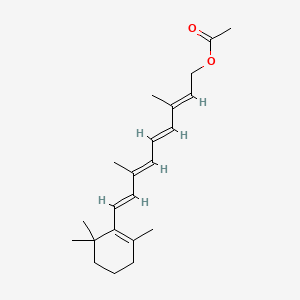
CAS 127-47-9PubChem CID 638034
Retinol, acetate
Retinyl acetate is an acetate ester. It is functionally related to an all-trans-retinol. — ChEBI
- IUPAC-Name
- [(2E,4E,6E,8E)-3,7-dimethyl-9-(2,6,6-trimethylcyclohexen-1-yl)nona-2,4,6,8-tetraenyl] acetate
- Summenformel
- C22H32O2
- Molekulargewicht
- 328.5 g/mol
- Exakte Masse
- 328.240230259 Da
- XLogP3
- 6,3
- Topologische polare Oberfläche
- 26,3 Ų
- Wasserstoffbrücken-Donoren
- 0
- Wasserstoffbrücken-Akzeptoren
- 2
- Kovalente Einheiten
- 1
- Definierte Stereozentren
- 0
Auch bekannt als
RETINYL ACETATEVitamin A acetateRetinol acetateVitamin A1 acetateall-trans-Retinol acetateCrystaletsVitamin A alcohol acetateDavitan A 650
16 weitere gemeldete Namen
all-trans-Vitamin A acetateRetinol, acetate, all-trans-(2E,4E,6E,8E)-3,7-dimethyl-9-(2,6,6-trimethylcyclohex-1-en-1-yl)nona-2,4,6,8-tetraen-1-yl acetateall-trans-RetinylacetateAcetic acid, retinyl ester3LE3D9D6OYVitamin A, acetateVitamin A acetate (tritiated)O(15)-acetylretinolORISTAR RANSC-122045NSC-122760RO-1-5275CHEBI:32095VITAMIN A ACETATE 1.5 M.I.U./G((2E,4E,6E,8E)-3,7-dimethyl-9-(2,6,6-trimethylcyclohexen-1-yl)nona-2,4,6,8-tetraenyl) acetate
Kennungen in externen Datenbanken
- ChEBI:CHEBI:32095
- ChEBI:CHEBI:94695
- ChEMBL:CHEMBL486193
- EPA DTXSID:DTXSID6021240
- PubMed:228596
Belege aus weiteren wissenschaftlichen Datenbanken
NIH PubChem PUG-View
Exakter Kennungstreffer638034
Attributed physical-property, hazard, environmental and use annotations.
- Carcinogen Classification: No indication of carcinogenicity to humans (not listed by IARC). Quelle: Toxin and Toxin Target Database (T3DB)
- Note: This chemical does not meet GHS hazard criteria for 0.3% (1 of 374) of reports. Quelle: European Chemicals Agency (ECHA)
- Signal: Danger Quelle: European Chemicals Agency (ECHA)
- GHS Hazard Statements: H315 (83.4%): Causes skin irritation [Warning Skin corrosion/irritation]; H360 (59.4%): May damage fertility or the unborn child [Danger Reproductive toxicity]; H361 (39.6%): Suspected of damaging fertility or the unborn child [Warning Reproductive toxicity]; H413 (64.4%): May cause long lasting harmful effects to aquatic life [Hazardous to the aquatic environment, long-term hazard] Quelle: European Chemicals Agency (ECHA)
- Precautionary Statement Codes: P203, P264, P273, P280, P302+P352, P318, P321, P332+P317, P362+P364, P405, and P501 (click each P-code to see the statement) Quelle: European Chemicals Agency (ECHA)
- ECHA C&L Notifications Summary: Aggregated GHS information provided per 374 reports by companies from 22 notifications to the ECHA C&L Inventory. Each notification may be associated with multiple companies.; Reported as not meeting GHS hazard criteria per 1 of 374 reports by companies.; There are 21 notifications provided by 373 of 374 reports by companies with hazard statement code(s).; Information may vary between notifications depending on impurities, additives, and other factors. The percentage value in parenthesis indicates the notified classification ratio from companies that provide hazard codes. Only hazard codes with percentage values above 10% are shown. For more detailed information, please visit ECHA C&L website. Quelle: European Chemicals Agency (ECHA)
Zugeordnet durch: Existing checksum-valid CAS to unique PubChem CID match. Abgerufen: 2026-08-31. Quelleneintrag öffnen
Wissenschaftliche Klassifizierungen und Gefahrenannotationen liefern Kontext und ersetzen nicht die oben gezeigte marktspezifische regulatorische Entscheidung.
Weitere Quellenabdeckung und Trefferstatus
| Quelle | Ergebnis | Geprüft |
|---|---|---|
| NIH PubChem PUG-View | Exakter Treffer | 2026-08-31 |
Ein erfasster Nicht-Treffer ist ein nützlicher Beleg dafür, dass die Quelle geprüft wurde; er ist keine Behauptung, dass der Stoff anderswo nicht existiert.
Am 2026-08-31 von NIH PubChem durch prüfsummengültigen CAS-Abgleich abgerufen. Chemische Eigenschaften ersetzen nicht die regulatorische Entscheidung auf dieser Seite.
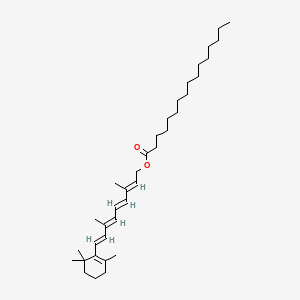
CAS 79-81-2PubChem CID 5280531
Retinol Palmitate
All-trans-retinyl palmitate is an all-trans-retinyl ester obtained by formal condensation of the carboxy group of palmitic (hexadecanoic acid) with the hydroxy group of all-trans-retinol. It is used in cosmetic products to treat various skin disorders such as acne, skin aging, wrinkles, dark spots, and also protect against psoriasis. It has a role as an antioxidant, a human xenobiotic metabolite and an Escherichia coli metabolite. It is a retinyl palmitate and an all-trans-retinyl ester. It is functionally related to an all-trans-retinol. — ChEBI
- IUPAC-Name
- [(2E,4E,6E,8E)-3,7-dimethyl-9-(2,6,6-trimethylcyclohexen-1-yl)nona-2,4,6,8-tetraenyl] hexadecanoate
- Summenformel
- C36H60O2
- Molekulargewicht
- 524.9 g/mol
- Exakte Masse
- 524.45933115 Da
- XLogP3
- 13,6
- Topologische polare Oberfläche
- 26,3 Ų
- Wasserstoffbrücken-Donoren
- 0
- Wasserstoffbrücken-Akzeptoren
- 2
- Kovalente Einheiten
- 1
- Definierte Stereozentren
- 0
Auch bekannt als
retinyl palmitateVITAMIN A PALMITATERetinol, hexadecanoateall-trans-Retinyl palmitateArovitOptovit-ARetinyl hexadecanoateVitamin A Solubilized
16 weitere gemeldete Namen
1D1K0N0VVCNSC-758478Retinol, palmitate, all-transAll-(e)-retinol palmitateCHEBI:17616Vitamin a palmitate (solubilized)Retinol Hexadecanoate((2E,4E,6E,8E)-3,7-dimethyl-9-(2,6,6-trimethylcyclohexen-1-yl)nona-2,4,6,8-tetraenyl) hexadecanoate(2E,4E,6E,8E)-3,7-Dimethyl-9-(2,6,6-trimethylcyclohex-1-en-1-yl)nona-2,4,6,8-tetraen-1-yl palmitatepalmitate-1-14cRetinol-15-3HRefChem:56213Retinyl-10,11-14C2CHEBI:15040201-228-5Afaxin
Kennungen in externen Datenbanken
- ChEBI:CHEBI:17616
- ChEMBL:CHEMBL1675
- EPA DTXSID:DTXSID1021241
- PubMed:38191030
- PubMed:32846153
- PubMed:20679000
- PubMed:19686701
- PubMed:17377406
- PubMed:17303254
- PubMed:17299104
- PubMed:17164434
- PubMed:16798117
- PubMed:16741517
- PubMed:16497549
- PubMed:16299098
Am 2026-08-31 von NIH PubChem durch prüfsummengültigen CAS-Abgleich abgerufen. Chemische Eigenschaften ersetzen nicht die regulatorische Entscheidung auf dieser Seite.
Weitere maßgebliche Stoffrecherche
Jeder Link durchsucht die jeweilige Quelle nach dieser Identität. Ein Link ist ein Recherchepfad und keine Behauptung, dass die Quelle einen exakten Eintrag enthält. Was jede Quelle ist und welches rechtliche Gewicht sie hat
Diesen Eintrag weiterverwenden
Amtliche Quelle und Geltungsbereich
Importiert aus dem Durchführungsbeschluss (EU) 2025/1175 der Kommission (Datensatzversion EU 2025/1175). Das Glossar liefert gebräuchliche Inhaltsstoffnamen für die nach Artikel 19 Absatz 1 Buchstabe g vorgeschriebene Inhaltsstoffliste; es ist keine Zulassungs- oder Sicherheitsliste.
Amtlichen Beschluss öffnen