
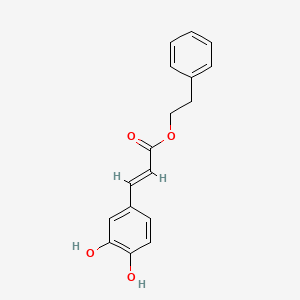
Caffeic Acid Phenethyl Ester
Caffeic Acid Phenethyl Ester is the phenethyl alcohol ester of caffeic acid and a bioactive component of honeybee hive propolis, with antineoplastic, cytoprotective and immunomodulating activities. Upon administration, caffeic acid phenethyl ester (CAPE) inhibits the activation of nuclear transcription factor NF-kappa B and may suppress p70S6K and Akt-driven signaling pathways. In addition, CAPE inhibits PDGF-induced proliferation of vascular smooth muscle cells through the activation of p38 mitogen-activated protein kinase (MAPK) and hypoxia-inducible factor (HIF)-1alpha and subsequent induction of heme oxygenase-1 (HO-1). — NCI Thesaurus (NCIt)
- IUPAC-Name
- 2-phenylethyl (E)-3-(3,4-dihydroxyphenyl)prop-2-enoate
- Summenformel
- C17H16O4
- Molekulargewicht
- 284.31 g/mol
- Exakte Masse
- 284.10485899 Da
- XLogP3
- 4,2
- Topologische polare Oberfläche
- 66,8 Ų
- Wasserstoffbrücken-Donoren
- 2
- Wasserstoffbrücken-Akzeptoren
- 4
- Kovalente Einheiten
- 1
- Definierte Stereozentren
- 0
Auch bekannt als
16 weitere gemeldete Namen
Kennungen in externen Datenbanken
- ChEBI:CHEBI:8062
- ChEBI:CHEBI:93478
- ChEMBL:CHEMBL319244
- EPA DTXSID:DTXSID80861176
- PubMed:24358168
- PubMed:18952420
- PubMed:16029149
- PubMed:15185725
- PubMed:11425564
- PubMed:9083480
- PubMed:8460151
- PubMed:7520698
- PubMed:7473544
Belege aus weiteren wissenschaftlichen Datenbanken
EMBL-EBI ChEBI
phenethyl caffeate
An alkyl caffeate ester in which 2-phenylethyl is the alkyl component.
- Rezeptur
- C17H16O4
- Durchschnittsmasse
- 284.311 g/mol
- Monoisotopische Masse
- 284.10486 Da
- Formale Ladung
- 0
- alkyl caffeate ester — is a (CHEBI:65331)
- immunomodulator — has role (CHEBI:50846)
- antineoplastic agent — has role (CHEBI:35610)
- metabolite — has role (CHEBI:25212)
- antioxidant — has role (CHEBI:22586)
- neuroprotective agent — has role (CHEBI:63726)
- antiviral agent — has role (CHEBI:22587)
- antibacterial agent — has role (CHEBI:33282)
- anti-inflammatory agent — has role (CHEBI:67079)
- alkyl caffeate ester — is a (CHEBI:65331)
- 22206942 Quelle: PubMed
- 22610380 Quelle: PubMed
- 22646141 Quelle: PubMed
- 22964505 Quelle: PubMed
- 22996076 Quelle: PubMed
- 23231684 Quelle: PubMed
- 23291456 Quelle: PubMed
- 23313590 Quelle: PubMed
- 23462369 Quelle: PubMed
- 23466879 Quelle: PubMed
- 23511289 Quelle: PubMed
- 23548785 Quelle: PubMed
- 23561222 Quelle: PubMed
- 23571777 Quelle: PubMed
- 23589406 Quelle: PubMed
- 23611786 Quelle: PubMed
- 23615471 Quelle: PubMed
- 23659443 Quelle: PubMed
- 23662124 Quelle: PubMed
- 23727925 Quelle: PubMed
- 23847089 Quelle: PubMed
- 23876066 Quelle: PubMed
- 23927014 Quelle: PubMed
Weitere kuratierte Namen
Querverweise aus dieser Quelle
- CAS: 104594-70-9 — KEGG COMPOUND
- CAS: 115610-29-2 — ChemIDplus
- REGISTRY_NUMBER: 4752508 — Reaxys
- MANUAL_X_REF: C00002766 — KNApSAcK
- MANUAL_X_REF: C10484 — KEGG COMPOUND
- MANUAL_X_REF: Caffeic_acid_phenethyl_ester — Wikipedia
- MANUAL_X_REF: QAP — PDBeChem
- MANUAL_X_REF: US2008167277 — Patent
- MANUAL_X_REF: WO2008006070 — Patent
Zugeordnet durch: Exact CAS cross-reference in the ChEBI compound record. Quelle aktualisiert: 2014-07-28. Abgerufen: 2026-08-31. Quelleneintrag öffnen
NIH PubChem PUG-View
Attributed physical-property, hazard, environmental and use annotations.
- Signal: Warning Quelle: European Chemicals Agency (ECHA)
- GHS Hazard Statements: H315 (100%): Causes skin irritation [Warning Skin corrosion/irritation]; H319 (100%): Causes serious eye irritation [Warning Serious eye damage/eye irritation]; H335 (98.6%): May cause respiratory irritation [Warning Specific target organ toxicity, single exposure; Respiratory tract irritation] Quelle: European Chemicals Agency (ECHA)
- Precautionary Statement Codes: P261, P264, P264+P265, P271, P280, P302+P352, P304+P340, P305+P351+P338, P319, P321, P332+P317, P337+P317, P362+P364, P403+P233, P405, and P501 (click each P-code to see the statement) Quelle: European Chemicals Agency (ECHA)
- ECHA C&L Notifications Summary: Aggregated GHS information provided per 70 reports by companies from 5 notifications to the ECHA C&L Inventory. Each notification may be associated with multiple companies.; Information may vary between notifications depending on impurities, additives, and other factors. The percentage value in parenthesis indicates the notified classification ratio from companies that provide hazard codes. Only hazard codes with percentage values above 10% are shown. For more detailed information, please visit ECHA C&L website. Quelle: European Chemicals Agency (ECHA)
Zugeordnet durch: Existing checksum-valid CAS to unique PubChem CID match. Abgerufen: 2026-08-31. Quelleneintrag öffnen
Wissenschaftliche Klassifizierungen und Gefahrenannotationen liefern Kontext und ersetzen nicht die oben gezeigte marktspezifische regulatorische Entscheidung.
Weitere Quellenabdeckung und Trefferstatus
| Quelle | Ergebnis | Geprüft |
|---|---|---|
| EMBL-EBI ChEBI | Exakter Treffer | 2026-08-31 |
| NIH PubChem PUG-View | Exakter Treffer | 2026-08-31 |
Ein erfasster Nicht-Treffer ist ein nützlicher Beleg dafür, dass die Quelle geprüft wurde; er ist keine Behauptung, dass der Stoff anderswo nicht existiert.
Am 2026-08-31 von NIH PubChem durch prüfsummengültigen CAS-Abgleich abgerufen. Chemische Eigenschaften ersetzen nicht die regulatorische Entscheidung auf dieser Seite.