
Amtlicher EU-KennzeichnungsnameGlossareintrag 11856
HEXAMETHYLINDANOPYRAN
Dieser Eintrag bestätigt einen amtlichen gebräuchlichen Inhaltsstoffnamen für die EU-Kennzeichnung kosmetischer Mittel. Er bestätigt für sich genommen nicht, dass der Stoff zulässig, unbeschränkt oder sicher ist.
Globale Belegübersicht
Die ermittelte Identität hat übereinstimmende regulatorische Belege in 2 von 13 indizierten Marktdatensätzen: 1 Ländereinträge und 1 EU-Anhangseinträge. Jedes Ergebnis und jede Belegslücke ist unten aufgeführt.
Geprüfte Märkte
13
Märkte mit Belegen
2
Belegslücken
11
Ermittelte Kennungen
2
Ermittelte Stoffidentität
CAS:1222-05-5
EC:214-946-9
Einträge im Inhaltsstoffindex:
HEXAMETHYLINDANOPYRAN
Kosmetische Funktionen: FRAGRANCE, PERFUMING
1,3,4,6,7,8-Hexahydro-4,6,6,7,8,8-hexamethylindeno(5,6-c)pyran; 1,3,4,6,7,8-Hexahydro-4,6,6,7,8,8-hexamethyl-cyclopenta-gamma-2-benzopyran; abbalide; galaxolide; HHCB; pearlide
4 übereinstimmende oder gemeldete Namen
HEXAMETHYLINDANOPYRANHexamethylindanopyran1,3,4,6,7,8-Hexahydro-4,6,6,7,8,8-hexamethylcyclopenta-γ-2-benzopyran1,3,4,6,7,8-Hexahydro-4,6,6,7,8,8-hexamethylcyclopenta-?-2-benzopyran
Regulatorische Belege in allen 13 Märkten
Öffnen Sie jeden übereinstimmenden Eintrag, um Geltungsbereich, Konzentration, Bedingungen, Warnhinweise und die Version der amtlichen Quelle zu sehen.
Wischen oder scrollen Sie horizontal, um Datenabdeckung und nächste Schritte zu sehen.
| Markt | Ergebnis | Einträge | Datensatz | Bedeutung / nächster Schritt |
|---|---|---|---|---|
| European Union EU | Beschränkt | 1Eintrag öffnen 1 | Complete annex dataset Regulation (EC) 1223/2009 consolidated to 1 May 2026 | Prüfen Sie jeden verknüpften Eintrag und die genauen Bedingungen. |
| Great Britain GB | Kein Treffer gefunden | 0 | Complete consolidated annex dataset GB retained Regulation 1223/2009 schedules, effective 15 August 2026 | No annex match is not approval and does not cover Northern Ireland, which follows the applicable EU framework. |
| Canada CA | Kein Treffer gefunden | 0 | Complete Hotlist snapshot Health Canada Cosmetic Ingredient Hotlist, 13 August 2025 | The Hotlist is an administrative compliance tool, not an exhaustive safety approval list. |
| New Zealand NZ | Kein Treffer gefunden | 0 | Complete schedules dataset Cosmetic Products Group Standard schedules effective 1 January 2026 | The searchable spreadsheet is an aid; the legal Group Standard and incorporated notices remain authoritative. |
| ASEAN ASEAN | Kein Treffer gefunden | 0 | Complete regional annex dataset ASEAN Cosmetic Directive annexes 2026-1, 22 June 2026 | Regional annex coverage does not replace member-state implementation dates, notifications or national deviations. |
| China CN | Kein Treffer gefunden | 0 | Complete prohibited catalogues plus official-source workflow NMPA 2021 banned catalogues plus dynamic IECIC List I/List II system current since 2025 | IECIC listing is not blanket approval; absence may require the new cosmetic ingredient route, and restrictions are checked separately. |
| Japan JP | Kein Treffer gefunden | 0 | Complete Standards appendices dataset MHLW Standards for Cosmetics official English source and Japanese amendments checked for the imported snapshot | The Japanese text and subsequent notices are canonical; no local match is not a product-compliance conclusion. |
| South Korea KR | Kein Treffer gefunden | 0 | Complete current appendix dataset MFDS Notice 2026-19, effective 18 March 2026 | Korean source wording is canonical and other positive lists/notices may still apply to the formulation. |
| United States US | Kein Treffer gefunden | 0 | Complete enumerated federal ingredient rules eCFR Title 21 issue date 27 August 2026 | FDA has no general approved-cosmetic-ingredient catalogue; absence from these sections is not approval or proof of safety. |
| Australia AU | Kein Treffer gefunden | 0 | Complete cosmetic-relevant Poisons Standard subset plus official workflow Therapeutic Goods (Poisons Standard—June 2026) Instrument 2026 | An AICIS Inventory match is not cosmetic approval; no Inventory match can indicate a new, exempted, reported or confidential introduction. |
| Brazil BR | Kein Treffer gefunden | 0 | Complete prohibited dataset plus current restricted-list workflow ANVISA RDC 1.029/2026 and RDC 1.030/2026, published 15 June 2026 | RDC 1.030/2026 amends rather than replaces the prohibited baseline, and the second restricted-list revision was still under consultation in July 2026. |
| India IN | Kein Treffer gefunden | 0 | Complete current Part 2 dataset plus official workflow for Parts 1, 3 and 4 Cosmetics Rules 2020 plus current BIS IS 4707 parts (1:2020, 2:2025, 3:2025, 4:2022) | The standards are separate controlled publications; absence from a locally indexed excerpt is not permission. |
| Saudi Arabia SA | Restricted | 1Eintrag öffnen 1 | Complete official list index SFDA live prohibited/restricted lists, snapshot 30 August 2026 | Prüfen Sie jeden verknüpften Eintrag und die genauen Bedingungen. |
Keine Marktzeilen entsprechen diesem Filter.
Übereinstimmende Markteinträge und Bedingungen
Saudi Arabia
SFDA live prohibited/restricted lists, snapshot 30 August 2026Exakte Belege aus den Anhängen II–VI
Annex IIIEintrag 336
Vollständigen regulatorischen Eintrag öffnenHexamethylindanopyran
Beschränkungen: The presence of the substance shall be indicated in the list of ingredients referred to in Article 19(1), point (g), when its concentration exceeds: — 0,001 % in leave-on products — 0,01 % in rinse-off products
Chemische Identität und Eigenschaften
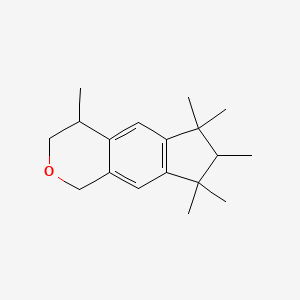
CAS 1222-05-5PubChem CID 91497
Galaxolide
Galaxolide is an organic heterotricyclic compound that is 1,3,4,6,7,8-hexahydrocyclopenta[g]isochromene substituted by methyl groups at positions 4, 6, 6, 7, 8 and 8 respectively. It is a synthetic musk used as a fragrance in cosmetics. It has a role as a fragrance. It is an organic heterotricyclic compound and a member of isochromenes. — ChEBI
- IUPAC-Name
- 4,6,6,7,8,8-hexamethyl-1,3,4,7-tetrahydrocyclopenta[g]isochromene
- Summenformel
- C18H26O
- Molekulargewicht
- 258.4 g/mol
- Exakte Masse
- 258.198365449 Da
- XLogP3
- 4,8
- Topologische polare Oberfläche
- 9,2 Ų
- Wasserstoffbrücken-Donoren
- 0
- Wasserstoffbrücken-Akzeptoren
- 1
- Kovalente Einheiten
- 1
- Definierte Stereozentren
- 0
Auch bekannt als
AbbalideGaloxolideHHCBPearlideGalaxolide WhitehexamethylindanopyranCyclopenta[g]-2-benzopyran, 1,3,4,6,7,8-hexahydro-4,6,6,7,8,8-hexamethyl-Hexahydrohexamethyl cyclopentabenzopyran
16 weitere gemeldete Namen
1,3,4,6,7,8-Hexahydro-4,6,6,7,8,8-hexamethyl-cyclopenta-gamma-2-benzopyranCHEBI:83784Hexahydro-4,6,6,7,8,8-hexamethylcyclopenta-gamma-2-benzopyran1,3,4,6,7,8-Hexahydro-4,6,6,7,8,8-hexamethylindeno(5,6-c)pyranCyclopenta(g)-2-benzopyran, 1,3,4,6,7,8-hexahydro-4,6,6,7,8,8-hexamethyl-1,3,4,6,7,8-hexahydro-4,6,6,7,8,8-hexamethylindeno[5,6-c]pyranhexahydro-hexamethylcyclopenta-benzopyranRefChem:633508214-946-94,6,6,7,8,8-Hexamethyl-1,3,4,6,7,8-hexahydrocyclopenta[g]isochromene1,3,4,6,7,8-Hexahydro-4,6,6,7,8,8-hexamethylcyclopenta[g]-2-benzopyran4,6,6,7,8,8-Hexamethyl-1,3,4,6,7,8-hexahydroindeno[5,6-c]pyran1,3,4,6,7,8-Hexahydro-4,6,6,7,8,8-hexamethylcyclopenta(g)-2-benzopyranEINECS 214-946-9CCRIS 8402Galaxolide 1
Kennungen in externen Datenbanken
- ChEBI:CHEBI:83784
- ChEMBL:CHEMBL1883305
- EPA DTXSID:DTXSID8027373
- PubMed:37797914
- PubMed:34687775
- PubMed:29427707
- PubMed:23084589
- PubMed:22967629
- PubMed:22813076
- PubMed:22779714
- PubMed:22733515
- PubMed:22709983
- PubMed:22699026
- PubMed:22540536
- PubMed:22489002
Belege aus weiteren wissenschaftlichen Datenbanken
NIH PubChem PUG-View
Exakter Kennungstreffer91497
Attributed physical-property, hazard, environmental and use annotations.
- Boiling Point: BP: 128 °C at 0.8 mm Hg Quelle: Hazardous Substances Data Bank (HSDB)
- Color/Form: Colorless crystals from ethanol Quelle: Hazardous Substances Data Bank (HSDB)
- Color/Form: Viscous liquid[ECHA; Search for Chemicals. 1,3,4,6,7,8-hexahydro-4,6,6,7,8,8-hexmethylindeno Quelle: Hazardous Substances Data Bank (HSDB)
- Color/Form: Almost colorless viscous liquid Quelle: Hazardous Substances Data Bank (HSDB)
- Density: 1.0054 at 20 °C/4 °C Quelle: Hazardous Substances Data Bank (HSDB)
- Density: Density: 0.99 to 1.017 g/cu cm at 20 °C Quelle: Hazardous Substances Data Bank (HSDB)
- Density: Crystal density: 1.087 g/cu cm Quelle: Hazardous Substances Data Bank (HSDB)
- LogP: log Kow = 5.90 Quelle: Hazardous Substances Data Bank (HSDB)
- Melting Point: 57-58 °C Quelle: Hazardous Substances Data Bank (HSDB)
- Melting Point: MP: -10 to 0 °C (mixture of isomers) Quelle: Hazardous Substances Data Bank (HSDB)
- Odor: Strong musk odor Quelle: Hazardous Substances Data Bank (HSDB)
- Odor: Odor type: Musk Quelle: Hazardous Substances Data Bank (HSDB)
- Physical Description: Liquid; CBI; Other Solid Quelle: EPA Chemical Data Reporting (CDR)
- Physical Description: Colorless solid with a strong odor of musk; mp = 57-58 deg C; [Merck Index] Nearly colorless viscous liquid; [HSDB] Viscous liquid with a musk-like odor; mp = -5 deg C; [CHEMINFO] Viscous liquid; mp = -10-0 deg C; [eChemPortal: ESIS: RAR] Quelle: Haz-Map, Information on Hazardous Chemicals and Occupational Diseases
- Refractive Index: Index of refraction: 1.5342 at 20 °C/D Quelle: Hazardous Substances Data Bank (HSDB)
- Solubility: In water, 1.75 mg/L at 25 °C Quelle: Hazardous Substances Data Bank (HSDB)
- Solubility: In water, 1.65-1.99 mg/L at 25 °C and pH 5-9[ECHA; Search for Chemicals. 1,3,4,6,7,8-hexahydro-4,6,6,7,8,8-hexmethylindeno Quelle: Hazardous Substances Data Bank (HSDB)
- Vapor Pressure: 0.00054 [mmHg] Quelle: Haz-Map, Information on Hazardous Chemicals and Occupational Diseases
- Vapor Pressure: 5.45X10⁻⁴ mm Hg at 25 °C Quelle: Hazardous Substances Data Bank (HSDB)
- Viscosity: Dynamic viscosity: 12,914 mPa.s[ECHA; Search for Chemicals. 1,3,4,6,7,8-hexahydro-4,6,6,7,8,8-hexmethylindeno Quelle: Hazardous Substances Data Bank (HSDB)
- Signal: Warning Quelle: Regulation (EC) No 1272/2008 of the European Parliament and of the Council
- GHS Hazard Statements: H400: Very toxic to aquatic life [Warning Hazardous to the aquatic environment, acute hazard]; H410: Very toxic to aquatic life with long lasting effects [Warning Hazardous to the aquatic environment, long-term hazard] Quelle: Regulation (EC) No 1272/2008 of the European Parliament and of the Council
- Precautionary Statement Codes: P273, P391, and P501 (click each P-code to see the statement) Quelle: Regulation (EC) No 1272/2008 of the European Parliament and of the Council
- Signal: Warning Quelle: European Chemicals Agency (ECHA)
- GHS Hazard Statements: H400 (97.9%): Very toxic to aquatic life [Warning Hazardous to the aquatic environment, acute hazard]; H410 (100%): Very toxic to aquatic life with long lasting effects [Warning Hazardous to the aquatic environment, long-term hazard] Quelle: European Chemicals Agency (ECHA)
- Precautionary Statement Codes: P273, P391, and P501 (click each P-code to see the statement) Quelle: European Chemicals Agency (ECHA)
- ECHA C&L Notifications Summary: Aggregated GHS information provided per 2093 reports by companies from 18 notifications to the ECHA C&L Inventory. Each notification may be associated with multiple companies.; Information may vary between notifications depending on impurities, additives, and other factors. The percentage value in parenthesis indicates the notified classification ratio from companies that provide hazard codes. Only hazard codes with percentage values above 10% are shown. For more detailed information, please visit ECHA C&L website. Quelle: European Chemicals Agency (ECHA)
- Signal: Danger Quelle: NITE-CMC
- GHS Hazard Statements: H360: May damage fertility or the unborn child [Danger Reproductive toxicity]; H400: Very toxic to aquatic life [Warning Hazardous to the aquatic environment, acute hazard]; H410: Very toxic to aquatic life with long lasting effects [Warning Hazardous to the aquatic environment, long-term hazard] Quelle: NITE-CMC
- Precautionary Statement Codes: P203, P273, P280, P318, P391, P405, and P501 (click each P-code to see the statement) Quelle: NITE-CMC
- Signal: Warning Quelle: NITE-CMC
- GHS Hazard Statements: H361: Suspected of damaging fertility or the unborn child [Warning Reproductive toxicity]; H400: Very toxic to aquatic life [Warning Hazardous to the aquatic environment, acute hazard]; H410: Very toxic to aquatic life with long lasting effects [Warning Hazardous to the aquatic environment, long-term hazard] Quelle: NITE-CMC
- Toxicity Summary: IDENTIFICATION AND USE: Galaxolide (HHCB) is an almost colorless viscous liquid. It is a synthetic, artificial musk fragrance, which is used as a laundry detergent fragrance, as well as an ingredient in perfumes, soaps, and cosmetics. HUMAN STUDIES: No irritation was observed in any of the 42 subjects tested in human repeated insult patch test even after repeated occlusive applications of undiluted material. High concentrations of HHCB can affect steroidogenesis in vitro using the H295R cell line. HHCB was not genotoxic in the micronucleus test with human lymphocytes in vitro in the presence and absence of metabolic activation. ANIMAL STUDIES: HHCB was added to the diet of rats at levels calculated to result in mean daily doses of 5, 15, 50 or 150 mg HHCB/kg. On completion of the 90-day treatment period, three males and three females from the high dose and control groups were maintained for a treatment free period of 4 weeks. No adverse effects were revealed from clinical examination or following extensive histopathological examinations. There were no significant findings at any dose level. Developmental study in rats described axial skeletal malformations at 500 mg/kg per day. In Quelle: Hazardous Substances Data Bank (HSDB)
- Environmental Bioconcentration: A BCF of 1,584 was measured in fish for galaxolide(SRC), using bluegill sunfish (Lepomis macrochirus) which were exposed to concentrations of 1 and 10 mg/L over an 28-day period(1). According to a classification scheme(2), this BCF suggests the potential for bioconcentration in aquatic organisms is very high(SRC). A polar metabolite accounting for 9-24% of the total radioactivity in tissue was detected(1). Quelle: Hazardous Substances Data Bank (HSDB)
- Environmental Fate: TERRESTRIAL FATE: Based on a classification scheme(1), an estimated Koc value of 2.0X10+4(SRC), determined from a structure estimation method(2), indicates that galaxolide is expected to be immobile in soil(SRC). Volatilization of galaxolide from moist soil surfaces is expected to be an important fate process(SRC) given an estimated Henry's Law constant of 1.1X10⁻⁴ atm-cu m/mole(SRC), based upon its vapor pressure, 5.45X10⁻⁴ mm Hg(3), and water solubility, 1.75 mg/L(3). However, adsorption to soil is expected to attenuate volatilization(SRC).) Galaxolide is not expected to volatilize from dry soil surfaces(SRC) based upon its vapor pressure(4). A biodegradation half-life in soil of 4 months(3) indicates that biodegradation is not an important environmental fate process in soil(SRC). Quelle: Hazardous Substances Data Bank (HSDB)
- Environmental Fate: AQUATIC FATE: Based on a classification scheme(1), an estimated Koc value of 2.0X10+4(SRC), determined from a structure estimation method(2), indicates that galaxolide is expected to adsorb to suspended solids and sediment(SRC). Volatilization from water surfaces is expected(3) based upon an estimated Henry's Law constant of 1.1X10⁻⁴ atm-cu m/mole(SRC), derived from its vapor pressure, 5.45X10⁻⁴ mm Hg(4), and water solubility, 1.75 mg/L(4). Using this Henry's Law constant and an estimation method(3), volatilization half-lives for a model river and model lake are 18 hrs and 10 days, respectively(SRC). However, volatilization from water surfaces is expected to be attenuated by adsorption to suspended solids and sediment in the water column. The estimated volatilization half-life from a model pond is 31 months if adsorption is considered(5). According to a classification scheme(6), a BCF of 1584(4) suggests the potential for bioconcentration in aquatic organisms is very high(SRC). A release of 0% CO2 in four weeks using an effluent from a semi-continuous activated sludge (SCAS) in the OECD 302 test(4) indicates that biodegradation is not an important environmental fate process in wate Quelle: Hazardous Substances Data Bank (HSDB)
- Environmental Fate: ATMOSPHERIC FATE: According to a model of gas/particle partitioning of semivolatile organic compounds in the atmosphere(1), galaxolide, which has a vapor pressure of 5.45X10⁻⁴ mm Hg at 25 °C((SRC), determined from a fragment constant method(2)), will exist in both the vapor and particulate phases in the ambient atmosphere. Vapor-phase galaxolide is degraded in the atmosphere by reaction with photochemically-produced hydroxyl radicals(SRC); the half-life for this reaction in air is estimated to be approximately 10 hrs(SRC), calculated from its rate constant of 2.60X10⁻¹¹ cu cm/molecule-sec at 25 °C(3). Particulate-phase galaxolide may be removed from the air by wet and dry deposition(SRC). Galaxolide does not contain chromophores that absorb at wavelengths >290 nm(4) and, therefore, is not expected to be susceptible to direct photolysis by sunlight(SRC). Quelle: Hazardous Substances Data Bank (HSDB)
- Consumer Uses: Fragrance Quelle: EPA Chemical Data Reporting (CDR)
- Industry Uses: Fragrance Quelle: EPA Chemical Data Reporting (CDR)
- Sources/Uses: Used as fragrance agent in perfumes, soaps, cosmetics, and detergents; [Merck Index] Quelle: Haz-Map, Information on Hazardous Chemicals and Occupational Diseases
- Uses: Synthetic, artificial musk fragrance. Quelle: Hazardous Substances Data Bank (HSDB)
- Uses: Fragrance ingredient in perfumes, soaps, cosmetics, and detergents. Quelle: Hazardous Substances Data Bank (HSDB)
- Uses: HHCB is used to make a fragrance long lasting and have a positive technical effect on its balance bringing the initial and residual smell into harmony. Quelle: Hazardous Substances Data Bank (HSDB)
Zugeordnet durch: Existing checksum-valid CAS to unique PubChem CID match. Abgerufen: 2026-08-31. Quelleneintrag öffnen
Wissenschaftliche Klassifizierungen und Gefahrenannotationen liefern Kontext und ersetzen nicht die oben gezeigte marktspezifische regulatorische Entscheidung.
Weitere Quellenabdeckung und Trefferstatus
| Quelle | Ergebnis | Geprüft |
|---|---|---|
| NIH PubChem PUG-View | Exakter Treffer | 2026-08-31 |
Ein erfasster Nicht-Treffer ist ein nützlicher Beleg dafür, dass die Quelle geprüft wurde; er ist keine Behauptung, dass der Stoff anderswo nicht existiert.
Am 2026-09-02 von NIH PubChem durch prüfsummengültigen CAS-Abgleich abgerufen. Chemische Eigenschaften ersetzen nicht die regulatorische Entscheidung auf dieser Seite.
Weitere maßgebliche Stoffrecherche
Jeder Link durchsucht die jeweilige Quelle nach dieser Identität. Ein Link ist ein Recherchepfad und keine Behauptung, dass die Quelle einen exakten Eintrag enthält. Was jede Quelle ist und welches rechtliche Gewicht sie hat
Diesen Eintrag weiterverwenden
Amtliche Quelle und Geltungsbereich
Importiert aus dem Durchführungsbeschluss (EU) 2025/1175 der Kommission (Datensatzversion EU 2025/1175). Das Glossar liefert gebräuchliche Inhaltsstoffnamen für die nach Artikel 19 Absatz 1 Buchstabe g vorgeschriebene Inhaltsstoffliste; es ist keine Zulassungs- oder Sicherheitsliste.
Amtlichen Beschluss öffnen