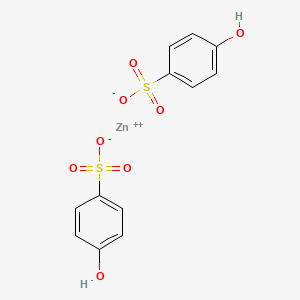
CAS 127-82-2PubChem CID 31391
Zinc Phenolsulfonate
Zinc phenolsulfonate appears as a colorless to white crystalline solid which turns pink on exposure to air. The primary is the threat to the environment. Immediate steps should be taken to limit its spread to the environment. It is soluble in water. It is used as an insecticide and in medicine.
— CAMEO Chemicals
- IUPAC-Name
- zinc bis(4-hydroxybenzenesulfonate)
- Summenformel
- C12H10O8S2Zn
- Molekulargewicht
- 411.7 g/mol
- Exakte Masse
- 409.910851 Da
- Topologische polare Oberfläche
- 172,0 Ų
- Wasserstoffbrücken-Donoren
- 2
- Wasserstoffbrücken-Akzeptoren
- 8
- Kovalente Einheiten
- 3
- Definierte Stereozentren
- 0
Auch bekannt als
Benzenesulfonic acid, 4-hydroxy-, zinc salt (2:1)HSDB 2551EINECS 204-867-8Zinc bis(4-hydroxybenzenesulphonate)UNII-4O71YT5YB5EPA Pesticide Chemical Code 089002zinc phenolsulphonate4O71YT5YB5
16 weitere gemeldete Namen
Zinc phenolsulfonate [NF]ZINC P-PHENOLSULPHONATEZINC PARAPHENOLSULFONATEZINC PARAPHENOLSULPHONATEZINC PHENOLSULFONATE [HSDB]ZINC PHENOLSULFONATE [VANDF]ZINC PHENOLSULFONATE [MART.]ZINC PHENOLSULFONATE [WHO-DD]4-HYDROXYBENZENESULFONIC ACID (2:1), ZINC SALTZINC PHENOLSULFONATE (MART.)((4-hydroxybenzenesulfonyl)oxy)zincio 4-hydroxybenzene-1-sulfonate[(4-hydroxybenzenesulfonyl)oxy]zincio 4-hydroxybenzene-1-sulfonatezinc phenolsulfateZinc pphenolsulfonateCaswell No 921AZinc phenolsulfic acid
Kennungen in externen Datenbanken
Belege aus weiteren wissenschaftlichen Datenbanken
NIH PubChem PUG-View
Exakter Kennungstreffer31391
Attributed physical-property, hazard, environmental and use annotations.
- Boiling Point:
248 °F at 760 mmHg (decomposes) (USCG, 1999)
Quelle: CAMEO Chemicals
- Physical Description:
Zinc phenolsulfonate appears as a colorless to white crystalline solid which turns pink on exposure to air. The primary is the threat to the environment. Immediate steps should be taken to limit its spread to the environment. It is soluble in water. It is used as an insecticide and in medicine.
Quelle: CAMEO Chemicals
- Physical Description:
Octahydrate: Odorless solid; Effloresces in dry air; [Merck Index]
Quelle: Haz-Map, Information on Hazardous Chemicals and Occupational Diseases
- First Aid:
INHALATION: move to fresh air.; INGESTION: if large amount has been swallowed, induce vomiting, followed by prompt and complete gastric lavage, cathartics, and demulcents.; EYES or SKIN: flush with water. (USCG, 1999)
Quelle: CAMEO Chemicals
- Note:
This chemical does not meet GHS hazard criteria for 46.8% (36 of 77) of reports.
Quelle: European Chemicals Agency (ECHA)
- Signal:
Warning
Quelle: European Chemicals Agency (ECHA)
- GHS Hazard Statements:
H302 (53.2%): Harmful if swallowed [Warning Acute toxicity, oral]; H315 (51.9%): Causes skin irritation [Warning Skin corrosion/irritation]; H319 (51.9%): Causes serious eye irritation [Warning Serious eye damage/eye irritation]; H335 (51.9%): May cause respiratory irritation [Warning Specific target organ toxicity, single exposure; Respiratory tract irritation]
Quelle: European Chemicals Agency (ECHA)
- Precautionary Statement Codes:
P261, P264, P264+P265, P270, P271, P280, P301+P317, P302+P352, P304+P340, P305+P351+P338, P319, P321, P330, P332+P317, P337+P317, P362+P364, P403+P233, P405, and P501 (click each P-code to see the statement)
Quelle: European Chemicals Agency (ECHA)
- ECHA C&L Notifications Summary:
Aggregated GHS information provided per 77 reports by companies from 5 notifications to the ECHA C&L Inventory. Each notification may be associated with multiple companies.; Reported as not meeting GHS hazard criteria per 36 of 77 reports by companies.; There are 4 notifications provided by 41 of 77 reports by companies with hazard statement code(s).; Information may vary between notifications depending on impurities, additives, and other factors. The percentage value in parenthesis indicates the notified classification ratio from companies that provide hazard codes. Only hazard codes with percentage values above 10% are shown. For more detailed information, please visit ECHA C&L website.
Quelle: European Chemicals Agency (ECHA)
- Health Effects:
Chronic exposure to zinc causes anemia, atazia, lethargy, and decreases the level of good cholesterol in the body. It is also believed to cause pancreatic and reproductive damage. (L49)
Quelle: Toxin and Toxin Target Database (T3DB)
- Cosmetic Ingredient Review Finding(s):
Safe in the present practices of use and concentration. Ingredient, concentration, and use information are available in documents discoverable at https://cir-reports.cir-safety.org
Quelle: Cosmetic Ingredient Review (CIR)
- Toxicity Summary:
Anaemia results from the excessive absorption of zinc suppressing copper and iron absorption, most likely through competitive binding of intestinal mucosal cells. Unbalanced levels of copper and zinc binding to Cu,Zn-superoxide dismutase has been linked to amyotrophic lateral sclerosis (ALS). Stomach acid dissolves metallic zinc to give corrosive zinc chloride, which can cause damage to the stomach lining. Metal fume fever is thought to be an immune response to inhaled zinc. (L48, L49, A49)
Quelle: Toxin and Toxin Target Database (T3DB)
Zugeordnet durch: Existing checksum-valid CAS to unique PubChem CID match.
Abgerufen: 2026-08-31.
Quelleneintrag öffnen
Wissenschaftliche Klassifizierungen und Gefahrenannotationen liefern Kontext und ersetzen nicht die oben gezeigte marktspezifische regulatorische Entscheidung.
Weitere Quellenabdeckung und Trefferstatus
| Quelle | Ergebnis | Geprüft |
|---|
| NIH PubChem PUG-View | Exakter Treffer | 2026-08-31 |
|---|
Ein erfasster Nicht-Treffer ist ein nützlicher Beleg dafür, dass die Quelle geprüft wurde; er ist keine Behauptung, dass der Stoff anderswo nicht existiert.
Am 2026-09-02 von NIH PubChem durch prüfsummengültigen CAS-Abgleich abgerufen. Chemische Eigenschaften ersetzen nicht die regulatorische Entscheidung auf dieser Seite.