
CAS
1 Eintrag
CAS 12510-42-8
CAS 12510-42-8 entspricht 1 EU-Anhangseintrag in den Anhängen II–VI der Verordnung (EG) Nr. 1223/2009.
Einträge zu CAS 12510-42-8
1 insgesamtChemische Identität und Eigenschaften
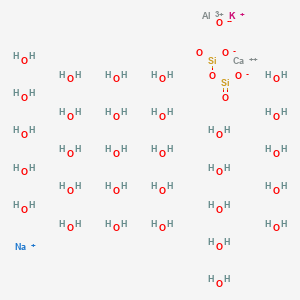
CAS 12510-42-8PubChem CID 61565
Erionite
Erionite can cause cancer according to an independent committee of scientific and health experts. — California Office of Environmental Health Hazard Assessment (OEHHA)
- IUPAC-Name
- aluminum;calcium;potassium;sodium;oxido-[oxido(oxo)silyl]oxy-oxosilane;oxygen(2-);triacontahydrate
- Summenformel
- AlCaH60KNaO36Si2+3
- Molekulargewicht
- 821.77 g/mol
- Exakte Masse
- 821.1378863 Da
- Topologische polare Oberfläche
- 120,0 Ų
- Wasserstoffbrücken-Donoren
- 30
- Wasserstoffbrücken-Akzeptoren
- 36
- Kovalente Einheiten
- 36
- Definierte Stereozentren
- 0
Auch bekannt als
Erionite ((K0-1Na0-1Ca0-0.5)10(Al10Si26O72).30H2O)RefChem:591091620-440-2643-075-0HSDB 7765AQTSNQQRPNNYRB-UHFFFAOYSA-N
Belege aus weiteren wissenschaftlichen Datenbanken
NIH PubChem PUG-View
Exakter Kennungstreffer61565
Attributed physical-property, hazard, environmental and use annotations.
- Color/Form: Hexagonal, cage-like structure composed of a framework of linked (Si,Al)O4 tetrahedra Quelle: Hazardous Substances Data Bank (HSDB)
- Color/Form: White prismatic crystals in radiating groups and occurs in a fibrous form Quelle: Hazardous Substances Data Bank (HSDB)
- Color/Form: Color varies from white to clear and it looks like transparent, glass-like fibers Quelle: Hazardous Substances Data Bank (HSDB)
- Density: Specific gravity: 2.02 to 2.08 Quelle: Hazardous Substances Data Bank (HSDB)
- Physical Description: White fibrous crystals; [NTP] Quelle: Haz-Map, Information on Hazardous Chemicals and Occupational Diseases
- IARC Carcinogenic Agent: Erionite Quelle: International Agency for Research on Cancer (IARC)
- IARC Carcinogenic Classes: Group 1: Carcinogenic to humans Quelle: International Agency for Research on Cancer (IARC)
- IARC Monographs: Volume 42: (1987) Silica and Some Silicates; Volume Sup 7: Overall Evaluations of Carcinogenicity: An Updating of IARC Monographs Volumes 1 to 42, 1987; 440 pages; ISBN 92-832-1411-0 (out of print); Volume 100C: (2012) Arsenic, Metals, Fibres, and Dusts Quelle: International Agency for Research on Cancer (IARC)
- Publication Year: 2012 Quelle: International Agency for Research on Cancer (IARC)
- Evaluation Year: 2009 Quelle: International Agency for Research on Cancer (IARC)
- Signal: Danger Quelle: Regulation (EC) No 1272/2008 of the European Parliament and of the Council
- GHS Hazard Statements: H350: May cause cancer [Danger Carcinogenicity] Quelle: Regulation (EC) No 1272/2008 of the European Parliament and of the Council
- Precautionary Statement Codes: P203, P280, P318, P405, and P501 (click each P-code to see the statement) Quelle: Regulation (EC) No 1272/2008 of the European Parliament and of the Council
- Signal: Danger Quelle: European Chemicals Agency (ECHA)
- GHS Hazard Statements: H350 (100%): May cause cancer [Danger Carcinogenicity] Quelle: European Chemicals Agency (ECHA)
- Precautionary Statement Codes: P203, P280, P318, P405, and P501 (click each P-code to see the statement) Quelle: European Chemicals Agency (ECHA)
- ECHA C&L Notifications Summary: Aggregated GHS information provided per 22 reports by companies from 1 notifications to the ECHA C&L Inventory.; Information may vary between notifications depending on impurities, additives, and other factors. The percentage value in parenthesis indicates the notified classification ratio from companies that provide hazard codes. Only hazard codes with percentage values above 10% are shown. For more detailed information, please visit ECHA C&L website. Quelle: European Chemicals Agency (ECHA)
- ECHA C&L Notifications Summary: The GHS information provided by 1 company from 1 notification to the ECHA C&L Inventory. Quelle: European Chemicals Agency (ECHA)
- Signal: Danger Quelle: NITE-CMC
- GHS Hazard Statements: H350: May cause cancer [Danger Carcinogenicity]; H372: Causes damage to organs through prolonged or repeated exposure [Danger Specific target organ toxicity, repeated exposure] Quelle: NITE-CMC
- Precautionary Statement Codes: P203, P260, P264, P270, P280, P318, P319, P405, and P501 (click each P-code to see the statement) Quelle: NITE-CMC
- Signal: Danger Quelle: Hazardous Chemical Information System (HCIS), Safe Work Australia
- Sources/Uses: Occupational exposures occur during mining, milling and processing of some zeolites as well as during agricultural work in areas in which soils are contaminated with erionite. [IARC] Zeolites are used in water softeners, detergents, cracking catalysts, adsorbents, desiccants, and solar collectors; [Hawley] Zeolites are used for pet litter, soil conditioners, animal feed, waste-water treatment, gas absorbents, etc. Erionite deposits exist in Arizona, Nevada, Oregon, and Utah. [NTP] Workers may be exposed in waste treatment, agricultural waste, air pollution control systems, cement aggregates, and building materials; [Siemiatycki, p. 326] Quelle: Haz-Map, Information on Hazardous Chemicals and Occupational Diseases
- Restricted Notes: Erionite is no longer commercially mined; [NTP] Quelle: Haz-Map, Information on Hazardous Chemicals and Occupational Diseases
- Industrial Processes with risk of exposure: Farming (Respiratory Hazards) [Category: Industry] Quelle: Haz-Map, Information on Hazardous Chemicals and Occupational Diseases
- Uses: Erionite is no longer mined or marketed for commercial purposes. Although other natural zeolites have many commercial uses (pet litter, soil conditioners, animal feed, waste-water treatment, gas absorbents, etc.) because of their unique properties, very few data are available specifically for erionite. It reportedly was used in the past as a noble metal-impregnated catalyst in a hydrocarbon-cracking process and was studied for use in fertilizers and to control odors in livestock production. Erionite-rich blocks have been used to build houses in parts of the western U.S., but this was a minor and unintentional use of the mineral. Quelle: Hazardous Substances Data Bank (HSDB)
Zugeordnet durch: Existing checksum-valid CAS to unique PubChem CID match. Abgerufen: 2026-08-31. Quelleneintrag öffnen
Wissenschaftliche Klassifizierungen und Gefahrenannotationen liefern Kontext und ersetzen nicht die oben gezeigte marktspezifische regulatorische Entscheidung.
Weitere Quellenabdeckung und Trefferstatus
| Quelle | Ergebnis | Geprüft |
|---|---|---|
| NIH PubChem PUG-View | Exakter Treffer | 2026-08-31 |
Ein erfasster Nicht-Treffer ist ein nützlicher Beleg dafür, dass die Quelle geprüft wurde; er ist keine Behauptung, dass der Stoff anderswo nicht existiert.
Am 2026-09-02 von NIH PubChem durch prüfsummengültigen CAS-Abgleich abgerufen. Chemische Eigenschaften ersetzen nicht die regulatorische Entscheidung auf dieser Seite.
Wie CAS 12510-42-8 auf dieser Website verwendet wird
CAS 12510-42-8 ist die Kennung des Chemical Abstracts Service, mit der diese Seite einem bestimmten Stoff zugeordnet wird. Im aktuellen Datenbestand hat 1 EU-Anhangseintrag diese Kennung; so können Sie gegenprüfen, ob derselbe Stoff in einem oder in mehreren regulatorischen Zusammenhängen auftaucht.
Nutzen Sie diese Seite, wenn eine Lieferantenspezifikation, ein Sicherheitsdatenblatt oder ein Rohstoffdossier CAS 12510-42-8 nennt und Sie alle verknüpften Einträge der Anhänge II–VI an einem Ort sehen möchten. Die Eintragskarten oben sind der schnellste Weg zu Konzentrationsgrenzen, Warnhinweisen, Anhangszuordnung und Produktartbedingungen.
Häufig gestellte Fragen
Ein durch CAS 12510-42-8 identifizierter Stoff kann in mehreren Anhängen der EU-Kosmetikverordnung vorkommen, wenn er in unterschiedlichen Zusammenhängen unterschiedlichen Bedingungen unterliegt. Ein Stoff kann beispielsweise nach Anhang III mit bestimmten Bedingungen beschränkt sein, und dieselbe CAS-Nummer kann auch in Anhang IV als zugelassener Farbstoff unter eigenen Eintragsbedingungen erscheinen. Jeder Eintrag muss einzeln geprüft werden.
Gleichen Sie die CAS-Nummer mit den Spezifikationsblättern und Analysenzertifikaten Ihrer Rohstoffe ab. Erscheint eine CAS-Nummer in Anhang II, prüfen Sie die Abwesenheit des Stoffs. Erscheint sie in Anhang III, prüfen Sie, ob Konzentrationsgrenzen und Produktartbedingungen in Ihrer Rezeptur eingehalten werden. Alle Anhangseinträge mit dieser CAS-Nummer sind oben aufgeführt.
Eine CAS-Nummer wird vom Chemical Abstracts Service (USA) vergeben und ist weltweit anerkannt. Eine EC-Nummer ist eine Kennung der Europäischen Kommission aus Verzeichnissen wie EINECS, ELINCS oder der NLP-Liste. Beide Kennungen können in Einträgen der EU-Kosmetikanhänge vorkommen. Manche Stoffe haben beide, manche nur eine, und einige ältere Einträge haben möglicherweise keine von beiden.
Der INCI-Checker akzeptiert Inhaltsstoffnamen, CAS-Nummern und EC-Nummern. Prüfen Sie diese CAS-Nummer direkt und gleichen Sie das Ergebnis anschließend mit den Spezifikationsblättern der Lieferanten und allen verknüpften Anhangsbedingungen ab.
Werkzeuge und nächste Schritte
Rezeptur prüfen
Eine vollständige INCI-Liste prüfen und anschließend mit CAS 12510-42-8 Lieferantendokumente zu den gefundenen Stoffen gegenprüfen.
INCI-CheckerNach Name suchen
Nach INCI-Namen, Aliasen oder verwandten Kennungen suchen, die in Ihrer Dokumentation neben CAS 12510-42-8 stehen.
Suche