CAS 1239-45-8
CAS 1239-45-8 entspricht 1 EU-Anhangseintrag in den Anhängen II–VI der Verordnung (EG) Nr. 1223/2009.
Einträge zu CAS 1239-45-8
1 insgesamtChemische Identität und Eigenschaften

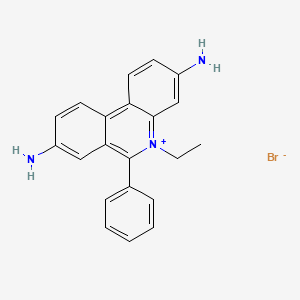
Ethidium Bromide
Ethidium bromide is the organic bromide salt of ethidium. It has a role as a geroprotector, an intercalator and a trypanocidal drug. It contains an ethidium. — ChEBI
- IUPAC-Name
- 5-ethyl-6-phenylphenanthridin-5-ium-3,8-diamine bromide
- Summenformel
- C21H20BrN3
- Molekulargewicht
- 394.3 g/mol
- Exakte Masse
- 393.08406 Da
- Topologische polare Oberfläche
- 55,9 Ų
- Wasserstoffbrücken-Donoren
- 2
- Wasserstoffbrücken-Akzeptoren
- 3
- Kovalente Einheiten
- 2
- Definierte Stereozentren
- 0
Auch bekannt als
16 weitere gemeldete Namen
Kennungen in externen Datenbanken
- ChEBI:CHEBI:4883
- ChEMBL:CHEMBL284328
- EPA DTXSID:DTXSID8025258
- PubMed:9921
Belege aus weiteren wissenschaftlichen Datenbanken
NIH PubChem PUG-View
Attributed physical-property, hazard, environmental and use annotations.
- Color/Form: Dark red crystals from alcohol Quelle: Hazardous Substances Data Bank (HSDB)
- Color/Form: Maroon powder Quelle: Hazardous Substances Data Bank (HSDB)
- Density: 0.34 g/cm³ Quelle: ILO-WHO International Chemical Safety Cards (ICSCs)
- Flash Point: >100 °C Quelle: ILO-WHO International Chemical Safety Cards (ICSCs)
- LogP: log Kow= -0.38 /Estimated/ Quelle: Hazardous Substances Data Bank (HSDB)
- LogP: -1.1 Quelle: ILO-WHO International Chemical Safety Cards (ICSCs)
- Melting Point: 260-262 °C (decomposes) Quelle: Hazardous Substances Data Bank (HSDB)
- Melting Point: 238-240 °C Quelle: ILO-WHO International Chemical Safety Cards (ICSCs)
- Physical Description: Dark red solid; [Merck Index] Red to brown solid; [ICSC] Dark red powder; [Sigma-Aldrich MSDS] Quelle: Haz-Map, Information on Hazardous Chemicals and Occupational Diseases
- Physical Description: RED-TO-BROWN CRYSTALS. Quelle: ILO-WHO International Chemical Safety Cards (ICSCs)
- Solubility: Solubility in 2-methoxyethanol is 20 mg/mL; ethanol, 2 mg/mL Quelle: Hazardous Substances Data Bank (HSDB)
- Solubility: Soluble in 750 parts chloroform at 20 °C Quelle: Hazardous Substances Data Bank (HSDB)
- Solubility: Soluble in 20 parts water at 20 °C Quelle: Hazardous Substances Data Bank (HSDB)
- Solubility: Solubility in water, g/100ml at 20 °C: 5 Quelle: ILO-WHO International Chemical Safety Cards (ICSCs)
- Vapor Pressure: 1.2X10⁻¹² mm Hg at 25 °C /Estimated/ Quelle: Hazardous Substances Data Bank (HSDB)
- Vapor Pressure: Vapor pressure at 25 °C: negligible Quelle: ILO-WHO International Chemical Safety Cards (ICSCs)
- Exposure Routes: The substance can be absorbed into the body by inhalation and by ingestion. Quelle: ILO-WHO International Chemical Safety Cards (ICSCs)
- Signal: Danger Quelle: Regulation (EC) No 1272/2008 of the European Parliament and of the Council
- GHS Hazard Statements: H302: Harmful if swallowed [Warning Acute toxicity, oral]; H330: Fatal if inhaled [Danger Acute toxicity, inhalation]; H341: Suspected of causing genetic defects [Warning Germ cell mutagenicity] Quelle: Regulation (EC) No 1272/2008 of the European Parliament and of the Council
- Precautionary Statement Codes: P203, P260, P264, P270, P271, P280, P284, P301+P317, P304+P340, P316, P318, P320, P330, P403+P233, P405, and P501 (click each P-code to see the statement) Quelle: Regulation (EC) No 1272/2008 of the European Parliament and of the Council
- Signal: Danger Quelle: European Chemicals Agency (ECHA)
- GHS Hazard Statements: H302 (97.1%): Harmful if swallowed [Warning Acute toxicity, oral]; H330 (85.3%): Fatal if inhaled [Danger Acute toxicity, inhalation]; H331 (26.5%): Toxic if inhaled [Danger Acute toxicity, inhalation]; H341 (97.1%): Suspected of causing genetic defects [Warning Germ cell mutagenicity] Quelle: European Chemicals Agency (ECHA)
- Precautionary Statement Codes: P203, P260, P261, P264, P270, P271, P280, P284, P301+P317, P304+P340, P316, P318, P320, P321, P330, P403+P233, P405, and P501 (click each P-code to see the statement) Quelle: European Chemicals Agency (ECHA)
- ECHA C&L Notifications Summary: Aggregated GHS information provided per 34 reports by companies from 9 notifications to the ECHA C&L Inventory. Each notification may be associated with multiple companies.; Information may vary between notifications depending on impurities, additives, and other factors. The percentage value in parenthesis indicates the notified classification ratio from companies that provide hazard codes. Only hazard codes with percentage values above 10% are shown. For more detailed information, please visit ECHA C&L website. Quelle: European Chemicals Agency (ECHA)
- Signal: Danger Quelle: Hazardous Chemical Information System (HCIS), Safe Work Australia
- GHS Hazard Statements: H302: Harmful if swallowed [Warning Acute toxicity, oral]; H330: Fatal if inhaled [Danger Acute toxicity, inhalation]; H341: Suspected of causing genetic defects [Warning Germ cell mutagenicity] Quelle: Hazardous Chemical Information System (HCIS), Safe Work Australia
- Precautionary Statement Codes: P203, P260, P264, P270, P271, P280, P284, P301+P317, P304+P340, P316, P318, P320, P330, P403+P233, P405, and P501 (click each P-code to see the statement) Quelle: Hazardous Chemical Information System (HCIS), Safe Work Australia
- Sources/Uses: Used in the determination of nucleic acids and as an antimicrobial (Trypanosoma); [Merck Index] Quelle: Haz-Map, Information on Hazardous Chemicals and Occupational Diseases
- Uses: Used as a DNA probe Quelle: Hazardous Substances Data Bank (HSDB)
Zugeordnet durch: Existing checksum-valid CAS to unique PubChem CID match. Abgerufen: 2026-08-31. Quelleneintrag öffnen
Wissenschaftliche Klassifizierungen und Gefahrenannotationen liefern Kontext und ersetzen nicht die oben gezeigte marktspezifische regulatorische Entscheidung.
Weitere Quellenabdeckung und Trefferstatus
| Quelle | Ergebnis | Geprüft |
|---|---|---|
| NIH PubChem PUG-View | Exakter Treffer | 2026-08-31 |
Ein erfasster Nicht-Treffer ist ein nützlicher Beleg dafür, dass die Quelle geprüft wurde; er ist keine Behauptung, dass der Stoff anderswo nicht existiert.
Am 2026-09-02 von NIH PubChem durch prüfsummengültigen CAS-Abgleich abgerufen. Chemische Eigenschaften ersetzen nicht die regulatorische Entscheidung auf dieser Seite.
Wie CAS 1239-45-8 auf dieser Website verwendet wird
CAS 1239-45-8 ist die Kennung des Chemical Abstracts Service, mit der diese Seite einem bestimmten Stoff zugeordnet wird. Im aktuellen Datenbestand hat 1 EU-Anhangseintrag diese Kennung; so können Sie gegenprüfen, ob derselbe Stoff in einem oder in mehreren regulatorischen Zusammenhängen auftaucht.
Nutzen Sie diese Seite, wenn eine Lieferantenspezifikation, ein Sicherheitsdatenblatt oder ein Rohstoffdossier CAS 1239-45-8 nennt und Sie alle verknüpften Einträge der Anhänge II–VI an einem Ort sehen möchten. Die Eintragskarten oben sind der schnellste Weg zu Konzentrationsgrenzen, Warnhinweisen, Anhangszuordnung und Produktartbedingungen.
Häufig gestellte Fragen
Werkzeuge und nächste Schritte
Rezeptur prüfen
Eine vollständige INCI-Liste prüfen und anschließend mit CAS 1239-45-8 Lieferantendokumente zu den gefundenen Stoffen gegenprüfen.
INCI-CheckerNach Name suchen
Nach INCI-Namen, Aliasen oder verwandten Kennungen suchen, die in Ihrer Dokumentation neben CAS 1239-45-8 stehen.
Suche