
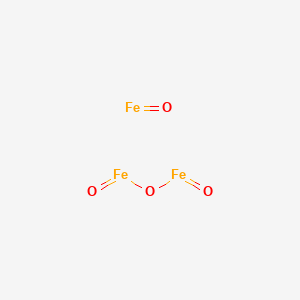
CAS 12227-89-3PubChem CID 16211978
Iron oxide (Fe3O4)
- IUPAC-Name
- oxoiron;oxo(oxoferriooxy)iron
- Summenformel
- Fe3O4
- Molekulargewicht
- 231.53 g/mol
- Exakte Masse
- 231.784465 Da
- Topologische polare Oberfläche
- 60,4 Ų
- Wasserstoffbrücken-Donoren
- 0
- Wasserstoffbrücken-Akzeptoren
- 4
- Kovalente Einheiten
- 2
- Definierte Stereozentren
- 0
Auch bekannt als
Ferriferrous OxideOxide, FerriferrousOxide, FerrosoferricRefChem:9235661317-61-9215-277-5Black Iron OxideC.I. 77499
16 weitere gemeldete Namen
CHEBI:50821EPT 500ferric ferrous oxideFerrosoferric OxideIron (II, III) OxideIron ores, magnetiteiron(II) diiron(III) oxideMagnetic BlackXM0M87F357Iron Oxide BlackIron(II,III)oxideEINECS 235-442-5Iron Oxide Pigment BlackIron(II,III) oxide, CPIron Oxide BlackDISCONTINUEDoxo[(oxoferrio)oxy]iron; oxoiron
Belege aus weiteren wissenschaftlichen Datenbanken
NIH PubChem PUG-View
Exakter Kennungstreffer16211978
Attributed physical-property, hazard, environmental and use annotations.
- Density: 5.17 @25 °C Quelle: PAC Chemical Database, U.S. Department of Energy
- Melting Point: 1597 °C Quelle: PAC Chemical Database, U.S. Department of Energy
- Physical Description: CBI; Other Solid Quelle: EPA Chemical Data Reporting (CDR)
- Physical Description: CBI; Dry Powder; Wet Solid; Large Crystals; Wet Solid; Other Solid; Dry Powder; Dry Powder; Other Solid; Liquid; Other Solid; Dry Powder; Large Crystals; Liquid; Liquid; Dry Powder; Large Crystals Quelle: EPA Chemical Data Reporting (CDR)
- Note: This chemical does not meet GHS hazard criteria for 47% (956 of 2034) of reports. Quelle: European Chemicals Agency (ECHA)
- Signal: Warning Quelle: European Chemicals Agency (ECHA)
- GHS Hazard Statements: H252 (13%): Self-heating in large quantities; may catch fire [Warning Self-heating substances and mixtures]; H315 (32.3%): Causes skin irritation [Warning Skin corrosion/irritation]; H319 (32.8%): Causes serious eye irritation [Warning Serious eye damage/eye irritation]; H335 (32.3%): May cause respiratory irritation [Warning Specific target organ toxicity, single exposure; Respiratory tract irritation] Quelle: European Chemicals Agency (ECHA)
- Precautionary Statement Codes: P235, P261, P264, P264+P265, P271, P280, P302+P352, P304+P340, P305+P351+P338, P319, P321, P332+P317, P337+P317, P362+P364, P403+P233, P405, P407, P410, P413, P420, and P501 (click each P-code to see the statement) Quelle: European Chemicals Agency (ECHA)
- ECHA C&L Notifications Summary: Aggregated GHS information provided per 2034 reports by companies from 19 notifications to the ECHA C&L Inventory. Each notification may be associated with multiple companies.; Reported as not meeting GHS hazard criteria per 956 of 2034 reports by companies.; There are 17 notifications provided by 1078 of 2034 reports by companies with hazard statement code(s).; Information may vary between notifications depending on impurities, additives, and other factors. The percentage value in parenthesis indicates the notified classification ratio from companies that provide hazard codes. Only hazard codes with percentage values above 10% are shown. For more detailed information, please visit ECHA C&L website. Quelle: European Chemicals Agency (ECHA)
- Note: This chemical does not meet GHS hazard criteria for 98.1% (355 of 362) of all reports. Quelle: European Chemicals Agency (ECHA)
- GHS Hazard Statements: Not Classified; Reported as not meeting GHS hazard criteria by 355 of 362 companies (only 1.9% companies provided GHS information). For more detailed information, please visit ECHA C&L website. Quelle: European Chemicals Agency (ECHA)
- ECHA C&L Notifications Summary: Aggregated GHS information provided per 362 reports by companies from 5 notifications to the ECHA C&L Inventory.; Reported as not meeting GHS hazard criteria per 355 of 362 reports by companies.; There are 4 notifications provided by 7 of 362 reports by companies with hazard statement code(s).; Information may vary between notifications depending on impurities, additives, and other factors. The percentage value in parenthesis indicates the notified classification ratio from companies that provide hazard codes. Only hazard codes with percentage values above 10% are shown. For more detailed information, please visit ECHA C&L website. Quelle: European Chemicals Agency (ECHA)
- Consumer Uses: Pigment Quelle: EPA Chemical Data Reporting (CDR)
- Consumer Uses: Not Known or Reasonably Ascertainable; Filler; Pigment; Dye; Magnetic element; Other Quelle: EPA Chemical Data Reporting (CDR)
- Industry Uses: Pigment Quelle: EPA Chemical Data Reporting (CDR)
- Industry Uses: Adsorbent; Laboratory chemicals; Dye; Pigment; Filler; Not Known or Reasonably Ascertainable; Abrasives; CBI; Other; Alloys; Magnetic element Quelle: EPA Chemical Data Reporting (CDR)
Zugeordnet durch: Existing checksum-valid CAS to unique PubChem CID match. Abgerufen: 2026-08-31. Quelleneintrag öffnen
Wissenschaftliche Klassifizierungen und Gefahrenannotationen liefern Kontext und ersetzen nicht die oben gezeigte marktspezifische regulatorische Entscheidung.
Weitere Quellenabdeckung und Trefferstatus
| Quelle | Ergebnis | Geprüft |
|---|---|---|
| NIH PubChem PUG-View | Exakter Treffer | 2026-08-31 |
Ein erfasster Nicht-Treffer ist ein nützlicher Beleg dafür, dass die Quelle geprüft wurde; er ist keine Behauptung, dass der Stoff anderswo nicht existiert.
Am 2026-09-02 von NIH PubChem durch prüfsummengültigen CAS-Abgleich abgerufen. Chemische Eigenschaften ersetzen nicht die regulatorische Entscheidung auf dieser Seite.