
CAS
1 Eintrag
CAS 116-14-3
CAS 116-14-3 entspricht 1 EU-Anhangseintrag in den Anhängen II–VI der Verordnung (EG) Nr. 1223/2009.
Einträge zu CAS 116-14-3
1 insgesamtChemische Identität und Eigenschaften
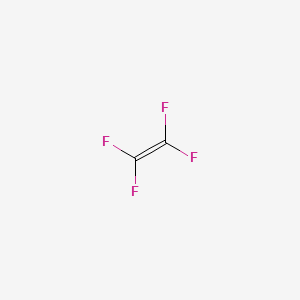
- IUPAC-Name
- 1,1,2,2-tetrafluoroethene
- Summenformel
- C2F4
- Molekulargewicht
- 100.01 g/mol
- Exakte Masse
- 99.99361265 Da
- XLogP3
- 1,3
- Topologische polare Oberfläche
- 0,0 Ų
- Wasserstoffbrücken-Donoren
- 0
- Wasserstoffbrücken-Akzeptoren
- 4
- Kovalente Einheiten
- 1
- Definierte Stereozentren
- 0
Auch bekannt als
TetrafluoroethenePerfluoroethylenePerfluoroetheneFluoroplast 41,1,2,2-TetrafluoroethyleneEthene, tetrafluoro-Ethylene, tetrafluoro-Tetrafluoroethylene monomer
16 weitere gemeldete Namen
TetrafluorethyleneOMW63Z518SCHEBI:38866ethylene tetrafluorideRefChem:6295204-126-9NSC451C2F4PerfluoraethylenTetrafluoraethenTetrafluoraethylenF2C=CF2Polytetrafluoroethylene preparationEthene, 1,1,2,2-tetrafluoro-TetrafluoretheneFluoropolymer, Fluorinated polymer, PTFE
Kennungen in externen Datenbanken
- ChEBI:CHEBI:38866
- ChEMBL:CHEMBL541730
- EPA DTXSID:DTXSID6021325
- PubMed:22481972
- PubMed:22378610
- PubMed:22368468
- PubMed:22322341
- PubMed:22294910
- PubMed:22271974
- PubMed:22232223
- PubMed:22164078
- PubMed:22111050
- PubMed:22073103
- PubMed:21998804
- PubMed:21931481
Belege aus weiteren wissenschaftlichen Datenbanken
NIH PubChem PUG-View
Exakter Kennungstreffer8301
Attributed physical-property, hazard, environmental and use annotations.
- Autoignition Temperature: 370 °F (USCG, 1999) Quelle: CAMEO Chemicals
- Autoignition Temperature: 370 °F (188 °C) /Tetrafluoroethylene, inhibited/ Quelle: Hazardous Substances Data Bank (HSDB)
- Autoignition Temperature: 188 °C Quelle: ILO-WHO International Chemical Safety Cards (ICSCs)
- Boiling Point: -105.3 °F at 760 mmHg (NTP, 1992) Quelle: CAMEO Chemicals
- Boiling Point: -75.9 °C Quelle: Hazardous Substances Data Bank (HSDB)
- Boiling Point: -75.9 °C Quelle: ILO-WHO International Chemical Safety Cards (ICSCs)
- Boiling Point: -105.3 °F Quelle: Occupational Safety and Health Administration (OSHA)
- Boiling Point: -75.9 °C @760 [mm Hg] Quelle: PAC Chemical Database, U.S. Department of Energy
- Color/Form: Colorless gas Quelle: Hazardous Substances Data Bank (HSDB)
- Density: 1.519 at -105 °F (NTP, 1992) - Denser than water; will sink Quelle: CAMEO Chemicals
- Density: 1.519 g/cu cm at -76 °C Quelle: Hazardous Substances Data Bank (HSDB)
- Density: Critical density = 0.58 g/cu cm; Heat of evaporation = 16,821 J/mol at -75.6 °C Quelle: Hazardous Substances Data Bank (HSDB)
- Density: Density (at -76 °C): 1.5 g/cm³ Quelle: ILO-WHO International Chemical Safety Cards (ICSCs)
- Density: 1.519 at -105 °F Quelle: Occupational Safety and Health Administration (OSHA)
- Density: 1.519 @ -76°C Quelle: PAC Chemical Database, U.S. Department of Energy
- Flash Point: <32 °F (<0 °C) (closed cup) /Tetrafluoroethylene, inhibited/ Quelle: Hazardous Substances Data Bank (HSDB)
- LogP: 1.21 (estimated) Quelle: ILO-WHO International Chemical Safety Cards (ICSCs)
- Melting Point: -224.5 °F (NTP, 1992) Quelle: CAMEO Chemicals
- Melting Point: -131.15 °C Quelle: Hazardous Substances Data Bank (HSDB)
- Melting Point: ODORLESS OR FAINT ODOR; CRITICAL TEMP: 92 °F= 33 °C= 306 DEG K; HEAT OF POLYMERIZATION: -450 BTU/LB= 250 CAL/G= -10.5X10+5 JOULES/KG; CRITICAL PRESSURE: 573 PSIA= 38.9 ATM= 3.95 MN/SQ M; HEAT OF COMBUSTION: -4,000 BTU/LB= -2,000 CAL/G= -90X10+5 JOULES/KG /INHIBITED/ Quelle: Hazardous Substances Data Bank (HSDB)
- Melting Point: -131.2 °C Quelle: ILO-WHO International Chemical Safety Cards (ICSCs)
- Melting Point: -224.5 °F Quelle: Occupational Safety and Health Administration (OSHA)
- Melting Point: -131.15 °C Quelle: PAC Chemical Database, U.S. Department of Energy
- Odor: Odorless Quelle: Hazardous Substances Data Bank (HSDB)
- Physical Description: Tetrafluoroethylene, stabilized appears as a colorless odorless gas. Easily ignited. Vapors are heavier than air. May asphyxiate by the displacement of air. May violently polymerize under prolonged exposure to fire or heat, violently rupturing the container. Under prolonged exposure to fire or heat the containers may rupture violently and rocket. Water insoluble. Quelle: CAMEO Chemicals
- Physical Description: Gas Vapor; Liquid Quelle: EPA Chemical Data Reporting (CDR)
- Physical Description: Colorless, odorless gas; [ACGIH] Quelle: Haz-Map, Information on Hazardous Chemicals and Occupational Diseases
- Physical Description: COLOURLESS ODOURLESS GAS. Quelle: ILO-WHO International Chemical Safety Cards (ICSCs)
- Physical Description: Colorless, odorless gas. Quelle: Occupational Safety and Health Administration (OSHA)
- Solubility: Insoluble (NTP, 1992) Quelle: CAMEO Chemicals
- Solubility: In water, 1.59X10+2 mg/L at 25 °C Quelle: Hazardous Substances Data Bank (HSDB)
- Solubility: Solubility in water, mg/l at 25 °C: 159 (very slightly soluble) Quelle: ILO-WHO International Chemical Safety Cards (ICSCs)
- Vapor Pressure: 22800 mmHg at 70 °F (NTP, 1992) Quelle: CAMEO Chemicals
- Vapor Pressure: 2.45X10+4 mm Hg at 25 °C /extrapolated/ Quelle: Hazardous Substances Data Bank (HSDB)
- Vapor Pressure: Vapor pressure, kPa at 20 °C: 2947 Quelle: ILO-WHO International Chemical Safety Cards (ICSCs)
- Vapor Pressure: 22800 mmHg at 70 °F Quelle: Occupational Safety and Health Administration (OSHA)
- Vapor Pressure: 750 [mm Hg] @-75.8 °C Quelle: PAC Chemical Database, U.S. Department of Energy
- IARC Carcinogenic Agent: Tetrafluoroethylene Quelle: International Agency for Research on Cancer (IARC)
- IARC Carcinogenic Classes: Group 2A: Probably carcinogenic to humans Quelle: International Agency for Research on Cancer (IARC)
- IARC Monographs: Volume 19: (1979) Some Monomers, Plastics and Synthetic Elastomers, and Acrolein; Volume Sup 7: Overall Evaluations of Carcinogenicity: An Updating of IARC Monographs Volumes 1 to 42, 1987; 440 pages; ISBN 92-832-1411-0 (out of print); Volume 71: (1999) Re-evaluation of Some Organic Chemicals, Hydrazine and Hydrogen Peroxide (Part 1, Part 2, Part 3); Volume 110: (2017) Some Chemicals Used as Solvents and in Polymer Manufacture Quelle: International Agency for Research on Cancer (IARC)
- Publication Year: 2017 Quelle: International Agency for Research on Cancer (IARC)
- Evaluation Year: 2014 Quelle: International Agency for Research on Cancer (IARC)
- Additional information: NB Overall evaluation upgraded to Group 2A on the basis of sufficient evidence in experimental animals with a striking and atypical pattern of tumours Quelle: International Agency for Research on Cancer (IARC)
- Substance: Tetrafluoroethylene Quelle: NTP Technical Reports
- NTP Technical Report: TR-450: Toxicology and Carcinogenesis Studies of Tetrafluoroethylene (CASRN 116-14-3) in F344 Rats and B6C3F1 Mice (Inhalation Studies) (1997 ) Quelle: NTP Technical Reports
- Peer Review Date: 12/05/95 Quelle: NTP Technical Reports
- Conclusion for Male Rat: Clear Evidence Quelle: NTP Technical Reports
- Conclusion for Female Rat: Clear Evidence Quelle: NTP Technical Reports
- Conclusion for Male Mice: Clear Evidence Quelle: NTP Technical Reports
- Exposure Routes: Exposure mainly occurs via inhalation. Quelle: ILO-WHO International Chemical Safety Cards (ICSCs)
- First Aid: EYES: First check the victim for contact lenses and remove if present. Flush victim's eyes with water or normal saline solution for 20 to 30 minutes while simultaneously calling a hospital or poison control center. Do not put any ointments, oils, or medication in the victim's eyes without specific instructions from a physician. IMMEDIATELY transport the victim after flushing eyes to a hospital even if no symptoms (such as redness or irritation) develop.; SKIN: CAUTION: Exposure of skin to compressed gases may result in freezing of the skin. Treatment for frostbite may be necessary. Remove the victim from the source of contamination. IMMEDIATELY wash affected areas gently with COLD water (and soap, if necessary) while removing and isolating all contaminated clothing. Dry carefully with clean, soft towels. If symptoms such as inflammation or irritation develop, IMMEDIATELY call a physician or go to a hospital for treatment.; INHALATION: IMMEDIATELY leave the contaminated area; take deep breaths of fresh air. If symptoms (such as wheezing, coughing, shortness of breath, or burning in the mouth, throat, or chest) develop, call a physician and be prepared to transport the victim to a ho Quelle: CAMEO Chemicals
- ERG2024, Guide 116P (Tetrafluoroethylene, stabilized): General First Aid:; · Call 911 or emergency medical service.; · Ensure that medical personnel are aware of the material(s) involved, take precautions to protect themselves and avoid contamination.; · Move victim to fresh air if it can be done safely.; · Administer oxygen if breathing is difficult.; · If victim is not breathing:; -- DO NOT perform mouth-to-mouth resuscitation; the victim may have ingested or inhaled the substance.; -- If equipped and pulse detected, wash face and mouth, then give artificial respiration using a proper respiratory medical device (bag-valve mask, pocket mask equipped with a one-way valve or other device).; -- If no pulse detected or no respiratory medical device available, provide continuous compressions. Conduct a pulse check every two minutes or monitor for any signs of spontaneous respirations.; · Remove and isolate contaminated clothing and shoes.; · For minor skin contact, avoid spreading material on unaffected skin.; · In case of contact with substance, remove immediately by flushing skin or eyes with running water for at least 20 minutes.; · For severe burns, immediate medical attention is required.; · Effects of exposure (inhalation, ingestion, Quelle: Emergency Response Guidebook (ERG)
- Signal: Danger Quelle: Regulation (EC) No 1272/2008 of the European Parliament and of the Council
- GHS Hazard Statements: H350: May cause cancer [Danger Carcinogenicity] Quelle: Regulation (EC) No 1272/2008 of the European Parliament and of the Council
- Precautionary Statement Codes: P203, P280, P318, P405, and P501 (click each P-code to see the statement) Quelle: Regulation (EC) No 1272/2008 of the European Parliament and of the Council
- Note: This chemical does not meet GHS hazard criteria for 59.3% (481 of 811) of all reports. Quelle: European Chemicals Agency (ECHA)
- Signal: Danger Quelle: European Chemicals Agency (ECHA)
- GHS Hazard Statements: H220 (30.7%): Extremely flammable gas [Danger Flammable gases]; H280 (36.6%): Contains gas under pressure; may explode if heated [Warning Gases under pressure]; H350 (36%): May cause cancer [Danger Carcinogenicity]; H371 (32.2%): May cause damage to organs [Warning Specific target organ toxicity, single exposure] Quelle: European Chemicals Agency (ECHA)
- Precautionary Statement Codes: P203, P210, P222, P260, P264, P270, P280, P308+P316, P318, P377, P381, P403, P405, P410+P403, and P501 (click each P-code to see the statement) Quelle: European Chemicals Agency (ECHA)
- ECHA C&L Notifications Summary: Aggregated GHS information provided per 811 reports by companies from 12 notifications to the ECHA C&L Inventory. Each notification may be associated with multiple companies.; Reported as not meeting GHS hazard criteria per 481 of 811 reports by companies.; There are 11 notifications provided by 330 of 811 reports by companies with hazard statement code(s).; Information may vary between notifications depending on impurities, additives, and other factors. The percentage value in parenthesis indicates the notified classification ratio from companies that provide hazard codes. Only hazard codes with percentage values above 10% are shown. For more detailed information, please visit ECHA C&L website. Quelle: European Chemicals Agency (ECHA)
- Signal: Danger Quelle: NITE-CMC
- GHS Hazard Statements: H350: May cause cancer [Danger Carcinogenicity] Quelle: NITE-CMC
- Precautionary Statement Codes: P203, P280, P318, P405, and P501 (click each P-code to see the statement) Quelle: NITE-CMC
- GHS Hazard Statements: H220: Extremely flammable gas [Danger Flammable gases]; H231: May react explosively even in the absence of air at elevated pressure and/or temperature [Danger Flammable gases]; H280: Contains gas under pressure; may explode if heated [Warning Gases under pressure]; H320: Causes eye irritation [Warning Serious eye damage/eye irritation]; H351: Suspected of causing cancer [Warning Carcinogenicity]; H371: May cause damage to organs [Warning Specific target organ toxicity, single exposure]; H373: May causes damage to organs through prolonged or repeated exposure [Warning Specific target organ toxicity, repeated exposure] Quelle: NITE-CMC
- NFPA Health Rating: 2 - Materials that, under emergency conditions, can cause temporary incapacitation or residual injury. Quelle: Hazardous Substances Data Bank (HSDB)
- NFPA Fire Rating: 4 - Materials that rapidly or completely vaporize at atmospheric pressure and normal ambient temperature or that are readily dispersed in air and burn readily. Quelle: Hazardous Substances Data Bank (HSDB)
- NFPA Instability Rating: 3 - Materials that in themselves are capable of detonation or explosive decomposition or explosive reaction but that require a strong initiating source or must be heated under confinement before initiation. Quelle: Hazardous Substances Data Bank (HSDB)
- Environmental Bioconcentration: An estimated BCF of 3 was calculated in fish for tetrafluoroethylene(SRC), using an estimated/ log Kow of 1.21(1) and a regression-derived equation(2). According to a classification scheme(3), this BCF suggests the potential for bioconcentration in aquatic organisms is low(SRC). Quelle: Hazardous Substances Data Bank (HSDB)
- Environmental Fate: TERRESTRIAL FATE: Based on a classification scheme(1), an estimated Koc value of 95(SRC), determined from a structure estimation method(2), indicates that tetrafluoroethylene is expected to have high mobility in soil(SRC). Volatilization of tetrafluoroethylene from moist soil surfaces is expected to be an important fate process(SRC) given an estimated Henry's Law constant of 0.63 atm-cu m/mole(SRC), based upon its vapor pressure, 2.45X10+4 mm Hg(3), and water solubility, 159 mg/L(4). Tetrafluoroethylene is expected to volatilize from dry soil surfaces(SRC) based upon its vapor pressure(3). Biodegradation data were not available(SRC, 2010). Quelle: Hazardous Substances Data Bank (HSDB)
- Environmental Fate: AQUATIC FATE: Based on a classification scheme(1), an estimated Koc value of 95(SRC), determined from a structure estimation method(2), indicates that tetrafluoroethylene is not expected to adsorb to suspended solids and sediment(SRC). Volatilization from water surfaces is expected(3) based upon an estimated Henry's Law constant of 0.63 atm-cu m/mole(SRC), derived from its vapor pressure, 2.45X10+4 mm Hg(4), and water solubility, 159 mg/L(5). Using this Henry's Law constant and an estimation method(3), volatilization half-lives for a model river and model lake are 3 hours and 4 days, respectively(SRC). According to a classification scheme(6), an estimated BCF of 3(SRC), from an estimated log Kow of 1.21(7) and a regression-derived equation(8), suggests the potential for bioconcentration in aquatic organisms is low(SRC). Biodegradation data were not available(SRC, 2010). Quelle: Hazardous Substances Data Bank (HSDB)
- Environmental Fate: ATMOSPHERIC FATE: According to a model of gas/particle partitioning of semivolatile organic compounds in the atmosphere(1), tetrafluoroethylene, which has a vapor pressure of 2.45X10+4 mm Hg at 25 °C(2), is expected to exist solely as a gas in the ambient atmosphere. Gas-phase tetrafluoroethylene is degraded in the atmosphere by reaction with photochemically-produced hydroxyl radicals(SRC); the half-life for this reaction in air is estimated to be 17 hours(SRC), calculated from its rate constant of 1.13X10⁻¹¹ cu cm/molecule-sec at 298 K(3). Gas-phase tetrafluoroethylene will be degraded in the atmosphere by reaction with ozone(3,4) and nitrate radicals(3). The rate constant for the vapor-phase reaction of tetrafluoroethylene with photochemically-produced hydroxyl radicals has been estimated as 1.13X10⁻¹¹ cu cm/molecule-sec at 298 K(1). The rate constant for the vapor-phase reaction of tetrafluoroethylene with ozone has been reported as 4.8X10⁻²¹ cu cm/molecule-sec at 298 K(1). The Global Warming Potential is considered to be negligible(5). Tetrafluoroethylene does not contain chromophores that absorb at wavelengths >290 nm(6), and therefore is not expected to be susceptible to dire Quelle: Hazardous Substances Data Bank (HSDB)
- Industry Uses: Intermediate; Monomers Quelle: EPA Chemical Data Reporting (CDR)
- Sources/Uses: Used to produce polytetrafluoroethylene polymers (Teflon); [ACGIH] Quelle: Haz-Map, Information on Hazardous Chemicals and Occupational Diseases
- Uses: In prepn of propellants for food product aerosols Quelle: Hazardous Substances Data Bank (HSDB)
- Uses: MONOMER FOR POLYTETRAFLUOETHYLENE RESINS; CHEM INT FOR HEXAFLUOROPROPYLENE; COMONOMER FOR PERFLUOROALKOXY RESINS, FLUORINATED ETHYLENE-PROPYLENE RESINS, & ETHYLENE-TETRAFLUOROETHYLENE RESINS; TERMONOMER WITH VINYLIDENE FLUORIDE & HEXAFLUOROPROPYLENE Quelle: Hazardous Substances Data Bank (HSDB)
- Uses: Used as a copolymer with hexafluoropropylene to substitute for polytetrafluoroethylene Quelle: Hazardous Substances Data Bank (HSDB)
- Uses: It is used mainly for the production of fluoropolymers. It reacts with perfluoronitrosoalkanes to produce so-called nitroso rubbers. It is also used in the production of low molecular mass compounds and intermediates, for example, for the manufacture of iodoperfluoroalkanes. Quelle: Hazardous Substances Data Bank (HSDB)
- Uses: Principal industrial use of CF2:CF2 is for preparation of polytetrafluoroethylene (Teflon (R)) Resins and copolymers. Quelle: Hazardous Substances Data Bank (HSDB)
- Uses: • Manufacture of chemicals and chemical products [Ref: http://www.spin2000.net/spinmyphp/]; • Coating for fishing lines [Ref: CAS2019 (JP01160443)]; • Construction [Ref: http://www.spin2000.net/spinmyphp/]; • Manufacture of radio, television and communication equipment [Ref: http://www.spin2000.net/spinmyphp/]; • Lubricants and additives [Ref: http://www.spin2000.net/spinmyphp/]; • Inert surface in UPLCs [Ref: https://doi.org/10.1039/C9EM00163H]; • Use in lithium batteries [Ref: Kountz, Dennis J., James R. Hoover, and George Martin Pruce. 2015. Li-Ion battery having improved safety agains combustion. EP 2 891 196 B1, issued 2015.]; • Floor polish [Ref: http://www.spin2000.net/spinmyphp/]; • Cosmetics (bronzer, blush, eye shadow, shaving cream (men's), foundation, mascara, facial powder, eye liner, mascara, sunscreen, sunscreen lip balm, sunscreen makeup, anti-aging, oil controller, eye cream, brow liner, concealer) [Ref: Brinch2018, GSP2014]; • Use in printed circuit boards [Ref: CAS2019 (US20030203174)]; • Architechtural membranes [Ref: https://www.bdir.com/projects/tensile-pvdf-membrane-roof-structures-tent-hotel-resort-guizhou-china]; • Reinforcement of fluorinated membranes [Re Quelle: NORMAN Suspect List Exchange
Zugeordnet durch: Existing checksum-valid CAS to unique PubChem CID match. Abgerufen: 2026-08-31. Quelleneintrag öffnen
Wissenschaftliche Klassifizierungen und Gefahrenannotationen liefern Kontext und ersetzen nicht die oben gezeigte marktspezifische regulatorische Entscheidung.
Weitere Quellenabdeckung und Trefferstatus
| Quelle | Ergebnis | Geprüft |
|---|---|---|
| NIH PubChem PUG-View | Exakter Treffer | 2026-08-31 |
Ein erfasster Nicht-Treffer ist ein nützlicher Beleg dafür, dass die Quelle geprüft wurde; er ist keine Behauptung, dass der Stoff anderswo nicht existiert.
Am 2026-08-31 von NIH PubChem durch prüfsummengültigen CAS-Abgleich abgerufen. Chemische Eigenschaften ersetzen nicht die regulatorische Entscheidung auf dieser Seite.
Wie CAS 116-14-3 auf dieser Website verwendet wird
CAS 116-14-3 ist die Kennung des Chemical Abstracts Service, mit der diese Seite einem bestimmten Stoff zugeordnet wird. Im aktuellen Datenbestand hat 1 EU-Anhangseintrag diese Kennung; so können Sie gegenprüfen, ob derselbe Stoff in einem oder in mehreren regulatorischen Zusammenhängen auftaucht.
Nutzen Sie diese Seite, wenn eine Lieferantenspezifikation, ein Sicherheitsdatenblatt oder ein Rohstoffdossier CAS 116-14-3 nennt und Sie alle verknüpften Einträge der Anhänge II–VI an einem Ort sehen möchten. Die Eintragskarten oben sind der schnellste Weg zu Konzentrationsgrenzen, Warnhinweisen, Anhangszuordnung und Produktartbedingungen.
Häufig gestellte Fragen
Ein durch CAS 116-14-3 identifizierter Stoff kann in mehreren Anhängen der EU-Kosmetikverordnung vorkommen, wenn er in unterschiedlichen Zusammenhängen unterschiedlichen Bedingungen unterliegt. Ein Stoff kann beispielsweise nach Anhang III mit bestimmten Bedingungen beschränkt sein, und dieselbe CAS-Nummer kann auch in Anhang IV als zugelassener Farbstoff unter eigenen Eintragsbedingungen erscheinen. Jeder Eintrag muss einzeln geprüft werden.
Gleichen Sie die CAS-Nummer mit den Spezifikationsblättern und Analysenzertifikaten Ihrer Rohstoffe ab. Erscheint eine CAS-Nummer in Anhang II, prüfen Sie die Abwesenheit des Stoffs. Erscheint sie in Anhang III, prüfen Sie, ob Konzentrationsgrenzen und Produktartbedingungen in Ihrer Rezeptur eingehalten werden. Alle Anhangseinträge mit dieser CAS-Nummer sind oben aufgeführt.
Eine CAS-Nummer wird vom Chemical Abstracts Service (USA) vergeben und ist weltweit anerkannt. Eine EC-Nummer ist eine Kennung der Europäischen Kommission aus Verzeichnissen wie EINECS, ELINCS oder der NLP-Liste. Beide Kennungen können in Einträgen der EU-Kosmetikanhänge vorkommen. Manche Stoffe haben beide, manche nur eine, und einige ältere Einträge haben möglicherweise keine von beiden.
Der INCI-Checker akzeptiert Inhaltsstoffnamen, CAS-Nummern und EC-Nummern. Prüfen Sie diese CAS-Nummer direkt und gleichen Sie das Ergebnis anschließend mit den Spezifikationsblättern der Lieferanten und allen verknüpften Anhangsbedingungen ab.
Werkzeuge und nächste Schritte
Rezeptur prüfen
Eine vollständige INCI-Liste prüfen und anschließend mit CAS 116-14-3 Lieferantendokumente zu den gefundenen Stoffen gegenprüfen.
INCI-CheckerNach Name suchen
Nach INCI-Namen, Aliasen oder verwandten Kennungen suchen, die in Ihrer Dokumentation neben CAS 116-14-3 stehen.
Suche