
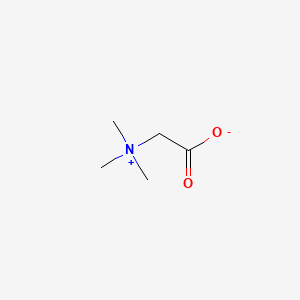
Betaine
Glycine betaine is the amino acid betaine derived from glycine. It has a role as a fundamental metabolite. It is an amino-acid betaine and a glycine derivative. It is a conjugate base of a N,N,N-trimethylglycinium. — ChEBI
- IUPAC-Name
- 2-(trimethylazaniumyl)acetate
- Summenformel
- C5H11NO2
- Molekulargewicht
- 117.15 g/mol
- Exakte Masse
- 117.078978594 Da
- XLogP3
- 0,5
- Topologische polare Oberfläche
- 40,1 Ų
- Wasserstoffbrücken-Donoren
- 0
- Wasserstoffbrücken-Akzeptoren
- 2
- Kovalente Einheiten
- 1
- Definierte Stereozentren
- 0
Auch bekannt als
16 weitere gemeldete Namen
Kennungen in externen Datenbanken
- ChEBI:CHEBI:17750
- ChEMBL:CHEMBL1182
- EPA DTXSID:DTXSID8022666
- PubMed:36080318
- PubMed:33124720
- PubMed:29968805
- PubMed:24323041
- PubMed:21501141
- PubMed:19261122
- PubMed:12777166
Belege aus weiteren wissenschaftlichen Datenbanken
EMBL-EBI ChEBI
glycine betaine
The amino acid betaine derived from glycine.
- Rezeptur
- C5H11NO2
- Durchschnittsmasse
- 117.148 g/mol
- Monoisotopische Masse
- 117.07898 Da
- Formale Ladung
- 0
- amino-acid betaine — is a (CHEBI:22860)
- glycine derivative — is a (CHEBI:24373)
- fundamental metabolite — has role (CHEBI:78675)
- fundamental metabolite — has role (CHEBI:78675)
- amino-acid betaine — is a (CHEBI:22860)
- glycine derivative — is a (CHEBI:24373)
- N,N,N-trimethylglycinium — is conjugate base of (CHEBI:41139)
Weitere kuratierte Namen
Querverweise aus dieser Quelle
- CAS: 107-43-7 — KEGG COMPOUND
- CAS: 107-43-7 — ChemIDplus
- CAS: 107-43-7 — NIST Chemistry WebBook
- REGISTRY_NUMBER: 26434 — Gmelin
- REGISTRY_NUMBER: 3537113 — Reaxys
- MANUAL_X_REF: 347 — DrugCentral
- MANUAL_X_REF: BET — PDBeChem
- MANUAL_X_REF: BETAINE — MetaCyc
- MANUAL_X_REF: C00007291 — KNApSAcK
- MANUAL_X_REF: C00719 — KEGG COMPOUND
- MANUAL_X_REF: C00719 — KEGG COMPOUND
- MANUAL_X_REF: D07523 — KEGG DRUG
- MANUAL_X_REF: HMDB0000043 — HMDB
- MANUAL_X_REF: Trimethylglycine — Wikipedia
- MANUAL_X_REF: YMDB01516 — YMDB
Zugeordnet durch: Exact CAS cross-reference in the ChEBI compound record. Quelle aktualisiert: 2024-04-18. Abgerufen: 2026-08-31. Quelleneintrag öffnen
NIH PubChem PUG-View
Attributed physical-property, hazard, environmental and use annotations.
- Color/Form: Deliquescent scales or prisms Quelle: Hazardous Substances Data Bank (HSDB)
- pKa: 1.83 Quelle: DrugBank
- Melting Point: 301-305°C Quelle: DrugBank
- Melting Point: Decomposes around 293 °C Quelle: Hazardous Substances Data Bank (HSDB)
- Physical Description: Liquid; Dry Powder Quelle: EPA Chemical Data Reporting (CDR)
- Physical Description: Deliquescent solid; [Merck Index] Powder; [Alfa Aesar MSDS] Quelle: Haz-Map, Information on Hazardous Chemicals and Occupational Diseases
- Physical Description: Free-flowing, white crystals; Savoury Quelle: Joint FAO/WHO Expert Committee on Food Additives (JECFA)
- Solubility: Soluble Quelle: DrugBank
- Solubility: Solubility (g/100 g solvent): methanol, 55; ethanol, 8.7. Sparingly soluble in ether. Quelle: Hazardous Substances Data Bank (HSDB)
- Solubility: Slightly soluble in chloroform Quelle: Hazardous Substances Data Bank (HSDB)
- Solubility: In water, 6.11X10+5 mg/L at 19 °C Quelle: Hazardous Substances Data Bank (HSDB)
- Solubility: Very soluble Quelle: Joint FAO/WHO Expert Committee on Food Additives (JECFA)
- Solubility: Soluble (in ethanol) Quelle: Joint FAO/WHO Expert Committee on Food Additives (JECFA)
- Vapor Pressure: 0.00000053 [mmHg] Quelle: Haz-Map, Information on Hazardous Chemicals and Occupational Diseases
- Note: This chemical does not meet GHS hazard criteria for 90.4% (274 of 303) of all reports. Quelle: European Chemicals Agency (ECHA)
- GHS Hazard Statements: Not Classified; Reported as not meeting GHS hazard criteria by 274 of 303 companies (only 9.6% companies provided GHS information). For more detailed information, please visit ECHA C&L website. Quelle: European Chemicals Agency (ECHA)
- ECHA C&L Notifications Summary: Aggregated GHS information provided per 303 reports by companies from 5 notifications to the ECHA C&L Inventory.; Reported as not meeting GHS hazard criteria per 274 of 303 reports by companies.; There are 3 notifications provided by 29 of 303 reports by companies with hazard statement code(s).; Information may vary between notifications depending on impurities, additives, and other factors. The percentage value in parenthesis indicates the notified classification ratio from companies that provide hazard codes. Only hazard codes with percentage values above 10% are shown. For more detailed information, please visit ECHA C&L website. Quelle: European Chemicals Agency (ECHA)
- Cosmetic Ingredient Review Conclusion: The CIR Expert Panel concluded that the eleven alkyl betaines listed below are safe in the present practices of use and concentration in cosmetics, when formulated to be non-irritating...Betaine... Quelle: Cosmetic Ingredient Review (CIR)
- Cosmetic Ingredient Review Finding(s): Safe for use in cosmetics, with qualifications Quelle: Cosmetic Ingredient Review (CIR)
- Environmental Bioconcentration: An estimated BCF of 0.3 was calculated in fish for betaine(SRC), using a water solubility of 611,000 mg/L at 19.3 °C(1) and a regression-derived equation(2). According to a classification scheme(3), this BCF suggests the potential for bioconcentration in aquatic organisms is low(SRC), provided the compound is not metabolized by the organism(SRC). Quelle: Hazardous Substances Data Bank (HSDB)
- Environmental Fate: TERRESTRIAL FATE: Based on a classification scheme(1), an estimated Koc value of 3(SRC), determined from a water solubility of 611,000 mg/L at 19.3 °C(2) and a regression-derived equation(3), indicates that betaine is expected to have very high mobility in soil(SRC). The estimated pKa of betaine, an inner salt, is 2.38(4). Volatilization of betaine from moist soil surfaces is not expected to be an important fate process(SRC) because ionic compounds do not volatilize. Betaine is not expected to volatilize from dry soil surfaces(SRC) based upon an estimated vapor pressure of 1.4X10⁻⁸ mm Hg(SRC), determined from a fragment constant method(5). No information on the aerobic biodegradation of betaine was located; however, the mineralization of alkyl betaine surfactants is considerable (>60% BODT reached in 28-day screening tests(6,7)) indicating that it is likely that betaine is also readily mineralized(SRC). Betaine is expected to biodegrade under anaerobic conditions as well based on data indicating that it is removed during anaerobic sewage treatment(8). Quelle: Hazardous Substances Data Bank (HSDB)
- Environmental Fate: AQUATIC FATE: Based on a classification scheme(1), an estimated Koc value of 3(SRC), determined from a water solubility of 611,000 mg/L at 19.3 °C(2) and a regression-derived equation(3), indicates that betaine is not expected to adsorb to suspended solids and sediment(SRC). An estimated pKa of 2.38(4) indicates betaine, will exist entirely as an inner salt at pH values of 5 to 9 and therefore volatilization from water surfaces will not occur as ionic compounds do not volatilize. According to a classification scheme(5), an estimated BCF of 0.3(SRC), from its water solubility(2) and a regression-derived equation(6), suggests the potential for bioconcentration in aquatic organisms is low(SRC). No information on the aerobic biodegradation of betaine was located; however, the mineralization of alkyl betaine surfactants is considerable (>60% BODT reached in 28-day screening tests(7,8)) indicating that it is likely that betaine is also readily mineralized(SRC). Betaine is expected to biodegrade under anaerobic conditions as well based on data indicating that it is removed during anaerobic sewage treatment(9). Quelle: Hazardous Substances Data Bank (HSDB)
- Environmental Fate: ATMOSPHERIC FATE: According to a model of gas/particle partitioning of semivolatile organic compounds in the atmosphere(1), betaine, which has an estimated vapor pressure of 1.4X10⁻⁸ mm Hg at 25 °C(SRC), determined from a fragment constant method(2), is expected to exist solely in the particulate phase in the ambient atmosphere. Particulate-phase betaine may be removed from the air by wet or dry deposition(SRC). Betaine does not contain chromophores that absorb at wavelengths >290 nm and therefore is not expected to be susceptible to direct photolysis by sunlight(3). Quelle: Hazardous Substances Data Bank (HSDB)
- Consumer Uses: Other Quelle: EPA Chemical Data Reporting (CDR)
- Industry Uses: Other; Solvent; Anti-freeze agent Quelle: EPA Chemical Data Reporting (CDR)
- Cosmetic Ingredient Review Link: CIR ingredient: Betaine Quelle: Cosmetic Ingredient Review (CIR)
- Sources/Uses: Occurs naturally in plants and animals; Used in the treatment of homocystinuria; [Merck Index] Used in soldering and resin curing fluxes, in organic synthesis, and in fisheries (promotes fish survival and aids transfer of salmon and trout from freshwater to seawater); [HSDB] Quelle: Haz-Map, Information on Hazardous Chemicals and Occupational Diseases
- Industrial Processes with risk of exposure: Soldering [Category: Heat or Machine] Quelle: Haz-Map, Information on Hazardous Chemicals and Occupational Diseases
- Uses: In soldering, resin curing fluxes, organic synthesis; in treatment of homocystinuria Quelle: Hazardous Substances Data Bank (HSDB)
- Uses: Lipotropic drug Quelle: Hazardous Substances Data Bank (HSDB)
- Uses: Gastric acidifier /Betaine hydrochloride/ Quelle: Hazardous Substances Data Bank (HSDB)
- Uses: Betaine ... /is/ known as /a/ dietary feeding attractant for many fish species ... Betaine given singly or mixed with other attractants has been found to have a positive effect on fish growth and survival rate. Betaine is also a very important substance for methyl donation and osmoregulation during the transfer of salmon and trout from freshwater to seawater ... Quelle: Hazardous Substances Data Bank (HSDB)
- Uses: Use (kg; approx.) in Germany (2009): >500; Consumption (g per capita; approx.) in Germany (2009): 0.00611; Calculated removal (%): 92.1 Quelle: NORMAN Suspect List Exchange
Zugeordnet durch: Existing checksum-valid CAS to unique PubChem CID match. Abgerufen: 2026-08-31. Quelleneintrag öffnen
Wissenschaftliche Klassifizierungen und Gefahrenannotationen liefern Kontext und ersetzen nicht die oben gezeigte marktspezifische regulatorische Entscheidung.
Weitere Quellenabdeckung und Trefferstatus
| Quelle | Ergebnis | Geprüft |
|---|---|---|
| EMBL-EBI ChEBI | Exakter Treffer | 2026-08-31 |
| NIH PubChem PUG-View | Exakter Treffer | 2026-08-31 |
Ein erfasster Nicht-Treffer ist ein nützlicher Beleg dafür, dass die Quelle geprüft wurde; er ist keine Behauptung, dass der Stoff anderswo nicht existiert.
Am 2026-08-31 von NIH PubChem durch prüfsummengültigen CAS-Abgleich abgerufen. Chemische Eigenschaften ersetzen nicht die regulatorische Entscheidung auf dieser Seite.