
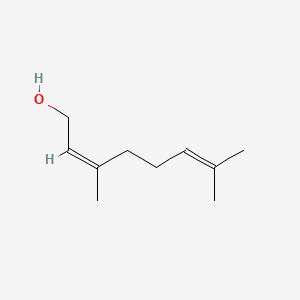
Nerol
Nerol is the (2Z)-stereoisomer of 3,7-dimethylocta-2,6-dien-1-ol. It has been isolated from the essential oils from plants like lemon grass. It has a role as a volatile oil component, a fragrance and a plant metabolite. — ChEBI
- IUPAC-Name
- (2Z)-3,7-dimethylocta-2,6-dien-1-ol
- Summenformel
- C10H18O
- Molekulargewicht
- 154.25 g/mol
- Exakte Masse
- 154.135765193 Da
- XLogP3
- 2,9
- Topologische polare Oberfläche
- 20,2 Ų
- Wasserstoffbrücken-Donoren
- 1
- Wasserstoffbrücken-Akzeptoren
- 1
- Kovalente Einheiten
- 1
- Definierte Stereozentren
- 0
Auch bekannt als
16 weitere gemeldete Namen
Kennungen in externen Datenbanken
- ChEBI:CHEBI:29452
- ChEMBL:CHEMBL452683
- EPA DTXSID:DTXSID3026728
- PubMed:11731906
- PubMed:7739729
Belege aus weiteren wissenschaftlichen Datenbanken
EMBL-EBI ChEBI
nerol
The (2Z)-stereoisomer of 3,7-dimethylocta-2,6-dien-1-ol. It has been isolated from the essential oils from plants like lemon grass.
- Rezeptur
- C10H18O
- Durchschnittsmasse
- 154.253 g/mol
- Monoisotopische Masse
- 154.13577 Da
- Formale Ladung
- 0
- 3,7-dimethylocta-2,6-dien-1-ol — is a (CHEBI:24221)
- fragrance — has role (CHEBI:48318)
- volatile oil component — has role (CHEBI:27311)
- plant metabolite — has role (CHEBI:76924)
- fragrance — has role (CHEBI:48318)
- volatile oil component — has role (CHEBI:27311)
- plant metabolite — has role (CHEBI:76924)
- 3,7-dimethylocta-2,6-dien-1-ol — is a (CHEBI:24221)
Weitere kuratierte Namen
Querverweise aus dieser Quelle
- CAS: 106-25-2 — KEGG COMPOUND
- CAS: 106-25-2 — ChemIDplus
- CAS: 106-25-2 — NIST Chemistry WebBook
- REGISTRY_NUMBER: 1722454 — Reaxys
- REGISTRY_NUMBER: 1722455 — Beilstein
- MANUAL_X_REF: C00000855 — KNApSAcK
- MANUAL_X_REF: C09871 — KEGG COMPOUND
- MANUAL_X_REF: CN103342627 — Patent
- MANUAL_X_REF: CPD-7978 — MetaCyc
- MANUAL_X_REF: LMPR0102010010 — LIPID MAPS
- MANUAL_X_REF: MX2013000640 — Patent
- MANUAL_X_REF: Nerol — Wikipedia
Zugeordnet durch: Exact CAS cross-reference in the ChEBI compound record. Quelle aktualisiert: 2019-10-03. Abgerufen: 2026-08-31. Quelleneintrag öffnen
NIH PubChem PUG-View
Attributed physical-property, hazard, environmental and use annotations.
- Boiling Point: 225 °C Quelle: Hazardous Substances Data Bank (HSDB)
- Boiling Point: BP: 224-225 at 745 mm Hg; 125 °C at 25 mm Hg Quelle: Hazardous Substances Data Bank (HSDB)
- Boiling Point: 103.00 to 105.00 °C. @ 9.00 mm Hg Quelle: Human Metabolome Database (HMDB)
- Boiling Point: 227 °C Quelle: Joint FAO/WHO Expert Committee on Food Additives (JECFA)
- Color/Form: Colorless oily liquid Quelle: Hazardous Substances Data Bank (HSDB)
- Color/Form: Liquid Quelle: Hazardous Substances Data Bank (HSDB)
- Density: 9.8756 g/cu cm at 20 °C Quelle: Hazardous Substances Data Bank (HSDB)
- Density: Density: 0.8813 at 15 °C Quelle: Hazardous Substances Data Bank (HSDB)
- Density: 0.875-0.880 Quelle: Joint FAO/WHO Expert Committee on Food Additives (JECFA)
- Flash Point: Flash Point: 107.78 °C /226 °F (closed cup) Quelle: Hazardous Substances Data Bank (HSDB)
- LogP: log Kow = 3.47 Quelle: Hazardous Substances Data Bank (HSDB)
- LogP: 3.47 Quelle: Human Metabolome Database (HMDB)
- Melting Point: <-15 °C Quelle: Hazardous Substances Data Bank (HSDB)
- Melting Point: Crystals; mp: 118 °C /Nerol tetrabromide/ Quelle: Hazardous Substances Data Bank (HSDB)
- Melting Point: Needles from petroleum ether; mp: 84-86 °C /Nerol allophanate/ Quelle: Hazardous Substances Data Bank (HSDB)
- Melting Point: < -15 °C Quelle: Human Metabolome Database (HMDB)
- Odor: Sweet rose Quelle: Hazardous Substances Data Bank (HSDB)
- Odor: The odor of pure nerol is sweet, rosy refreshing and "wet" seashore Quelle: Hazardous Substances Data Bank (HSDB)
- Physical Description: CBI; Liquid Quelle: EPA Chemical Data Reporting (CDR)
- Physical Description: Liquid with an odor of sweet rose; [Merck Index] Colorless to pale yellow liquid with a pleasant odor; [CAMEO] Quelle: Haz-Map, Information on Hazardous Chemicals and Occupational Diseases
- Physical Description: Liquid Quelle: Human Metabolome Database (HMDB)
- Physical Description: Colourless liquid; fresh, sweet, rose-like aroma Quelle: Joint FAO/WHO Expert Committee on Food Additives (JECFA)
- Refractive Index: Index of refraction: 1.4746 at 20 °C/D Quelle: Hazardous Substances Data Bank (HSDB)
- Refractive Index: 1.467-1.478 Quelle: Joint FAO/WHO Expert Committee on Food Additives (JECFA)
- Solubility: In water, 1311 mg/L at 25 °C Quelle: Hazardous Substances Data Bank (HSDB)
- Solubility: In water, 531 mg/L at 25 °C Quelle: Hazardous Substances Data Bank (HSDB)
- Solubility: Very soluble in ethanol Quelle: Hazardous Substances Data Bank (HSDB)
- Solubility: Soluble in absolute alcohol Quelle: Hazardous Substances Data Bank (HSDB)
- Solubility: Soluble in alcohol, chloroform, ether Quelle: Hazardous Substances Data Bank (HSDB)
- Solubility: 0.531 mg/mL at 25 °C Quelle: Human Metabolome Database (HMDB)
- Solubility: Insoluble in water; soluble in chloroform, ether, most fixed oils Quelle: Joint FAO/WHO Expert Committee on Food Additives (JECFA)
- Solubility: soluble (in ethanol) Quelle: Joint FAO/WHO Expert Committee on Food Additives (JECFA)
- Vapor Pressure: 0.03 [mmHg] Quelle: Haz-Map, Information on Hazardous Chemicals and Occupational Diseases
- Vapor Pressure: 3.0X01-2 mm Hg at 25 °C (extrapolated) Quelle: Hazardous Substances Data Bank (HSDB)
- Note: This chemical does not meet GHS hazard criteria for < 0.1% (2 of 2141) of reports. Quelle: European Chemicals Agency (ECHA)
- Signal: Danger Quelle: European Chemicals Agency (ECHA)
- GHS Hazard Statements: H315 (97%): Causes skin irritation [Warning Skin corrosion/irritation]; H317 (78.6%): May cause an allergic skin reaction [Warning Sensitization, Skin]; H318 (63.7%): Causes serious eye damage [Danger Serious eye damage/eye irritation]; H319 (33%): Causes serious eye irritation [Warning Serious eye damage/eye irritation] Quelle: European Chemicals Agency (ECHA)
- Precautionary Statement Codes: P261, P264, P264+P265, P272, P280, P302+P352, P305+P351+P338, P305+P354+P338, P317, P321, P332+P317, P333+P317, P337+P317, P362+P364, and P501 (click each P-code to see the statement) Quelle: European Chemicals Agency (ECHA)
- ECHA C&L Notifications Summary: Aggregated GHS information provided per 2141 reports by companies from 27 notifications to the ECHA C&L Inventory. Each notification may be associated with multiple companies.; Reported as not meeting GHS hazard criteria per 2 of 2141 reports by companies.; There are 26 notifications provided by 2139 of 2141 reports by companies with hazard statement code(s).; Information may vary between notifications depending on impurities, additives, and other factors. The percentage value in parenthesis indicates the notified classification ratio from companies that provide hazard codes. Only hazard codes with percentage values above 10% are shown. For more detailed information, please visit ECHA C&L website. Quelle: European Chemicals Agency (ECHA)
- Signal: Danger Quelle: Hazardous Chemical Information System (HCIS), Safe Work Australia
- GHS Hazard Statements: H315: Causes skin irritation [Warning Skin corrosion/irritation]; H317: May cause an allergic skin reaction [Warning Sensitization, Skin]; H318: Causes serious eye damage [Danger Serious eye damage/eye irritation] Quelle: Hazardous Chemical Information System (HCIS), Safe Work Australia
- Precautionary Statement Codes: P261, P264, P264+P265, P272, P280, P302+P352, P305+P354+P338, P317, P321, P332+P317, P333+P317, P362+P364, and P501 (click each P-code to see the statement) Quelle: Hazardous Chemical Information System (HCIS), Safe Work Australia
- Signal: Warning Quelle: Hazardous Substances Data Bank (HSDB)
- GHS Hazard Statements: H315: Causes skin irritation [Warning Skin corrosion/irritation]; H319: Causes serious eye irritation [Warning Serious eye damage/eye irritation]; H335: May cause respiratory irritation [Warning Specific target organ toxicity, single exposure; Respiratory tract irritation] Quelle: Hazardous Substances Data Bank (HSDB)
- Precautionary Statement Codes: P261, P264, P264+P265, P271, P280, P302+P352, P304+P340, P305+P351+P338, P319, P321, P332+P317, P337+P317, P362+P364, P403+P233, P405, and P501 (click each P-code to see the statement) Quelle: Hazardous Substances Data Bank (HSDB)
- Toxicity Summary: IDENTIFICATION AND USE: Nerol is a colorless oily fluid. Nerol is reported to be found in neroli oil (with geraniol) and in many essential oils. It used as a base for the manufacture of perfumes and in fragrances. HUMAN EXPOSURE AND TOXICITY: A single sensitization test was carried out on 25 volunteers. The material was tested at a concentration of 4% in petrolatum and produced no sensitization reactions. In other study, nerol was utilized in a closed patch test on the back or forearm of 314 subjects for 24-48 hr. Slight erythema was demonstrated in 10 (3.19%) subjects. In an in vitro chromosome aberration test in cultured human lymphocytes nerol was not clastogenic with and without metabolic activation. ANIMAL STUDIES: Eye irritant effects were observed in rabbits. Slight skin irritation was observed in guinea pigs and rabbits. Respiratory irritation was assessed in mice by recording their respiratory rate when exposed to nerol. Mice were exposed to the test material for 1 min using a nebulizer for aerosolization in a 2600 mL chamber. Mild to moderate decrease in the respiratory rate was observed, and the ED25 (dose at which there is a 25% reduction in the respiratory rate) was ca Quelle: Hazardous Substances Data Bank (HSDB)
- Environmental Bioconcentration: An estimated BCF of 90 was calculated in fish for nerol(SRC), using a log Kow of 3.47(1) and a regression-derived equation(2). According to a classification scheme(3), this BCF suggests the potential for bioconcentration in aquatic organisms is moderate(SRC). Quelle: Hazardous Substances Data Bank (HSDB)
- Environmental Fate: TERRESTRIAL FATE: Based on a classification scheme(1), an estimated Koc value of 94(SRC), determined from a structure estimation method(2), indicates that nerol is expected to have high mobility in soil(SRC). Volatilization of nerol from moist soil surfaces is expected to be an important fate process(SRC) given an estimated Henry's Law constant of 1.2X10⁻⁵ atm-cu m/mole(SRC), derived from its extrapolated vapor pressure, 0.03 mm Hg(2), and water solubility, 531 mg/L(3). Even though the vapor pressure is low environmentally at standard temperature and pressure, there is a detectable odor; therefore, nerol may volatilize from dry soil(SRC). Utilizing the OECD 301D test (closed bottle), 80% of the Theoretical BOD was reached in 4 weeks(5) indicating that biodegradation is an important environmental fate process. Two screening tests found mixtures of nerol and geraniol to be readily biodegradable based on 100% degradation after 28 and 15 days(6). Quelle: Hazardous Substances Data Bank (HSDB)
- Environmental Fate: AQUATIC FATE: Based on a classification scheme(1), an estimated Koc value of 94(SRC), determined from a structure estimation method(2), indicates that nerol is not expected to adsorb to suspended solids and sediment(SRC). Volatilization from water surfaces is expected(3) based upon an estimated Henry's Law constant of 1.2X10⁻⁵ atm-cu m/mole(SRC), derived from its extrapolated vapor pressure, 0.03 mm Hg(2), and water solubility, 531 mg/L(4). Using this Henry's Law constant and an estimation method(3), volatilization half-lives for a model river and model lake are 4.1 and 34 days, respectively(SRC). According to a classification scheme(5), an estimated BCF of 90(SRC), from its log Kow of 3.47(6) and a regression-derived equation(2), suggests the potential for bioconcentration in aquatic organisms is moderate(SRC). Utilizing the OECD 301D test (closed bottle) and a river water inoculum, 80% of the Theoretical BOD was reached in 4 weeks(7) indicating that biodegradation is an important environmental fate process. Two screening tests found mixtures of nerol and geraniol to be readily biodegradable based on 100% degradation after 28 and 15 days(8). Nerol is not expected to undergo hydrol Quelle: Hazardous Substances Data Bank (HSDB)
- Environmental Fate: ATMOSPHERIC FATE: According to a model of gas/particle partitioning of semivolatile organic compounds in the atmosphere(1), nerol, which has an extrapolated vapor pressure of 0.03 mm Hg at 25 °C(2), is expected to exist solely as a vapor in the ambient atmosphere. Vapor-phase nerol is degraded in the atmosphere by reaction with photochemically-produced hydroxyl radicals(SRC); the half-life for this reaction in air is estimated to be 2.1 hours(SRC), calculated from its rate constant of 1.8X10⁻¹⁰ cu cm/molecule-sec at 25 °C(SRC) that was derived using a structure estimation method(2). Vapor-phase nerol is also degraded in the atmosphere by reaction with ozone(SRC); the half-life for this reaction in air is estimated to be 19 minutes(SRC), calculated from its rate constant of 8.6X10⁻¹⁶ cu cm/molecule-sec at 25 °C(SRC) that was derived using a structure estimation method(2). Vapor-phase nerol is degraded in the atmosphere by reaction with nitrate radicals(SRC); the half-life for this reaction in air is estimated to be 4 minutes(SRC), calculated from a rate constant of 1.66X10⁻¹¹ cu cm/molecule-sec at 24 °C for the analogous compound geraniol(3). The nitrate radical (NO3) is the dominan Quelle: Hazardous Substances Data Bank (HSDB)
- Consumer Uses: Intermediates; Fragrance; Odor agents Quelle: EPA Chemical Data Reporting (CDR)
- Industry Uses: Intermediates; Other; Fragrance; Odor agents Quelle: EPA Chemical Data Reporting (CDR)
- Sources/Uses: Permitted for use as an inert ingredient in non-food pesticide products; [EPA] Present in many essential oils; Used as a base for perfume manufacture; [Merck Index] Also used as a flavoring agent; [CAMEO] The cis-isomer of geraniol; [Merck Index] Quelle: Haz-Map, Information on Hazardous Chemicals and Occupational Diseases
- Uses: Uses: In public use since the 1920's. Use in fragrances in the USA amounts to approximately 20,000 lbs per year. Quelle: Hazardous Substances Data Bank (HSDB)
- Uses: Base for manufacture of perfumes. Quelle: Hazardous Substances Data Bank (HSDB)
- Uses: Reported uses (ppm):; Table: Reported uses (ppm): (Flavor and Extract Manufacturers' Association, 1994) [Table#8244] Quelle: Hazardous Substances Data Bank (HSDB)
- Uses: A wide variety of nerol esters are in use as fragrance ingredients. A considerable amount of nerol is used internally by the producers as intermediates for manufacture of other terpene products, particularly citral, ionones, methylionones, citronellol, citronellal, hydroxycitronellal, menthol, and carotenoids. Quelle: Hazardous Substances Data Bank (HSDB)
- Uses: For more Uses (Complete) data for Nerol (7 total), please visit the HSDB record page. Quelle: Hazardous Substances Data Bank (HSDB)
Zugeordnet durch: Existing checksum-valid CAS to unique PubChem CID match. Abgerufen: 2026-08-31. Quelleneintrag öffnen
Wissenschaftliche Klassifizierungen und Gefahrenannotationen liefern Kontext und ersetzen nicht die oben gezeigte marktspezifische regulatorische Entscheidung.
Weitere Quellenabdeckung und Trefferstatus
| Quelle | Ergebnis | Geprüft |
|---|---|---|
| EMBL-EBI ChEBI | Exakter Treffer | 2026-08-31 |
| NIH PubChem PUG-View | Exakter Treffer | 2026-08-31 |
Ein erfasster Nicht-Treffer ist ein nützlicher Beleg dafür, dass die Quelle geprüft wurde; er ist keine Behauptung, dass der Stoff anderswo nicht existiert.
Am 2026-08-31 von NIH PubChem durch prüfsummengültigen CAS-Abgleich abgerufen. Chemische Eigenschaften ersetzen nicht die regulatorische Entscheidung auf dieser Seite.