
Cosmetic Ingredient Order: How the EU 1% Rule Works
Read the EU 1% rule with two sample lists, see where colorants fit and learn what a changed ingredient order can actually establish.
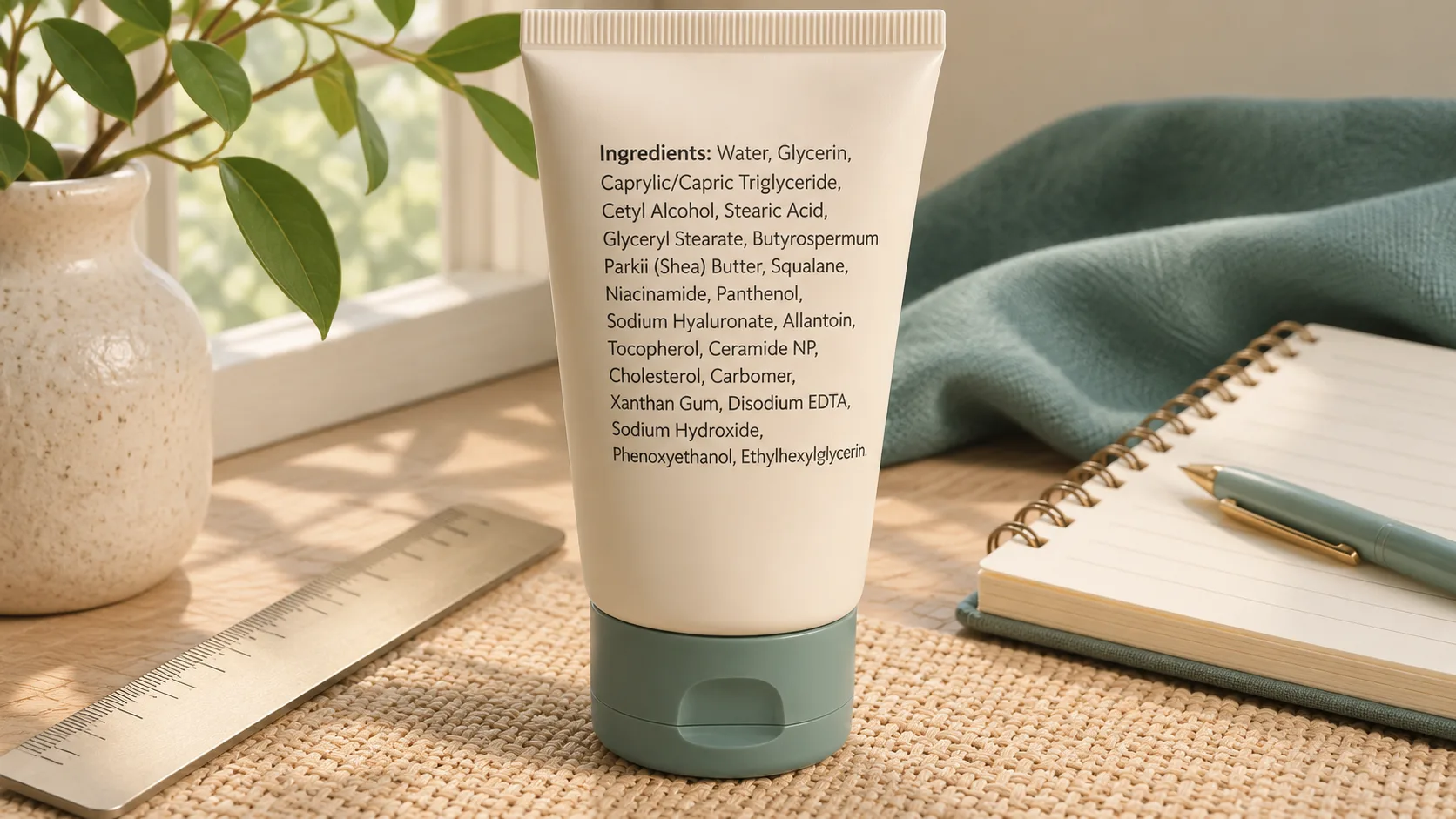
For EU cosmetics, Article 19 generally orders ingredients by their weight when added. The first names give you a starting point for understanding the formula. Ingredients below 1% can be listed in any order after those above 1%. The package does not mark the point where the order changes.
Work through a sample label
Imagine a carton lists Aqua, Glycerin, Caprylic/Capric Triglyceride, Panthenol, Citric Acid. You can record the exact names and their printed sequence. You cannot work out the percentage of panthenol, or conclude that the citric acid content is lower than the panthenol content. Both might be in a part of the list where order is flexible. This invented label illustrates the reading method and is not a formula.
Recognize two other label conventions
Colourants other than those intended to colour the hair can appear after the other ingredients. On decorative cosmetics sold in several shades, a shared list can indicate possible colourants with “may contain” or “+/−”. Fragrance and aromatic compositions can appear under Parfum or Aroma, with additional names where separate declaration is required.
A practical way to compare packages
Copy the ingredients from the same market and exact product variant. Use the ingredient list comparison (https://cosingchecker.com/formula-compare/) to find added and removed names, then look up names individually in ingredient search (https://cosingchecker.com/search/) If the only difference is position, report that the order changed. Leave percentages unknown unless a reliable product-specific source gives them.
Official source
EU Cosmetics Regulation 1223/2009, Article 19 (https://eur-lex.europa.eu/legal-content/EN/TXT/?uri=CELEX%3A32009R1223) This guide describes the EU rule. For the US, consult the FDA labelling summary (https://www.fda.gov/cosmetics/cosmetics-labeling-regulations/summary-cosmetics-labeling-requirements) which describes its own 1% convention.
A practical comparison note for ingredients near the end
Record the actual sequence on both packages and indicate whether you know the concentrations from a separate product source. If the labels reorder a pair of names, report the order as observed. Apply the relevant market and label convention before explaining what the difference could mean.
Worked example: two names swap positions
Imagine both lists start with Aqua and Glycerin. The rest of the lists show two named ingredients in opposite order. Write down the two sequences and confirm which market’s label conventions apply. Without separate composition data, you cannot identify where the flexible ordering rules begin on each package. The lists can show a visible order change without resolving whether the ingredient amounts are different.
If a product has possible colorants or a collective fragrance name, keep that label structure in your notes. For a professional question, record the legal text and the details of the product presentation. If an exact percentage is needed, seek product-specific confirmation and preserve the wording and basis of the amount stated by its source.
Related records and guides: Compare two ingredient lists · Cosmetic ingredient lookup.
Example: the two lists agree on names but not on position
Consider two EU cream declarations: A lists Aqua, Glycerin, Panthenol, and Citric Acid. B lists the same names but swaps Panthenol and Citric Acid. Record that the shared order changed. You cannot mark the 1% boundary or calculate either ingredient’s concentration from the printed names. The rule lets ingredients below 1% be listed in any order after those above 1%; the carton does not identify which names fall on which side. Start with the guide to reading Glycerin on a cosmetic label if you need to confirm a name, and the reformulation comparison workflow if the labels belong to different versions.
What would actually resolve the comparison?
A brand could confirm the formula revision while declining to publish percentages. In that case, record the version as confirmed and the quantities as unknown. For a professional label review, retain the formulation and its approved artwork so everyone checks the same version. If you need the legal wording, use the official EU Cosmetics Regulation (Article 19) and keep the ingredient ordering and the separate colorant conventions in their own fields.
Über diesen Artikel
Dieser Artikel gehört zum Blog von CosIng Checker, in dem wir Leitfäden, Notizen und praxisnahe Erläuterungen zu kosmetischen Inhaltsstoffen der EU, Beschränkungen aus den Anhängen II–VI, Warnhinweisen, Konservierungsstoffen, UV-Filtern, Farbstoffen und verwandten Compliance-Themen veröffentlichen.