
TITANIUM DIOXIDE (NANO)
Titanium dioxide (nano)
TITANIUM DIOXIDE (NANO) steht in Anhang VI als Eintrag der Positivliste für UV-Filter in kosmetischen Mitteln der EU. Höchstkonzentration in diesem Eintrag: 25% - In case of combined use of Titanium Dioxide and Titanium Dioxide (nano), the sum shall not exceed the limit of 25%..
Eintragsdetails
Höchstkonzentration
25% - In case of combined use of Titanium Dioxide and Titanium Dioxide (nano), the sum shall not exceed the limit of 25%.
Warnhinweise
Not to be used in applications that may lead to exposure of the end-user's lungs by inhalation
Only nanomaterials having the following characteristics are allowed:
— purity ≥ 99 %,
— rutile form, or rutile with up to 5 % anatase, with crystalline structure and physical appearance as clusters of spherical, needle, or lanceolate shapes,
— median particle size based on number size distribution ≥ 30 nm,
— aspect ratio from 1 to 4,5, and volume specific surface area ≤ 460 m2/cm3,
— coated with Silica, Hydrated Silica, Alumina, Aluminium Hydroxide, Aluminium Stearate, Stearic Acid, Trimethoxycaprylylsilane, Glycerin, Dimethicone, Hydrogen Dimethicone, Simethicone;
or coated with one of the following combinations:
—Silica at a maximum concentration of 16 % and Cetyl Phosphate at a maximum concentration of 6 %,
—Alumina at a maximum concentration of 7 % and Manganese Dioxide at a maximum concentration of 0,7 % (not to be used in lip products), —Alumina at a maximum concentration of 3 % and Triethoxycaprylylsilane at a maximum concentration of 9 %,
— photocatalytic activity ≤ 10 % compared to corresponding non-coated or non-doped reference,
— nanoparticles are photostable in the final formulation.
Wording of conditions of use and warnings:
For face products containing Titanium Dioxide (nano) coated with the combination Alumina and Manganese Dioxide: Not to be used on the lips.
INCI-Glossarname
TITANIUM DIOXIDE (NANO)
Chemische Bezeichnung
Titanium dioxide (nano)
Chemische / IUPAC-Bezeichnung
Titanium dioxide [1];Anatase (TiO2) [2];Rutile (TiO2) [3]
Regulatorische Informationen
SCCS-Gutachten
- Opinion on Titanium Dioxide
- Opinion for clarification of the meaning of the term "sprayable applications/products" for the nano forms of Carbon Black CI 77266, Titanium Oxide and Zinc Oxide
- OPINION ON Titanium Dioxide (nano form) as UV-Filter in sprays
- OPINION ON Titanium Dioxide (nano form) coated with Cetyl Phosphate, Manganese Dioxide or Triethoxycaprylylsilane as UV-filter in dermally applied cosmetic
Kerndaten
Chemische Identität und Eigenschaften
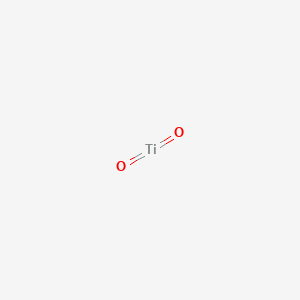
Titanium dioxide
Titanium dioxide is a titanium oxide with the formula TiO2. A naturally occurring oxide sourced from ilmenite, rutile and anatase, it has a wide range of applications. It has a role as a food colouring. — ChEBI
- IUPAC-Name
- dioxotitanium
- Summenformel
- O2Ti
- Molekulargewicht
- 79.866 g/mol
- Exakte Masse
- 79.9377699 Da
- Topologische polare Oberfläche
- 34,1 Ų
- Wasserstoffbrücken-Donoren
- 0
- Wasserstoffbrücken-Akzeptoren
- 2
- Kovalente Einheiten
- 1
- Definierte Stereozentren
- 0
Auch bekannt als
16 weitere gemeldete Namen
Kennungen in externen Datenbanken
Am 2026-08-31 von NIH PubChem durch prüfsummengültigen CAS-Abgleich abgerufen. Chemische Eigenschaften ersetzen nicht die regulatorische Entscheidung auf dieser Seite.
Verzeichnisverknüpfungen für TITANIUM DIOXIDE (NANO)
Verwandte Einträge zu TITANIUM DIOXIDE (NANO)
Für diesen Eintrag gibt es nur wenige direkte Treffer; daher werden auch nahe liegende Einträge aus Anhang VI angezeigt.
TITANIUM DIOXIDE
TITANIUM DIOXIDE
BIS-ETHYLHEXYLOXYPHENOL METHOXYPHENYL TRIAZINE
DIETHYLAMINO HYDROXYBENZOYL HEXYL BENZOATE
DISODIUM PHENYL DIBENZIMIDAZOLE TETRASULFONATE
TRIS-BIPHENYL TRIAZINE / TRIS-BIPHENYL TRIAZINE (NANO)
METHYLENE BIS-BENZOTRIAZOLYL TETRAMETHYLBUTYLPHENOL
METHYLENE BIS-BENZOTRIAZOLYL TETRAMETHYLBUTYLPHENOL (NANO)
Was Anhang VI für TITANIUM DIOXIDE (NANO) bedeutet
TITANIUM DIOXIDE (NANO) ist ein zugelassener UV-Filter, der in Anhang VI der EU-Kosmetikverordnung (EG) Nr. 1223/2009 aufgeführt ist. Nur UV-Filter dieser Positivliste dürfen für den UV-Schutz in kosmetischen Mitteln der EU verwendet werden.
Die in diesem Eintrag festgelegte zulässige Höchstkonzentration gilt für das gebrauchsfertige Produkt. Einige UV-Filter sind auf bestimmte Anwendungsarten beschränkt oder erfordern Warnhinweise auf dem Etikett.
Dieser Eintrag ist zum Abgleich von Namen und Kennungen mit 2 Inhaltsstoffen des CosIng-Verzeichnisses verknüpft. Die Seite zeigt außerdem 11 verwandte Anhangseinträge mit überschneidenden Kennungen, Anhangslogik oder Namensmustern.
Compliance-Checkliste
- Die Konzentration im gebrauchsfertigen Produkt darf nicht überschreiten: 25% - In case of combined use of Titanium Dioxide and Titanium Dioxide (nano), the sum shall not exceed the limit of 25%.
- Prüfen Sie, ob der UV-Filter sowohl für Produkte, die auf der Haut verbleiben, als auch für abzuspülende Produkte zugelassen ist.
- Geben Sie, soweit erforderlich, Lichtschutzfaktor- oder UV-Schutz-Warnhinweise an.
Häufig gestellte Fragen
Quellenhinweis zu Anhang VI, Eintrag TITANIUM DIOXIDE (NANO)
Diese Seite fasst einen Eintrag aus Anhang VI für TITANIUM DIOXIDE (NANO) aus öffentlichen Materialien der Europäischen Kommission zu kosmetischen Mitteln zusammen und ergänzt, soweit verfügbar, verknüpfte Treffer aus dem Verzeichnis oder bei Kennungen.
Nutzen Sie diese Eintragsseite, um die Bedingungen aus Anhang VI für TITANIUM DIOXIDE (NANO) zu prüfen; bestätigen Sie jede endgültige regulatorische Entscheidung jedoch anhand des aktuellen amtlichen Anhangswortlauts und der Quelldateien.
Werkzeuge und nächste Schritte
Rezeptur prüfen
Fügen Sie eine vollständige INCI-Liste ein, um TITANIUM DIOXIDE (NANO) und andere markierte EU-Anhangseinträge in einem Durchgang zu finden.
INCI-CheckerEinträge vergleichen
TITANIUM DIOXIDE (NANO) nebeneinander mit einem anderen Anhangseintrag vergleichen, um Unterschiede bei Beschränkungen, Konzentrationen und Anhangszuordnung zu prüfen.
VergleichenDen Anhang durchsuchen
Alle Einträge in Anhang VI ansehen und die regulatorischen Bedingungen der Stoffe in diesem Anhang vergleichen.
Anhang VI öffnen