
chlorphenesin
3-(p-Chlorophenoxy)-propane-1,2-diol
chlorphenesin steht in Anhang V als Eintrag der Positivliste für Konservierungsstoffe in kosmetischen Mitteln der EU. Höchstkonzentration in diesem Eintrag: 0.3%.
Eintragsdetails
Höchstkonzentration
0.3%
INCI-Glossarname
chlorphenesin
Chemische Bezeichnung
3-(p-Chlorophenoxy)-propane-1,2-diol
Regulatorische Informationen
Identifizierte Inhaltsstoffe
Kerndaten
Chemische Identität und Eigenschaften
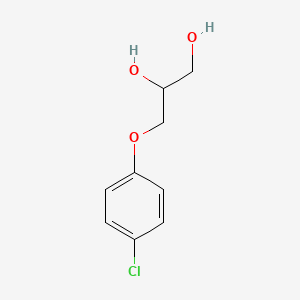
Chlorphenesin
Chlorphenesin is glycerol in which the hydrogen of one of the primary hydroxy groups is substituted by a 4-chlorophenyl group. It has antifungal and antibacterial properties, and is used for treatment of cutaneous and vaginal infections. Its 1-carbamate is used as a skeletal muscle relaxant for the treatment of painful muscle spasm. It has a role as an antibacterial drug, a muscle relaxant and an antifungal drug. It is a glycol, a member of propane-1,2-diols and a member of monochlorobenzenes. — ChEBI
- IUPAC-Name
- 3-(4-chlorophenoxy)propane-1,2-diol
- Summenformel
- C9H11ClO3
- Molekulargewicht
- 202.63 g/mol
- Exakte Masse
- 202.0396719 Da
- XLogP3
- 1,2
- Topologische polare Oberfläche
- 49,7 Ų
- Wasserstoffbrücken-Donoren
- 2
- Wasserstoffbrücken-Akzeptoren
- 3
- Kovalente Einheiten
- 1
- Definierte Stereozentren
- 0
Auch bekannt als
16 weitere gemeldete Namen
Kennungen in externen Datenbanken
- ChEBI:CHEBI:3642
- ChEMBL:CHEMBL388751
- EPA DTXSID:DTXSID0049028
- PubMed:6503049
- PubMed:4105542
- PubMed:3074423
Belege aus weiteren wissenschaftlichen Datenbanken
EMBL-EBI ChEBI
chlorphenesin
Glycerol in which the hydrogen of one of the primary hydroxy groups is substituted by a 4-chlorophenyl group. It has antifungal and antibacterial properties, and is used for treatment of cutaneous and vaginal infections. Its 1-carbamate is used as a skeletal muscle relaxant for the treatment of painful muscle spasm.
- Rezeptur
- C9H11ClO3
- Durchschnittsmasse
- 202.637 g/mol
- Monoisotopische Masse
- 202.03967 Da
- Formale Ladung
- 0
- monochlorobenzenes — is a (CHEBI:83403)
- glycol — is a (CHEBI:13643)
- propane-1,2-diols — is a (CHEBI:26284)
- antifungal drug — has role (CHEBI:86327)
- muscle relaxant — has role (CHEBI:51371)
- antibacterial drug — has role (CHEBI:36047)
- antifungal drug — has role (CHEBI:86327)
- muscle relaxant — has role (CHEBI:51371)
- antibacterial drug — has role (CHEBI:36047)
- monochlorobenzenes — is a (CHEBI:83403)
- glycol — is a (CHEBI:13643)
- propane-1,2-diols — is a (CHEBI:26284)
- 17178228 Quelle: PubMed
Weitere kuratierte Namen
Querverweise aus dieser Quelle
Zugeordnet durch: Exact CAS cross-reference in the ChEBI compound record. Quelle aktualisiert: 2015-07-09. Abgerufen: 2026-08-31. Quelleneintrag öffnen
NIH PubChem PUG-View
Attributed physical-property, hazard, environmental and use annotations.
- LogP: 1.2 Quelle: DrugBank
- LogP: 1.2 Quelle: Human Metabolome Database (HMDB)
- Melting Point: 86–92 Quelle: DrugBank
- Melting Point: 78 °C Quelle: Human Metabolome Database (HMDB)
- Physical Description: Solid Quelle: Human Metabolome Database (HMDB)
- Solubility: 10000 mg/L Quelle: DrugBank
- Solubility: 1.04e+01 g/L Quelle: Human Metabolome Database (HMDB)
- Signal: Danger Quelle: European Chemicals Agency (ECHA)
- GHS Hazard Statements: H302 (30.6%): Harmful if swallowed [Warning Acute toxicity, oral]; H315 (84.1%): Causes skin irritation [Warning Skin corrosion/irritation]; H318 (13.3%): Causes serious eye damage [Danger Serious eye damage/eye irritation]; H319 (69.7%): Causes serious eye irritation [Warning Serious eye damage/eye irritation]; H332 (10.8%): Harmful if inhaled [Warning Acute toxicity, inhalation]; H335 (35.1%): May cause respiratory irritation [Warning Specific target organ toxicity, single exposure; Respiratory tract irritation] Quelle: European Chemicals Agency (ECHA)
- Precautionary Statement Codes: P261, P264, P264+P265, P270, P271, P280, P301+P317, P302+P352, P304+P340, P305+P351+P338, P305+P354+P338, P317, P319, P321, P330, P332+P317, P337+P317, P362+P364, P403+P233, P405, and P501 (click each P-code to see the statement) Quelle: European Chemicals Agency (ECHA)
- ECHA C&L Notifications Summary: Aggregated GHS information provided per 353 reports by companies from 14 notifications to the ECHA C&L Inventory. Each notification may be associated with multiple companies.; Information may vary between notifications depending on impurities, additives, and other factors. The percentage value in parenthesis indicates the notified classification ratio from companies that provide hazard codes. Only hazard codes with percentage values above 10% are shown. For more detailed information, please visit ECHA C&L website. Quelle: European Chemicals Agency (ECHA)
- Cosmetic Ingredient Review Finding(s): Safe in the present practices of use and concentration. Ingredient, concentration, and use information are available in documents discoverable at https://cir-reports.cir-safety.org Quelle: Cosmetic Ingredient Review (CIR)
- Cosmetic Ingredient Review Link: CIR ingredient: Chlorphenesin Quelle: Cosmetic Ingredient Review (CIR)
Zugeordnet durch: Existing checksum-valid CAS to unique PubChem CID match. Abgerufen: 2026-08-31. Quelleneintrag öffnen
Wissenschaftliche Klassifizierungen und Gefahrenannotationen liefern Kontext und ersetzen nicht die oben gezeigte marktspezifische regulatorische Entscheidung.
Weitere Quellenabdeckung und Trefferstatus
| Quelle | Ergebnis | Geprüft |
|---|---|---|
| EMBL-EBI ChEBI | Exakter Treffer | 2026-08-31 |
| NIH PubChem PUG-View | Exakter Treffer | 2026-08-31 |
Ein erfasster Nicht-Treffer ist ein nützlicher Beleg dafür, dass die Quelle geprüft wurde; er ist keine Behauptung, dass der Stoff anderswo nicht existiert.
Am 2026-09-02 von NIH PubChem durch prüfsummengültigen CAS-Abgleich abgerufen. Chemische Eigenschaften ersetzen nicht die regulatorische Entscheidung auf dieser Seite.
Verzeichnisverknüpfungen für chlorphenesin
Verwandte Einträge zu chlorphenesin
Für diesen Eintrag gibt es nur wenige direkte Treffer; daher werden auch nahe liegende Einträge aus Anhang V angezeigt.
7-ETHYLBICYCLOOXAZOLIDINE
SODIUM HYDROXYMETHYLGLYCINATE
HEXAMIDINE / HEXAMIDINE DIISETHIONATE / HEXAMIDINE DIPARABEN / HEXAMIDINE PARABEN
Benzethonium Chloride
BENZALKONIUM CHLORIDE / BENZALKONIUM BROMIDE / BENZALKONIUM SACCHARINATE
DIMETHYL OXAZOLIDINE
BEHENTRIMONIUM CHLORIDE (1) / CETRIMONIUM BROMIDE / CETRIMONIUM CHLORIDE (2)/ LAURTRIMONIUM BROMIDE…
IODOPROPYNYL BUTYLCARBAMATE
Was Anhang V für chlorphenesin bedeutet
chlorphenesin ist ein zugelassener Konservierungsstoff, der in Anhang V der EU-Kosmetikverordnung (EG) Nr. 1223/2009 aufgeführt ist. Nur Stoffe dieser Positivliste dürfen in der EU als kosmetische Konservierungsstoffe verwendet werden.
Jeder Eintrag zu einem Konservierungsstoff legt zulässige Höchstkonzentrationen und den Anwendungsbereich fest. Die Konzentrationen dürfen das aufgeführte Maximum nicht überschreiten. Für einige Konservierungsstoffe sind Warnhinweise auf dem Produktetikett erforderlich.
Dieser Eintrag ist zum Abgleich von Namen und Kennungen mit 1 Inhaltsstoff des CosIng-Verzeichnisses verknüpft. Die Seite zeigt außerdem 12 verwandte Anhangseinträge mit überschneidenden Kennungen, Anhangslogik oder Namensmustern.
Compliance-Checkliste
- Die Einsatzkonzentration darf nicht überschreiten: 0.3%
- Prüfen Sie, dass der Konservierungsstoff bei der zulässigen Konzentration in Ihrer Matrix wirksam ist.
Häufig gestellte Fragen
Quellenhinweis zu Anhang V, Eintrag chlorphenesin
Diese Seite fasst einen Eintrag aus Anhang V für chlorphenesin aus öffentlichen Materialien der Europäischen Kommission zu kosmetischen Mitteln zusammen und ergänzt, soweit verfügbar, verknüpfte Treffer aus dem Verzeichnis oder bei Kennungen.
Nutzen Sie diese Eintragsseite, um die Bedingungen aus Anhang V für chlorphenesin zu prüfen; bestätigen Sie jede endgültige regulatorische Entscheidung jedoch anhand des aktuellen amtlichen Anhangswortlauts und der Quelldateien.
Werkzeuge und nächste Schritte
Rezeptur prüfen
Fügen Sie eine vollständige INCI-Liste ein, um chlorphenesin und andere markierte EU-Anhangseinträge in einem Durchgang zu finden.
INCI-CheckerEinträge vergleichen
chlorphenesin nebeneinander mit einem anderen Anhangseintrag vergleichen, um Unterschiede bei Beschränkungen, Konzentrationen und Anhangszuordnung zu prüfen.
VergleichenDen Anhang durchsuchen
Alle Einträge in Anhang V ansehen und die regulatorischen Bedingungen der Stoffe in diesem Anhang vergleichen.
Anhang V öffnen