
Acetone oxime
Acetone oxime ist in Anhang II als verbotener Stoff für kosmetische Mittel aufgeführt, die in der EU in Verkehr gebracht werden.
Eintragsdetails
Chemische Bezeichnung
Acetone oxime
Regulatorische Informationen
Kerndaten
Chemische Identität und Eigenschaften
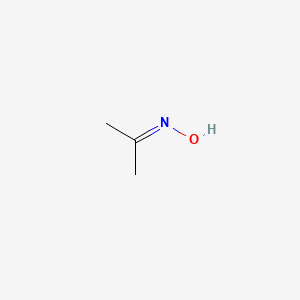
- IUPAC-Name
- N-propan-2-ylidenehydroxylamine
- Summenformel
- C3H7NO
- Molekulargewicht
- 73.09 g/mol
- Exakte Masse
- 73.052763847 Da
- XLogP3
- 0,1
- Topologische polare Oberfläche
- 32,6 Ų
- Wasserstoffbrücken-Donoren
- 1
- Wasserstoffbrücken-Akzeptoren
- 2
- Kovalente Einheiten
- 1
- Definierte Stereozentren
- 0
Auch bekannt als
16 weitere gemeldete Namen
Kennungen in externen Datenbanken
- ChEBI:CHEBI:15349
- EPA DTXSID:DTXSID6020010
- PubMed:3401844
Belege aus weiteren wissenschaftlichen Datenbanken
NIH PubChem PUG-View
Attributed physical-property, hazard, environmental and use annotations.
- Boiling Point: 133 °C Quelle: Hazardous Substances Data Bank (HSDB)
- Boiling Point: Boiling point = 134.8 °C at 728 mm Hg Quelle: Hazardous Substances Data Bank (HSDB)
- Color/Form: Columnar prisms Quelle: Hazardous Substances Data Bank (HSDB)
- Color/Form: Colorless crystals Quelle: Hazardous Substances Data Bank (HSDB)
- Density: Density: 0.9113 g/cm cu at 62 °C Quelle: Hazardous Substances Data Bank (HSDB)
- Dissociation Constants: pK = 12.42 at 24.9 °C Quelle: Hazardous Substances Data Bank (HSDB)
- LogP: log Kow = 0.12 Quelle: Hazardous Substances Data Bank (HSDB)
- Melting Point: 61 °C Quelle: Hazardous Substances Data Bank (HSDB)
- Physical Description: Crystals with a chloral odor; [Hawley] White powder; [Alfa Aesar MSDS] Quelle: Haz-Map, Information on Hazardous Chemicals and Occupational Diseases
- Refractive Index: Refractive index = 1.4156 at 20 °C Quelle: Hazardous Substances Data Bank (HSDB)
- Solubility: In water, 30.0 to 32.7% w/w at 20.0 °C Quelle: Hazardous Substances Data Bank (HSDB)
- Solubility: Soluble in water Quelle: Hazardous Substances Data Bank (HSDB)
- Solubility: Soluble in ethanol, diethyl ether, chloroform, ligroin Quelle: Hazardous Substances Data Bank (HSDB)
- Vapor Pressure: 3.12 [mmHg] Quelle: Haz-Map, Information on Hazardous Chemicals and Occupational Diseases
- Vapor Pressure: 1.82 mm Hg at 25 °C (242 hPa) Quelle: Hazardous Substances Data Bank (HSDB)
- Signal: Danger Quelle: Regulation (EC) No 1272/2008 of the European Parliament and of the Council
- GHS Hazard Statements: H312: Harmful in contact with skin [Warning Acute toxicity, dermal]; H317: May cause an allergic skin reaction [Warning Sensitization, Skin]; H318: Causes serious eye damage [Danger Serious eye damage/eye irritation]; H336: May cause drowsiness or dizziness [Warning Specific target organ toxicity, single exposure; Narcotic effects]; H350: May cause cancer [Danger Carcinogenicity]; H373: May causes damage to organs through prolonged or repeated exposure [Warning Specific target organ toxicity, repeated exposure] Quelle: Regulation (EC) No 1272/2008 of the European Parliament and of the Council
- Precautionary Statement Codes: P203, P260, P261, P264+P265, P271, P272, P280, P302+P352, P304+P340, P305+P354+P338, P317, P318, P319, P321, P333+P317, P362+P364, P403+P233, P405, and P501 (click each P-code to see the statement) Quelle: Regulation (EC) No 1272/2008 of the European Parliament and of the Council
- Signal: Danger Quelle: European Chemicals Agency (ECHA)
- GHS Hazard Statements: H228 (99.3%): Flammable solid [Danger Flammable solids]; H312 (80.9%): Harmful in contact with skin [Warning Acute toxicity, dermal]; H317 (94.7%): May cause an allergic skin reaction [Warning Sensitization, Skin]; H318 (96.7%): Causes serious eye damage [Danger Serious eye damage/eye irritation]; H351 (81.6%): Suspected of causing cancer [Warning Carcinogenicity] Quelle: European Chemicals Agency (ECHA)
- Precautionary Statement Codes: P203, P210, P240, P241, P261, P264+P265, P272, P280, P302+P352, P305+P354+P338, P317, P318, P321, P333+P317, P362+P364, P370+P378, P405, and P501 (click each P-code to see the statement) Quelle: European Chemicals Agency (ECHA)
- ECHA C&L Notifications Summary: Aggregated GHS information provided per 152 reports by companies from 11 notifications to the ECHA C&L Inventory. Each notification may be associated with multiple companies.; Information may vary between notifications depending on impurities, additives, and other factors. The percentage value in parenthesis indicates the notified classification ratio from companies that provide hazard codes. Only hazard codes with percentage values above 10% are shown. For more detailed information, please visit ECHA C&L website. Quelle: European Chemicals Agency (ECHA)
- Signal: Danger Quelle: Hazardous Substances Data Bank (HSDB)
- GHS Hazard Statements: H228: Flammable solid [Danger Flammable solids]; H312: Harmful in contact with skin [Warning Acute toxicity, dermal]; H317: May cause an allergic skin reaction [Warning Sensitization, Skin]; H318: Causes serious eye damage [Danger Serious eye damage/eye irritation]; H351: Suspected of causing cancer [Warning Carcinogenicity] Quelle: Hazardous Substances Data Bank (HSDB)
- Precautionary Statement Codes: P203, P210, P240, P241, P261, P264+P265, P272, P280, P302+P352, P305+P354+P338, P317, P318, P321, P333+P317, P362+P364, P370+P378, P405, and P501 (click each P-code to see the statement) Quelle: Hazardous Substances Data Bank (HSDB)
- Toxicity Summary: IDENTIFICATION AND USE: Acetoxime is a solid. It is used in organic synthesis (intermediate), as a solvent for cellulose ethers, and as a primer for diesel fuels. HUMAN STUDIES: Acetoxime has been tested in vitro as an experimental medication for herpes infection. ANIMAL STUDIES: Acetoxime was tested for carcinogenicity by chronic administration in the drinking water to male and female rats. The dose of 1.0 g/liter was administered 5 days/week for 18 months (total dose, 6.2 -7.0 g/rat). Acetoxime induced benign hepatocellular adenomas in 80% of the males but did not produce tumors in the females. The 90 day-NOAEL of the test substance in rats by the oral route was 15 mg/kg bw/day in both sexes. No effects were observed in the reproductive organs or tissues up to the highest dose tested (50 mg/kg bw/day). Acetoxime was negative in the Ames test with TA97, TA98, TA100 and TA1535 with and without metabolic activation. Acetoxime was genotoxic in Drosophila melanogaster. When tested in vivo acetoxime was found to induce a specific pattern of base damage in rat liver DNA and RNA, including the induction of increased levels of 8-hydroxyguanine. Because acetoxime was a weaker carcinogen in Quelle: Hazardous Substances Data Bank (HSDB)
- Environmental Bioconcentration: An estimated BCF of 3 was calculated in fish for acetoxime(SRC), using a log Kow of 0.12(1) and a regression-derived equation(2). According to a classification scheme(3), this BCF suggests the potential for bioconcentration in aquatic organisms is low(SRC). Quelle: Hazardous Substances Data Bank (HSDB)
- Environmental Fate: TERRESTRIAL FATE: Based on a classification scheme(1), an estimated Koc value of 1.3(SRC), determined from a log Kow of 0.12(2) and a regression-derived equation(3), indicates that acetoxime is expected to have very high mobility in soil(SRC). The pKa of acetoxime is 12.42(4), indicating that this compound will exist as its neutral species in the environment (pH 5-9). Volatilization of acetoxime from moist soil surfaces is expected to be an important fate process(SRC) given an estimated Henry's Law constant of 7.8X10⁻⁶ atm-cu m/mole(SRC), developed using a fragment constant estimation method(3). Acetoxime is expected to volatilize from dry soil surfaces(SRC) based upon a vapor pressure of 1.82 mm Hg at 25 °C(5). A 0% of theoretical BOD using domestic sewage in the Closed Bottle test(6) suggests that biodegradation is not an important environmental fate process in soil(SRC). Quelle: Hazardous Substances Data Bank (HSDB)
- Environmental Fate: AQUATIC FATE: Based on a classification scheme(1), an estimated Koc value of 1.3(SRC), determined from a log Kow of 0.12(2) and a regression-derived equation(3), indicates that acetoxime is not expected to adsorb to suspended solids and sediment(SRC). Volatilization from water surfaces is expected(4) based upon an estimated Henry's Law constant of 7.8X10⁻⁶ atm-cu m/mole(SRC), developed using a fragment constant estimation method(3). Using this Henry's Law constant and an estimation method(5), volatilization half-lives for a model river and model lake are 4 days and 33 days, respectively(SRC). According to a classification scheme(6), an estimated BCF of 3.2(SRC), from its log Kow(2) and a regression-derived equation(3), suggests the potential for bioconcentration in aquatic organisms is low. A 0% of theoretical BOD using domestic sewage in the Closed Bottle test(7) suggests that biodegradation is not an important environmental fate process in water(SRC). Quelle: Hazardous Substances Data Bank (HSDB)
- Environmental Fate: ATMOSPHERIC FATE: According to a model of gas/particle partitioning of semivolatile organic compounds in the atmosphere(1), acetoxime, which has a vapor pressure of 1.82 mm Hg at 25 °C(2), is expected to exist solely as a vapor in the ambient atmosphere. Vapor-phase acetoxime is degraded in the atmosphere by reaction with photochemically-produced hydroxyl radicals(SRC); the half-life for this reaction in air is estimated to be 48 days(SRC), calculated from its rate constant of 3.3X10⁻¹³ cu cm/molecule-sec at 25 °C(SRC) that was derived using a structure estimation method(3). Acetoxime does not contain chromophores that absorb at wavelengths >290 nm(4) and, therefore, is not expected to be susceptible to direct photolysis by sunlight(SRC). Quelle: Hazardous Substances Data Bank (HSDB)
- Sources/Uses: Used as a solvent (cellulose ethers), primer (diesel fuels), and intermediate (organic synthesis); [Hawley] Quelle: Haz-Map, Information on Hazardous Chemicals and Occupational Diseases
- Uses: MEDICATION Quelle: Hazardous Substances Data Bank (HSDB)
- Uses: Organic synthesis (intermediate); solvent for cellulose ethers; primer for diesel fuels. Quelle: Hazardous Substances Data Bank (HSDB)
Zugeordnet durch: Existing checksum-valid CAS to unique PubChem CID match. Abgerufen: 2026-08-31. Quelleneintrag öffnen
Wissenschaftliche Klassifizierungen und Gefahrenannotationen liefern Kontext und ersetzen nicht die oben gezeigte marktspezifische regulatorische Entscheidung.
Weitere Quellenabdeckung und Trefferstatus
| Quelle | Ergebnis | Geprüft |
|---|---|---|
| NIH PubChem PUG-View | Exakter Treffer | 2026-08-31 |
Ein erfasster Nicht-Treffer ist ein nützlicher Beleg dafür, dass die Quelle geprüft wurde; er ist keine Behauptung, dass der Stoff anderswo nicht existiert.
Am 2026-09-02 von NIH PubChem durch prüfsummengültigen CAS-Abgleich abgerufen. Chemische Eigenschaften ersetzen nicht die regulatorische Entscheidung auf dieser Seite.
Verwandte Einträge zu Acetone oxime
Für diesen Eintrag gibt es nur wenige direkte Treffer; daher werden auch nahe liegende Einträge aus Anhang II angezeigt.
reaction mass of 1,3-dioxan-5-ol and 1,3-dioxolan-4-ylmethanol
2-(dimethylamino)-2-[(4-methylphenyl)methyl]-1-[4-(morpholin-4-yl)phenyl]butan-1-one
Multi-walled Carbon Tubes (synthetic graphite in tubular shape) with a geometric tube diameter rang…
2,3-epoxypropyl neodecanoate
foramsulfuron (ISO); 2-{[(4,6-dimethoxypyrimidin-2-yl)carbamoyl]sulfamoyl}-4-formamido-N,N-dimethyl…
Benthiavalicarb-isopropyl (ISO); isopropyl [(S)-1-{[(R)-1-(6-fluoro-1,3-benzothiazol-2-yl)ethyl]car…
3,3'-dimethylbiphenyl-4,4'-diyl diisocyanate
7-oxabicyclo[4.1.0]hept-3-ylmethyl 7-oxabicyclo[4.1.0]heptane-3-carboxylate
Sodium 3-(allyloxy)-2-hydroxypropanesulphonate
difenoconazole (ISO); 1-({2-[2-chloro-4-(4-chlorophenoxy)phenyl]-4-methyl-1,3-dioxolan-2-yl}methyl)…
1,4-dichloro-2-nitrobenzene
Was Anhang II für Acetone oxime bedeutet
Acetone oxime ist in Anhang II der EU-Kosmetikverordnung (EG) Nr. 1223/2009 als verbotener Stoff aufgeführt und darf nicht absichtlich zugesetzt werden. Artikel 17 regelt gesondert unbeabsichtigte geringe Mengen, die bei guter Herstellungspraxis technisch unvermeidbar und mit der Sicherheitsanforderung nach Artikel 3 vereinbar sind.
Rezepturentwickler müssen ihre Inhaltsstoffe und Rohstoffe prüfen, um sicherzustellen, dass keiner davon diesen Stoff enthält. Lieferanten sollten auf Anfrage eine Dokumentation vorlegen, die die Abwesenheit bestätigt.
Die Seite zeigt außerdem 12 verwandte Anhangseinträge mit überschneidenden Kennungen, Anhangslogik oder Namensmustern.
Compliance-Checkliste
- Prüfen Sie, dass dieser Stoff in allen Rohstoffen und fertigen Rezepturen nicht enthalten ist.
- Fordern Sie von Rohstofflieferanten eine Abwesenheitsbestätigung oder ein Analysenzertifikat an.
- Dokumentieren Sie das Prüfergebnis in der Produktinformationsdatei (PIF).
Häufig gestellte Fragen
Quellenhinweis zu Anhang II, Eintrag Acetone oxime
Diese Seite fasst einen Eintrag aus Anhang II für Acetone oxime aus öffentlichen Materialien der Europäischen Kommission zu kosmetischen Mitteln zusammen und ergänzt, soweit verfügbar, verknüpfte Treffer aus dem Verzeichnis oder bei Kennungen.
Nutzen Sie diese Eintragsseite, um die Bedingungen aus Anhang II für Acetone oxime zu prüfen; bestätigen Sie jede endgültige regulatorische Entscheidung jedoch anhand des aktuellen amtlichen Anhangswortlauts und der Quelldateien.
Werkzeuge und nächste Schritte
Rezeptur prüfen
Fügen Sie eine vollständige INCI-Liste ein, um Acetone oxime und andere markierte EU-Anhangseinträge in einem Durchgang zu finden.
INCI-CheckerEinträge vergleichen
Acetone oxime nebeneinander mit einem anderen Anhangseintrag vergleichen, um Unterschiede bei Beschränkungen, Konzentrationen und Anhangszuordnung zu prüfen.
VergleichenDen Anhang durchsuchen
Alle Einträge in Anhang II ansehen und die regulatorischen Bedingungen der Stoffe in diesem Anhang vergleichen.
Anhang II öffnen