
1,2-Benzenedicarboxylic acid, dipentylester, branched and linear [1]; n-Pentyl-isopentylphthalate [2]; di-n-Pentyl phthalate [3]; Diisopentylphthalate [4]
Listed by the Saudi Food and Drug Authority as prohibited in cosmetic products.
Regulatorische Entscheidung und vollständige Bedingungen
- Status
- Prohibited
- Rechtsrolle
- Binding rule
- Regulatorische Zusammenfassung
- Listed by the Saudi Food and Drug Authority as prohibited in cosmetic products.
- Bedingungen und Beschränkungen
- A prohibition entry may contain no separate condition text because the regulatory outcome is the prohibition itself. Öffnen Sie die zitierte Quelle und wenden Sie die unten genannten marktweiten Anforderungen an.
Stoffidentität
- Name in der amtlichen Quelle
- 1,2-Benzenedicarboxylic acid, dipentylester, branched and linear [1]; n-Pentyl-isopentylphthalate [2]; di-n-Pentyl phthalate [3]; Diisopentylphthalate [4]
- CAS
- 84777-06-0; 131-18-0; 605-50-5
- EC
- Not supplied in this source row
- Identitätszuordnung
- standalone:official_sfda_record
Marktübergreifende Übersicht zu dieser Identität
Exakte verknüpfte Einträge, die derzeit auf dieser Website vorhanden sind. Ein fehlender Markt bedeutet, dass kein exakter Treffer importiert wurde, nicht dass der Stoff verwendet werden darf.
European Union
1 verknüpfter Eintrag
Unterstützenden Eintrag öffnenNew Zealand
3 verknüpfte Einträge
Unterstützenden Eintrag öffnenChina
1 verknüpfter Eintrag · 1 mit besonderen Bedingungen
Unterstützenden Eintrag öffnenSouth Korea
1 verknüpfter Eintrag · 1 mit besonderen Bedingungen
Unterstützenden Eintrag öffnenBrazil
1 verknüpfter Eintrag · 1 mit besonderen Bedingungen
Unterstützenden Eintrag öffnenIndia
1 verknüpfter Eintrag · 1 mit besonderen Bedingungen
Unterstützenden Eintrag öffnenSaudi Arabia
Aktueller Eintrag1 verknüpfter Eintrag
Unterstützenden Eintrag öffnen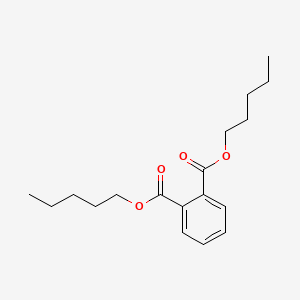
Verifizierte Chemie für CAS 131-18-0
Dipentyl phthalate
Dipentyl phthalate is a phthalate ester that is the dipentyl ester of benzene-1,2-dicarboxylic acid. It has a role as a plasticiser. It is a phthalate ester and a diester. It is functionally related to a pentan-1-ol. — ChEBI
- IUPAC-Name
- dipentyl benzene-1,2-dicarboxylate
- Summenformel
- C18H26O4
- Molekulargewicht
- 306.4 g/mol
- Exakte Masse
- 306.18310931 Da
- Monoisotopische Masse
- 306.18310931 Da
- XLogP3
- 5,8
- Topologische polare Oberfläche
- 52,6 Ų
- Molekulare Komplexität
- 295,0
- Formale Ladung
- 0
- Wasserstoffbrücken-Donoren
- 0
- Wasserstoffbrücken-Akzeptoren
- 4
- Drehbare Bindungen
- 12
- Schweratome
- 22
- Kovalente Einheiten
- 1
An PubChem gemeldete Namen und Synonyme
16 weitere gemeldete Namen
Kennungen in externen Datenbanken
- ChEBI:CHEBI:34680
- ChEMBL:CHEMBL1503330
- EPA DTXSID:DTXSID5031131
- PubMed:40570975
- PubMed:36715143
- PubMed:33983380
- PubMed:33798595
- PubMed:33049310
- PubMed:28927721
- PubMed:28571686
- PubMed:27532513
- PubMed:26472102
- PubMed:26454885
- PubMed:25938866
- PubMed:25055962
Erweiterte Strukturstatistik
- Definierte Atom-Stereozentren
- 0
- Nicht definierte Atom-Stereozentren
- 0
- Definierte Bindungs-Stereozentren
- 0
- Nicht definierte Bindungs-Stereozentren
- 0
- 3D-Pharmakophormerkmale
- 5
- 3D-Ringe
- 1
- 3D-Hydrophobe
- 2
- 3D-Akzeptormerkmale
- 2
- 3D-Donormerkmale
- 0
- 3D-Anionenzentren
- 0
- 3D-Kationenzentren
- 0
- 3D-Konformere
- 10
- Effektive 3D-Rotoren
- 12,0
Maschinenlesbare Strukturkennungen
- SMILES
CCCCCOC(=O)C1=CC=CC=C1C(=O)OCCCCC- InChI
InChI=1S/C18H26O4/c1-3-5-9-13-21-17(19)15-11-7-8-12-16(15)18(20)22-14-10-6-4-2/h7-8,11-12H,3-6,9-10,13-14H2,1-2H3- InChIKey
IPKKHRVROFYTEK-UHFFFAOYSA-N
Belege aus weiteren wissenschaftlichen Datenbanken
NIH PubChem PUG-View
Attributed physical-property, hazard, environmental and use annotations.
- Boiling Point: 648 °F at 760 mmHg (NTP, 1992) Quelle: CAMEO Chemicals
- Boiling Point: 342 °C Quelle: Hazardous Substances Data Bank (HSDB)
- Color/Form: Colorless, oily liquid Quelle: Hazardous Substances Data Bank (HSDB)
- Density: 1.022 at 68 °F (NTP, 1992) - Denser than water; will sink Quelle: CAMEO Chemicals
- Density: 1.022 at 20 °C Quelle: Hazardous Substances Data Bank (HSDB)
- Flash Point: 357 °F (NTP, 1992) Quelle: CAMEO Chemicals
- Flash Point: 357 °F; 180 °C (Closed cup) Quelle: Hazardous Substances Data Bank (HSDB)
- Flash Point: 245 dec F (118 °C) (Closed cup) Quelle: Hazardous Substances Data Bank (HSDB)
- LogP: log Kow = 5.62 Quelle: Hazardous Substances Data Bank (HSDB)
- Melting Point: less than -67 °F (NTP, 1992) Quelle: CAMEO Chemicals
- Melting Point: FP: less than -55 °C Quelle: Hazardous Substances Data Bank (HSDB)
- Odor: Nearly odorless Quelle: Hazardous Substances Data Bank (HSDB)
- Physical Description: Di-n-pentyl phthalate is a clear colorless to light yellow liquid. Practically odorless. Floats on water. (NTP, 1992) Quelle: CAMEO Chemicals
- Physical Description: Colorless oily liquid; [Hawley] Clear colorless to light yellow liquid; [CAMEO] Clear very faintly yellow liquid; [MSDSonline] Quelle: Haz-Map, Information on Hazardous Chemicals and Occupational Diseases
- Refractive Index: Index of refraction: 1.488 at 25 °C Quelle: Hazardous Substances Data Bank (HSDB)
- Solubility: less than 1 mg/mL at 68 °F (NTP, 1992) Quelle: CAMEO Chemicals
- Solubility: Phthalate esters are soluble to various extents in many common organic solvents and oils, but have a relatively low solubility in water. /Phthalate esters/ Quelle: Hazardous Substances Data Bank (HSDB)
- Solubility: Soluble in carbon tetrachloride, carbon disulfide Quelle: Hazardous Substances Data Bank (HSDB)
- Solubility: In water, 0.8 mg/L at 25 °C Quelle: Hazardous Substances Data Bank (HSDB)
- Vapor Pressure: 0.000196 [mmHg] Quelle: Haz-Map, Information on Hazardous Chemicals and Occupational Diseases
- Vapor Pressure: Vapor pressures for phthalate esters are extremely low, contributing much to their thermal stability in plastics. /Phthalate esters/ Quelle: Hazardous Substances Data Bank (HSDB)
- Carcinogen Classification: No indication of carcinogenicity to humans (not listed by IARC). Quelle: Toxin and Toxin Target Database (T3DB)
- Exposure Routes: Oral (L1903) ; inhalation (L1903) ; dermal (L1903) Quelle: Toxin and Toxin Target Database (T3DB)
- First Aid: EYES: First check the victim for contact lenses and remove if present. Flush victim's eyes with water or normal saline solution for 20 to 30 minutes while simultaneously calling a hospital or poison control center. Do not put any ointments, oils, or medication in the victim's eyes without specific instructions from a physician. IMMEDIATELY transport the victim after flushing eyes to a hospital even if no symptoms (such as redness or irritation) develop.; SKIN: IMMEDIATELY flood affected skin with water while removing and isolating all contaminated clothing. Gently wash all affected skin areas thoroughly with soap and water. If symptoms such as redness or irritation develop, IMMEDIATELY call a physician and be prepared to transport the victim to a hospital for treatment.; INHALATION: IMMEDIATELY leave the contaminated area; take deep breaths of fresh air. If symptoms (such as wheezing, coughing, shortness of breath, or burning in the mouth, throat, or chest) develop, call a physician and be prepared to transport the victim to a hospital. Provide proper respiratory protection to rescuers entering an unknown atmosphere. Whenever possible, Self-Contained Breathing Apparatus (SCBA) shou Quelle: CAMEO Chemicals
- Signal: Danger Quelle: Regulation (EC) No 1272/2008 of the European Parliament and of the Council
- GHS Hazard Statements: H360FD: May damage fertility; May damage the unborn child [Danger Reproductive toxicity]; H400: Very toxic to aquatic life [Warning Hazardous to the aquatic environment, acute hazard] Quelle: Regulation (EC) No 1272/2008 of the European Parliament and of the Council
- Precautionary Statement Codes: P203, P273, P280, P318, P391, P405, and P501 (click each P-code to see the statement) Quelle: Regulation (EC) No 1272/2008 of the European Parliament and of the Council
- Signal: Danger Quelle: European Chemicals Agency (ECHA)
- GHS Hazard Statements: H360 (99.3%): May damage fertility or the unborn child [Danger Reproductive toxicity]; H400 (100%): Very toxic to aquatic life [Warning Hazardous to the aquatic environment, acute hazard] Quelle: European Chemicals Agency (ECHA)
- Precautionary Statement Codes: P203, P273, P280, P318, P391, P405, and P501 (click each P-code to see the statement) Quelle: European Chemicals Agency (ECHA)
- ECHA C&L Notifications Summary: Aggregated GHS information provided per 271 reports by companies from 10 notifications to the ECHA C&L Inventory. Each notification may be associated with multiple companies.; Information may vary between notifications depending on impurities, additives, and other factors. The percentage value in parenthesis indicates the notified classification ratio from companies that provide hazard codes. Only hazard codes with percentage values above 10% are shown. For more detailed information, please visit ECHA C&L website. Quelle: European Chemicals Agency (ECHA)
- Signal: Danger Quelle: NITE-CMC
- GHS Hazard Statements: H360: May damage fertility or the unborn child [Danger Reproductive toxicity] Quelle: NITE-CMC
- Precautionary Statement Codes: P203, P280, P318, P405, and P501 (click each P-code to see the statement) Quelle: NITE-CMC
- Signal: Danger Quelle: Hazardous Chemical Information System (HCIS), Safe Work Australia
- GHS Hazard Statements: H360FD: May damage fertility; May damage the unborn child [Danger Reproductive toxicity]; H400: Very toxic to aquatic life [Warning Hazardous to the aquatic environment, acute hazard] Quelle: Hazardous Chemical Information System (HCIS), Safe Work Australia
- Health Effects: Phthalate esters are endocrine disruptors. Animal studies have shown that they disrupt reproductive development and can cause a number of malformations in affected young, such as reduced anogenital distance (AGD), cryptorchidism, hypospadias, and reduced fertility. The combination of effects associated with phthalates is called 'phthalate syndrome’. (A2883) Quelle: Toxin and Toxin Target Database (T3DB)
- NFPA Health Rating: 1 - Materials that, under emergency conditions, can cause significant irritation. Quelle: Hazardous Substances Data Bank (HSDB)
- NFPA Fire Rating: 1 - Materials that must be preheated before ignition can occur. Materials require considerable preheating, under all ambient temperature conditions, before ignition and combustion can occur. Quelle: Hazardous Substances Data Bank (HSDB)
- NFPA Instability Rating: 0 - Materials that in themselves are normally stable, even under fire conditions. Quelle: Hazardous Substances Data Bank (HSDB)
- Toxicity Summary: Phthalate esters are endocrine disruptors. They decrease foetal testis testosterone production and reduce the expression of steroidogenic genes by decreasing mRNA expression. Some phthalates have also been shown to reduce the expression of insulin-like peptide 3 (insl3), an important hormone secreted by the Leydig cell necessary for development of the gubernacular ligament. Animal studies have shown that these effects disrupt reproductive development and can cause a number of malformations in affected young. (A2883) Quelle: Toxin and Toxin Target Database (T3DB)
- Environmental Bioconcentration: An estimated BCF of 420 was calculated in fish for diamyl phthalate(SRC), using a log Kow of 5.62(1) and a regression-derived equation(2). According to a classification scheme(3), this BCF suggests the potential for bioconcentration in aquatic organisms is high, provided the compound is not metabolized by the organism(SRC). However, bioconcentration studies on compounds which are structurally similar suggest that bioconcentration may be lower than that indicated by the regression-derived equations due to the ability of aquatic organisms to readily metabolize this class of compounds(4). Quelle: Hazardous Substances Data Bank (HSDB)
- Environmental Fate: TERRESTRIAL FATE: Based on a classification scheme(1), an estimated Koc value of 27,000(SRC), determined from a log Kow values of 5.62(2), and a regression-derived equation(3), indicate that diamyl phthalate is expected to be immobile in soil(SRC). Volatilization of diamyl phthalate from moist soil surfaces is not expected to be an important fate process(SRC) given an estimated Henry's Law constant of 8.9X10⁻⁷ atm-cu m/mole(SRC), using a fragment constant estimation method(4). Diamyl phthalate is not expected to volatilize from dry soil surfaces(SRC) based upon an estimated vapor pressure of 2.0X10⁻⁴ mm Hg(SRC), determined from a fragment constant method(5). Biodegradation studies using pure cultures indicate that diamyl phthalate may biodegrade under aerobic conditions yielding phthalic acid and amyl alcohol(6). Although biodegradation data on diamyl phthalate are limited, biodegradation studies on a series of phthalate esters have demonstrated that, in general, phthalate esters are readily biodegraded(7). Quelle: Hazardous Substances Data Bank (HSDB)
- Environmental Fate: AQUATIC FATE: Based on a classification scheme(1), an estimated Koc value of 27,000(SRC), determined from a log Kow values of 5.62(2), and a regression-derived equation(3), indicate that diamyl phthalate is expected to adsorb to suspended solids and sediment(SRC). Volatilization from water surfaces is not expected(3) based upon an estimated Henry's Law constant of 8.9X10⁻⁷ atm-cu m/mole(SRC), developed using a fragment constant estimation method(4). According to a classification scheme(5), an estimated BCF of 420(SRC), from its log Kow(2) and a regression-derived equation(6), suggests the potential for bioconcentration in aquatic organisms is high, provided the compound is not metabolized by the organism(SRC). However, bioconcentration studies on compounds which are structurally similar suggest that bioconcentration may be lower than that indicated by the regression-derived equations due to the ability of aquatic organisms to readily metabolize this class of compounds(7). Estimated hydrolysis half-lives of 3.4 years and 130 days at pHs 7 and 8, respectively, suggest that hydrolysis is not expected to be an important process(8). Biodegradation studies using pure cultures indicate th Quelle: Hazardous Substances Data Bank (HSDB)
- Environmental Fate: ATMOSPHERIC FATE: According to a model of gas/particle partitioning of semivolatile organic compounds in the atmosphere(1), diamyl phthalate, which has an estimated vapor pressure of 2.0X10⁻⁴ mm Hg at 25 °C(SRC), determined from a fragment constant method(2), is expected to exist solely as a vapor in the ambient atmosphere. Vapor-phase diamyl phthalate is degraded in the atmosphere by reaction with photochemically-produced hydroxyl radicals(SRC); the half-life for this reaction in air is estimated to be 32 hours(SRC), calculated from its rate constant of 1.2X10⁻¹¹ cu cm/molecule-sec at 25 °C(SRC) that was derived using a structure estimation method(3). Diamyl phthalate does contain chromophores that absorb at wavelengths >290 nm(4) and therefore may be susceptible to direct photolysis by sunlight(SRC). Quelle: Hazardous Substances Data Bank (HSDB)
- Sources/Uses: Used as plasticizer; [Hawley] Quelle: Haz-Map, Information on Hazardous Chemicals and Occupational Diseases
- Uses: Plasticizer Quelle: Hazardous Substances Data Bank (HSDB)
- Uses: Phthalate esters are mainly used as plasticizers, primarily used to soften polyvinyl chloride. They are found in a number of products, including glues, building materials, personal care products, detergents and surfactants, packaging, children's toys, paints, pharmaceuticals, food products, and textiles. Phthalates are used in a variety of household applications such as shower curtains, vinyl upholstery, adhesives, floor tiles, food containers and wrappers, and cleaning materials. Personal care items containing phthalates include perfume, eye shadow, moisturizer, nail polish, liquid soap, and hair spray. (L1903) Quelle: Toxin and Toxin Target Database (T3DB)
Zugeordnet durch: Existing checksum-valid CAS to unique PubChem CID match. Abgerufen: 2026-08-31. Quelleneintrag öffnen
Wissenschaftliche Klassifizierungen und Gefahrenannotationen liefern Kontext und ersetzen nicht die oben gezeigte marktspezifische regulatorische Entscheidung.
Weitere Quellenabdeckung und Trefferstatus
| Quelle | Ergebnis | Geprüft |
|---|---|---|
| NIH PubChem PUG-View | Exakter Treffer | 2026-08-31 |
Ein erfasster Nicht-Treffer ist ein nützlicher Beleg dafür, dass die Quelle geprüft wurde; er ist keine Behauptung, dass der Stoff anderswo nicht existiert.
Am 2026-09-02 von NIH PubChem durch prüfsummengültigen CAS-Abgleich abgerufen. Chemische Eigenschaften ersetzen nicht die regulatorische Entscheidung auf dieser Seite.
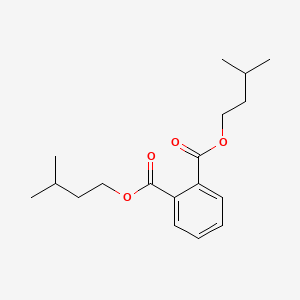
Verifizierte Chemie für CAS 605-50-5
Diisopentyl phthalate
isoamyl phthalate has been reported in Cryptotaenia canadensis with data available. — LOTUS - the natural products occurrence database
- IUPAC-Name
- bis(3-methylbutyl) benzene-1,2-dicarboxylate
- Summenformel
- C18H26O4
- Molekulargewicht
- 306.4 g/mol
- Exakte Masse
- 306.18310931 Da
- Monoisotopische Masse
- 306.18310931 Da
- XLogP3
- 5,6
- Topologische polare Oberfläche
- 52,6 Ų
- Molekulare Komplexität
- 315,0
- Formale Ladung
- 0
- Wasserstoffbrücken-Donoren
- 0
- Wasserstoffbrücken-Akzeptoren
- 4
- Drehbare Bindungen
- 10
- Schweratome
- 22
- Kovalente Einheiten
- 1
An PubChem gemeldete Namen und Synonyme
16 weitere gemeldete Namen
Kennungen in externen Datenbanken
- EPA DTXSID:DTXSID80209236
- PubMed:22715693
Erweiterte Strukturstatistik
- Definierte Atom-Stereozentren
- 0
- Nicht definierte Atom-Stereozentren
- 0
- Definierte Bindungs-Stereozentren
- 0
- Nicht definierte Bindungs-Stereozentren
- 0
- 3D-Pharmakophormerkmale
- 5
- 3D-Ringe
- 1
- 3D-Hydrophobe
- 2
- 3D-Akzeptormerkmale
- 2
- 3D-Donormerkmale
- 0
- 3D-Anionenzentren
- 0
- 3D-Kationenzentren
- 0
- 3D-Konformere
- 10
- Effektive 3D-Rotoren
- 10,0
Maschinenlesbare Strukturkennungen
- SMILES
CC(C)CCOC(=O)C1=CC=CC=C1C(=O)OCCC(C)C- InChI
InChI=1S/C18H26O4/c1-13(2)9-11-21-17(19)15-7-5-6-8-16(15)18(20)22-12-10-14(3)4/h5-8,13-14H,9-12H2,1-4H3- InChIKey
JANBFCARANRIKJ-UHFFFAOYSA-N
Am 2026-09-02 von NIH PubChem durch prüfsummengültigen CAS-Abgleich abgerufen. Chemische Eigenschaften ersetzen nicht die regulatorische Entscheidung auf dieser Seite.
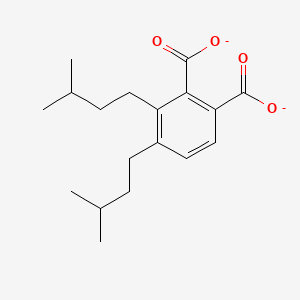
Verifizierte Chemie für CAS 84777-06-0
1,2-Benzenedicarboxylic acid, dipentyl ester, branched and linear
- IUPAC-Name
- 3,4-bis(3-methylbutyl)phthalate
- Summenformel
- C18H24O4-2
- Formel ohne Ladung
- C18H24O4
- Molekulargewicht
- 304.4 g/mol
- Exakte Masse
- 304.16745924 Da
- Monoisotopische Masse
- 304.16745924 Da
- XLogP3
- 6,5
- Topologische polare Oberfläche
- 80,3 Ų
- Molekulare Komplexität
- 364,0
- Formale Ladung
- -2
- Wasserstoffbrücken-Donoren
- 0
- Wasserstoffbrücken-Akzeptoren
- 4
- Drehbare Bindungen
- 6
- Schweratome
- 22
- Kovalente Einheiten
- 1
An PubChem gemeldete Namen und Synonyme
Erweiterte Strukturstatistik
- Definierte Atom-Stereozentren
- 0
- Nicht definierte Atom-Stereozentren
- 0
- Definierte Bindungs-Stereozentren
- 0
- Nicht definierte Bindungs-Stereozentren
- 0
- 3D-Pharmakophormerkmale
- 9
- 3D-Ringe
- 1
- 3D-Hydrophobe
- 2
- 3D-Akzeptormerkmale
- 4
- 3D-Donormerkmale
- 0
- 3D-Anionenzentren
- 2
- 3D-Kationenzentren
- 0
- 3D-Konformere
- 10
- Effektive 3D-Rotoren
- 8,0
Maschinenlesbare Strukturkennungen
- SMILES
CC(C)CCC1=C(C(=C(C=C1)C(=O)[O-])C(=O)[O-])CCC(C)C- InChI
InChI=1S/C18H26O4/c1-11(2)5-7-13-8-10-15(17(19)20)16(18(21)22)14(13)9-6-12(3)4/h8,10-12H,5-7,9H2,1-4H3,(H,19,20)(H,21,22)/p-2- InChIKey
YRWFRHKQYQHUTP-UHFFFAOYSA-L
Am 2026-09-02 von NIH PubChem durch prüfsummengültigen CAS-Abgleich abgerufen. Chemische Eigenschaften ersetzen nicht die regulatorische Entscheidung auf dieser Seite.
Amtliche Quelle und Herkunft
- Registrierte Quelle
- Saudi SFDA prohibited and restricted ingredient lists
- Quellenverweis
- SFDA prohibited list, page 115, row 7
- Eintrags-ID der Quelle
prohibited-114-7- Quellenversion
- live-snapshot-2026-08-30
- Quellsprache
- English
- Übersetzungsstatus
- Original is English
- Stand geprüft
- 2026-08-30 05:18 UTC
- Validierungsmethode
- complete SFDA paginated HTML snapshot; strict page/row counts
- SHA-256
ceb6cc636e6b1f4b3013f88ce0297217b49d6194342c6ece5c03b1e04256d71a
Hinweise zum registrierten Datensatz
- Datensatzabdeckung
- Prohibited and restricted substances with CAS, EC and conditions
- Hinweis zur Behörde
- Official SFDA dated lists; version and hash each release
Wie dieser Eintrag in den Marktdatensatz passt
Statusverteilung
Bedingungstext ist bei 0 von 2090 aktuellen Einträgen vorhanden. Ein leeres Bedingungsfeld wird entsprechend der oben genannten Eintragsart interpretiert; es wird niemals in die Aussage einer uneingeschränkten Verwendung umgedeutet.
Saudi Arabia Marktkontext
Complete official list index
Abdeckungsversion: SFDA live prohibited/restricted lists, snapshot 30 August 2026
Every page and entry in the public SFDA prohibited and restricted ingredient indexes; restricted detail pages remain the source for conditions.
Verifizierungs-Checkliste
- Search names and CAS across both SFDA lists.
- Open the cited restricted-entry detail and apply every condition.
- Check current SFDA/GSO technical regulations and updates.
- Complete eCosma notification, label and responsible-party requirements.
Amtliche Marktquellen
- Saudi SFDA prohibited and restricted ingredient listsOfficial SFDA dated lists; version and hash each release
Verifizierungsablauf und Vollständigkeit des Eintrags
Bevor Sie dieses Ergebnis für eine Compliance-Entscheidung verwenden
- Bestätigen Sie, dass „1,2-Benzenedicarboxylic acid, dipentylester, branched and linear [1]; n-Pentyl-isopentylphthalate [2]; di-n-Pentyl phthalate [3]; Diisopentylphthalate [4]“ und jede CAS-/EC-Kennung sich auf das Material in Ihrer Lieferantenspezifikation beziehen.
- Search names and CAS across both SFDA lists.
- Open the cited restricted-entry detail and apply every condition.
- Check current SFDA/GSO technical regulations and updates.
- Complete eCosma notification, label and responsible-party requirements.
- Dokumentieren Sie die Quellenversion und prüfen Sie die Behörde vor Herstellung, Notifizierung oder Inverkehrbringen erneut.
In diesem Eintrag verfügbare Felder
- Amtlicher StoffnameVerfügbar
- CASVerfügbar
- ECNicht angegeben
- Gesonderter BedingungstextIn der Quellzeile nicht vorhanden
- Datum des InkrafttretensNicht angegeben
- Snapshot-Hash und MethodeVerfügbar
Fragen, die diese Seite beantwortet
Dauerhafte Zitierweise
1,2-Benzenedicarboxylic acid, dipentylester, branched and linear [1]; n-Pentyl-isopentylphthalate [2]; di-n-Pentyl phthalate [3]; Diisopentylphthalate [4]. SFDA prohibited list, page 115, row 7. Saudi Arabia. Source version live-snapshot-2026-08-30. CosIng Checker regulatory record: https://cosingchecker.com/de/regulations/sa/records/10746/
Zitieren Sie die Aufsichtsbehörde als rechtliche Autorität. Diese Seite ist ein strukturierter Belegindex und eine Verifizierungshilfe, kein Ersatz für den amtlichen Text oder eine fachkundige rechtliche Bewertung.
Auslegung und Grenzen für Saudi Arabia
This official record identifies the substance as prohibited for cosmetic use in the stated market scope.
Do not rely on a formulation containing this identity until the cited source, effective date and exact substance match have been verified.
Wie die Rechtsrolle auszulegen ist
The cited row forms part of a binding rule or legally incorporated list for this market.
Belege auf dieser Seite
- Erfasstes Ergebnis: Prohibited
- Rechtsrolle: Binding rule
- Quellenversion: live-snapshot-2026-08-30
Was es nicht beweist
No list match is not permission; Gulf/SFDA product, claim, notification and technical requirements still apply.
Weitere maßgebliche Stoffrecherche
Keine dieser Quellen hebt die oben genannte Marktentscheidung auf.
Cosmetic Ingredient Review safety assessments
Expert Panel conclusions, assessed ingredient groups, use conditions, dates and report documents
Independent expert review considered by FDA; not a government approval or binding market rule
Diese Identität bei der Quelle recherchierenFDA Global Substance Registration System
UNII identifiers, preferred names, substance types, codes and public substance relationships
Identity registry only; UNII availability does not imply FDA review or approval
Diese Identität bei der Quelle recherchierenILO/WHO International Chemical Safety Cards
Hazards, symptoms, first aid, storage, incompatibilities and physical properties for covered chemicals
International occupational chemical-safety reference; not cosmetic-use approval
Diese Identität bei der Quelle recherchierenJapan NITE-CHRIP
Chemical identity, Japanese and foreign legal lists, GHS hazards and exposure-related information
Chemical-management evidence; cosmetic status remains governed by the applicable MHLW standard and market rules
Diese Identität bei der Quelle recherchierenNIOSH Pocket Guide to Chemical Hazards
REL, PEL, IDLH, properties, exposure routes, symptoms, target organs, first aid and measurement methods for covered workplace chemicals
US occupational-health guidance and limits; not a cosmetic ingredient decision
Diese Identität bei der Quelle recherchierenOECD eChemPortal
Gateway to authority-owned physical-property, fate, ecotoxicity, toxicity, exposure and GHS records
Discovery gateway; each linked authority remains responsible for its data
Diese Identität bei der Quelle recherchierenUS EPA CompTox CTX APIs
Für den Import ist ein API-Schlüssel erforderlichDTXSID identity, experimental and predicted properties, toxicity, bioactivity, exposure and environmental data
Scientific and computational evidence; predictions must remain labelled and do not determine cosmetic legality
Diese Identität bei der Quelle recherchieren