
Malononitrile
New Zealand Cosmetic Products Group Standard Schedule 4, reference 149.
Regulatorische Entscheidung und vollständige Bedingungen
- Status
- Prohibited
- Rechtsrolle
- Binding rule
- Regulatorische Zusammenfassung
- New Zealand Cosmetic Products Group Standard Schedule 4, reference 149.
- Bedingungen und Beschränkungen
- A prohibition entry may contain no separate condition text because the regulatory outcome is the prohibition itself. Öffnen Sie die zitierte Quelle und wenden Sie die unten genannten marktweiten Anforderungen an.
Stoffidentität
- Name in der amtlichen Quelle
- Malononitrile
- CAS
- 109-77-3
- EC
- Not supplied in this source row
- Identitätszuordnung
- standalone:official_nz_schedule
Marktübergreifende Übersicht zu dieser Identität
Exakte verknüpfte Einträge, die derzeit auf dieser Website vorhanden sind. Ein fehlender Markt bedeutet, dass kein exakter Treffer importiert wurde, nicht dass der Stoff verwendet werden darf.
European Union
1 verknüpfter Eintrag
Unterstützenden Eintrag öffnenGreat Britain
1 verknüpfter Eintrag
Unterstützenden Eintrag öffnenCanada
1 verknüpfter Eintrag
Unterstützenden Eintrag öffnenNew Zealand
Aktueller Eintrag1 verknüpfter Eintrag
Unterstützenden Eintrag öffnenASEAN
1 verknüpfter Eintrag
Unterstützenden Eintrag öffnenChina
1 verknüpfter Eintrag · 1 mit besonderen Bedingungen
Unterstützenden Eintrag öffnenSouth Korea
1 verknüpfter Eintrag
Unterstützenden Eintrag öffnenBrazil
1 verknüpfter Eintrag · 1 mit besonderen Bedingungen
Unterstützenden Eintrag öffnenIndia
1 verknüpfter Eintrag · 1 mit besonderen Bedingungen
Unterstützenden Eintrag öffnenSaudi Arabia
1 verknüpfter Eintrag
Unterstützenden Eintrag öffnen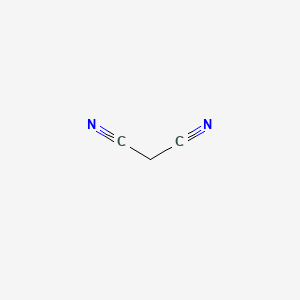
Verifizierte Chemie für CAS 109-77-3
Malononitrile
Malononitrile is a dinitrile that is methane substituted by two cyano groups. It is a dinitrile and an aliphatic nitrile. — ChEBI
- IUPAC-Name
- propanedinitrile
- Summenformel
- C3H2N2
- Molekulargewicht
- 66.06 g/mol
- Exakte Masse
- 66.021798072 Da
- Monoisotopische Masse
- 66.021798072 Da
- XLogP3
- -0,5
- Topologische polare Oberfläche
- 47,6 Ų
- Molekulare Komplexität
- 82,0
- Formale Ladung
- 0
- Wasserstoffbrücken-Donoren
- 0
- Wasserstoffbrücken-Akzeptoren
- 2
- Drehbare Bindungen
- 0
- Schweratome
- 5
- Kovalente Einheiten
- 1
An PubChem gemeldete Namen und Synonyme
16 weitere gemeldete Namen
Kennungen in externen Datenbanken
- ChEBI:CHEBI:33186
- ChEMBL:CHEMBL3187514
- EPA DTXSID:DTXSID6021907
- PubMed:23125765
- PubMed:23125655
- PubMed:23030064
- PubMed:22968474
- PubMed:22939001
- PubMed:22934677
- PubMed:22932824
- PubMed:22922279
- PubMed:22920458
- PubMed:22876607
- PubMed:22870807
- PubMed:22825620
Erweiterte Strukturstatistik
- Definierte Atom-Stereozentren
- 0
- Nicht definierte Atom-Stereozentren
- 0
- Definierte Bindungs-Stereozentren
- 0
- Nicht definierte Bindungs-Stereozentren
- 0
- 3D-Pharmakophormerkmale
- 2
- 3D-Ringe
- 0
- 3D-Hydrophobe
- 0
- 3D-Akzeptormerkmale
- 2
- 3D-Donormerkmale
- 0
- 3D-Anionenzentren
- 0
- 3D-Kationenzentren
- 0
- 3D-Konformere
- 1
- Effektive 3D-Rotoren
- 0,0
Maschinenlesbare Strukturkennungen
- SMILES
C(C#N)C#N- InChI
InChI=1S/C3H2N2/c4-2-1-3-5/h1H2- InChIKey
CUONGYYJJVDODC-UHFFFAOYSA-N
Belege aus weiteren wissenschaftlichen Datenbanken
NIH PubChem PUG-View
Attributed physical-property, hazard, environmental and use annotations.
- Boiling Point: 424 to 426 °F at 760 mmHg (EPA, 1998) Quelle: CAMEO Chemicals
- Boiling Point: 218-219 °C @ 760 mm Hg Quelle: Hazardous Substances Data Bank (HSDB)
- Boiling Point: 218-220 °C Quelle: ILO-WHO International Chemical Safety Cards (ICSCs)
- Boiling Point: 220 °C @760 [mm Hg] Quelle: PAC Chemical Database, U.S. Department of Energy
- Boiling Point: 426 °F Quelle: The National Institute for Occupational Safety and Health (NIOSH)
- Color/Form: Colorless solid Quelle: Hazardous Substances Data Bank (HSDB)
- Color/Form: White powder or colorless crystals Quelle: Hazardous Substances Data Bank (HSDB)
- Density: 1.191 at 68 °F (EPA, 1998) - Denser than water; will sink Quelle: CAMEO Chemicals
- Density: 1.1910 @ 20 °C/4 °C Quelle: Hazardous Substances Data Bank (HSDB)
- Density: 1.19 g/cm³ Quelle: ILO-WHO International Chemical Safety Cards (ICSCs)
- Density: 1.049 @ 34°C Quelle: PAC Chemical Database, U.S. Department of Energy
- Density: 1.19 Quelle: The National Institute for Occupational Safety and Health (NIOSH)
- Dissociation Constants: pKa = 11.40 Quelle: Hazardous Substances Data Bank (HSDB)
- Flash Point: 266 °F (EPA, 1998) Quelle: CAMEO Chemicals
- Flash Point: 266 °F Quelle: Haz-Map, Information on Hazardous Chemicals and Occupational Diseases
- Flash Point: 266 °F (OPEN CUP) Quelle: Hazardous Substances Data Bank (HSDB)
- Flash Point: 112 °C o.c. Quelle: ILO-WHO International Chemical Safety Cards (ICSCs)
- Flash Point: (oc) 266 °F Quelle: The National Institute for Occupational Safety and Health (NIOSH)
- LogP: log Kow = -0.60 Quelle: Hazardous Substances Data Bank (HSDB)
- LogP: -0.6 Quelle: ILO-WHO International Chemical Safety Cards (ICSCs)
- Melting Point: 90 °F (EPA, 1998) Quelle: CAMEO Chemicals
- Melting Point: 32 °C Quelle: Hazardous Substances Data Bank (HSDB)
- Melting Point: 30-34 °C Quelle: ILO-WHO International Chemical Safety Cards (ICSCs)
- Melting Point: 30.5 °C Quelle: PAC Chemical Database, U.S. Department of Energy
- Melting Point: 90 °F Quelle: The National Institute for Occupational Safety and Health (NIOSH)
- Physical Description: Malononitrile appears as a white-colored crystalline solid. Denser than water and soluble in water. Toxic by ingestion and may severely irritate skin and eyes. May polymerize violently if exposed to temperatures above 266 °F. Used to make other chemicals. Quelle: CAMEO Chemicals
- Physical Description: Other Solid Quelle: EPA Chemical Data Reporting (CDR)
- Physical Description: White powder or colorless crystals; Note: Melts above 90 degrees F. Forms cyanide in the body; [NIOSH] Quelle: Haz-Map, Information on Hazardous Chemicals and Occupational Diseases
- Physical Description: COLOURLESS CRYSTALS OR WHITE POWDER. Quelle: ILO-WHO International Chemical Safety Cards (ICSCs)
- Physical Description: White powder or colorless crystals. [Note: Melts above 90 °F. Forms cyanide in the body.] Quelle: The National Institute for Occupational Safety and Health (NIOSH)
- Refractive Index: Index of refraction: 1.4146 @ 34 °C/D Quelle: Hazardous Substances Data Bank (HSDB)
- Solubility: greater than or equal to 100 mg/mL at 72.5 °F (NTP, 1992) Quelle: CAMEO Chemicals
- Solubility: SOL IN ACETIC ACID, CHLOROFORM Quelle: Hazardous Substances Data Bank (HSDB)
- Solubility: Soluble in acetone and benzene Quelle: Hazardous Substances Data Bank (HSDB)
- Solubility: In water, 1.33X10+5 mg/l @ 25 °C Quelle: Hazardous Substances Data Bank (HSDB)
- Solubility: In ethanol, 0.40 g/ml @ 25 °C; in ether, 0.20 g/ml @ 25 °C Quelle: Hazardous Substances Data Bank (HSDB)
- Solubility: Solubility in water, g/100ml at 20 °C: 13.3 (moderate) Quelle: ILO-WHO International Chemical Safety Cards (ICSCs)
- Solubility: 13% Quelle: The National Institute for Occupational Safety and Health (NIOSH)
- Vapor Pressure: 0.2 [mmHg] Quelle: Haz-Map, Information on Hazardous Chemicals and Occupational Diseases
- Vapor Pressure: 0.200 mm Hg @ 25 °C Quelle: Hazardous Substances Data Bank (HSDB)
- Vapor Pressure: Vapor pressure, Pa at 25 °C: 27 Quelle: ILO-WHO International Chemical Safety Cards (ICSCs)
- Vapor Pressure: 11 [mm Hg] @99 °C Quelle: PAC Chemical Database, U.S. Department of Energy
- Carcinogen Classification: No indication of carcinogenicity to humans (not listed by IARC). Quelle: Toxin and Toxin Target Database (T3DB)
- Exposure Routes: The substance can be absorbed into the body by inhalation, through the skin and by ingestion. Quelle: ILO-WHO International Chemical Safety Cards (ICSCs)
- Exposure Routes: inhalation, skin absorption, ingestion, skin and/or eye contact Quelle: The National Institute for Occupational Safety and Health (NIOSH)
- Exposure Routes: Oral (L96) ; inhalation (L96) ; dermal (L96) Quelle: Toxin and Toxin Target Database (T3DB)
- First Aid: Warning: Malononitrile may be fatal if inhaled, swallowed, or absorbed through skin or mucous membranes. Caution is advised.; Signs and Symptoms of Malononitrile Exposure: Signs and symptoms of acute exposure to malononitrile may include hypertension (high blood pressure) and tachycardia (rapid heart rate), followed by hypotension (low blood pressure) and bradycardia (slow heart rate). Cherry-red or bloody mucous membranes may be noted. Cardiac arrhythmias and other cardiac abnormalities are common. Cyanosis (blue tint to the skin and mucous membranes) may be observed. Other symptoms include anxiety, confusion, tightness in the chest, and involuntary urination and defecation. Headache, vertigo (dizziness), agitation, and giddiness may be followed by combative behavior, convulsions, paralysis, protruding eyeballs, dilated and unreactive pupils, unconsciousness and coma. Tachypnea (rapid, shallow respirations) or hyperpnea (rapid, deep respirations) may be followed by respiratory depression or arrest. Lung hemorrhage and pulmonary edema may also occur. Malononitrile is irritating to the skin, eyes, and mucous membranes. Lacrimation (tearing) and a burning sensation of the mouth and t Quelle: CAMEO Chemicals
- ERG2024, Guide 153 (Malononitrile): General First Aid:; · Call 911 or emergency medical service.; · Ensure that medical personnel are aware of the material(s) involved, take precautions to protect themselves and avoid contamination.; · Move victim to fresh air if it can be done safely.; · Administer oxygen if breathing is difficult.; · If victim is not breathing:; -- DO NOT perform mouth-to-mouth resuscitation; the victim may have ingested or inhaled the substance.; -- If equipped and pulse detected, wash face and mouth, then give artificial respiration using a proper respiratory medical device (bag-valve mask, pocket mask equipped with a one-way valve or other device).; -- If no pulse detected or no respiratory medical device available, provide continuous compressions. Conduct a pulse check every two minutes or monitor for any signs of spontaneous respirations.; · Remove and isolate contaminated clothing and shoes.; · For minor skin contact, avoid spreading material on unaffected skin.; · In case of contact with substance, remove immediately by flushing skin or eyes with running water for at least 20 minutes.; · For severe burns, immediate medical attention is required.; · Effects of exposure (inhalation, ingestion, Quelle: Emergency Response Guidebook (ERG)
- First Aid: (General first aid procedures); Eye: Irrigate immediately - If this chemical contacts the eyes, immediately wash (irrigate) the eyes with large amounts of water, occasionally lifting the lower and upper lids. Get medical attention immediately.; Skin: Water wash immediately - If this chemical contacts the skin, immediately wash the contaminated skin with water. If this chemical penetrates the clothing, immediately remove the clothing and wash the skin with water. If symptoms occur after washing, get medical attention immediately.; Breathing: Respiratory support; Swallow: Medical attention immediately - If this chemical has been swallowed, get medical attention immediately. Quelle: The National Institute for Occupational Safety and Health (NIOSH)
- Signal: Danger Quelle: Regulation (EC) No 1272/2008 of the European Parliament and of the Council
- GHS Hazard Statements: H301: Toxic if swallowed [Danger Acute toxicity, oral]; H311: Toxic in contact with skin [Danger Acute toxicity, dermal]; H331: Toxic if inhaled [Danger Acute toxicity, inhalation]; H400: Very toxic to aquatic life [Warning Hazardous to the aquatic environment, acute hazard]; H410: Very toxic to aquatic life with long lasting effects [Warning Hazardous to the aquatic environment, long-term hazard] Quelle: Regulation (EC) No 1272/2008 of the European Parliament and of the Council
- Precautionary Statement Codes: P261, P262, P264, P270, P271, P273, P280, P301+P316, P302+P352, P304+P340, P316, P321, P330, P361+P364, P391, P403+P233, P405, and P501 (click each P-code to see the statement) Quelle: Regulation (EC) No 1272/2008 of the European Parliament and of the Council
- Signal: Danger Quelle: European Chemicals Agency (ECHA)
- GHS Hazard Statements: H300 (68.5%): Fatal if swallowed [Danger Acute toxicity, oral]; H301 (31.5%): Toxic if swallowed [Danger Acute toxicity, oral]; H311+H331 (52%): Toxic in contact with skin or if inhaled. [Danger Acute toxicity, dermal; acute toxicity, inhalation]; H311 (100%): Toxic in contact with skin [Danger Acute toxicity, dermal]; H317 (68.5%): May cause an allergic skin reaction [Warning Sensitization, Skin]; H319 (68.9%): Causes serious eye irritation [Warning Serious eye damage/eye irritation]; H331 (100%): Toxic if inhaled [Danger Acute toxicity, inhalation]; H400 (100%): Very toxic to aquatic life [Warning Hazardous to the aquatic environment, acute hazard]; H410 (100%): Very toxic to aquatic life with long lasting effects [Warning Hazardous to the aquatic environment, long-term hazard] Quelle: European Chemicals Agency (ECHA)
- Precautionary Statement Codes: P261, P262, P264, P264+P265, P270, P271, P272, P273, P280, P301+P316, P302+P352, P304+P340, P305+P351+P338, P316, P321, P330, P333+P317, P337+P317, P361+P364, P362+P364, P391, P403+P233, P405, and P501 (click each P-code to see the statement) Quelle: European Chemicals Agency (ECHA)
- ECHA C&L Notifications Summary: Aggregated GHS information provided per 254 reports by companies from 10 notifications to the ECHA C&L Inventory. Each notification may be associated with multiple companies.; Information may vary between notifications depending on impurities, additives, and other factors. The percentage value in parenthesis indicates the notified classification ratio from companies that provide hazard codes. Only hazard codes with percentage values above 10% are shown. For more detailed information, please visit ECHA C&L website. Quelle: European Chemicals Agency (ECHA)
- Signal: Danger Quelle: NITE-CMC
- GHS Hazard Statements: H301: Toxic if swallowed [Danger Acute toxicity, oral]; H311: Toxic in contact with skin [Danger Acute toxicity, dermal]; H319: Causes serious eye irritation [Warning Serious eye damage/eye irritation]; H330: Fatal if inhaled [Danger Acute toxicity, inhalation]; H370: Causes damage to organs [Danger Specific target organ toxicity, single exposure] Quelle: NITE-CMC
- Precautionary Statement Codes: P260, P262, P264, P264+P265, P270, P271, P280, P284, P301+P316, P302+P352, P304+P340, P305+P351+P338, P308+P316, P316, P320, P321, P330, P337+P317, P361+P364, P403+P233, P405, and P501 (click each P-code to see the statement) Quelle: NITE-CMC
- Signal: Danger Quelle: Hazardous Chemical Information System (HCIS), Safe Work Australia
- GHS Hazard Statements: H301: Toxic if swallowed [Danger Acute toxicity, oral]; H311: Toxic in contact with skin [Danger Acute toxicity, dermal]; H331: Toxic if inhaled [Danger Acute toxicity, inhalation]; H410: Very toxic to aquatic life with long lasting effects [Warning Hazardous to the aquatic environment, long-term hazard] Quelle: Hazardous Chemical Information System (HCIS), Safe Work Australia
- Health Effects: Exposure to high levels of cyanide for a short time harms the brain and heart and can even cause coma, seizures, apnea, cardiac arrest and death. Chronic inhalation of cyanide causes breathing difficulties, chest pain, vomiting, blood changes, headaches, and enlargement of the thyroid gland. Skin contact with cyanide salts can irritate and produce sores. (L96, L97) Quelle: Toxin and Toxin Target Database (T3DB)
- Target Organs: Eyes, skin, respiratory system, central nervous system, cardiovascular system Quelle: The National Institute for Occupational Safety and Health (NIOSH)
- Toxicity Summary: Organic nitriles decompose into cyanide ions both in vivo and in vitro. Consequently the primary mechanism of toxicity for organic nitriles is their production of toxic cyanide ions or hydrogen cyanide. Cyanide is an inhibitor of cytochrome c oxidase in the fourth complex of the electron transport chain (found in the membrane of the mitochondria of eukaryotic cells). It complexes with the ferric iron atom in this enzyme. The binding of cyanide to this cytochrome prevents transport of electrons from cytochrome c oxidase to oxygen. As a result, the electron transport chain is disrupted and the cell can no longer aerobically produce ATP for energy. Tissues that mainly depend on aerobic respiration, such as the central nervous system and the heart, are particularly affected. Cyanide is also known produce some of its toxic effects by binding to catalase, glutathione peroxidase, methemoglobin, hydroxocobalamin, phosphatase, tyrosinase, ascorbic acid oxidase, xanthine oxidase, succinic dehydrogenase, and Cu/Zn superoxide dismutase. Cyanide binds to the ferric ion of methemoglobin to form inactive cyanmethemoglobin. (L97) Quelle: Toxin and Toxin Target Database (T3DB)
- Environmental Bioconcentration: An estimated BCF of 3 was calculated for malononitrile(SRC), using a log Kow of -0.60(1) and a regression-derived equation(2). According to a classification scheme(3), this BCF suggests the potential for bioconcentration in aquatic organisms is low(SRC). Quelle: Hazardous Substances Data Bank (HSDB)
- Environmental Fate: TERRESTRIAL FATE: Based on a classification scheme(1), an estimated Koc value of 11(SRC), determined from a log Kow of -0.60(2) and a regression-derived equation(3), indicates that malononitrile is expected to have very high mobility in soil(SRC). Volatilization of malononitrile from moist soil surfaces is not expected to be an important fate process(SRC) given an estimated Henry's Law constant of 1.27X10⁻⁸ atm-cu m/mole(SRC), using a fragment constant estimation method(4). Malononitrile is not expected to volatilize from dry soil surfaces(SRC) based upon a vapor pressure of 0.20 mm Hg(5). Nitriles are biodegraded by enzyme-catalyzed hydrolysis to ultimately form carboxylic acids and ammonia(6,7). Thus, malononitrile may biodegrade in soil(SRC). Quelle: Hazardous Substances Data Bank (HSDB)
- Environmental Fate: AQUATIC FATE: Based on a classification scheme(1), an estimated Koc value of 11(SRC), determined from a log Kow of -0.60(2) and a regression-derived equation(3), indicates that malononitrile is not expected to adsorb to suspended solids and sediment(SRC). Volatilization from water surfaces is not expected(3) based upon an estimated Henry's Law constant of 1.27X10⁻⁸ atm-cu m/mole(SRC), developed using a fragment constant estimation method(4). According to a classification scheme(5), an estimated BCF of 3(SRC), from its log Kow(2) and a regression-derived equation(6), suggests the potential for bioconcentration in aquatic organisms is low(SRC). The neutral and base hydrolysis rate constants for malononitrile in water at 25 °C were experimentally determined to be 0.00135/hr and 806/M-hr, respectively, which corresponds to a half-life of 20.2 days at a pH of 7(7); at pHs of 5, 6, 8 and 9, the hydrolysis half-lives would be 21.4, 21.3. 13.4 and 3.1 days, respectively(SRC). Nitriles are biodegraded by enzyme-catalyzed hydrolysis to ultimately form carboxylic acids and ammonia(8,9). Thus, malononitrile may biodegrade in water(SRC). Quelle: Hazardous Substances Data Bank (HSDB)
- Environmental Fate: ATMOSPHERIC FATE: According to a model of gas/particle partitioning of semivolatile organic compounds in the atmosphere(1), malononitrile, which has a vapor pressure of 0.200 mm Hg at 25 °C(2), is expected to exist solely as a vapor in the ambient atmosphere(SRC). Vapor-phase malononitrile is degraded in the atmosphere by reaction with photochemically-produced hydroxyl radicals(SRC); the half-life for this reaction in air is estimated to be 476 days(SRC), calculated from its rate constant of 3.37X10⁻¹⁴ cu cm/molecule-sec at 25 °C(SRC) determined using a structure estimation method(3). Quelle: Hazardous Substances Data Bank (HSDB)
- Industry Uses: Intermediate Quelle: EPA Chemical Data Reporting (CDR)
- Sources/Uses: Used in organic synthesis of thiamine, an anti-cancer drug, acrylic fibers, and dyes; used as a leaching agent for gold; [HSDB] Quelle: Haz-Map, Information on Hazardous Chemicals and Occupational Diseases
- Uses: Organic synthesis; leaching agent for gold Quelle: Hazardous Substances Data Bank (HSDB)
- Uses: Used as lubricating oil additive; thiamine synthesis; anti-cancer agent synthesis; acrylic fiber and dyestuff synthesis. Quelle: Hazardous Substances Data Bank (HSDB)
- Uses: In life science industry, especially for synthesis of N-containing heterocycles; in production of herbicides, the diuretic triamterene, antineoplastic methotrexate, adenine, dyes, 7,7,8,8-tetracyanoquinodimethane, 2-chlorobenzyliden malononitrile (CS-gas) used for self-defense. Quelle: Hazardous Substances Data Bank (HSDB)
Zugeordnet durch: Existing checksum-valid CAS to unique PubChem CID match. Abgerufen: 2026-08-31. Quelleneintrag öffnen
Wissenschaftliche Klassifizierungen und Gefahrenannotationen liefern Kontext und ersetzen nicht die oben gezeigte marktspezifische regulatorische Entscheidung.
Weitere Quellenabdeckung und Trefferstatus
| Quelle | Ergebnis | Geprüft |
|---|---|---|
| NIH PubChem PUG-View | Exakter Treffer | 2026-08-31 |
Ein erfasster Nicht-Treffer ist ein nützlicher Beleg dafür, dass die Quelle geprüft wurde; er ist keine Behauptung, dass der Stoff anderswo nicht existiert.
Am 2026-08-31 von NIH PubChem durch prüfsummengültigen CAS-Abgleich abgerufen. Chemische Eigenschaften ersetzen nicht die regulatorische Entscheidung auf dieser Seite.
Amtliche Quelle und Herkunft
- Registrierte Quelle
- New Zealand cosmetic product schedules 4–8
- Quellenverweis
- Schedule 4, reference 149, source row 151
- Eintrags-ID der Quelle
S4-151- Quellenversion
- effective-2026-01-01
- Quellsprache
- English
- Übersetzungsstatus
- Original is English
- Datum des Inkrafttretens
- 2026-01-01
- Quelle aktualisiert
- 2024-01-01
- Stand geprüft
- 2026-08-30 04:54 UTC
- Validierungsmethode
- openpyxl extraction; reviewed per-schedule counts
- SHA-256
4e62e372fb0aad7ac630af8c41fa50b38b52a793fd51b99697a65f8ecce1ae8a
Hinweise zum registrierten Datensatz
- Datensatzabdeckung
- Prohibited and restricted substances, permitted colorants, preservatives and UV filters
- Hinweis zur Behörde
- Official EPA group standard schedules; current market-specific rule source
Wie dieser Eintrag in den Marktdatensatz passt
Statusverteilung
Bedingungstext ist bei 747 von 2913 aktuellen Einträgen vorhanden. Ein leeres Bedingungsfeld wird entsprechend der oben genannten Eintragsart interpretiert; es wird niemals in die Aussage einer uneingeschränkten Verwendung umgedeutet.
New Zealand Marktkontext
Complete schedules dataset
Abdeckungsversion: Cosmetic Products Group Standard schedules effective 1 January 2026
Schedules 4–8: prohibited, restricted, colourant, preservative and UV-filter entries.
Verifizierungs-Checkliste
- Search exact identity across Schedules 4–8.
- Apply use, concentration and warning conditions.
- Check hazardous-substance classification and Group Standard scope.
- Confirm the latest legal instrument, not only the spreadsheet.
Amtliche Marktquellen
- New Zealand cosmetic product schedules 4–8Official EPA group standard schedules; current market-specific rule source
Verifizierungsablauf und Vollständigkeit des Eintrags
Bevor Sie dieses Ergebnis für eine Compliance-Entscheidung verwenden
- Bestätigen Sie, dass „Malononitrile“ und jede CAS-/EC-Kennung sich auf das Material in Ihrer Lieferantenspezifikation beziehen.
- Search exact identity across Schedules 4–8.
- Apply use, concentration and warning conditions.
- Check hazardous-substance classification and Group Standard scope.
- Confirm the latest legal instrument, not only the spreadsheet.
- Dokumentieren Sie die Quellenversion und prüfen Sie die Behörde vor Herstellung, Notifizierung oder Inverkehrbringen erneut.
In diesem Eintrag verfügbare Felder
- Amtlicher StoffnameVerfügbar
- CASVerfügbar
- ECNicht angegeben
- Gesonderter BedingungstextIn der Quellzeile nicht vorhanden
- Datum des InkrafttretensVerfügbar
- Snapshot-Hash und MethodeVerfügbar
Fragen, die diese Seite beantwortet
Dauerhafte Zitierweise
Malononitrile. Schedule 4, reference 149, source row 151. New Zealand. Source version effective-2026-01-01. CosIng Checker regulatory record: https://cosingchecker.com/de/regulations/nz/records/6834/
Zitieren Sie die Aufsichtsbehörde als rechtliche Autorität. Diese Seite ist ein strukturierter Belegindex und eine Verifizierungshilfe, kein Ersatz für den amtlichen Text oder eine fachkundige rechtliche Bewertung.
Auslegung und Grenzen für New Zealand
This official record identifies the substance as prohibited for cosmetic use in the stated market scope.
Do not rely on a formulation containing this identity until the cited source, effective date and exact substance match have been verified.
Wie die Rechtsrolle auszulegen ist
The cited row forms part of a binding rule or legally incorporated list for this market.
Belege auf dieser Seite
- Erfasstes Ergebnis: Prohibited
- Rechtsrolle: Binding rule
- Quellenversion: effective-2026-01-01
- Datum des Inkrafttretens: 2026-01-01
Was es nicht beweist
The searchable spreadsheet is an aid; the legal Group Standard and incorporated notices remain authoritative.
Weitere maßgebliche Stoffrecherche
Keine dieser Quellen hebt die oben genannte Marktentscheidung auf.
Cosmetic Ingredient Review safety assessments
Expert Panel conclusions, assessed ingredient groups, use conditions, dates and report documents
Independent expert review considered by FDA; not a government approval or binding market rule
Diese Identität bei der Quelle recherchierenFDA Global Substance Registration System
UNII identifiers, preferred names, substance types, codes and public substance relationships
Identity registry only; UNII availability does not imply FDA review or approval
Diese Identität bei der Quelle recherchierenILO/WHO International Chemical Safety Cards
Hazards, symptoms, first aid, storage, incompatibilities and physical properties for covered chemicals
International occupational chemical-safety reference; not cosmetic-use approval
Diese Identität bei der Quelle recherchierenJapan NITE-CHRIP
Chemical identity, Japanese and foreign legal lists, GHS hazards and exposure-related information
Chemical-management evidence; cosmetic status remains governed by the applicable MHLW standard and market rules
Diese Identität bei der Quelle recherchierenNIOSH Pocket Guide to Chemical Hazards
REL, PEL, IDLH, properties, exposure routes, symptoms, target organs, first aid and measurement methods for covered workplace chemicals
US occupational-health guidance and limits; not a cosmetic ingredient decision
Diese Identität bei der Quelle recherchierenOECD eChemPortal
Gateway to authority-owned physical-property, fate, ecotoxicity, toxicity, exposure and GHS records
Discovery gateway; each linked authority remains responsible for its data
Diese Identität bei der Quelle recherchierenUS EPA CompTox CTX APIs
Für den Import ist ein API-Schlüssel erforderlichDTXSID identity, experimental and predicted properties, toxicity, bioactivity, exposure and environmental data
Scientific and computational evidence; predictions must remain labelled and do not determine cosmetic legality
Diese Identität bei der Quelle recherchieren