
Diphenylamine (CAS No. 122-39-4), when used as a fragrance ingredient.
IS 4707 Part 2:2025 Annex A lists this ingredient as one that must not form part of a cosmetic product in India.
Regulatorische Entscheidung und vollständige Bedingungen
- Status
- Prohibited
- Rechtsrolle
- Binding rule
- Regulatorische Zusammenfassung
- IS 4707 Part 2:2025 Annex A lists this ingredient as one that must not form part of a cosmetic product in India.
- Bedingungen und Beschränkungen
Must not form part of the composition of cosmetic products. Apply the general trace and safety notes published after Annex A.
Stoffidentität
- Name in der amtlichen Quelle
- Diphenylamine (CAS No. 122-39-4), when used as a fragrance ingredient.
- CAS
- 122-39-4
- EC
- Not supplied in this source row
- Identitätszuordnung
- standalone:official_bis_record
Marktübergreifende Übersicht zu dieser Identität
Exakte verknüpfte Einträge, die derzeit auf dieser Website vorhanden sind. Ein fehlender Markt bedeutet, dass kein exakter Treffer importiert wurde, nicht dass der Stoff verwendet werden darf.
European Union
1 verknüpfter Eintrag
Unterstützenden Eintrag öffnenGreat Britain
1 verknüpfter Eintrag
Unterstützenden Eintrag öffnenCanada
1 verknüpfter Eintrag
Unterstützenden Eintrag öffnenNew Zealand
1 verknüpfter Eintrag
Unterstützenden Eintrag öffnenASEAN
1 verknüpfter Eintrag
Unterstützenden Eintrag öffnenChina
1 verknüpfter Eintrag · 1 mit besonderen Bedingungen
Unterstützenden Eintrag öffnenSouth Korea
1 verknüpfter Eintrag
Unterstützenden Eintrag öffnenBrazil
1 verknüpfter Eintrag · 1 mit besonderen Bedingungen
Unterstützenden Eintrag öffnenIndia
Aktueller Eintrag1 verknüpfter Eintrag · 1 mit besonderen Bedingungen
Unterstützenden Eintrag öffnenSaudi Arabia
1 verknüpfter Eintrag
Unterstützenden Eintrag öffnen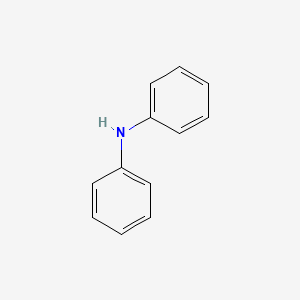
Verifizierte Chemie für CAS 122-39-4
Diphenylamine
Diphenylamine is an aromatic amine containing two phenyl substituents. It has been used as a fungicide for the treatment of superficial scald in apples and pears, but is no longer approved for this purpose within the European Union. It has a role as a ferroptosis inhibitor, an antioxidant, a radical scavenger, a carotogenesis inhibitor, an EC 1.3.99.29 [phytoene desaturase (zeta-carotene-forming)] inhibitor and an antifungal agrochemical. It is an aromatic amine, a secondary amino compound and a bridged diphenyl fungicide. — ChEBI
- IUPAC-Name
- N-phenylaniline
- Summenformel
- C12H11N
- Molekulargewicht
- 169.22 g/mol
- Exakte Masse
- 169.089149355 Da
- Monoisotopische Masse
- 169.089149355 Da
- XLogP3
- 3,5
- Topologische polare Oberfläche
- 12,0 Ų
- Molekulare Komplexität
- 116,0
- Formale Ladung
- 0
- Wasserstoffbrücken-Donoren
- 1
- Wasserstoffbrücken-Akzeptoren
- 1
- Drehbare Bindungen
- 2
- Schweratome
- 13
- Kovalente Einheiten
- 1
An PubChem gemeldete Namen und Synonyme
16 weitere gemeldete Namen
Kennungen in externen Datenbanken
- ChEBI:CHEBI:4640
- ChEMBL:CHEMBL38688
- EPA DTXSID:DTXSID4021975
- PubMed:25622337
- PubMed:25028461
- PubMed:22889607
- PubMed:22868159
- PubMed:22684718
- PubMed:22682933
- PubMed:22649790
- PubMed:22645627
- PubMed:22609852
- PubMed:22608425
- PubMed:22588514
- PubMed:22579651
Erweiterte Strukturstatistik
- Definierte Atom-Stereozentren
- 0
- Nicht definierte Atom-Stereozentren
- 0
- Definierte Bindungs-Stereozentren
- 0
- Nicht definierte Bindungs-Stereozentren
- 0
- 3D-Pharmakophormerkmale
- 4
- 3D-Ringe
- 2
- 3D-Hydrophobe
- 0
- 3D-Akzeptormerkmale
- 0
- 3D-Donormerkmale
- 1
- 3D-Anionenzentren
- 0
- 3D-Kationenzentren
- 1
- 3D-Konformere
- 3
- Effektive 3D-Rotoren
- 2,0
Maschinenlesbare Strukturkennungen
- SMILES
C1=CC=C(C=C1)NC2=CC=CC=C2- InChI
InChI=1S/C12H11N/c1-3-7-11(8-4-1)13-12-9-5-2-6-10-12/h1-10,13H- InChIKey
DMBHHRLKUKUOEG-UHFFFAOYSA-N
Belege aus weiteren wissenschaftlichen Datenbanken
NIH PubChem PUG-View
Attributed physical-property, hazard, environmental and use annotations.
- Autoignition Temperature: 1175 °F (USCG, 1999) Quelle: CAMEO Chemicals
- Autoignition Temperature: 1173 °F (634 °C) Quelle: Hazardous Substances Data Bank (HSDB)
- Autoignition Temperature: 634 °C Quelle: ILO-WHO International Chemical Safety Cards (ICSCs)
- Boiling Point: 576 °F at 760 mmHg (NTP, 1992) Quelle: CAMEO Chemicals
- Boiling Point: 302 °C Quelle: Hazardous Substances Data Bank (HSDB)
- Boiling Point: 302.00 °C. @ 760.00 mm Hg Quelle: Human Metabolome Database (HMDB)
- Boiling Point: 302 °C Quelle: ILO-WHO International Chemical Safety Cards (ICSCs)
- Boiling Point: 576 °F Quelle: Occupational Safety and Health Administration (OSHA)
- Boiling Point: 302 °C @760 [mm Hg] Quelle: PAC Chemical Database, U.S. Department of Energy
- Boiling Point: 576 °F Quelle: The National Institute for Occupational Safety and Health (NIOSH)
- Color/Form: Monoclinic leaflets from dilute alcohol Quelle: Hazardous Substances Data Bank (HSDB)
- Color/Form: Crystals Quelle: Hazardous Substances Data Bank (HSDB)
- Color/Form: Colorless, tan, amber, or brown crystalline solid. Quelle: Hazardous Substances Data Bank (HSDB)
- Density: 1.068 at 141.8 °F (USCG, 1999) - Denser than water; will sink Quelle: CAMEO Chemicals
- Density: 1.16 Quelle: Hazardous Substances Data Bank (HSDB)
- Density: 1.2 g/cm³ Quelle: ILO-WHO International Chemical Safety Cards (ICSCs)
- Density: 1.16 Quelle: Occupational Safety and Health Administration (OSHA)
- Density: 1.158 @ 22°C Quelle: PAC Chemical Database, U.S. Department of Energy
- Density: 1.16 Quelle: The National Institute for Occupational Safety and Health (NIOSH)
- Dissociation Constants: pKa = 0.78 @ 24 °C Quelle: Hazardous Substances Data Bank (HSDB)
- Flash Point: 307 °F (NTP, 1992) Quelle: CAMEO Chemicals
- Flash Point: 307 °F Quelle: Haz-Map, Information on Hazardous Chemicals and Occupational Diseases
- Flash Point: 153 °C OC Quelle: Hazardous Substances Data Bank (HSDB)
- Flash Point: 153 °C c.c. Quelle: ILO-WHO International Chemical Safety Cards (ICSCs)
- Flash Point: 307 °F Quelle: Occupational Safety and Health Administration (OSHA)
- Flash Point: 307 °F Quelle: The National Institute for Occupational Safety and Health (NIOSH)
- LogP: log Kow = 3.50 Quelle: Hazardous Substances Data Bank (HSDB)
- LogP: 3.50 Quelle: Human Metabolome Database (HMDB)
- LogP: 3.5 Quelle: ILO-WHO International Chemical Safety Cards (ICSCs)
- Melting Point: 129 to 131 °F (NTP, 1992) Quelle: CAMEO Chemicals
- Melting Point: 53-54 °C Quelle: Hazardous Substances Data Bank (HSDB)
- Melting Point: 52 - 54 °C Quelle: Human Metabolome Database (HMDB)
- Melting Point: 53 °C Quelle: ILO-WHO International Chemical Safety Cards (ICSCs)
- Melting Point: 127 °F Quelle: Occupational Safety and Health Administration (OSHA)
- Melting Point: 53.2 °C Quelle: PAC Chemical Database, U.S. Department of Energy
- Melting Point: 127 °F Quelle: The National Institute for Occupational Safety and Health (NIOSH)
- Odor: Pleasant, floral odor. Quelle: Hazardous Substances Data Bank (HSDB)
- Physical Description: Diphenylamine is a light tan to brown solid with a pleasant odor. Sinks in water. (USCG, 1999) Quelle: CAMEO Chemicals
- Physical Description: Liquid; CBI; Large Crystals; Wet Solid; Dry Powder Quelle: EPA Chemical Data Reporting (CDR)
- Physical Description: Colorless, tan, amber, or brown crystalline solid with a pleasant, floral odor. (fungicide); [NIOSH] Quelle: Haz-Map, Information on Hazardous Chemicals and Occupational Diseases
- Physical Description: Solid Quelle: Human Metabolome Database (HMDB)
- Physical Description: COLOURLESS CRYSTALS WITH CHARACTERISTIC ODOUR. Quelle: ILO-WHO International Chemical Safety Cards (ICSCs)
- Physical Description: Colorless, tan, amber, or brown crystalline solid with a pleasant, floral odor. Quelle: Occupational Safety and Health Administration (OSHA)
- Physical Description: Colorless, tan, amber, or brown crystalline solid with a pleasant, floral odor. [fungicide] Quelle: The National Institute for Occupational Safety and Health (NIOSH)
- Solubility: less than 1 mg/mL at 61 °F (NTP, 1992) Quelle: CAMEO Chemicals
- Solubility: 1 g dissolves in 2.2 ml of alcohol, 4 ml propyl alcohol; Freely sol in benzene, ether, glacial acetic acid, carbon disulfide. Quelle: Hazardous Substances Data Bank (HSDB)
- Solubility: Very sol in ethanol, acetone, benzene, carbon tetrachloride, pyridine, ethyl acetate; sol in ether, acetic acid; slightly sol in chloroform Quelle: Hazardous Substances Data Bank (HSDB)
- Solubility: Soluble in oxygenated and aromatic solvents Quelle: Hazardous Substances Data Bank (HSDB)
- Solubility: In water, 53 mg/liter @ 20 °C Quelle: Hazardous Substances Data Bank (HSDB)
- Solubility: 0.053 mg/mL at 20 °C Quelle: Human Metabolome Database (HMDB)
- Solubility: Solubility in water: very poor Quelle: ILO-WHO International Chemical Safety Cards (ICSCs)
- Solubility: 0.03% Quelle: The National Institute for Occupational Safety and Health (NIOSH)
- Vapor Pressure: 1 mmHg at 226.9 °F ; 60 mmHg at 404.4 °F (NTP, 1992) Quelle: CAMEO Chemicals
- Vapor Pressure: 0.00067 [mmHg] Quelle: Haz-Map, Information on Hazardous Chemicals and Occupational Diseases
- Vapor Pressure: 6.70X10⁻⁴ mm Hg @ 25 °C Quelle: Hazardous Substances Data Bank (HSDB)
- Vapor Pressure: Vapor pressure at 20 °C: negligible Quelle: ILO-WHO International Chemical Safety Cards (ICSCs)
- Vapor Pressure: 1 mmHg at 227 °F Quelle: Occupational Safety and Health Administration (OSHA)
- Vapor Pressure: (227 °F): 1 mmHg Quelle: The National Institute for Occupational Safety and Health (NIOSH)
- IARC Carcinogenic Agent: Diphenylamine Quelle: International Agency for Research on Cancer (IARC)
- IARC Carcinogenic Classes: Group 2B: Possibly carcinogenic to humans Quelle: International Agency for Research on Cancer (IARC)
- IARC Monographs: Volume 130: (2022) 1,1,1-Trichloroethane and Four Other Industrial Chemicals Quelle: International Agency for Research on Cancer (IARC)
- Publication Year: 2022 online Quelle: International Agency for Research on Cancer (IARC)
- Evaluation Year: 2021 Quelle: International Agency for Research on Cancer (IARC)
- Carcinogen Classification: No indication of carcinogenicity to humans (not listed by IARC). Quelle: Toxin and Toxin Target Database (T3DB)
- Exposure Routes: The substance can be absorbed into the body by inhalation, through the skin and by ingestion. Quelle: ILO-WHO International Chemical Safety Cards (ICSCs)
- Exposure Routes: inhalation, skin absorption, ingestion, skin and/or eye contact Quelle: The National Institute for Occupational Safety and Health (NIOSH)
- First Aid: EYES: First check the victim for contact lenses and remove if present. Flush victim's eyes with water or normal saline solution for 20 to 30 minutes while simultaneously calling a hospital or poison control center. Do not put any ointments, oils, or medication in the victim's eyes without specific instructions from a physician. IMMEDIATELY transport the victim after flushing eyes to a hospital even if no symptoms (such as redness or irritation) develop.; SKIN: IMMEDIATELY flood affected skin with water while removing and isolating all contaminated clothing. Gently wash all affected skin areas thoroughly with soap and water. If symptoms such as redness or irritation develop, IMMEDIATELY call a physician and be prepared to transport the victim to a hospital for treatment.; INHALATION: IMMEDIATELY leave the contaminated area; take deep breaths of fresh air. If symptoms (such as wheezing, coughing, shortness of breath, or burning in the mouth, throat, or chest) develop, call a physician and be prepared to transport the victim to a hospital. Provide proper respiratory protection to rescuers entering an unknown atmosphere. Whenever possible, Self-Contained Breathing Apparatus (SCBA) shou Quelle: CAMEO Chemicals
- First Aid: (General first aid procedures); Eye: Irrigate immediately - If this chemical contacts the eyes, immediately wash (irrigate) the eyes with large amounts of water, occasionally lifting the lower and upper lids. Get medical attention immediately.; Skin: Soap wash promptly - If this chemical contacts the skin, promptly wash the contaminated skin with soap and water. If this chemical penetrates the clothing, promptly remove the clothing and wash the skin with soap and water. Get medical attention promptly.; Breathing: Respiratory support; Swallow: Medical attention immediately - If this chemical has been swallowed, get medical attention immediately. Quelle: The National Institute for Occupational Safety and Health (NIOSH)
- Signal: Danger Quelle: Regulation (EC) No 1272/2008 of the European Parliament and of the Council
- GHS Hazard Statements: H301: Toxic if swallowed [Danger Acute toxicity, oral]; H311: Toxic in contact with skin [Danger Acute toxicity, dermal]; H331: Toxic if inhaled [Danger Acute toxicity, inhalation]; H373 **: May causes damage to organs through prolonged or repeated exposure [Warning Specific target organ toxicity, repeated exposure]; H400: Very toxic to aquatic life [Warning Hazardous to the aquatic environment, acute hazard]; H410: Very toxic to aquatic life with long lasting effects [Warning Hazardous to the aquatic environment, long-term hazard] Quelle: Regulation (EC) No 1272/2008 of the European Parliament and of the Council
- Precautionary Statement Codes: P260, P261, P262, P264, P270, P271, P273, P280, P301+P316, P302+P352, P304+P340, P316, P319, P321, P330, P361+P364, P391, P403+P233, P405, and P501 (click each P-code to see the statement) Quelle: Regulation (EC) No 1272/2008 of the European Parliament and of the Council
- Signal: Danger Quelle: European Chemicals Agency (ECHA)
- GHS Hazard Statements: H301+H311+H331 (10.1%): Toxic if swallowed, in contact with skin or if inhaled [Danger Acute toxicity, oral; acute toxicity, dermal; acute toxicity, inhalation]; H301 (> 99.9%): Toxic if swallowed [Danger Acute toxicity, oral]; H311 (> 99.9%): Toxic in contact with skin [Danger Acute toxicity, dermal]; H319 (30.9%): Causes serious eye irritation [Warning Serious eye damage/eye irritation]; H331 (> 99.9%): Toxic if inhaled [Danger Acute toxicity, inhalation]; H351 (11.1%): Suspected of causing cancer [Warning Carcinogenicity]; H373 (100%): May causes damage to organs through prolonged or repeated exposure [Warning Specific target organ toxicity, repeated exposure]; H400 (96.2%): Very toxic to aquatic life [Warning Hazardous to the aquatic environment, acute hazard]; H410 (100%): Very toxic to aquatic life with long lasting effects [Warning Hazardous to the aquatic environment, long-term hazard] Quelle: European Chemicals Agency (ECHA)
- Precautionary Statement Codes: P203, P260, P261, P262, P264, P264+P265, P270, P271, P273, P280, P301+P316, P302+P352, P304+P340, P305+P351+P338, P316, P318, P319, P321, P330, P337+P317, P361+P364, P391, P403+P233, P405, and P501 (click each P-code to see the statement) Quelle: European Chemicals Agency (ECHA)
- ECHA C&L Notifications Summary: Aggregated GHS information provided per 1984 reports by companies from 46 notifications to the ECHA C&L Inventory. Each notification may be associated with multiple companies.; Information may vary between notifications depending on impurities, additives, and other factors. The percentage value in parenthesis indicates the notified classification ratio from companies that provide hazard codes. Only hazard codes with percentage values above 10% are shown. For more detailed information, please visit ECHA C&L website. Quelle: European Chemicals Agency (ECHA)
- Signal: Warning Quelle: NITE-CMC
- GHS Hazard Statements: H351: Suspected of causing cancer [Warning Carcinogenicity] Quelle: NITE-CMC
- Precautionary Statement Codes: P203, P280, P318, P405, and P501 (click each P-code to see the statement) Quelle: NITE-CMC
- Signal: Danger Quelle: NITE-CMC
- GHS Hazard Statements: H318: Causes serious eye damage [Danger Serious eye damage/eye irritation]; H335: May cause respiratory irritation [Warning Specific target organ toxicity, single exposure; Respiratory tract irritation]; H361: Suspected of damaging fertility or the unborn child [Warning Reproductive toxicity]; H370: Causes damage to organs [Danger Specific target organ toxicity, single exposure]; H373: May causes damage to organs through prolonged or repeated exposure [Warning Specific target organ toxicity, repeated exposure]; H400: Very toxic to aquatic life [Warning Hazardous to the aquatic environment, acute hazard]; H410: Very toxic to aquatic life with long lasting effects [Warning Hazardous to the aquatic environment, long-term hazard] Quelle: NITE-CMC
- NFPA Health Rating: 3 - Materials that, under emergency conditions, can cause serious or permanent injury. Quelle: Hazardous Substances Data Bank (HSDB)
- NFPA Fire Rating: 1 - Materials that must be preheated before ignition can occur. Materials require considerable preheating, under all ambient temperature conditions, before ignition and combustion can occur. Quelle: Hazardous Substances Data Bank (HSDB)
- NFPA Instability Rating: 0 - Materials that in themselves are normally stable, even under fire conditions. Quelle: Hazardous Substances Data Bank (HSDB)
- Target Organs: Hepatic; Urinary Quelle: EPA Integrated Risk Information System (IRIS)
- Target Organs: Eyes, skin, respiratory system, cardiovascular system, blood, bladder, reproductive system Quelle: The National Institute for Occupational Safety and Health (NIOSH)
- Toxicity Summary: Diphenylamine uncouples mitochondrial oxidative phosphorylation, resulting in a decrease in hepatocellular ATP content and consequently hepatocyte injury (A15350). Short-term and long-term exposure in animal models results in altered haematological parameters, splenic erythropoiesis, splenic congestion and haemosiderosis (L2078). Quelle: Toxin and Toxin Target Database (T3DB)
- Environmental Bioconcentration: BCFs ranging from 101 to 242 and 51 to 253 (species unidentified) were measured using 0.1 and 0.01 mg/liter of N,N-diphenylamine, respectively, and a 8-week study period(1). According to a classification scheme(2), these BCFs suggest the potential for bioconcentration in aquatic organisms is moderate(SRC). Quelle: Hazardous Substances Data Bank (HSDB)
- Environmental Fate: TERRESTRIAL FATE: Based on a classification scheme(1), an estimated Koc value of 1,900(SRC), determined from a log Kow of 3.50(2) and a regression-derived equation(3), indicates that N,N-diphenylamine is expected to have low mobility in soil(SRC). Volatilization of N,N-diphenylamine from moist soil surfaces is expected to be an important fate process(SRC) given an estimated Henry's Law constant of 2.7X10⁻⁶ atm-cu m/mole(SRC) derived from its vapor pressure, 6.7X10⁻⁴ mm Hg(4), and water solubility, 53 mg/liter(5). N,N-Diphenylamine is not expected to volatilize from dry soil surfaces(SRC) based upon its vapor pressure(4). N,N-Diphenylamine is not expected to biodegrade in soil based on aqueous screening tests(6). N,N-Diphenylamine, present at 30 mg/l, reached 0% of its theoretical BOD in 2 weeks using an activated sludge innoculum at 100 mg/l and the Japanese MITI test(6). Quelle: Hazardous Substances Data Bank (HSDB)
- Environmental Fate: AQUATIC FATE: Based on a classification scheme(1), an estimated Koc value of 1,900(SRC), determined from a log Kow of 3.50(2) and a regression-derived equation(3), indicates that N,N-diphenylamine is expected to adsorb to suspended solids and sediment(SRC). Volatilization from water surfaces is expected(3) based upon an estimated Henry's Law constant of 2.7X10⁻⁶ atm-cu m/mole(SRC), derived from its vapor pressure, 6.70X10⁻⁴ mm Hg(4), and water solubility, 53 mg/l(5). Using this Henry's Law constant and an estimation method(3), volatilization half-lives for a model river and model lake are 9.4 and 107 days, respectively(SRC). According to a classification scheme(6), BCFs ranging from 51 to 253(7), suggests bioconcentration in aquatic organisms is moderate(SRC). N,N-Diphenylamine was found to be not readily biodegradable in aqueous screening tests(7). N,N-Diphenylamine, present at 30 mg/l, reached 0% of its theoretical BOD in 2 weeks using an activated sludge innoculum at 100 mg/l and the Japanese MITI test(7). Quelle: Hazardous Substances Data Bank (HSDB)
- Environmental Fate: ATMOSPHERIC FATE: According to a model of gas/particle partitioning of semivolatile organic compounds in the atmosphere(1), N,N-diphenylamine, which has a vapor pressure of 6.7X10⁻⁴ mm Hg at 25 °C(2) is expected to exist solely as a vapor in the ambient atmosphere(SRC). Vapor-phase N,N-diphenylamine is degraded in the atmosphere by reaction with photochemically-produced hydroxyl radicals(SRC); the half-life for this reaction in air is estimated to be 1.9 hours(SRC), calculated from its rate constant of 2.0X10⁻¹⁰ cu cm/molecule-sec at 25 °C(SRC) that was derived using a structure estimation method(3). Quelle: Hazardous Substances Data Bank (HSDB)
- Consumer Uses: Lubricating agent; Other; Energy Releasers (explosives, motive propellant); Antioxidant; Dye Quelle: EPA Chemical Data Reporting (CDR)
- Industry Uses: Stabilizing agent; Dye; Intermediate; Other; Chemical reaction regulator; Antioxidant; Processing aids not otherwise specified Quelle: EPA Chemical Data Reporting (CDR)
- Sources/Uses: Used as an antioxidant, stabilizer of explosives, fungicide, and analytical chemical reagent; also used in the manufacture of dyes and pesticides; [ACGIH] Used to make dyes, to stabilize nitrocellulose explosives and celluloid, to treat screwworm topically (veterinary), and to test for nitrate or nitrite poisoning; [Merck Index] Quelle: Haz-Map, Information on Hazardous Chemicals and Occupational Diseases
- Uses: For diphenylamine (USEPA/OPP Pesticide Code: 038501) ACTIVE products with label matches. /SRP: Registered for use in the U.S. but approved pesticide uses may change periodically and so federal, state and local authorities must be consulted for currently approved uses./ Quelle: Hazardous Substances Data Bank (HSDB)
- Uses: Manufacture of dyes; stabilizing nitrocellulose explosives and celluloid; in analytical chemistry for detection of nitrates, chlorates and other oxidizing substances with which, in presence of sulfuric acid, it gives a deep-blue color. Quelle: Hazardous Substances Data Bank (HSDB)
- Uses: VET: Topically in anti-screwworm mixtures; in test for nitrate or nitrate poisoning. Quelle: Hazardous Substances Data Bank (HSDB)
- Uses: Rubber antioxidants and accelerators, solid rocket propellants, pesticides, dyes, pharmaceuticals, storage preservation of apples, stabilizer for nitrocellulose. Quelle: Hazardous Substances Data Bank (HSDB)
- Uses: For more Uses (Complete) data for N,N-DIPHENYLAMINE (10 total), please visit the HSDB record page. Quelle: Hazardous Substances Data Bank (HSDB)
- Uses: This is a natural compound that is used as a pesticide. Quelle: Toxin and Toxin Target Database (T3DB)
Zugeordnet durch: Existing checksum-valid CAS to unique PubChem CID match. Abgerufen: 2026-08-31. Quelleneintrag öffnen
Wissenschaftliche Klassifizierungen und Gefahrenannotationen liefern Kontext und ersetzen nicht die oben gezeigte marktspezifische regulatorische Entscheidung.
Weitere Quellenabdeckung und Trefferstatus
| Quelle | Ergebnis | Geprüft |
|---|---|---|
| NIH PubChem PUG-View | Exakter Treffer | 2026-08-31 |
Ein erfasster Nicht-Treffer ist ein nützlicher Beleg dafür, dass die Quelle geprüft wurde; er ist keine Behauptung, dass der Stoff anderswo nicht existiert.
Am 2026-08-31 von NIH PubChem durch prüfsummengültigen CAS-Abgleich abgerufen. Chemische Eigenschaften ersetzen nicht die regulatorische Entscheidung auf dieser Seite.
Amtliche Quelle und Herkunft
- Registrierte Quelle
- India BIS IS 4707 cosmetic ingredient standards
- Quellenverweis
- IS 4707 (Part 2):2025 Annex A, entry 427
- Eintrags-ID der Quelle
annex-a:427- Quellenversion
- IS 4707 (Part 2):2025, fifth revision
- Quellsprache
- English
- Übersetzungsstatus
- Original is English
- Datum des Inkrafttretens
- 2025-08-09
- Quelle aktualisiert
- 2025-08-09
- Stand geprüft
- 2026-08-31 15:30 UTC
- Validierungsmethode
- 206 text layers; Annex A 1-1614 and Annex B 1-313 with seven lettered source rows
- SHA-256
905dd0326361c53da8a354b948331946951ac3ae27d60d8e2474efb051239603
Hinweise zum registrierten Datensatz
- Datensatzabdeckung
- Complete current Part 2:2025 Annex A prohibited and Annex B restricted rows; Parts 1, 3 and 4 remain linked official checks
- Hinweis zur Behörde
- Indian Standards referenced by the cosmetics regulatory framework; use the controlled current editions
Wie dieser Eintrag in den Marktdatensatz passt
Statusverteilung
Bedingungstext ist bei 1931 von 1931 aktuellen Einträgen vorhanden. Ein leeres Bedingungsfeld wird entsprechend der oben genannten Eintragsart interpretiert; es wird niemals in die Aussage einer uneingeschränkten Verwendung umgedeutet.
India Marktkontext
Complete current Part 2 dataset plus official workflow for Parts 1, 3 and 4
Abdeckungsversion: Cosmetics Rules 2020 plus current BIS IS 4707 parts (1:2020, 2:2025, 3:2025, 4:2022)
All 1,614 prohibited Annex A rows and 317 numbered/lettered restricted Annex B rows from IS 4707 Part 2:2025; official checks remain for colourants, preservatives and UV filters in Parts 1, 3 and 4.
Verifizierungs-Checkliste
- Confirm product class and current Cosmetics Rules/gazette amendments.
- Check all applicable parts of IS 4707 by exact identity.
- Apply Schedule S/other finished-product standards where relevant.
- Verify licence/import registration, labelling and testing requirements.
Amtliche Marktquellen
- India Cosmetics Rules 2020Official CDSCO rules and gazette updates; standards may require separate licensed sources
- India BIS IS 4707 cosmetic ingredient standardsIndian Standards referenced by the cosmetics regulatory framework; use the controlled current editions
Verifizierungsablauf und Vollständigkeit des Eintrags
Bevor Sie dieses Ergebnis für eine Compliance-Entscheidung verwenden
- Bestätigen Sie, dass „Diphenylamine (CAS No. 122-39-4), when used as a fragrance ingredient.“ und jede CAS-/EC-Kennung sich auf das Material in Ihrer Lieferantenspezifikation beziehen.
- Confirm product class and current Cosmetics Rules/gazette amendments.
- Check all applicable parts of IS 4707 by exact identity.
- Apply Schedule S/other finished-product standards where relevant.
- Verify licence/import registration, labelling and testing requirements.
- Dokumentieren Sie die Quellenversion und prüfen Sie die Behörde vor Herstellung, Notifizierung oder Inverkehrbringen erneut.
In diesem Eintrag verfügbare Felder
- Amtlicher StoffnameVerfügbar
- CASVerfügbar
- ECNicht angegeben
- Gesonderter BedingungstextVerfügbar
- Datum des InkrafttretensVerfügbar
- Snapshot-Hash und MethodeVerfügbar
Fragen, die diese Seite beantwortet
Dauerhafte Zitierweise
Diphenylamine (CAS No. 122-39-4), when used as a fragrance ingredient.. IS 4707 (Part 2):2025 Annex A, entry 427. India. Source version IS 4707 (Part 2):2025, fifth revision. CosIng Checker regulatory record: https://cosingchecker.com/de/regulations/in/records/15021/
Zitieren Sie die Aufsichtsbehörde als rechtliche Autorität. Diese Seite ist ein strukturierter Belegindex und eine Verifizierungshilfe, kein Ersatz für den amtlichen Text oder eine fachkundige rechtliche Bewertung.
Auslegung und Grenzen für India
This official record identifies the substance as prohibited for cosmetic use in the stated market scope.
Do not rely on a formulation containing this identity until the cited source, effective date and exact substance match have been verified.
Wie die Rechtsrolle auszulegen ist
The cited row forms part of a binding rule or legally incorporated list for this market.
Belege auf dieser Seite
- Erfasstes Ergebnis: Prohibited
- Rechtsrolle: Binding rule
- Quellenversion: IS 4707 (Part 2):2025, fifth revision
- Datum des Inkrafttretens: 2025-08-09
Was es nicht beweist
The standards are separate controlled publications; absence from a locally indexed excerpt is not permission.
Weitere maßgebliche Stoffrecherche
Keine dieser Quellen hebt die oben genannte Marktentscheidung auf.
Cosmetic Ingredient Review safety assessments
Expert Panel conclusions, assessed ingredient groups, use conditions, dates and report documents
Independent expert review considered by FDA; not a government approval or binding market rule
Diese Identität bei der Quelle recherchierenFDA Global Substance Registration System
UNII identifiers, preferred names, substance types, codes and public substance relationships
Identity registry only; UNII availability does not imply FDA review or approval
Diese Identität bei der Quelle recherchierenILO/WHO International Chemical Safety Cards
Hazards, symptoms, first aid, storage, incompatibilities and physical properties for covered chemicals
International occupational chemical-safety reference; not cosmetic-use approval
Diese Identität bei der Quelle recherchierenJapan NITE-CHRIP
Chemical identity, Japanese and foreign legal lists, GHS hazards and exposure-related information
Chemical-management evidence; cosmetic status remains governed by the applicable MHLW standard and market rules
Diese Identität bei der Quelle recherchierenNIOSH Pocket Guide to Chemical Hazards
REL, PEL, IDLH, properties, exposure routes, symptoms, target organs, first aid and measurement methods for covered workplace chemicals
US occupational-health guidance and limits; not a cosmetic ingredient decision
Diese Identität bei der Quelle recherchierenOECD eChemPortal
Gateway to authority-owned physical-property, fate, ecotoxicity, toxicity, exposure and GHS records
Discovery gateway; each linked authority remains responsible for its data
Diese Identität bei der Quelle recherchierenUS EPA CompTox CTX APIs
Für den Import ist ein API-Schlüssel erforderlichDTXSID identity, experimental and predicted properties, toxicity, bioactivity, exposure and environmental data
Scientific and computational evidence; predictions must remain labelled and do not determine cosmetic legality
Diese Identität bei der Quelle recherchieren