
哌甲酯及其盐类 — Methylphenidate (INN) (CAS No.113-45-1) and its salts
Methylphenidate (INN) (CAS No.113-45-1) and its salts
The NMPA binding 2021 catalogue prohibits this raw material in cosmetic formulas in China.
Regulatorische Entscheidung und vollständige Bedingungen
- Status
- Prohibited
- Rechtsrolle
- Binding rule
- Regulatorische Zusammenfassung
- The NMPA binding 2021 catalogue prohibits this raw material in cosmetic formulas in China.
- Bedingungen und Beschränkungen
Prohibited in cosmetic product formulas. Verify the cited Chinese source identity and any later NMPA amendment before use.
Stoffidentität
- Name in der amtlichen Quelle
- 哌甲酯及其盐类 — Methylphenidate (INN) (CAS No.113-45-1) and its salts
- CAS
- 113-45-1
- EC
- Not supplied in this source row
- Identitätszuordnung
- standalone:official_nmpa_record
Marktübergreifende Übersicht zu dieser Identität
Exakte verknüpfte Einträge, die derzeit auf dieser Website vorhanden sind. Ein fehlender Markt bedeutet, dass kein exakter Treffer importiert wurde, nicht dass der Stoff verwendet werden darf.
European Union
1 verknüpfter Eintrag
Unterstützenden Eintrag öffnenGreat Britain
1 verknüpfter Eintrag
Unterstützenden Eintrag öffnenCanada
1 verknüpfter Eintrag
Unterstützenden Eintrag öffnenNew Zealand
1 verknüpfter Eintrag
Unterstützenden Eintrag öffnenASEAN
1 verknüpfter Eintrag
Unterstützenden Eintrag öffnenChina
Aktueller Eintrag1 verknüpfter Eintrag · 1 mit besonderen Bedingungen
Unterstützenden Eintrag öffnenSouth Korea
1 verknüpfter Eintrag · 1 mit besonderen Bedingungen
Unterstützenden Eintrag öffnenBrazil
1 verknüpfter Eintrag · 1 mit besonderen Bedingungen
Unterstützenden Eintrag öffnenIndia
1 verknüpfter Eintrag · 1 mit besonderen Bedingungen
Unterstützenden Eintrag öffnenSaudi Arabia
1 verknüpfter Eintrag
Unterstützenden Eintrag öffnen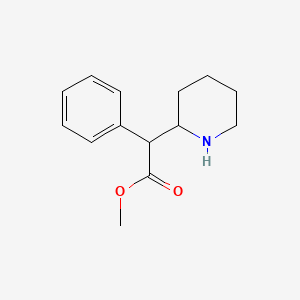
Verifizierte Chemie für CAS 113-45-1
Methylphenidate
Methyl phenyl(piperidin-2-yl)acetate is a amino acid ester that is methyl phenylacetate in which one of the hydrogens alpha to the carbonyl group is replaced by a piperidin-2-yl group. It is a methyl ester, a member of piperidines and a beta-amino acid ester. — ChEBI
- IUPAC-Name
- methyl 2-phenyl-2-piperidin-2-ylacetate
- Summenformel
- C14H19NO2
- Molekulargewicht
- 233.31 g/mol
- Exakte Masse
- 233.141578849 Da
- Monoisotopische Masse
- 233.141578849 Da
- XLogP3
- 0,2
- Topologische polare Oberfläche
- 38,3 Ų
- Molekulare Komplexität
- 249,0
- Formale Ladung
- 0
- Wasserstoffbrücken-Donoren
- 1
- Wasserstoffbrücken-Akzeptoren
- 3
- Drehbare Bindungen
- 4
- Schweratome
- 17
- Kovalente Einheiten
- 1
An PubChem gemeldete Namen und Synonyme
16 weitere gemeldete Namen
Kennungen in externen Datenbanken
Erweiterte Strukturstatistik
- Definierte Atom-Stereozentren
- 0
- Nicht definierte Atom-Stereozentren
- 2
- Definierte Bindungs-Stereozentren
- 0
- Nicht definierte Bindungs-Stereozentren
- 0
- 3D-Pharmakophormerkmale
- 5
- 3D-Ringe
- 2
- 3D-Hydrophobe
- 0
- 3D-Akzeptormerkmale
- 1
- 3D-Donormerkmale
- 1
- 3D-Anionenzentren
- 0
- 3D-Kationenzentren
- 1
- 3D-Konformere
- 10
- Effektive 3D-Rotoren
- 5,2
Maschinenlesbare Strukturkennungen
- SMILES
COC(=O)C(C1CCCCN1)C2=CC=CC=C2- InChI
InChI=1S/C14H19NO2/c1-17-14(16)13(11-7-3-2-4-8-11)12-9-5-6-10-15-12/h2-4,7-8,12-13,15H,5-6,9-10H2,1H3- InChIKey
DUGOZIWVEXMGBE-UHFFFAOYSA-N
Belege aus weiteren wissenschaftlichen Datenbanken
NIH PubChem PUG-View
Attributed physical-property, hazard, environmental and use annotations.
- Boiling Point: BP: 135 to 137 °C at 0.6 mm Hg Quelle: Hazardous Substances Data Bank (HSDB)
- Color/Form: Crystals from ethanol (aqueous) Quelle: Hazardous Substances Data Bank (HSDB)
- Dissociation Constants: pKa = 8.9 Quelle: Hazardous Substances Data Bank (HSDB)
- Dissociation Constants: pKa = 8.77 Quelle: Hazardous Substances Data Bank (HSDB)
- LogP: log Kow = 0.20 at pH 7.2 Quelle: Hazardous Substances Data Bank (HSDB)
- LogP: 2.1 Quelle: Human Metabolome Database (HMDB)
- Melting Point: 74-75 °C Quelle: Hazardous Substances Data Bank (HSDB)
- Melting Point: 224 - 226 °C Quelle: Human Metabolome Database (HMDB)
- Physical Description: Solid Quelle: Human Metabolome Database (HMDB)
- Solubility: 1255mg/L Quelle: DrugBank
- Solubility: Practically insoluble in water Quelle: Hazardous Substances Data Bank (HSDB)
- Solubility: Soluble in alcohol, ethyl acetate, ether; practically insoluble in petroleum ether Quelle: Hazardous Substances Data Bank (HSDB)
- Solubility: 1.82e-01 g/L Quelle: Human Metabolome Database (HMDB)
- Carcinogen Classification: No indication of carcinogenicity to humans (not listed by IARC). Quelle: Toxin and Toxin Target Database (T3DB)
- Exposure Routes: Oral. Readily absorbed in a biphasic manner when orally administered (tablets) to children diagnosed with ADHD and to healthy adults. In children and adults males, after administration of a single oral dose of Ritalin LA and Ritalin given in two doses 4 hours apart, peak plasma concentration is reached approximately 2 hours for the first phase and 5-6 hours for the second phase. The absolute oral bioavailability of methylphenidate in children was 22±8% for d-methylphenidate and 5±3% for l-methylphenidate. These low values suggest that methylphenidate is highly metabolized presystemically. Quelle: Toxin and Toxin Target Database (T3DB)
- Signal: Warning Quelle: European Chemicals Agency (ECHA)
- GHS Hazard Statements: H302 (100%): Harmful if swallowed [Warning Acute toxicity, oral]; H315 (100%): Causes skin irritation [Warning Skin corrosion/irritation]; H319 (100%): Causes serious eye irritation [Warning Serious eye damage/eye irritation]; H341 (100%): Suspected of causing genetic defects [Warning Germ cell mutagenicity] Quelle: European Chemicals Agency (ECHA)
- Precautionary Statement Codes: P203, P264, P264+P265, P270, P280, P301+P317, P302+P352, P305+P351+P338, P318, P321, P330, P332+P317, P337+P317, P362+P364, P405, and P501 (click each P-code to see the statement) Quelle: European Chemicals Agency (ECHA)
- ECHA C&L Notifications Summary: The GHS information provided by 1 company from 1 notification to the ECHA C&L Inventory. Quelle: European Chemicals Agency (ECHA)
- Signal: Danger Quelle: Hazardous Substances Data Bank (HSDB)
- GHS Hazard Statements: H302: Harmful if swallowed [Warning Acute toxicity, oral]; H334: May cause allergy or asthma symptoms or breathing difficulties if inhaled [Danger Sensitization, respiratory] Quelle: Hazardous Substances Data Bank (HSDB)
- Precautionary Statement Codes: P233, P260, P264, P270, P271, P284, P301+P317, P304+P340, P330, P342+P316, P403, and P501 (click each P-code to see the statement) Quelle: Hazardous Substances Data Bank (HSDB)
- Health Effects: Using large amounts of these drugs can result in a condition known as amphetamine psychosis -- which can result in auditory, visual and tactile hallucinations, intense paranoia, irrational thoughts and beliefs, delusions, and mental confusion. Quelle: Toxin and Toxin Target Database (T3DB)
- Toxicity Summary: IDENTIFICATION AND USE: Methylphenidate Hydrochloride is a psychostimulant used to treat different behavioral disorders. Indications: Used to treat narcolepsy and hyperkinetic states in children (as an adjunct to psychological, educational and social measures) for amphetamine, dextroamphetamine and ethylphenidate. It is misused for performance enhancement and relief of fatigue. Abuse either orally or by injection is extremely common. HUMAN EXPOSURE AND TOXICITY: Main risks include: Acute central nervous system (CNS) stimulation, cardiotoxicity causing tachycardia, arrhythmias, hypertension and cardiovascular collapse. High risk of dependency and abuse. Cardiovascular effects include: palpitation, chest pain, tachycardia, arrhythmias and hypertension; cardiovascular collapse can occur in severe poisoning. Myocardial ischemia, infarction and ventricular dysfunction are described. CNS effects include: stimulation of CNS, tremor, restlessness, agitation, insomnia, increased motor activity, headache, convulsions, coma and hyperreflexia. Stroke and cerebral vasculitis have been observed. Gastrointestinal effects include: vomiting, diarrhea and cramps. Genitourinary effects include: incre Quelle: Hazardous Substances Data Bank (HSDB)
- Toxicity Summary: The first step in a medication overdose is to immediately contact a poison control center for the appropriate management steps. Doses that exceed 60 mg of the immediate-release formulation or 120 mg of the extended-release formulation can be considered toxic. If the overdosed quantity is unknown, the patient should be assessed for signs and symptoms such as tremors, hyperreflexia, convulsions, euphoria, confusion, hallucinations, delirium, flushing, and fever, in addition to the common adverse effects mentioned above. Supportive care with supplemental oxygen, intravenous fluids, and external cooling methods is the mainstay of treatment. Multiple studies have shown that benzodiazepines are an option, especially if dystonia, agitation, or convulsions are present. Quelle: StatPearls
- Toxicity Summary: Methylphenidate blocks dopamine uptake in central adrenergic neurons by blocking dopamine transport or carrier proteins. Methylphenidate acts at the brain stem arousal system and the cerebral cortex and causes increased sympathomimetic activity in the central nervous system. Alteration of serotonergic pathways via changes in dopamine transport may result. Quelle: Toxin and Toxin Target Database (T3DB)
- Environmental Bioconcentration: An estimated BCF of 3 was calculated in fish for methylphenidate(SRC), using a log Kow of 0.20(1) and a regression-derived equation(2). According to a classification scheme(2), this BCF suggests the potential for bioconcentration in aquatic organisms is low(SRC). Quelle: Hazardous Substances Data Bank (HSDB)
- Environmental Fate: TERRESTRIAL FATE: Based on a classification scheme(1), an estimated Koc value of 1600(SRC), determined from a structure estimation method(2), indicates that methylphenidate is expected to have low mobility in soil(SRC). The pKa of methylphenidate is 8.9(3), indicating that this compound will exist partially in the cation form in the environment and cations generally adsorb more strongly to soils containing organic carbon and clay than their neutral counterparts(4). Volatilization of the neutral species of methylphenidate from moist soil surfaces is not expected to be an important fate process(SRC) given an estimated Henry's Law constant of 4.4X10⁻⁹ atm-cu m/mole(SRC), using a fragment constant estimation method(5). Methylphenidate is not expected to volatilize from dry soil surfaces(SRC) based upon an estimated vapor pressure of 5.9X10⁻⁵ mm Hg at 25 °C(SRC), determined from a fragment constant method(2). Biodegradation data in soil were not available(SRC, 2015). Quelle: Hazardous Substances Data Bank (HSDB)
- Environmental Fate: AQUATIC FATE: Based on a classification scheme(1), an estimated Koc value of 1600(SRC), determined from a structure estimation method(2), indicates that methylphenidate is expected to adsorb to suspended solids and sediment(SRC). Volatilization of the neutral species from water surfaces is not expected(3) based upon an estimated Henry's Law constant of 4.4X10⁻⁹ atm-cu m/mole(SRC), developed using a fragment constant estimation method(4). A pKa of 8.9(5) indicates methylphenidate will exist partially in the cation form at pH values of 5 to 9 and, therefore, volatilization from water surfaces is not expected to be an important fate process(SRC). According to a classification scheme(6), an estimated BCF of 3(SRC), from its log Kow of 0.20(7) and a regression-derived equation(2), suggests the potential for bioconcentration in aquatic organisms is low(SRC). Base-catalyzed second-order hydrolysis rate constant half-lives of 23 and 2.3 years at pH values of 7 and 8, respectively(2), suggest that hydrolysis may be a slow environmental fate process. Biodegradation data in water were not available(SRC, 2015). Quelle: Hazardous Substances Data Bank (HSDB)
- Environmental Fate: ATMOSPHERIC FATE: According to a model of gas/particle partitioning of semivolatile organic compounds in the atmosphere(1), methylphenidate, which has an estimated vapor pressure of 5.9X10⁻⁵ mm Hg at 25 °C(SRC), determined from a fragment constant method(2), will exist in both the vapor and particulate phases in the ambient atmosphere. Vapor-phase methylphenidate is degraded in the atmosphere by reaction with photochemically-produced hydroxyl radicals(SRC); the half-life for this reaction in air is estimated to be 1 hr(SRC), calculated from its rate constant of 1.1X10⁻¹⁰ cu cm/molecule-sec at 25 °C(SRC) that was derived using a structure estimation method(3). Particulate-phase methylphenidate may be removed from the air by wet and dry deposition(SRC). Methylphenidate contains chromophores that absorb at wavelengths >290 nm(4) and, therefore, may be susceptible to direct photolysis by sunlight(SRC). Quelle: Hazardous Substances Data Bank (HSDB)
- Uses: Methylphenidate (DEA Code Number: 1724) is a Schedule II controlled substance. Quelle: Hazardous Substances Data Bank (HSDB)
- Uses: Schedule II Controlled Substance: (A) The drug or other substance has a high potential for abuse; (B) The drug or other substance has a currently accepted medical use in treatment in the United States or a currently accepted medical use with severe restrictions; and (C) Abuse of the drug or other substances may lead to severe psychological or physical dependence. Quelle: Hazardous Substances Data Bank (HSDB)
- Uses: MEDICATION (VET) Quelle: Hazardous Substances Data Bank (HSDB)
- Uses: MEDICATION Quelle: Hazardous Substances Data Bank (HSDB)
- Uses: Central Nervous System Stimulants; Dopamine Uptake Inhibitors Quelle: Hazardous Substances Data Bank (HSDB)
- Uses: Use (kg) in Switzerland (2009): >250; Use (kg; approx.) in Germany (2009): >1000; Use (kg) in USA (2002): 9090; Consumption (g per capita) in Switzerland (2009): 0.032; Consumption (g per capita; approx.) in Germany (2009): 0.012; Consumption (g per capita) in the USA (2002): 0.032; Excretion rate: 0.1; Calculated removal (%): 92.1 Quelle: NORMAN Suspect List Exchange
- Uses: For use as an integral part of a total treatment program which typically includes other remedial measures (psychological, educational, social) for a stabilizing effect in children with a behavioral syndrome characterized by the following group of developmentally inappropriate symptoms: moderate-to-severe distractibility, short attention span, hyperactivity, emotional lability, and impulsivity. Quelle: Toxin and Toxin Target Database (T3DB)
Zugeordnet durch: Existing checksum-valid CAS to unique PubChem CID match. Abgerufen: 2026-08-31. Quelleneintrag öffnen
Wissenschaftliche Klassifizierungen und Gefahrenannotationen liefern Kontext und ersetzen nicht die oben gezeigte marktspezifische regulatorische Entscheidung.
Weitere Quellenabdeckung und Trefferstatus
| Quelle | Ergebnis | Geprüft |
|---|---|---|
| NIH PubChem PUG-View | Exakter Treffer | 2026-08-31 |
Ein erfasster Nicht-Treffer ist ein nützlicher Beleg dafür, dass die Quelle geprüft wurde; er ist keine Behauptung, dass der Stoff anderswo nicht existiert.
Am 2026-09-02 von NIH PubChem durch prüfsummengültigen CAS-Abgleich abgerufen. Chemische Eigenschaften ersetzen nicht die regulatorische Entscheidung auf dieser Seite.
Amtliche Quelle und Herkunft
- Registrierte Quelle
- China NMPA banned raw-material catalogues (2021)
- Quellenverweis
- NMPA 2021 Catalogue of Raw Materials Banned for Cosmetics, entry 906
- Eintrags-ID der Quelle
chemical-906- Quellenversion
- NMPA Announcement No. 74 of 2021, effective 2021-05-26
- Quellsprache
- Chinese with source English/Latin identity
- Übersetzungsstatus
- Official English translation · Englische Übersetzung
- Datum des Inkrafttretens
- 2021-05-26
- Quelle aktualisiert
- 2021-05-26
- Stand geprüft
- 2026-08-31 14:13 UTC
- Validierungsmethode
- pdfplumber tables; exact 1,284 + 109 row counts and contiguous source numbering
- SHA-256
8848aa3e0c7ac5e74f56fc27927336c4fc2e5bc80137da087c2ca9ba2d2c075e
Hinweise zum registrierten Datensatz
- Datensatzabdeckung
- All 1,284 banned raw materials and 109 banned plant/animal raw materials effective from 26 May 2021
- Hinweis zur Behörde
- Binding NMPA catalogues replacing Tables 1 and 2 of the 2015 Technical Specification
Wie dieser Eintrag in den Marktdatensatz passt
Statusverteilung
Bedingungstext ist bei 1393 von 1393 aktuellen Einträgen vorhanden. Ein leeres Bedingungsfeld wird entsprechend der oben genannten Eintragsart interpretiert; es wird niemals in die Aussage einer uneingeschränkten Verwendung umgedeutet.
China Marktkontext
Complete prohibited catalogues plus official-source workflow
Abdeckungsversion: NMPA 2021 banned catalogues plus dynamic IECIC List I/List II system current since 2025
All 1,284 banned raw materials and 109 banned plant/animal raw materials, plus the official workflow for the dynamic existing-ingredient inventory, other technical restrictions and new ingredients.
Verifizierungs-Checkliste
- Search the current NMPA IECIC List I and List II by Chinese name and identity.
- Check prohibited/restricted and positive lists in the current Safety and Technical Standards.
- Review technical purpose, use history and any monitoring period.
- Confirm Chinese labelling, safety assessment and filing/registration duties.
Amtliche Marktquellen
- China NMPA IECIC dynamic inventoryOfficial NMPA inventory, not a blanket permission or safety decision
- China draft mandatory cosmetic safety standardConsultation draft — not current law and not a substitute for the effective NMPA catalogues
- China NMPA banned raw-material catalogues (2021)Binding NMPA catalogues replacing Tables 1 and 2 of the 2015 Technical Specification
Verifizierungsablauf und Vollständigkeit des Eintrags
Bevor Sie dieses Ergebnis für eine Compliance-Entscheidung verwenden
- Bestätigen Sie, dass „哌甲酯及其盐类 — Methylphenidate (INN) (CAS No.113-45-1) and its salts“ und jede CAS-/EC-Kennung sich auf das Material in Ihrer Lieferantenspezifikation beziehen.
- Search the current NMPA IECIC List I and List II by Chinese name and identity.
- Check prohibited/restricted and positive lists in the current Safety and Technical Standards.
- Review technical purpose, use history and any monitoring period.
- Confirm Chinese labelling, safety assessment and filing/registration duties.
- Dokumentieren Sie die Quellenversion und prüfen Sie die Behörde vor Herstellung, Notifizierung oder Inverkehrbringen erneut.
In diesem Eintrag verfügbare Felder
- Amtlicher StoffnameVerfügbar
- CASVerfügbar
- ECNicht angegeben
- Gesonderter BedingungstextVerfügbar
- Datum des InkrafttretensVerfügbar
- Snapshot-Hash und MethodeVerfügbar
Fragen, die diese Seite beantwortet
Dauerhafte Zitierweise
哌甲酯及其盐类 — Methylphenidate (INN) (CAS No.113-45-1) and its salts. NMPA 2021 Catalogue of Raw Materials Banned for Cosmetics, entry 906. China. Source version NMPA Announcement No. 74 of 2021, effective 2021-05-26. CosIng Checker regulatory record: https://cosingchecker.com/de/regulations/cn/records/12595/
Zitieren Sie die Aufsichtsbehörde als rechtliche Autorität. Diese Seite ist ein strukturierter Belegindex und eine Verifizierungshilfe, kein Ersatz für den amtlichen Text oder eine fachkundige rechtliche Bewertung.
Auslegung und Grenzen für China
This official record identifies the substance as prohibited for cosmetic use in the stated market scope.
Do not rely on a formulation containing this identity until the cited source, effective date and exact substance match have been verified.
Wie die Rechtsrolle auszulegen ist
The cited row forms part of a binding rule or legally incorporated list for this market.
Belege auf dieser Seite
- Erfasstes Ergebnis: Prohibited
- Rechtsrolle: Binding rule
- Quellenversion: NMPA Announcement No. 74 of 2021, effective 2021-05-26
- Datum des Inkrafttretens: 2021-05-26
Was es nicht beweist
IECIC listing is not blanket approval; absence may require the new cosmetic ingredient route, and restrictions are checked separately.
Weitere maßgebliche Stoffrecherche
Keine dieser Quellen hebt die oben genannte Marktentscheidung auf.
Cosmetic Ingredient Review safety assessments
Expert Panel conclusions, assessed ingredient groups, use conditions, dates and report documents
Independent expert review considered by FDA; not a government approval or binding market rule
Diese Identität bei der Quelle recherchierenFDA Global Substance Registration System
UNII identifiers, preferred names, substance types, codes and public substance relationships
Identity registry only; UNII availability does not imply FDA review or approval
Diese Identität bei der Quelle recherchierenILO/WHO International Chemical Safety Cards
Hazards, symptoms, first aid, storage, incompatibilities and physical properties for covered chemicals
International occupational chemical-safety reference; not cosmetic-use approval
Diese Identität bei der Quelle recherchierenJapan NITE-CHRIP
Chemical identity, Japanese and foreign legal lists, GHS hazards and exposure-related information
Chemical-management evidence; cosmetic status remains governed by the applicable MHLW standard and market rules
Diese Identität bei der Quelle recherchierenNIOSH Pocket Guide to Chemical Hazards
REL, PEL, IDLH, properties, exposure routes, symptoms, target organs, first aid and measurement methods for covered workplace chemicals
US occupational-health guidance and limits; not a cosmetic ingredient decision
Diese Identität bei der Quelle recherchierenOECD eChemPortal
Gateway to authority-owned physical-property, fate, ecotoxicity, toxicity, exposure and GHS records
Discovery gateway; each linked authority remains responsible for its data
Diese Identität bei der Quelle recherchierenUS EPA CompTox CTX APIs
Für den Import ist ein API-Schlüssel erforderlichDTXSID identity, experimental and predicted properties, toxicity, bioactivity, exposure and environmental data
Scientific and computational evidence; predictions must remain labelled and do not determine cosmetic legality
Diese Identität bei der Quelle recherchieren