
α-氯甲苯 — α-Chlorotoluene (Benzyl chloride) (CAS No. 100-44-7)
α-Chlorotoluene (Benzyl chloride) (CAS No. 100-44-7)
The NMPA binding 2021 catalogue prohibits this raw material in cosmetic formulas in China.
Regulatorische Entscheidung und vollständige Bedingungen
- Status
- Prohibited
- Rechtsrolle
- Binding rule
- Regulatorische Zusammenfassung
- The NMPA binding 2021 catalogue prohibits this raw material in cosmetic formulas in China.
- Bedingungen und Beschränkungen
Prohibited in cosmetic product formulas. Verify the cited Chinese source identity and any later NMPA amendment before use.
Stoffidentität
- Name in der amtlichen Quelle
- α-氯甲苯 — α-Chlorotoluene (Benzyl chloride) (CAS No. 100-44-7)
- CAS
- 100-44-7
- EC
- Not supplied in this source row
- Identitätszuordnung
- standalone:official_nmpa_record
Marktübergreifende Übersicht zu dieser Identität
Exakte verknüpfte Einträge, die derzeit auf dieser Website vorhanden sind. Ein fehlender Markt bedeutet, dass kein exakter Treffer importiert wurde, nicht dass der Stoff verwendet werden darf.
European Union
1 verknüpfter Eintrag
Unterstützenden Eintrag öffnenGreat Britain
1 verknüpfter Eintrag
Unterstützenden Eintrag öffnenCanada
1 verknüpfter Eintrag
Unterstützenden Eintrag öffnenNew Zealand
1 verknüpfter Eintrag
Unterstützenden Eintrag öffnenASEAN
1 verknüpfter Eintrag
Unterstützenden Eintrag öffnenChina
Aktueller Eintrag1 verknüpfter Eintrag · 1 mit besonderen Bedingungen
Unterstützenden Eintrag öffnenSouth Korea
1 verknüpfter Eintrag
Unterstützenden Eintrag öffnenBrazil
1 verknüpfter Eintrag · 1 mit besonderen Bedingungen
Unterstützenden Eintrag öffnenIndia
1 verknüpfter Eintrag · 1 mit besonderen Bedingungen
Unterstützenden Eintrag öffnenSaudi Arabia
1 verknüpfter Eintrag
Unterstützenden Eintrag öffnen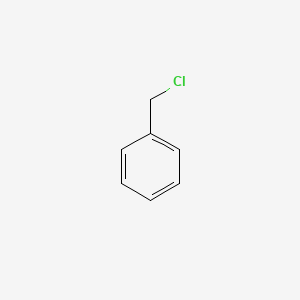
Verifizierte Chemie für CAS 100-44-7
Benzyl Chloride
Benzyl chloride is a member of the class of benzyl chlorides that is toluene substituted on the alpha-carbon with chlorine. — ChEBI
- IUPAC-Name
- chloromethylbenzene
- Summenformel
- C7H7Cl
- Molekulargewicht
- 126.58 g/mol
- Exakte Masse
- 126.0236279 Da
- Monoisotopische Masse
- 126.0236279 Da
- XLogP3
- 2,3
- Topologische polare Oberfläche
- 0,0 Ų
- Molekulare Komplexität
- 55,0
- Formale Ladung
- 0
- Wasserstoffbrücken-Donoren
- 0
- Wasserstoffbrücken-Akzeptoren
- 0
- Drehbare Bindungen
- 1
- Schweratome
- 8
- Kovalente Einheiten
- 1
An PubChem gemeldete Namen und Synonyme
16 weitere gemeldete Namen
Kennungen in externen Datenbanken
- ChEBI:CHEBI:615597
- ChEMBL:CHEMBL498878
- EPA DTXSID:DTXSID0020153
- PubMed:22606153
- PubMed:22590290
- PubMed:22589987
- PubMed:22546633
- PubMed:22412719
- PubMed:22412651
- PubMed:22390789
- PubMed:22313188
- PubMed:22292034
- PubMed:22259582
- PubMed:22224095
- PubMed:22220017
Erweiterte Strukturstatistik
- Definierte Atom-Stereozentren
- 0
- Nicht definierte Atom-Stereozentren
- 0
- Definierte Bindungs-Stereozentren
- 0
- Nicht definierte Bindungs-Stereozentren
- 0
- 3D-Pharmakophormerkmale
- 1
- 3D-Ringe
- 1
- 3D-Hydrophobe
- 0
- 3D-Akzeptormerkmale
- 0
- 3D-Donormerkmale
- 0
- 3D-Anionenzentren
- 0
- 3D-Kationenzentren
- 0
- 3D-Konformere
- 2
- Effektive 3D-Rotoren
- 1,0
Maschinenlesbare Strukturkennungen
- SMILES
C1=CC=C(C=C1)CCl- InChI
InChI=1S/C7H7Cl/c8-6-7-4-2-1-3-5-7/h1-5H,6H2- InChIKey
KCXMKQUNVWSEMD-UHFFFAOYSA-N
Belege aus weiteren wissenschaftlichen Datenbanken
EMBL-EBI ChEBI
benzyl chloride
A member of the class of benzyl chlorides that is toluene substituted on the α-carbon with chlorine.
- Rezeptur
- C7H7Cl
- Durchschnittsmasse
- 126.586 g/mol
- Monoisotopische Masse
- 126.02363 Da
- Formale Ladung
- 0
Weitere kuratierte Namen
Querverweise aus dieser Quelle
- CAS: 100-44-7 — ChemIDplus
- CAS: 100-44-7 — KEGG COMPOUND
- CAS: 100-44-7 — NIST Chemistry WebBook
- MANUAL_X_REF: 1644 — PPDB
- MANUAL_X_REF: Benzyl_chloride — Wikipedia
- MANUAL_X_REF: C19167 — KEGG COMPOUND
- MANUAL_X_REF: HMDB0059882 — HMDB
- REGISTRY_NUMBER: 471308 — Reaxys
Zugeordnet durch: Exact CAS cross-reference in the ChEBI compound record. Quelle aktualisiert: 2014-07-28. Abgerufen: 2026-08-31. Quelleneintrag öffnen
NIH PubChem PUG-View
Attributed physical-property, hazard, environmental and use annotations.
- Autoignition Temperature: 1161 °F (USCG, 1999) Quelle: CAMEO Chemicals
- Autoignition Temperature: 1085 °F (585 °C) Quelle: Hazardous Substances Data Bank (HSDB)
- Autoignition Temperature: 585 °C Quelle: ILO-WHO International Chemical Safety Cards (ICSCs)
- Boiling Point: 354 °F at 760 mmHg (EPA, 1998) Quelle: CAMEO Chemicals
- Boiling Point: 174 °C Quelle: Hazardous Substances Data Bank (HSDB)
- Boiling Point: BP: 99 °C at 62 mm Hg Quelle: Hazardous Substances Data Bank (HSDB)
- Boiling Point: 179 °C Quelle: ILO-WHO International Chemical Safety Cards (ICSCs)
- Boiling Point: 354 °F Quelle: Occupational Safety and Health Administration (OSHA)
- Boiling Point: 179 °C @760 [mm Hg] Quelle: PAC Chemical Database, U.S. Department of Energy
- Boiling Point: 354 °F Quelle: The National Institute for Occupational Safety and Health (NIOSH)
- Color/Form: Colorless to slightly yellow liquid Quelle: Hazardous Substances Data Bank (HSDB)
- Density: 1.1 at 68 °F (EPA, 1998) - Denser than water; will sink Quelle: CAMEO Chemicals
- Density: 1.1004 g/cu cm at 20 °C Quelle: Hazardous Substances Data Bank (HSDB)
- Density: Relative density (water = 1): 1.1 Quelle: ILO-WHO International Chemical Safety Cards (ICSCs)
- Density: 1.1 Quelle: Occupational Safety and Health Administration (OSHA)
- Density: 1.1004 @ 20°C Quelle: PAC Chemical Database, U.S. Department of Energy
- Density: 1.10 Quelle: The National Institute for Occupational Safety and Health (NIOSH)
- Flash Point: 153 °F (EPA, 1998) Quelle: CAMEO Chemicals
- Flash Point: 153 °F Quelle: Haz-Map, Information on Hazardous Chemicals and Occupational Diseases
- Flash Point: 153 °F (67 °C) (closed cup) Quelle: Hazardous Substances Data Bank (HSDB)
- Flash Point: 74 °C (open cup) Quelle: Hazardous Substances Data Bank (HSDB)
- Flash Point: 67 °C c.c. Quelle: ILO-WHO International Chemical Safety Cards (ICSCs)
- Flash Point: 153 °F Quelle: Occupational Safety and Health Administration (OSHA)
- Flash Point: 153 °F Quelle: The National Institute for Occupational Safety and Health (NIOSH)
- LogP: log Kow = 2.30 Quelle: Hazardous Substances Data Bank (HSDB)
- LogP: 2.3 Quelle: ILO-WHO International Chemical Safety Cards (ICSCs)
- Melting Point: -54 to -45 °F (EPA, 1998) Quelle: CAMEO Chemicals
- Melting Point: -39.4 °C Quelle: Hazardous Substances Data Bank (HSDB)
- Melting Point: MP: -48 to -43 °C. Specific gravity: 1.100 at 20 °C/20 °C. Rapidly decomposes when heated in the presence of iron Quelle: Hazardous Substances Data Bank (HSDB)
- Melting Point: ~-43 °C Quelle: ILO-WHO International Chemical Safety Cards (ICSCs)
- Melting Point: -38 °F Quelle: Occupational Safety and Health Administration (OSHA)
- Melting Point: -45 °C Quelle: PAC Chemical Database, U.S. Department of Energy
- Melting Point: -38 °F Quelle: The National Institute for Occupational Safety and Health (NIOSH)
- Odor: Rather unpleasant, irritating odor Quelle: Hazardous Substances Data Bank (HSDB)
- Odor: Pungent, aromatic odor Quelle: Hazardous Substances Data Bank (HSDB)
- Physical Description: Benzyl chloride appears as a colorless liquid with an irritating odor. Toxic by inhalation and skin absorption. Flash point 153 °F. Slightly soluble in water. Corrosive to metals and tissue. A lachrymator. Density 9.2 lb /gal. Quelle: CAMEO Chemicals
- Physical Description: Liquid Quelle: EPA Chemical Data Reporting (CDR)
- Physical Description: Colorless to slightly yellow liquid with a pungent, aromatic odor; [NIOSH] Quelle: Haz-Map, Information on Hazardous Chemicals and Occupational Diseases
- Physical Description: COLOURLESS LIQUID WITH PUNGENT ODOUR. Quelle: ILO-WHO International Chemical Safety Cards (ICSCs)
- Physical Description: Colorless to slightly yellow liquid with a pungent, aromatic odor. Quelle: Occupational Safety and Health Administration (OSHA)
- Physical Description: Colorless to slightly yellow liquid with a pungent, aromatic odor. Quelle: The National Institute for Occupational Safety and Health (NIOSH)
- Refractive Index: Index of refraction: 1.5391 at 20 °C/D Quelle: Hazardous Substances Data Bank (HSDB)
- Refractive Index: Index of refraction: 1.5415 at 15 °C/D; very refractive Quelle: Hazardous Substances Data Bank (HSDB)
- Solubility: Reaction (NTP, 1992) Quelle: CAMEO Chemicals
- Solubility: In water, 525 mg/L at 25 °C Quelle: Hazardous Substances Data Bank (HSDB)
- Solubility: Miscible with ethanol, ethyl ether, chloroform; slightly soluble in carbon tetrachloride Quelle: Hazardous Substances Data Bank (HSDB)
- Solubility: Miscible in most organic solvents Quelle: Hazardous Substances Data Bank (HSDB)
- Solubility: Soluble in ethanol(>10%), ethyl ether(>10%), and chloroform(>10%) Quelle: Hazardous Substances Data Bank (HSDB)
- Solubility: Solubility in water, g/100ml: Quelle: ILO-WHO International Chemical Safety Cards (ICSCs)
- Solubility: 0.05% Quelle: The National Institute for Occupational Safety and Health (NIOSH)
- Vapor Pressure: 1 mmHg at 71.6 °F (EPA, 1998) Quelle: CAMEO Chemicals
- Vapor Pressure: 1.23 [mmHg] Quelle: Haz-Map, Information on Hazardous Chemicals and Occupational Diseases
- Vapor Pressure: VP: 1 Pa at -34 °C; 10 Pa at -11 °C; 100 Pa at 17.7 °C; 1 kPa at 55.4 °C; 10 kPa at 106.3 °C; 100 kPa at 178.9 °C Quelle: Hazardous Substances Data Bank (HSDB)
- Vapor Pressure: 1.23 mm Hg at 25 °C Quelle: Hazardous Substances Data Bank (HSDB)
- Vapor Pressure: Vapor pressure, Pa at 20 °C: 120 Quelle: ILO-WHO International Chemical Safety Cards (ICSCs)
- Vapor Pressure: 1 mmHg Quelle: Occupational Safety and Health Administration (OSHA)
- Vapor Pressure: 0.75 [mm Hg] @17.7 °C Quelle: PAC Chemical Database, U.S. Department of Energy
- Vapor Pressure: 1 mmHg Quelle: The National Institute for Occupational Safety and Health (NIOSH)
- Exposure Routes: The substance can be absorbed into the body by inhalation, through the skin and by ingestion. Quelle: ILO-WHO International Chemical Safety Cards (ICSCs)
- Exposure Routes: inhalation, ingestion, skin and/or eye contact Quelle: The National Institute for Occupational Safety and Health (NIOSH)
- First Aid: Signs and Symptoms of Acute Benzyl Chloride Exposure: Benzyl chloride may be very irritating to the skin, eyes, and mucous membranes. Eye irritation may be severe, and permanent eye damage may result. Lacrimation (tearing) is common. Other signs and symptoms of acute exposure may include headache, dizziness, weakness, fatigue, irritability, itching of the skin, profuse sweating, insomnia, tremors, unsteadiness, and central nervous system depression. Gastrointestinal effects may include nausea, vomiting, cramps, anorexia, and diarrhea. Pulmonary edema and disturbance of liver function may also occur.; Emergency Life-Support Procedures: Acute exposure to benzyl chloride may require decontamination and life support for the victims. Emergency personnel should wear protective clothing appropriate to the type and degree of contamination. Air-purifying or supplied-air respiratory equipment should also be worn, as necessary. Rescue vehicles should carry supplies such as plastic sheeting and disposable plastic bags to assist in preventing spread of contamination.; Inhalation Exposure:; 1. Move victims to fresh air. Emergency personnel should avoid self-exposure to benzyl chloride.; 2. Evalu Quelle: CAMEO Chemicals
- ERG2024, Guide 156 (Benzyl chloride): General First Aid:; · Call 911 or emergency medical service.; · Ensure that medical personnel are aware of the material(s) involved, take precautions to protect themselves and avoid contamination.; · Move victim to fresh air if it can be done safely.; · Administer oxygen if breathing is difficult.; · If victim is not breathing:; -- DO NOT perform mouth-to-mouth resuscitation; the victim may have ingested or inhaled the substance.; -- If equipped and pulse detected, wash face and mouth, then give artificial respiration using a proper respiratory medical device (bag-valve mask, pocket mask equipped with a one-way valve or other device).; -- If no pulse detected or no respiratory medical device available, provide continuous compressions. Conduct a pulse check every two minutes or monitor for any signs of spontaneous respirations.; · Remove and isolate contaminated clothing and shoes.; · For minor skin contact, avoid spreading material on unaffected skin.; · In case of contact with substance, remove immediately by flushing skin or eyes with running water for at least 20 minutes.; · For severe burns, immediate medical attention is required.; · Effects of exposure (inhalation, ingestion, Quelle: Emergency Response Guidebook (ERG)
- First Aid: (General first aid procedures); Eye: Irrigate immediately - If this chemical contacts the eyes, immediately wash (irrigate) the eyes with large amounts of water, occasionally lifting the lower and upper lids. Get medical attention immediately.; Skin: Soap wash immediately - If this chemical contacts the skin, immediately wash the contaminated skin with soap and water. If this chemical penetrates the clothing, immediately remove the clothing, wash the skin with soap and water, and get medical attention promptly.; Breathing: Respiratory support; Swallow: Medical attention immediately - If this chemical has been swallowed, get medical attention immediately. Quelle: The National Institute for Occupational Safety and Health (NIOSH)
- Signal: Danger Quelle: Regulation (EC) No 1272/2008 of the European Parliament and of the Council
- GHS Hazard Statements: H302: Harmful if swallowed [Warning Acute toxicity, oral]; H315: Causes skin irritation [Warning Skin corrosion/irritation]; H318: Causes serious eye damage [Danger Serious eye damage/eye irritation]; H331: Toxic if inhaled [Danger Acute toxicity, inhalation]; H335: May cause respiratory irritation [Warning Specific target organ toxicity, single exposure; Respiratory tract irritation]; H350: May cause cancer [Danger Carcinogenicity]; H373 **: May causes damage to organs through prolonged or repeated exposure [Warning Specific target organ toxicity, repeated exposure] Quelle: Regulation (EC) No 1272/2008 of the European Parliament and of the Council
- Precautionary Statement Codes: P203, P260, P261, P264, P264+P265, P270, P271, P280, P301+P317, P302+P352, P304+P340, P305+P354+P338, P316, P317, P318, P319, P321, P330, P332+P317, P362+P364, P403+P233, P405, and P501 (click each P-code to see the statement) Quelle: Regulation (EC) No 1272/2008 of the European Parliament and of the Council
- Signal: Danger Quelle: European Chemicals Agency (ECHA)
- GHS Hazard Statements: H302 (100%): Harmful if swallowed [Warning Acute toxicity, oral]; H315 (100%): Causes skin irritation [Warning Skin corrosion/irritation]; H317 (19.6%): May cause an allergic skin reaction [Warning Sensitization, Skin]; H318 (100%): Causes serious eye damage [Danger Serious eye damage/eye irritation]; H331 (99.9%): Toxic if inhaled [Danger Acute toxicity, inhalation]; H335 (99.9%): May cause respiratory irritation [Warning Specific target organ toxicity, single exposure; Respiratory tract irritation]; H350 (99.9%): May cause cancer [Danger Carcinogenicity]; H373 (99.9%): May causes damage to organs through prolonged or repeated exposure [Warning Specific target organ toxicity, repeated exposure] Quelle: European Chemicals Agency (ECHA)
- Precautionary Statement Codes: P203, P260, P261, P264, P264+P265, P270, P271, P272, P280, P301+P317, P302+P352, P304+P340, P305+P354+P338, P316, P317, P318, P319, P321, P330, P332+P317, P333+P317, P362+P364, P403+P233, P405, and P501 (click each P-code to see the statement) Quelle: European Chemicals Agency (ECHA)
- ECHA C&L Notifications Summary: Aggregated GHS information provided per 899 reports by companies from 23 notifications to the ECHA C&L Inventory. Each notification may be associated with multiple companies.; Information may vary between notifications depending on impurities, additives, and other factors. The percentage value in parenthesis indicates the notified classification ratio from companies that provide hazard codes. Only hazard codes with percentage values above 10% are shown. For more detailed information, please visit ECHA C&L website. Quelle: European Chemicals Agency (ECHA)
- Signal: Warning Quelle: European Chemicals Agency (ECHA)
- GHS Hazard Statements: H226 (50%): Flammable liquid and vapor [Warning Flammable liquids]; H317 (50%): May cause an allergic skin reaction [Warning Sensitization, Skin]; H332 (100%): Harmful if inhaled [Warning Acute toxicity, inhalation]; H361 (50%): Suspected of damaging fertility or the unborn child [Warning Reproductive toxicity]; H411 (100%): Toxic to aquatic life with long lasting effects [Hazardous to the aquatic environment, long-term hazard] Quelle: European Chemicals Agency (ECHA)
- Precautionary Statement Codes: P203, P210, P233, P240, P241, P242, P243, P261, P271, P272, P273, P280, P302+P352, P303+P361+P353, P304+P340, P317, P318, P321, P333+P317, P362+P364, P370+P378, P391, P403+P235, P405, and P501 (click each P-code to see the statement) Quelle: European Chemicals Agency (ECHA)
- ECHA C&L Notifications Summary: Aggregated GHS information provided per 2 reports by companies from 2 notifications to the ECHA C&L Inventory. Each notification may be associated with multiple companies.; Information may vary between notifications depending on impurities, additives, and other factors. The percentage value in parenthesis indicates the notified classification ratio from companies that provide hazard codes. Only hazard codes with percentage values above 10% are shown. For more detailed information, please visit ECHA C&L website. Quelle: European Chemicals Agency (ECHA)
- Signal: Danger Quelle: NITE-CMC
- NFPA Health Rating: 3 - Materials that, under emergency conditions, can cause serious or permanent injury. Quelle: Hazardous Substances Data Bank (HSDB)
- NFPA Fire Rating: 2 - Materials that must be moderately heated or exposed to relatively high ambient temperatures before ignition can occur. Materials would not under normal conditions form hazardous atmospheres with air, but under high ambient temperatures or under moderate heating could release vapor in sufficient quantities to produce hazardous atmospheres with air. Quelle: Hazardous Substances Data Bank (HSDB)
- NFPA Instability Rating: 1 - Materials that in themselves are normally stable but that can become unstable at elevated temperatures and pressures. Quelle: Hazardous Substances Data Bank (HSDB)
- Target Organs: Eyes, skin, respiratory system, central nervous system Quelle: The National Institute for Occupational Safety and Health (NIOSH)
- Toxicity Summary: Toxic by all routes (ie, oral, dermal, inhalation), exposure to benzyl chloride may occur occupationally at sites where the substance is used as a chemical intermediate in the synthesis of a wide range of commercial products (eg, dyes, perfumes, resins, plasticizers, and pesticides), or environmentally, from air contaminated by industrial sources, incinerators, and certain floor tiles. This colorless to slightly yellow liquid is an extreme irritant to skin, eyes, and mucous membranes. Symptomatology may include severe irritation of the upper respiratory tract (with coughing), conjuctivitis, dizziness, weakness, headache, tremors in eyelids and fingers, increased bilirubin in blood, and decrease in number of leukocytes. Lung damage, pulmonary edema, permanent eye damage, and CNS depression are all possible from severe exposure. While listed in one source as an example of primary carcinogen, IARC reports that inadequate evidence in humans, and only limited evidence in animals prevents benzyl chloride from being classified as to its carcinogenicity to humans. Acute oral dosing of rats led to severe gastritis, hyperkeratosis and hyperplasia of the squamouns stomach, and progressive les Quelle: Hazardous Substances Data Bank (HSDB)
- Environmental Bioconcentration: An estimated BCF of 20 was calculated in fish for benzyl chloride(SRC), using a log Kow of 2.30(1) and a regression-derived equation(2). According to a classification scheme(3), this BCF suggests the potential for bioconcentration in aquatic organisms is low(SRC). Quelle: Hazardous Substances Data Bank (HSDB)
- Environmental Fate: TERRESTRIAL FATE: Based on a classification scheme(1), an estimated Koc value of 100(SRC), determined from a log Kow of 2.30(2) and a regression-derived equation(3), indicates that benzyl chloride is expected to have high mobility in soil(SRC). Volatilization of benzyl chloride from moist soil surfaces is expected to be an important fate process(SRC) given an estimated Henry's Law constant of 4.1X10⁻⁴ atm-cu m/mole(SRC), derived from its vapor pressure, 1.23 mm Hg(4), and water solubility, 525 mg/L(5). Benzyl chloride is expected to volatilize from dry soil surfaces(SRC) based upon its vapor pressure(4). Utilizing the Japanese MITI test, 70.9% of the Theoretical BOD was reached in 2 weeks(6) indicating that biodegradation is an important environmental fate process(SRC). However, because of its rapid reaction in water, the percent biodegradation may be that of the hydrolysis product, benzyl alcohol(6). Quelle: Hazardous Substances Data Bank (HSDB)
- Environmental Fate: AQUATIC FATE: Based on a classification scheme(1), an estimated Koc value of 100(SRC), determined from a log Kow of 2.30(2) and a regression-derived equation(3), indicates that benzyl chloride is not expected to adsorb to suspended solids and sediment(SRC). Volatilization from water surfaces is expected(4) based upon an estimated Henry's Law constant of 4.1X10⁻⁴ atm-cu m/mole(SRC), derived from its vapor pressure, 1.23 mm Hg(5), and water solubility, 525 mg/L(6). Using this Henry's Law constant and an estimation method(4), volatilization half-lives for a model river and model lake are 6 hrs and 5 days, respectively(SRC). Benzyl chloride hydrolyzes in water with a reported half-life of 15 hours reported(7). According to a classification scheme(8), an estimated BCF of 20(SRC), from its log Kow(2) and a regression-derived equation(3), suggests the potential for bioconcentration in aquatic organisms is low(SRC). Utilizing the Japanese MITI test, 70.9% of the Theoretical BOD was reached in 2 weeks(9) indicating that biodegradation is an important environmental fate process(SRC). However, because of its rapid reaction in water, the percent biodegradation may be that of the hydrolysis pro Quelle: Hazardous Substances Data Bank (HSDB)
- Environmental Fate: ATMOSPHERIC FATE: According to a model of gas/particle partitioning of semivolatile organic compounds in the atmosphere(1), benzyl chloride, which has a vapor pressure of 1.23 mm Hg at 25 °C(2), is expected to exist solely as a vapor in the ambient atmosphere. Vapor-phase benzyl chloride is degraded in the atmosphere by reaction with photochemically-produced hydroxyl radicals(SRC); the half-life for this reaction in air is estimated to be 7 days(SRC), calculated from its rate constant of 2.90X10⁻¹² cu cm/molecule-sec at 25 °C(3). Benzyl chloride does not contain chromophores that absorb at wavelengths >290 nm(4) and, therefore, is not expected to be susceptible to direct photolysis by sunlight(SRC). Quelle: Hazardous Substances Data Bank (HSDB)
- Industry Uses: Plasticizer; Corrosion inhibitor; Intermediate; Lubricating agent Quelle: EPA Chemical Data Reporting (CDR)
- Uses: Benzyl chloride is used as a chemical intermediate in the manufacture of certain dyes and pharmaceutical, perfume and flavor products. It is also used as a photographic developer. Benzyl chloride has been used as an irritant gas in chemical warfare. Quelle: EPA Hazardous Air Pollutants
- Sources/Uses: Used in the manufacture of dyes, plasticizers, lubricants, pharmaceuticals, and other organic chemicals; [ACGIH] Quelle: Haz-Map, Information on Hazardous Chemicals and Occupational Diseases
- Uses: ... Used mainly to produce plasticizers (e.g., benzyl butyl phthalate), benzyl alcohol, and phenylacetic acid via benzyl cyanide (used in the production of synthetic penicillin). On a smaller scale, it is used to produce quaternary ammonium salts (for disinfectants and phase-transfer catalysts), benzyl esters (benzyl benzoate and benzyl acetate for the flavors and perfumes industry), dyes of the triphenylmethane series, dibenzyl disulfide (antioxidant for lubricants), benzylphenol, and benzylamines. Quelle: Hazardous Substances Data Bank (HSDB)
- Uses: Manufacture of benzyl compounds, perfumes, pharmaceutical products, dyes, synthetic tannins, and artificial resins Quelle: Hazardous Substances Data Bank (HSDB)
- Uses: As an irritant gas in chemical warfare (former use) Quelle: Hazardous Substances Data Bank (HSDB)
- Uses: Manufacture of photographic developer; penicillin precursors; gasoline gum inhibitors; quarternary compounds; intermediates Quelle: Hazardous Substances Data Bank (HSDB)
- Uses: For more Uses (Complete) data for BENZYL CHLORIDE (9 total), please visit the HSDB record page. Quelle: Hazardous Substances Data Bank (HSDB)
Zugeordnet durch: Existing checksum-valid CAS to unique PubChem CID match. Abgerufen: 2026-08-31. Quelleneintrag öffnen
Wissenschaftliche Klassifizierungen und Gefahrenannotationen liefern Kontext und ersetzen nicht die oben gezeigte marktspezifische regulatorische Entscheidung.
Weitere Quellenabdeckung und Trefferstatus
| Quelle | Ergebnis | Geprüft |
|---|---|---|
| EMBL-EBI ChEBI | Exakter Treffer | 2026-08-31 |
| NIH PubChem PUG-View | Exakter Treffer | 2026-08-31 |
Ein erfasster Nicht-Treffer ist ein nützlicher Beleg dafür, dass die Quelle geprüft wurde; er ist keine Behauptung, dass der Stoff anderswo nicht existiert.
Am 2026-08-31 von NIH PubChem durch prüfsummengültigen CAS-Abgleich abgerufen. Chemische Eigenschaften ersetzen nicht die regulatorische Entscheidung auf dieser Seite.
Amtliche Quelle und Herkunft
- Registrierte Quelle
- China NMPA banned raw-material catalogues (2021)
- Quellenverweis
- NMPA 2021 Catalogue of Raw Materials Banned for Cosmetics, entry 258
- Eintrags-ID der Quelle
chemical-258- Quellenversion
- NMPA Announcement No. 74 of 2021, effective 2021-05-26
- Quellsprache
- Chinese with source English/Latin identity
- Übersetzungsstatus
- Official English translation · Englische Übersetzung
- Datum des Inkrafttretens
- 2021-05-26
- Quelle aktualisiert
- 2021-05-26
- Stand geprüft
- 2026-08-31 14:13 UTC
- Validierungsmethode
- pdfplumber tables; exact 1,284 + 109 row counts and contiguous source numbering
- SHA-256
8848aa3e0c7ac5e74f56fc27927336c4fc2e5bc80137da087c2ca9ba2d2c075e
Hinweise zum registrierten Datensatz
- Datensatzabdeckung
- All 1,284 banned raw materials and 109 banned plant/animal raw materials effective from 26 May 2021
- Hinweis zur Behörde
- Binding NMPA catalogues replacing Tables 1 and 2 of the 2015 Technical Specification
Wie dieser Eintrag in den Marktdatensatz passt
Statusverteilung
Bedingungstext ist bei 1393 von 1393 aktuellen Einträgen vorhanden. Ein leeres Bedingungsfeld wird entsprechend der oben genannten Eintragsart interpretiert; es wird niemals in die Aussage einer uneingeschränkten Verwendung umgedeutet.
China Marktkontext
Complete prohibited catalogues plus official-source workflow
Abdeckungsversion: NMPA 2021 banned catalogues plus dynamic IECIC List I/List II system current since 2025
All 1,284 banned raw materials and 109 banned plant/animal raw materials, plus the official workflow for the dynamic existing-ingredient inventory, other technical restrictions and new ingredients.
Verifizierungs-Checkliste
- Search the current NMPA IECIC List I and List II by Chinese name and identity.
- Check prohibited/restricted and positive lists in the current Safety and Technical Standards.
- Review technical purpose, use history and any monitoring period.
- Confirm Chinese labelling, safety assessment and filing/registration duties.
Amtliche Marktquellen
- China NMPA IECIC dynamic inventoryOfficial NMPA inventory, not a blanket permission or safety decision
- China draft mandatory cosmetic safety standardConsultation draft — not current law and not a substitute for the effective NMPA catalogues
- China NMPA banned raw-material catalogues (2021)Binding NMPA catalogues replacing Tables 1 and 2 of the 2015 Technical Specification
Verifizierungsablauf und Vollständigkeit des Eintrags
Bevor Sie dieses Ergebnis für eine Compliance-Entscheidung verwenden
- Bestätigen Sie, dass „α-氯甲苯 — α-Chlorotoluene (Benzyl chloride) (CAS No. 100-44-7)“ und jede CAS-/EC-Kennung sich auf das Material in Ihrer Lieferantenspezifikation beziehen.
- Search the current NMPA IECIC List I and List II by Chinese name and identity.
- Check prohibited/restricted and positive lists in the current Safety and Technical Standards.
- Review technical purpose, use history and any monitoring period.
- Confirm Chinese labelling, safety assessment and filing/registration duties.
- Dokumentieren Sie die Quellenversion und prüfen Sie die Behörde vor Herstellung, Notifizierung oder Inverkehrbringen erneut.
In diesem Eintrag verfügbare Felder
- Amtlicher StoffnameVerfügbar
- CASVerfügbar
- ECNicht angegeben
- Gesonderter BedingungstextVerfügbar
- Datum des InkrafttretensVerfügbar
- Snapshot-Hash und MethodeVerfügbar
Fragen, die diese Seite beantwortet
Dauerhafte Zitierweise
α-氯甲苯 — α-Chlorotoluene (Benzyl chloride) (CAS No. 100-44-7). NMPA 2021 Catalogue of Raw Materials Banned for Cosmetics, entry 258. China. Source version NMPA Announcement No. 74 of 2021, effective 2021-05-26. CosIng Checker regulatory record: https://cosingchecker.com/de/regulations/cn/records/11947/
Zitieren Sie die Aufsichtsbehörde als rechtliche Autorität. Diese Seite ist ein strukturierter Belegindex und eine Verifizierungshilfe, kein Ersatz für den amtlichen Text oder eine fachkundige rechtliche Bewertung.
Auslegung und Grenzen für China
This official record identifies the substance as prohibited for cosmetic use in the stated market scope.
Do not rely on a formulation containing this identity until the cited source, effective date and exact substance match have been verified.
Wie die Rechtsrolle auszulegen ist
The cited row forms part of a binding rule or legally incorporated list for this market.
Belege auf dieser Seite
- Erfasstes Ergebnis: Prohibited
- Rechtsrolle: Binding rule
- Quellenversion: NMPA Announcement No. 74 of 2021, effective 2021-05-26
- Datum des Inkrafttretens: 2021-05-26
Was es nicht beweist
IECIC listing is not blanket approval; absence may require the new cosmetic ingredient route, and restrictions are checked separately.
Weitere maßgebliche Stoffrecherche
Keine dieser Quellen hebt die oben genannte Marktentscheidung auf.
Cosmetic Ingredient Review safety assessments
Expert Panel conclusions, assessed ingredient groups, use conditions, dates and report documents
Independent expert review considered by FDA; not a government approval or binding market rule
Diese Identität bei der Quelle recherchierenFDA Global Substance Registration System
UNII identifiers, preferred names, substance types, codes and public substance relationships
Identity registry only; UNII availability does not imply FDA review or approval
Diese Identität bei der Quelle recherchierenILO/WHO International Chemical Safety Cards
Hazards, symptoms, first aid, storage, incompatibilities and physical properties for covered chemicals
International occupational chemical-safety reference; not cosmetic-use approval
Diese Identität bei der Quelle recherchierenJapan NITE-CHRIP
Chemical identity, Japanese and foreign legal lists, GHS hazards and exposure-related information
Chemical-management evidence; cosmetic status remains governed by the applicable MHLW standard and market rules
Diese Identität bei der Quelle recherchierenNIOSH Pocket Guide to Chemical Hazards
REL, PEL, IDLH, properties, exposure routes, symptoms, target organs, first aid and measurement methods for covered workplace chemicals
US occupational-health guidance and limits; not a cosmetic ingredient decision
Diese Identität bei der Quelle recherchierenOECD eChemPortal
Gateway to authority-owned physical-property, fate, ecotoxicity, toxicity, exposure and GHS records
Discovery gateway; each linked authority remains responsible for its data
Diese Identität bei der Quelle recherchierenUS EPA CompTox CTX APIs
Für den Import ist ein API-Schlüssel erforderlichDTXSID identity, experimental and predicted properties, toxicity, bioactivity, exposure and environmental data
Scientific and computational evidence; predictions must remain labelled and do not determine cosmetic legality
Diese Identität bei der Quelle recherchieren