
ACROLEIN
Acrylaldehyde
ACROLEIN ist im EU-CosIng-Verzeichnis aufgeführt, aber auf dieser Seite sind noch keine direkten Anhangseinträge verknüpft.
Auf einen Blick
- Funktion
- Not reported
- CAS
- 107-02-8
- EC
- 203-453-4
- EU-Anhänge
- Nicht aufgeführtEs ist kein EU-Anhangseintrag verknüpft. Das ist keine Zulassung.
Regulatorische Belege nach Markt
Für keinen der hier erfassten 13 Märkte wurde eine Vorschrift zu diesem Inhaltsstoff importiert.
Das beschreibt dieses Verzeichnis, nicht das Recht. Eine fehlende importierte Vorschrift ist kein Beleg dafür, dass ein Inhaltsstoff zulässig ist: Eine Vorschrift kann unter einem anderen Namen oder einer anderen Kennung oder in einem hier noch nicht importierten Datensatz existieren.
Verzeichnisangaben zu ACROLEIN
INCI-Name
ACROLEIN
Beschreibung
Acrylaldehyde
Herkunft des Eintrags
- Verzeichnisverweis
- 97367
- Importierte Identität
- ACROLEIN
- Quellenaktualisierung
- 03/10/2019
Anhangseinträge für ACROLEIN
Kerndaten
Chemische Identität und Eigenschaften
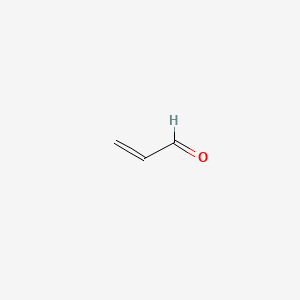
Acrolein
Acrolein is an enal that is prop-2-ene with an oxo group at position 1. It has a role as a herbicide, a toxin and a human xenobiotic metabolite. — ChEBI
- IUPAC-Name
- prop-2-enal
- Summenformel
- C3H4O
- Molekulargewicht
- 56.06 g/mol
- Exakte Masse
- 56.026214747 Da
- XLogP3
- 0,0
- Topologische polare Oberfläche
- 17,1 Ų
- Wasserstoffbrücken-Donoren
- 0
- Wasserstoffbrücken-Akzeptoren
- 1
- Kovalente Einheiten
- 1
- Definierte Stereozentren
- 0
Auch bekannt als
16 weitere gemeldete Namen
Kennungen in externen Datenbanken
Belege aus weiteren wissenschaftlichen Datenbanken
EMBL-EBI ChEBI
acrolein
An enal that is prop-2-ene with an oxo group at position 1.
- Rezeptur
- C3H4O
- Durchschnittsmasse
- 56.064 g/mol
- Monoisotopische Masse
- 56.02621 Da
- Formale Ladung
- 0
- enal — is a (CHEBI:51688)
- toxin — has role (CHEBI:27026)
- human xenobiotic metabolite — has role (CHEBI:76967)
- herbicide — has role (CHEBI:24527)
- toxin — has role (CHEBI:27026)
- human xenobiotic metabolite — has role (CHEBI:76967)
- herbicide — has role (CHEBI:24527)
- enal — is a (CHEBI:51688)
Weitere kuratierte Namen
Querverweise aus dieser Quelle
Zugeordnet durch: Exact CAS cross-reference in the ChEBI compound record. Quelle aktualisiert: 2015-10-23. Abgerufen: 2026-08-31. Quelleneintrag öffnen
NIH PubChem PUG-View
Attributed physical-property, hazard, environmental and use annotations.
- Autoignition Temperature: 453 °F (USCG, 1999) Quelle: CAMEO Chemicals
- Autoignition Temperature: 428 °F (220 °C); unstable Quelle: Hazardous Substances Data Bank (HSDB)
- Autoignition Temperature: 234 °C Quelle: ILO-WHO International Chemical Safety Cards (ICSCs)
- Boiling Point: 126 °F at 760 mmHg (EPA, 1998) Quelle: CAMEO Chemicals
- Boiling Point: 52.3 °C Quelle: Hazardous Substances Data Bank (HSDB)
- Boiling Point: BP: 17.5 °C at 200 mm Hg; 2.5 °C at 100 mm Hg; -7.5 °C at 60 mm Hg; -64.5 °C at 1.0 mm Hg Quelle: Hazardous Substances Data Bank (HSDB)
- Boiling Point: 52.00 to 53.00 °C. @ 760.00 mm Hg Quelle: Human Metabolome Database (HMDB)
- Boiling Point: 53 °C Quelle: ILO-WHO International Chemical Safety Cards (ICSCs)
- Boiling Point: 127 °F Quelle: Occupational Safety and Health Administration (OSHA)
- Boiling Point: 52.6 °C @760 [mm Hg] Quelle: PAC Chemical Database, U.S. Department of Energy
- Boiling Point: 127 °F Quelle: The National Institute for Occupational Safety and Health (NIOSH)
- Color/Form: Colorless or yellowish liquid Quelle: Hazardous Substances Data Bank (HSDB)
- Density: 0.8389 to 0.8621 at 32 to 68 °F (EPA, 1998) Quelle: CAMEO Chemicals
- Density: 0.8389 at 20 °C Quelle: Hazardous Substances Data Bank (HSDB)
- Density: Bulk density: 7.03 lb/gal at 20 °C Quelle: Hazardous Substances Data Bank (HSDB)
- Density: Relative density (water = 1): 0.8 Quelle: ILO-WHO International Chemical Safety Cards (ICSCs)
- Density: 0.84 Quelle: Occupational Safety and Health Administration (OSHA)
- Density: 0.841 @ 20°C Quelle: PAC Chemical Database, U.S. Department of Energy
- Density: 0.84 Quelle: The National Institute for Occupational Safety and Health (NIOSH)
- Flash Point: -15 °F (EPA, 1998) Quelle: CAMEO Chemicals
- Flash Point: -29 °C (-20 °F) - closed cup Quelle: Hazardous Substances Data Bank (HSDB)
- Flash Point: -15 °F (closed cup); -26 °C (closed cup) Quelle: Hazardous Substances Data Bank (HSDB)
- Flash Point: <0 °F (open cup); -18 °C (open cup) Quelle: Hazardous Substances Data Bank (HSDB)
- Flash Point: -26 °C c.c. Quelle: ILO-WHO International Chemical Safety Cards (ICSCs)
- Flash Point: -15 °F Quelle: Occupational Safety and Health Administration (OSHA)
- Flash Point: -15 °F Quelle: The National Institute for Occupational Safety and Health (NIOSH)
- LogP: log Kow = -0.01 Quelle: Hazardous Substances Data Bank (HSDB)
- LogP: -0.01 Quelle: Human Metabolome Database (HMDB)
- LogP: 0.9 Quelle: ILO-WHO International Chemical Safety Cards (ICSCs)
- Melting Point: -126 °F (EPA, 1998) Quelle: CAMEO Chemicals
- Melting Point: -87.8 °C Quelle: Hazardous Substances Data Bank (HSDB)
- Melting Point: -87.7 °C Quelle: Human Metabolome Database (HMDB)
- Melting Point: -88 °C Quelle: ILO-WHO International Chemical Safety Cards (ICSCs)
- Melting Point: -126 °F Quelle: Occupational Safety and Health Administration (OSHA)
- Melting Point: -87.7 °C Quelle: PAC Chemical Database, U.S. Department of Energy
- Melting Point: -126 °F Quelle: The National Institute for Occupational Safety and Health (NIOSH)
- Odor: Extremely sharp; extremely acrid, pungent, burnt sweet; hot fat Quelle: Hazardous Substances Data Bank (HSDB)
- Odor: Disagreeable choking odor Quelle: Hazardous Substances Data Bank (HSDB)
- Physical Description: Acrolein, stabilized appears as a colorless to yellow volatile liquid with a disagreeable choking odor. Flash point below 0 °F. Initially irritating to the eyes and mucous membranes. Very toxic by inhalation. Less dense than water (7.0 lb / gal). Vapors heavier than air. Used to make other chemicals, plastics, and as a herbicide. Rate of onset: Immediate Persistence: Minutes to hour Odor threshold: 1 ppm Source/use/other hazard: Herbicide; tox and corrosive fumes. Quelle: CAMEO Chemicals
- Physical Description: Liquid Quelle: EPA Chemical Data Reporting (CDR)
- Physical Description: Colorless or yellow liquid with a piercing, disagreeable odor; [NIOSH] Quelle: Haz-Map, Information on Hazardous Chemicals and Occupational Diseases
- Physical Description: Liquid Quelle: Human Metabolome Database (HMDB)
- Physical Description: YELLOW-TO-COLOURLESS LIQUID WITH PUNGENT ODOUR. Quelle: ILO-WHO International Chemical Safety Cards (ICSCs)
- Physical Description: Colorless or yellow liquid with a piercing, disagreeable odor. Quelle: Occupational Safety and Health Administration (OSHA)
- Physical Description: Colorless or yellow liquid with a piercing, disagreeable odor. Quelle: The National Institute for Occupational Safety and Health (NIOSH)
- Refractive Index: Index of refraction: 1.4017 at 20 °C/D Quelle: Hazardous Substances Data Bank (HSDB)
- Solubility: greater than or equal to 100 mg/mL at 70 °F (NTP, 1992) Quelle: CAMEO Chemicals
- Solubility: In water, 2.11X10+5 mg/L at 20 °C Quelle: Hazardous Substances Data Bank (HSDB)
- Solubility: Soluble in ethanol, ether, acetone; slightly soluble in chloroform Quelle: Hazardous Substances Data Bank (HSDB)
- Solubility: Soluble in oxygenated solvents Quelle: Hazardous Substances Data Bank (HSDB)
- Solubility: Miscible with lower alcohols, ketones, benzene, diethyl ether and other common organic solvents Quelle: Hazardous Substances Data Bank (HSDB)
- Solubility: 212 mg/mL at 25 °C Quelle: Human Metabolome Database (HMDB)
- Solubility: Solubility in water, g/100ml at 20 °C: 20 (freely soluble) Quelle: ILO-WHO International Chemical Safety Cards (ICSCs)
- Solubility: 40% Quelle: The National Institute for Occupational Safety and Health (NIOSH)
- Vapor Pressure: 135.71 to 210 mmHg at 50 to 68 °F (EPA, 1998) Quelle: CAMEO Chemicals
- Vapor Pressure: 274.0 [mmHg] Quelle: Haz-Map, Information on Hazardous Chemicals and Occupational Diseases
- Vapor Pressure: VP: 217.5 mm Hg at 20 °C; 442.5 mm Hg at 38 °C Quelle: Hazardous Substances Data Bank (HSDB)
- Vapor Pressure: 274 mm Hg at 25 °C Quelle: Hazardous Substances Data Bank (HSDB)
- Vapor Pressure: Vapor pressure, kPa at 20 °C: 29 Quelle: ILO-WHO International Chemical Safety Cards (ICSCs)
- Vapor Pressure: 210 mmHg Quelle: Occupational Safety and Health Administration (OSHA)
- Vapor Pressure: 210 [mm Hg] @20 °C Quelle: PAC Chemical Database, U.S. Department of Energy
- Vapor Pressure: 210 mmHg Quelle: The National Institute for Occupational Safety and Health (NIOSH)
- Viscosity: 0.35 cP at 20 °C Quelle: Hazardous Substances Data Bank (HSDB)
- pH: pH 6.0 (max), a 10% solution in water at 25 °C Quelle: Hazardous Substances Data Bank (HSDB)
- IARC Carcinogenic Agent: Acrolein Quelle: International Agency for Research on Cancer (IARC)
- IARC Carcinogenic Classes: Group 2A: Probably carcinogenic to humans Quelle: International Agency for Research on Cancer (IARC)
- IARC Monographs: Volume 63: (1995) Dry Cleaning, Some Chlorinated Solvents and Other Industrial Chemicals; Volume Sup 7: Overall Evaluations of Carcinogenicity: An Updating of IARC Monographs Volumes 1 to 42, 1987; 440 pages; ISBN 92-832-1411-0 (out of print); Volume 128: (2021) Acrolein, Crotonaldehyde, and Arecoline Quelle: International Agency for Research on Cancer (IARC)
- Publication Year: 2021 online Quelle: International Agency for Research on Cancer (IARC)
- Evaluation Year: 2020 Quelle: International Agency for Research on Cancer (IARC)
- Carcinogen Classification: 3, not classifiable as to its carcinogenicity to humans. (L135) Quelle: Toxin and Toxin Target Database (T3DB)
- Exposure Routes: The substance can be absorbed into the body by inhalation of its vapour, through the skin and by ingestion. Serious local effects by all routes of exposure. Quelle: ILO-WHO International Chemical Safety Cards (ICSCs)
- Exposure Routes: inhalation, ingestion, skin and/or eye contact Quelle: The National Institute for Occupational Safety and Health (NIOSH)
- Exposure Routes: Oral (L121) ; inhalation (L121) ; dermal (L121) Quelle: Toxin and Toxin Target Database (T3DB)
- First Aid: Warning: Acrolein is highly irritating to skin and mucous membranes. Caution is advised.; Signs and Symptoms of Acute Acrolein Exposure: Signs and symptoms of acute exposure to acrolein may be severe and include shortness of breath, tightness in the chest, pulmonary edema, and coma. Lacrimation (tearing), nausea, vomiting, and diarrhea may also occur. Acrolein will irritate or burn the skin and mucous membranes. Eye contact may cause irritation, swelling, discharge, and/or corneal injury.; Emergency Life-Support Procedures: Acute exposure to acrolein may require decontamination and life support for the victims. Emergency personnel should wear protective clothing appropriate to the type and degree of contamination. Air-purifying or supplied-air respiratory equipment should also be worn, as necessary. Rescue vehicles should carry supplies such as plastic sheeting and disposable plastic bags to assist in preventing spread of contamination.; Inhalation Exposure:; 1. Move victims to fresh air. Emergency personnel should avoid self-exposure to acrolein.; 2. Evaluate vital signs including pulse and respiratory rate, and note any trauma. If no pulse is detected, provide CPR. If not breathi Quelle: CAMEO Chemicals
- ERG2024, Guide 131P (Acrolein, stabilized): General First Aid:; · Call 911 or emergency medical service.; · Ensure that medical personnel are aware of the material(s) involved, take precautions to protect themselves and avoid contamination.; · Move victim to fresh air if it can be done safely.; · Administer oxygen if breathing is difficult.; · If victim is not breathing:; -- DO NOT perform mouth-to-mouth resuscitation; the victim may have ingested or inhaled the substance.; -- If equipped and pulse detected, wash face and mouth, then give artificial respiration using a proper respiratory medical device (bag-valve mask, pocket mask equipped with a one-way valve or other device).; -- If no pulse detected or no respiratory medical device available, provide continuous compressions. Conduct a pulse check every two minutes or monitor for any signs of spontaneous respirations.; · Remove and isolate contaminated clothing and shoes.; · For minor skin contact, avoid spreading material on unaffected skin.; · In case of contact with substance, remove immediately by flushing skin or eyes with running water for at least 20 minutes.; · For severe burns, immediate medical attention is required.; · Effects of exposure (inhalation, ingestion, Quelle: Emergency Response Guidebook (ERG)
- First Aid: (General first aid procedures); Eye: Irrigate immediately - If this chemical contacts the eyes, immediately wash (irrigate) the eyes with large amounts of water, occasionally lifting the lower and upper lids. Get medical attention immediately.; Skin: Water flush immediately - If this chemical contacts the skin, immediately flush the contaminated skin with water. If this chemical penetrates the clothing, immediately remove the clothing and flush the skin with water. Get medical attention promptly.; Breathing: Respiratory support; Swallow: Medical attention immediately - If this chemical has been swallowed, get medical attention immediately. Quelle: The National Institute for Occupational Safety and Health (NIOSH)
- Signal: Danger Quelle: Regulation (EC) No 1272/2008 of the European Parliament and of the Council
- GHS Hazard Statements: H225: Highly Flammable liquid and vapor [Danger Flammable liquids]; H300: Fatal if swallowed [Danger Acute toxicity, oral]; H311: Toxic in contact with skin [Danger Acute toxicity, dermal]; H314: Causes severe skin burns and eye damage [Danger Skin corrosion/irritation]; H330: Fatal if inhaled [Danger Acute toxicity, inhalation]; H400: Very toxic to aquatic life [Warning Hazardous to the aquatic environment, acute hazard]; H410: Very toxic to aquatic life with long lasting effects [Warning Hazardous to the aquatic environment, long-term hazard] Quelle: Regulation (EC) No 1272/2008 of the European Parliament and of the Council
- Precautionary Statement Codes: P210, P233, P240, P241, P242, P243, P260, P262, P264, P270, P271, P273, P280, P284, P301+P316, P301+P330+P331, P302+P352, P302+P361+P354, P303+P361+P353, P304+P340, P305+P354+P338, P316, P320, P321, P330, P361+P364, P363, P370+P378, P391, P403+P233, P403+P235, P405, and P501 (click each P-code to see the statement) Quelle: Regulation (EC) No 1272/2008 of the European Parliament and of the Council
- Note: This chemical does not meet GHS hazard criteria for 1.9% (36 of 1920) of reports. Quelle: European Chemicals Agency (ECHA)
- Signal: Danger Quelle: European Chemicals Agency (ECHA)
- GHS Hazard Statements: H225 (98.1%): Highly Flammable liquid and vapor [Danger Flammable liquids]; H300 (84.1%): Fatal if swallowed [Danger Acute toxicity, oral]; H301 (14.1%): Toxic if swallowed [Danger Acute toxicity, oral]; H311 (97%): Toxic in contact with skin [Danger Acute toxicity, dermal]; H314 (98.1%): Causes severe skin burns and eye damage [Danger Skin corrosion/irritation]; H318 (16.2%): Causes serious eye damage [Danger Serious eye damage/eye irritation]; H330 (98.1%): Fatal if inhaled [Danger Acute toxicity, inhalation]; H400 (98.1%): Very toxic to aquatic life [Warning Hazardous to the aquatic environment, acute hazard]; H410 (84%): Very toxic to aquatic life with long lasting effects [Warning Hazardous to the aquatic environment, long-term hazard] Quelle: European Chemicals Agency (ECHA)
- Precautionary Statement Codes: P210, P233, P240, P241, P242, P243, P260, P262, P264, P264+P265, P270, P271, P273, P280, P284, P301+P316, P301+P330+P331, P302+P352, P302+P361+P354, P303+P361+P353, P304+P340, P305+P354+P338, P316, P317, P320, P321, P330, P361+P364, P363, P370+P378, P391, P403+P233, P403+P235, P405, and P501 (click each P-code to see the statement) Quelle: European Chemicals Agency (ECHA)
- ECHA C&L Notifications Summary: Aggregated GHS information provided per 1920 reports by companies from 21 notifications to the ECHA C&L Inventory. Each notification may be associated with multiple companies.; Reported as not meeting GHS hazard criteria per 36 of 1920 reports by companies.; There are 20 notifications provided by 1884 of 1920 reports by companies with hazard statement code(s).; Information may vary between notifications depending on impurities, additives, and other factors. The percentage value in parenthesis indicates the notified classification ratio from companies that provide hazard codes. Only hazard codes with percentage values above 10% are shown. For more detailed information, please visit ECHA C&L website. Quelle: European Chemicals Agency (ECHA)
- Signal: Danger Quelle: NITE-CMC
- GHS Hazard Statements: H225: Highly Flammable liquid and vapor [Danger Flammable liquids]; H300: Fatal if swallowed [Danger Acute toxicity, oral]; H311: Toxic in contact with skin [Danger Acute toxicity, dermal]; H314: Causes severe skin burns and eye damage [Danger Skin corrosion/irritation]; H318: Causes serious eye damage [Danger Serious eye damage/eye irritation]; H330: Fatal if inhaled [Danger Acute toxicity, inhalation]; H336: May cause drowsiness or dizziness [Warning Specific target organ toxicity, single exposure; Narcotic effects]; H350: May cause cancer [Danger Carcinogenicity]; H370: Causes damage to organs [Danger Specific target organ toxicity, single exposure]; H372: Causes damage to organs through prolonged or repeated exposure [Danger Specific target organ toxicity, repeated exposure]; H400: Very toxic to aquatic life [Warning Hazardous to the aquatic environment, acute hazard]; H410: Very toxic to aquatic life with long lasting effects [Warning Hazardous to the aquatic environment, long-term hazard] Quelle: NITE-CMC
- Precautionary Statement Codes: P203, P210, P233, P240, P241, P242, P243, P260, P261, P262, P264, P264+P265, P270, P271, P273, P280, P284, P301+P316, P301+P330+P331, P302+P352, P302+P361+P354, P303+P361+P353, P304+P340, P305+P354+P338, P308+P316, P316, P317, P318, P319, P320, P321, P330, P361+P364, P363, P370+P378, P391, P403+P233, P403+P235, P405, and P501 (click each P-code to see the statement) Quelle: NITE-CMC
- GHS Hazard Statements: H225: Highly Flammable liquid and vapor [Danger Flammable liquids]; H300: Fatal if swallowed [Danger Acute toxicity, oral]; H311: Toxic in contact with skin [Danger Acute toxicity, dermal]; H314: Causes severe skin burns and eye damage [Danger Skin corrosion/irritation]; H318: Causes serious eye damage [Danger Serious eye damage/eye irritation]; H330: Fatal if inhaled [Danger Acute toxicity, inhalation]; H336: May cause drowsiness or dizziness [Warning Specific target organ toxicity, single exposure; Narcotic effects]; H370: Causes damage to organs [Danger Specific target organ toxicity, single exposure]; H372: Causes damage to organs through prolonged or repeated exposure [Danger Specific target organ toxicity, repeated exposure] Quelle: NITE-CMC
- Health Effects: Acrolein is a severe pulmonary irritant and lachrymatory agent. Breathing large amounts of acrolein damages the lungs and could cause death. (L121, L122) Quelle: Toxin and Toxin Target Database (T3DB)
- NFPA Health Rating: 4 - Materials that, under emergency conditions, can be lethal. Quelle: Hazardous Substances Data Bank (HSDB)
- NFPA Fire Rating: 3 - Liquids and solids that can be ignited under almost all ambient temperature conditions. Materials produce hazardous atmospheres with air under almost all ambient temperatures or, though unaffected by ambient temperatures, are readily ignited under almost all conditions. Quelle: Hazardous Substances Data Bank (HSDB)
- NFPA Instability Rating: 3 - Materials that in themselves are capable of detonation or explosive decomposition or explosive reaction but that require a strong initiating source or must be heated under confinement before initiation. Quelle: Hazardous Substances Data Bank (HSDB)
- Target Organs: Gastrointestinal (Stomach and Intestines, part of the digestive system), Ocular (Eyes), Respiratory (From the Nose to the Lungs) Quelle: Agency for Toxic Substances and Disease Registry (ATSDR)
- Target Organs: Respiratory Quelle: EPA Integrated Risk Information System (IRIS)
- Target Organs: Eyes, skin, respiratory system, heart Quelle: The National Institute for Occupational Safety and Health (NIOSH)
- Toxicity Summary: IDENTIFICATION AND USE: Acrolein is a colorless or yellowish liquid. Acrolein is a biocide currently registered as an herbicide to control aquatic weeds in irrigation canals, as a burrow fumigant to control rodents, and as a microbiocide to eliminate slime-forming microbes in oil drilling operations, pulp and paper mills, and in industrial cooling towers. It has activity as a molluscicide, but is not currently registered for use against mollusks. It is an intermediate for synthetic glycerol, polyurethane and polyester resins, methionine, and pharmaceuticals. In World War I, it was used as a tear gas under the name Papite. HUMAN EXPOSURE AND TOXICITY: The threshold levels of acrolein causing irritation and health effects are 0.7 mg/ cu m for odor perception, 0.13 mg/cu m for eye irritation, 0.3 mg/cu m for nasal irritation and eye blinking, and 0.7 mg/cu m for decreased respiratory rate. Potential symptoms of overexposure are irritation of eyes, skin and mucous membranes; decreased pulmonary function; delayed pulmonary edema; chronic respiratory disease. Intense lacrimation and nasal irritation ordinarily give adequate warning of inhalation, but exposed patients should be observed f Quelle: Hazardous Substances Data Bank (HSDB)
- Toxicity Summary: Acrolein rapidly and irreversibly binds to lysine moieties and sulfhydryl groups found on many cellular molecules forming thiol ethers. By this mechanism acrolein can bind to messenger compounds to produce direct cytotoxic effects or secondary effects from interrupted cell signaling pathways. Perturbation of inflammatory responses in bronchial epithelial cells was demonstrated by direct action of acrolein on the inhibitor of nuclear factor kappa-B (IκB) kinase, which inhibits activation of nuclear factor kappa-light-chain-enhancer of activated B cells (NF-κB) transcription factor and suppresses interleukin 8 (IL-8) production. Rapid binding of acrolein to neural receptors in the corneal and nasal mucosa results in rapid depolarization of the associated neurons to produce ocular and nasal irritation. Acrolein also binds rapidly to glutathione, which may be inhibitory to the enzyme glutathione peroxidase and result in a lower level of cellular protection against oxygen radical toxicity. Further, the adduction of glutathione generates GS-propionaldehyde, which produces oxygen and possibly hydroxy radicals via cytosolic aldehyde dehydrogenase. Acrolein inhibits thioredoxin and thioredo Quelle: Toxin and Toxin Target Database (T3DB)
- Environmental Bioconcentration: An estimated BCF of 3 was calculated in fish for acrolein(SRC), using a log Kow of -0.01(1) and a regression-derived equation(2). According to a classification scheme(3), this BCF suggests the potential for bioconcentration in aquatic organisms is low(SRC). Results of BCF tests using carp (Cyprinus carpio) which were exposed to acrolein over an 8-week indicate the compound has low bioconcentration(4), however, actual BCF values were not reported(SRC). A log BCF of 2.54 (BCF = 347) was measured for acrolein in a bluegill sunfish based on the whole body weight(5). In another study, a BCF of 344 was measured for acrolein in bluegill sunfish(6). However, these measured values may be an overestimate since total (14)C was measured in the fish, which may have resulted in the measurement of acrolein metabolites(7). Quelle: Hazardous Substances Data Bank (HSDB)
- Environmental Fate: Due to its high vapor pressure and water solubility, acrolein is expected to be highly mobile when released into the environment, although degradative processes are likely to limit its transport. Quelle: Hazardous Substances Data Bank (HSDB)
- Environmental Fate: TERRESTRIAL FATE: Based on a classification scheme(1), an estimated Koc value of 1.0(SRC), determined from a structure estimation method(2), indicates that acrolein is expected to have very high mobility in soil(SRC). Volatilization of acrolein from moist soil surfaces is expected to be an important fate process(SRC) given a Henry's Law constant of 1.22X10⁻⁴ atm-cu m/mole(3). Acrolein is expected to volatilize from dry soil surfaces(SRC) based upon a vapor pressure of 274 mm Hg(4). It has been reported that acrolein is metabolized easily in soil, being mineralized to carbon dioxide(5). In a laboratory study conducted in an aerobic sandy loam soil, acrolein was completely gone within 8 hours in the nonsterile soils and within 115 hours in the sterilized soil(6); the biotransformation half-life in the nonsterile soil was calculated to be 4.2 hours(6). In field dissipation studies, acrolein had a half-life of 7.5 to 10.2 hours(5). Results of biodegradation studies in aquatic systems suggest that acrolein, at low concentrations, is subject to aerobic biodegradation(7). In moist soil, transformation of the acrolein via hydration may occur followed by aerobic biodegradation of the hydrat Quelle: Hazardous Substances Data Bank (HSDB)
- Environmental Fate: AQUATIC FATE: Based on a classification scheme(1), an estimated Koc value of 1.0(SRC), determined from a structure estimation method(2), indicates that acrolein is not expected to adsorb to suspended solids and sediment(SRC). Volatilization from water surfaces is expected(3) based upon a Henry's Law constant of 1.22X10⁻⁴ atm-cu m/mole(4). Using this Henry's Law constant and an estimation method(3), volatilization half-lives for a model river and model lake are 7.6 hours and 4.6 days, respectively(SRC). According to a classification scheme(5), an estimated BCF of 3(SRC), from its log Kow of -0.01(6) and a regression-derived equation(2), suggests the potential for bioconcentration in aquatic organisms is low(SRC). Although acrolein has no hydrolyzable functional group, the simple and reversible hydration of acrolein to form 3-hydroxypropan-1-al is known to proceed by first order kinetics(7). Half-lives in buffers at pH 6-8 were 1.7 to 2.3 days, and a fall in pH was detected during the decline of 3-hydroxypropan-1-al in nonsterile irrigation water(7). Hydrolysis half-lives of 3.5 days (pH 5), 1.5 days (pH 7), and 4 hours (pH 10) have also been reported for acrolein(8). A half-life for Quelle: Hazardous Substances Data Bank (HSDB)
- Environmental Fate: AQUATIC FATE: Experimental data for decay of acrolein in water indicate approx 1st order kinetics. The reaction continued to completion in natural water. Data on effects of pH on decay of acrolein may be used as a conservative estimate of dissipation rate. In water flowing in 2 channels, an 8 to 10 fold discrepancy between observed and predicted rates of dissipation was attributed to major losses in volatilization and adsorption. A relatively nonvolatile reaction product (which gave a positive reaction with dinitrophenylhydrazine) accumulated initially but dissipated. Quelle: Hazardous Substances Data Bank (HSDB)
- Environmental Fate: ATMOSPHERIC FATE: According to a model of gas/particle partitioning of semivolatile organic compounds in the atmosphere(1), acrolein, which has a vapor pressure of 274 mm Hg at 25 °C(2), is expected to exist solely as a vapor in the ambient atmosphere. Vapor-phase acrolein is degraded in the atmosphere by reaction with photochemically-produced hydroxyl radicals(SRC); the half-life for this reaction in air is estimated to be 19 hours(SRC), calculated from its rate constant of 2.00X10⁻¹¹ cu cm/molecule-sec at 25 °C(3). Products of the reaction of acrolein with hydroxyl radicals include: carbon dioxide, formaldehyde, and glycolaldehyde(4). Acrolein is degraded slowly in the atmosphere by reaction with ozone and nitrate radicals(SRC). The half-life for the reaction with ozone is estimated to be 38 days(SRC), calculated from its rate constant of 3.01X10⁻¹⁹ cu cm/molecule-sec at 25 °C(3). The half-life for the reaction with nitrate radicals is estimated to be 98 days(SRC), calculated from its rate constant of 3.280X10⁻¹⁶ cu cm/molecule-sec at 25 °C(3). Acrolein absorbs at wavelengths >290 nm(3) and, therefore, may be susceptible to direct photolysis by sunlight(SRC). Based on measured qu Quelle: Hazardous Substances Data Bank (HSDB)
- Industry Uses: Other; Intermediate; Corrosion inhibitor; Reducing agent Quelle: EPA Chemical Data Reporting (CDR)
- Uses: The largest use for acrolein is as an intermediate in the synthesis of acrylic acid and as a biocide. Quelle: EPA Hazardous Air Pollutants
- Sources/Uses: Used in the manufacture of various organic chemical products; also used as a fungicide and pesticide; one of the causes of smoke inhalation injury; acrolein is a combustion product of wood, cellulose, and polyethylene; [Sullivan, p. 1017] Also used as a biocide to kill microorganisms, a fumigant to kill rodents, a leather tanning agent, and histology fixative; [ATSDR Medical Management] Quelle: Haz-Map, Information on Hazardous Chemicals and Occupational Diseases
- Industrial Processes with risk of exposure: Metal Preparation and Pouring [Category: Foundry]; Using Disinfectants or Biocides [Category: Clean]; Farming (Pesticides) [Category: Industry]; Firefighting [Category: Other]; Leather Tanning and Processing [Category: Industry]; Burning Natural Polymers [Category: Burn]; Welding Over Coatings [Category: Weld]; Burning Synthetic Polymers [Category: Burn] Quelle: Haz-Map, Information on Hazardous Chemicals and Occupational Diseases
- Activities with risk of exposure: Ceramics making [Category: Hobbies]; Lost-wax casting [Category: Hobbies]; Textile arts [Category: Hobbies]; Smoking cigarettes [Category: Food & Drugs]; Burning biomass fuel for cooking and heating [Category: Environments] Quelle: Haz-Map, Information on Hazardous Chemicals and Occupational Diseases
- Uses: For acrolein (USEPA/OPP Pesticide Code: 000701) ACTIVE products with label matches. /SRP: Registered for use in the USA but approved pesticide uses may change periodically and so federal, state and local authorities must be consulted for currently approved uses./ Quelle: Hazardous Substances Data Bank (HSDB)
- Uses: It is used commercially as a very effective broad-spectrum biocide in very low concentrations of approximately 10 ppm. For example, it is applied to control the growth of aquatic weeds in irrigation waterways or of algae and mollusks in recirculating water systems. Of particular importance is the use of acrolein as a biocide in oil-field brines; it increases the efficiency of oil-field water flooding and is useful in brine disposal operations. Furthermore, it is used in oil-field waters to scavenge malodorous hydrogen sulfide completely. The main field of use includes the production of methionine, methionine hydroxy analog, acrylic acid, 1,3 propanediol, glutaraldehyde, pyridines, flavors and fragrances. Quelle: Hazardous Substances Data Bank (HSDB)
- Uses: Manufacturing colloidal forms of metals; making plastics, perfumes; warning agent in methyl chloride refrigerant. Has been used in military poison gas mixtures. Used in organic synthesis. Aquatic herbicide. Quelle: Hazardous Substances Data Bank (HSDB)
- Uses: Intermediate for synthetic glycerol, polyurethane and polyester resins, methionine, pharmaceuticals; herbicide; warning agents in gases. Quelle: Hazardous Substances Data Bank (HSDB)
- Uses: For more Uses (Complete) data for ACROLEIN (10 total), please visit the HSDB record page. Quelle: Hazardous Substances Data Bank (HSDB)
- Uses: Acrolein is used as a pesticide to control algae, weeds, bacteria, and mollusks. It is also used to make other chemicals, such as polyester resin, polyurethane, propylene glycol, acrylic acid, acrylonitrile, and glycerol. Small amounts of acrolein can be formed when trees, tobacco, other plants, gasoline, and oil are burned. (L121) Quelle: Toxin and Toxin Target Database (T3DB)
Zugeordnet durch: Existing checksum-valid CAS to unique PubChem CID match. Abgerufen: 2026-08-31. Quelleneintrag öffnen
Wissenschaftliche Klassifizierungen und Gefahrenannotationen liefern Kontext und ersetzen nicht die oben gezeigte marktspezifische regulatorische Entscheidung.
Weitere Quellenabdeckung und Trefferstatus
| Quelle | Ergebnis | Geprüft |
|---|---|---|
| EMBL-EBI ChEBI | Exakter Treffer | 2026-08-31 |
| NIH PubChem PUG-View | Exakter Treffer | 2026-08-31 |
Ein erfasster Nicht-Treffer ist ein nützlicher Beleg dafür, dass die Quelle geprüft wurde; er ist keine Behauptung, dass der Stoff anderswo nicht existiert.
Am 2026-08-31 von NIH PubChem durch prüfsummengültigen CAS-Abgleich abgerufen. Chemische Eigenschaften ersetzen nicht die regulatorische Entscheidung auf dieser Seite.
Verwandte Belege aus dem Verzeichnis
Inhaltsstoffe mit sich überschneidenden Rezepturfunktionen
Weitere amtliche und wissenschaftliche Quellen
11 externe Datenbanken zur Prüfung dieser Identität
Jeder Link durchsucht die jeweilige Quelle nach dieser Identität. Was jede Quelle ist und welches rechtliche Gewicht sie hat
Wie ACROLEIN im CosIng-Verzeichnis erscheint
Das CosIng-Verzeichnis führt ACROLEIN als kosmetischen Inhaltsstoff, und diese Seite verknüpft ihn mit 0 Anhangseinträgen. Der Verzeichniseintrag erfasst Namen und Kennungen, während die Anhangseinträge zeigen, wo der Stoff im EU-Kosmetikrecht verboten, beschränkt oder positiv gelistet ist.
ACROLEIN ist in den amtlichen Daten außerdem mit 1 kosmetischen Funktion gekennzeichnet. Funktionsbezeichnungen beschreiben die beabsichtigte Verwendung, ersetzen aber nicht die regulatorische Prüfung verknüpfter Anhangseinträge vor der Rezeptierung oder Kennzeichnung.
Häufig gestellte Fragen
Quellenhinweis zu ACROLEIN
Diese Seite gibt den CosIng-Verzeichniseintrag für ACROLEIN aus öffentlichen Materialien der Europäischen Kommission zu kosmetischen Inhaltsstoffen wieder und zeigt verknüpfte Kennungen auch dann, wenn derzeit kein direkter Anhangstreffer zugeordnet ist.
Nutzen Sie diese Verzeichnisseite, um ACROLEIN zu recherchieren und verknüpfte Einträge zu vergleichen; verifizieren Sie Beschränkungen und Rechtsstatus jedoch anhand des aktuellen amtlichen Quellentextes und Rechts, bevor Sie regulatorische Entscheidungen treffen.
Werkzeuge und nächste Schritte
Rezeptur prüfen
Eine vollständige INCI-Liste prüfen, um ACROLEIN und etwaige verknüpfte EU-Anhangsbeschränkungen oder Allergenmarkierungen zu erkennen.
INCI-CheckerÄhnliche Inhaltsstoffe suchen
Weitere Inhaltsstoffe aus dem Verzeichnis und Anhangseinträge finden, die mit ACROLEIN, seinen Kennungen oder nahen Namensvarianten zusammenhängen.
Suche