
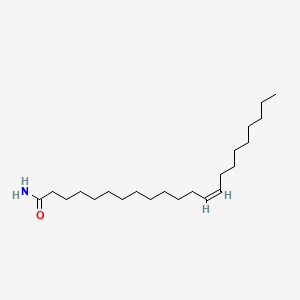
Erucamide
Erucamide is a primary fatty amide resulting from the formal condensation of the carboxy group of erucic acid with ammonia. It is commonly used as a slip additive in the plastic manufacturing industry. It has a role as an EC 3.1.1.7 (acetylcholinesterase) inhibitor, a mammalian metabolite, a plant metabolite, a human metabolite and a rat metabolite. It is functionally related to an erucic acid. — ChEBI
- IUPAC-Name
- (Z)-docos-13-enamide
- Summenformel
- C22H43NO
- Molekulargewicht
- 337.6 g/mol
- Exakte Masse
- 337.334464995 Da
- XLogP3
- 8,8
- Topologische polare Oberfläche
- 43,1 Ų
- Wasserstoffbrücken-Donoren
- 1
- Wasserstoffbrücken-Akzeptoren
- 1
- Kovalente Einheiten
- 1
- Definierte Stereozentren
- 0
Auch bekannt als
16 weitere gemeldete Namen
Kennungen in externen Datenbanken
- ChEBI:CHEBI:142245
- ChEMBL:CHEMBL1232565
- EPA DTXSID:DTXSID4026929
- PubMed:40014714
- PubMed:28392566
- PubMed:22880162
- PubMed:2334413
Belege aus weiteren wissenschaftlichen Datenbanken
NIH PubChem PUG-View
Attributed physical-property, hazard, environmental and use annotations.
- Color/Form: SOLID Quelle: Hazardous Substances Data Bank (HSDB)
- Melting Point: 75-80 °C Quelle: Hazardous Substances Data Bank (HSDB)
- Physical Description: Dry Powder; Large Crystals; Dry Powder; Large Crystals; Large Crystals; Other Solid; CBI Quelle: EPA Chemical Data Reporting (CDR)
- Physical Description: Solid; [Hawley] Off-white beads with a fatty odor; [MSDSonline] Quelle: Haz-Map, Information on Hazardous Chemicals and Occupational Diseases
- Solubility: SOL IN ISOPROPANOL; SLIGHTLY SOL IN ALCOHOL, ACETONE Quelle: Hazardous Substances Data Bank (HSDB)
- Vapor Pressure: 0.00000001 [mmHg] Quelle: Haz-Map, Information on Hazardous Chemicals and Occupational Diseases
- Note: This chemical does not meet GHS hazard criteria for 67.1% (429 of 639) of all reports. Quelle: European Chemicals Agency (ECHA)
- Signal: Warning Quelle: European Chemicals Agency (ECHA)
- GHS Hazard Statements: H315 (32.7%): Causes skin irritation [Warning Skin corrosion/irritation]; H319 (32.7%): Causes serious eye irritation [Warning Serious eye damage/eye irritation]; H335 (32.7%): May cause respiratory irritation [Warning Specific target organ toxicity, single exposure; Respiratory tract irritation] Quelle: European Chemicals Agency (ECHA)
- Precautionary Statement Codes: P261, P264, P264+P265, P271, P280, P302+P352, P304+P340, P305+P351+P338, P319, P321, P332+P317, P337+P317, P362+P364, P403+P233, P405, and P501 (click each P-code to see the statement) Quelle: European Chemicals Agency (ECHA)
- ECHA C&L Notifications Summary: Aggregated GHS information provided per 639 reports by companies from 7 notifications to the ECHA C&L Inventory. Each notification may be associated with multiple companies.; Reported as not meeting GHS hazard criteria per 429 of 639 reports by companies.; There are 5 notifications provided by 210 of 639 reports by companies with hazard statement code(s).; Information may vary between notifications depending on impurities, additives, and other factors. The percentage value in parenthesis indicates the notified classification ratio from companies that provide hazard codes. Only hazard codes with percentage values above 10% are shown. For more detailed information, please visit ECHA C&L website. Quelle: European Chemicals Agency (ECHA)
- Environmental Bioconcentration: The vapor pressure of erucamide has been estimated to be 1.28X10⁻⁶ mm Hg at 25 °C from its melting point of 77.5 °C(1) and an estimation method(3). The Henry's Law constant for erucamide has been estimated to be 2.844X10⁻⁶ atm-cu m/mole by an estimation method(4). From the ratio of estimated vapor pressure and estimated Henry's Law constant, the water solubility of erucamide has been estimated to be 0.2 mg/L(2). Since erucamide is a long chain aliphatic amide, it is likely to have low water solubility. The low water solubility of erucamide suggests that bioconcentration of the compound in aquatic organisms may be important(2,SRC). Quelle: Hazardous Substances Data Bank (HSDB)
- Environmental Fate: TERRESTRIAL FATE: Based on expected slow hydrolysis(1-2) of erucamide in water, hydrolysis should be unimportant in soil The presence of chromophoric groups in erucamide that are capable of absorbing sunlight(1) suggests that photolysis may be important on soil surfaces. The fact that the erucamide is degradable by fungi(3) indicates that it has the potential to biodegrade in soil, but its rate of biodegradation is unknown. The estimated log Koc of 4.02(1) indicates that erucamide should be immobile in soil(4). The vapor pressure 1.28X10⁻⁶ mm Hg at 25 °C estimated from its melting point of 77.5 °C(5) and an estimation method(6,SRC) suggests volatilization from soil should not be important(SRC). Quelle: Hazardous Substances Data Bank (HSDB)
- Environmental Fate: AQUATIC FATE: Hydrolysis of erucamide should not be important in environmental waters(1-2). Based on the available chromophoric group, direct photolysis of erucamide may be important in clear surface water(1). Biodegradation of erucamide may be important in soil(3), but degradation rate data are unknown. The volatilization half-life of erucamide from a model river has been estimated to be 23 days(1-5). Therefore, volatilization from water should not be important(SRC). The estimated log Koc of 4.02(1) indicates that erucamide may strongly adsorb to suspended solid and sediment in water(4). The estimated bioconcentration factor of 6310(1) suggests that bioconcentration of erucamide in aquatic organisms should be important(SRC). Quelle: Hazardous Substances Data Bank (HSDB)
- Environmental Fate: ATMOSPHERIC FATE: Based on the estimated vapor pressure of 1.28X10⁻⁶ mm of Hg, erucamide should be found in the atmosphere both in particulate and vapor phase(3). In the atmosphere, vapor phase erucamide should react quickly with photochemically produced hydroxyl radicals and ozone present in the ambient air. Based on an estimation method(1), the rate constant for the reaction of erucamide with hydroxyl radicals has been estimated to be 1.03X10⁻¹⁰ cu-cm/molecule-sec(1). Assuming the daily average concn of hydroxyl radicals in the atmosphere as 5X10+5/cu-cm(2), the half-life for this reaction has been estimated to be 3.7 hrs. Based on an estimation method(4), the rate constant for the reaction of erucamide with atmospheric ozone has been estimated to be 13.0X10⁻¹⁷ cu m/molecule-sec. Assuming the average concn of atmospheric ozone to be 7X10+11 molecules/cu cm(2), the half-lives for these reactions have been estimated to be 2.1 hrs. Particulate erucamide may be removed from the atmosphere by dry deposition(SRC). Quelle: Hazardous Substances Data Bank (HSDB)
- Consumer Uses: Flux agent; Not Known or Reasonably Ascertainable; Anti-adhesive/cohesive; Lubricating agent Quelle: EPA Chemical Data Reporting (CDR)
- Industry Uses: Lubricating agent; Anti-adhesive/cohesive; Processing aids not otherwise specified; Not Known or Reasonably Ascertainable; Anti-slip agent; Adhesion/cohesion promoter Quelle: EPA Chemical Data Reporting (CDR)
- Sources/Uses: Used as foam stabilizer, adherent, antiblock agent for polyethylenes, and solvent for waxes and resins; [HSDB] Quelle: Haz-Map, Information on Hazardous Chemicals and Occupational Diseases
- Uses: FOAM STABILIZER; SOLVENT FOR WAXES & RESINS; EMULSIONS; ANTIBLOCK AGENT FOR POLYETHYLENE Quelle: Hazardous Substances Data Bank (HSDB)
- Uses: Used as adherent Quelle: Hazardous Substances Data Bank (HSDB)
- Uses: Plastics -> Typical concentration range in plastic materials -> 0.1% Quelle: NORMAN Suspect List Exchange
Zugeordnet durch: Existing checksum-valid CAS to unique PubChem CID match. Abgerufen: 2026-08-31. Quelleneintrag öffnen
Wissenschaftliche Klassifizierungen und Gefahrenannotationen liefern Kontext und ersetzen nicht die oben gezeigte marktspezifische regulatorische Entscheidung.
Weitere Quellenabdeckung und Trefferstatus
| Quelle | Ergebnis | Geprüft |
|---|---|---|
| NIH PubChem PUG-View | Exakter Treffer | 2026-08-31 |
Ein erfasster Nicht-Treffer ist ein nützlicher Beleg dafür, dass die Quelle geprüft wurde; er ist keine Behauptung, dass der Stoff anderswo nicht existiert.
Am 2026-08-31 von NIH PubChem durch prüfsummengültigen CAS-Abgleich abgerufen. Chemische Eigenschaften ersetzen nicht die regulatorische Entscheidung auf dieser Seite.