
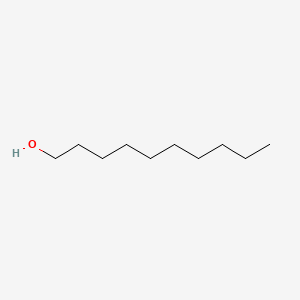
1-Decanol
Decan-1-ol is a fatty alcohol consisting of a hydroxy function at C-1 of an unbranched saturated chain of ten carbon atoms. It has a role as a metabolite, a pheromone and a protic solvent. It is a primary alcohol and a decanol. — ChEBI
- IUPAC-Name
- decan-1-ol
- Summenformel
- C10H22O
- Molekulargewicht
- 158.28 g/mol
- Exakte Masse
- 158.167065321 Da
- XLogP3
- 4,6
- Topologische polare Oberfläche
- 20,2 Ų
- Wasserstoffbrücken-Donoren
- 1
- Wasserstoffbrücken-Akzeptoren
- 1
- Kovalente Einheiten
- 1
- Definierte Stereozentren
- 0
Auch bekannt als
16 weitere gemeldete Namen
Kennungen in externen Datenbanken
- ChEBI:CHEBI:28903
- ChEMBL:CHEMBL25363
- EPA DTXSID:DTXSID7021946
- PubMed:23060241
- PubMed:22998553
- PubMed:22967520
- PubMed:22738247
- PubMed:22685486
- PubMed:22679477
- PubMed:22606152
- PubMed:22593687
- PubMed:22468788
- PubMed:22424076
- PubMed:22379392
- PubMed:22355590
Belege aus weiteren wissenschaftlichen Datenbanken
NIH PubChem PUG-View
Attributed physical-property, hazard, environmental and use annotations.
- Autoignition Temperature: 550 °F (USCG, 1999) Quelle: CAMEO Chemicals
- Autoignition Temperature: 550 °F (288 °C) Quelle: Hazardous Substances Data Bank (HSDB)
- Autoignition Temperature: 255 °C Quelle: ILO-WHO International Chemical Safety Cards (ICSCs)
- Boiling Point: 446 °F at 760 mmHg (USCG, 1999) Quelle: CAMEO Chemicals
- Boiling Point: boiling point equals 446 °F Quelle: Haz-Map, Information on Hazardous Chemicals and Occupational Diseases
- Boiling Point: 229 °C Quelle: Hazardous Substances Data Bank (HSDB)
- Boiling Point: BP: 115 to 120 °C at 15 mm Hg; 109.5 °C at 8 mm Hg Quelle: Hazardous Substances Data Bank (HSDB)
- Boiling Point: 230 °C Quelle: ILO-WHO International Chemical Safety Cards (ICSCs)
- Boiling Point: 233 °C Quelle: Joint FAO/WHO Expert Committee on Food Additives (JECFA)
- Boiling Point: 232.9 °C @760 [mm Hg] Quelle: PAC Chemical Database, U.S. Department of Energy
- Color/Form: Colorless to water-white liquid Quelle: Hazardous Substances Data Bank (HSDB)
- Color/Form: Colorless, viscous, refractive liquid Quelle: Hazardous Substances Data Bank (HSDB)
- Color/Form: Moderately viscous, strongly refractive liquid Quelle: Hazardous Substances Data Bank (HSDB)
- Density: 0.84 at 68 °F (USCG, 1999) - Less dense than water; will float Quelle: CAMEO Chemicals
- Density: 0.8297 g/cu cm at 20 °C Quelle: Hazardous Substances Data Bank (HSDB)
- Density: 0.83 g/cm³ Quelle: ILO-WHO International Chemical Safety Cards (ICSCs)
- Density: Relative density of the vapour/air-mixture at 20 °C (air = 1): 1.01 Quelle: ILO-WHO International Chemical Safety Cards (ICSCs)
- Density: 0.826-0.831 Quelle: Joint FAO/WHO Expert Committee on Food Additives (JECFA)
- Density: 0.83 @ 20°C Quelle: PAC Chemical Database, U.S. Department of Energy
- Flash Point: 180 °F (USCG, 1999) Quelle: CAMEO Chemicals
- Flash Point: Flash point equals 180 °F Quelle: Haz-Map, Information on Hazardous Chemicals and Occupational Diseases
- Flash Point: 82 °C (180 °F) - closed cup Quelle: Hazardous Substances Data Bank (HSDB)
- Flash Point: 180 °F (82 °C) (Open cup) Quelle: Hazardous Substances Data Bank (HSDB)
- Flash Point: 108 °C c.c. Quelle: ILO-WHO International Chemical Safety Cards (ICSCs)
- LogP: log Kow= 4.57 Quelle: Hazardous Substances Data Bank (HSDB)
- LogP: 4.57 Quelle: Human Metabolome Database (HMDB)
- LogP: 4.23 (calculated) Quelle: ILO-WHO International Chemical Safety Cards (ICSCs)
- Melting Point: 44 °F (USCG, 1999) Quelle: CAMEO Chemicals
- Melting Point: 7 °C Quelle: Hazardous Substances Data Bank (HSDB)
- Melting Point: Surface tension = 0.029742 N/m (at melting point) Quelle: Hazardous Substances Data Bank (HSDB)
- Melting Point: 6.9 °C Quelle: Human Metabolome Database (HMDB)
- Melting Point: 7 °C Quelle: ILO-WHO International Chemical Safety Cards (ICSCs)
- Melting Point: 7 °C Quelle: PAC Chemical Database, U.S. Department of Energy
- Odor: Sweet odor Quelle: Hazardous Substances Data Bank (HSDB)
- Odor: Floral, fruity odor Quelle: Hazardous Substances Data Bank (HSDB)
- Odor: RESEMBLE ORANGE FLOWERS Quelle: Hazardous Substances Data Bank (HSDB)
- Physical Description: Decyl alcohol appears as a clear colorless liquid with a sweet fat-like odor. Flash point 180 °F. Less dense than water and insoluble in water. Vapors are heavier than air. Quelle: CAMEO Chemicals
- Physical Description: Liquid; Wet Solid; Liquid Quelle: EPA Chemical Data Reporting (CDR)
- Physical Description: Clear liquid with a sweet odor; [CAMEO] Odor resembles orange flowers; [CHEMINFO] Quelle: Haz-Map, Information on Hazardous Chemicals and Occupational Diseases
- Physical Description: Liquid Quelle: Human Metabolome Database (HMDB)
- Physical Description: COLOURLESS LIQUID WITH CHARACTERISTIC ODOUR. Quelle: ILO-WHO International Chemical Safety Cards (ICSCs)
- Physical Description: colourless liquid/floral, waxy, fruity odour Quelle: Joint FAO/WHO Expert Committee on Food Additives (JECFA)
- Refractive Index: Index of refraction = 1.4372 at 20 °C/D Quelle: Hazardous Substances Data Bank (HSDB)
- Refractive Index: 1.435-1.439 Quelle: Joint FAO/WHO Expert Committee on Food Additives (JECFA)
- Solubility: In water, 37 mg/L at 25 °C Quelle: Hazardous Substances Data Bank (HSDB)
- Solubility: Soluble in carbon tetrachloride; miscible in ethanol, ether, acetone, benzene, chloroform Quelle: Hazardous Substances Data Bank (HSDB)
- Solubility: 1:3 IN 60% ALCOHOL Quelle: Hazardous Substances Data Bank (HSDB)
- Solubility: Soluble in alcohol, ether, mineral oil, propylene glycol, fixed oils; Insoluble in glycerin water at 233 °C Quelle: Hazardous Substances Data Bank (HSDB)
- Solubility: Solubility in water, g/100ml at 20 °C: 0.37 (very poor) Quelle: ILO-WHO International Chemical Safety Cards (ICSCs)
- Solubility: soluble in alcohol, ether, mineral oil, propylene glycol, most fixed oils; Insoluble in glycerin, water Quelle: Joint FAO/WHO Expert Committee on Food Additives (JECFA)
- Solubility: 1 ml in 3 ml 60% alcohol (in ethanol) Quelle: Joint FAO/WHO Expert Committee on Food Additives (JECFA)
- Vapor Pressure: 0.00851 [mmHg] Quelle: Haz-Map, Information on Hazardous Chemicals and Occupational Diseases
- Vapor Pressure: 0.00851 mm Hg at 25 °C Quelle: Hazardous Substances Data Bank (HSDB)
- Vapor Pressure: Vapor pressure, Pa at 20 °C: 1 Quelle: ILO-WHO International Chemical Safety Cards (ICSCs)
- Vapor Pressure: 1 [mm Hg] @69.5 °C Quelle: PAC Chemical Database, U.S. Department of Energy
- Viscosity: 10.9 mPa.s at 25 °C Quelle: Hazardous Substances Data Bank (HSDB)
- Exposure Routes: The substance can be absorbed into the body by inhalation of its aerosol. Quelle: ILO-WHO International Chemical Safety Cards (ICSCs)
- First Aid: CONTACT WITH EYES: flush with water for 15 min. (USCG, 1999) Quelle: CAMEO Chemicals
- Note: This chemical does not meet GHS hazard criteria for 1.3% (47 of 3504) of reports. Quelle: European Chemicals Agency (ECHA)
- Signal: Warning Quelle: European Chemicals Agency (ECHA)
- GHS Hazard Statements: H315 (51.7%): Causes skin irritation [Warning Skin corrosion/irritation]; H319 (91.8%): Causes serious eye irritation [Warning Serious eye damage/eye irritation]; H411 (66.3%): Toxic to aquatic life with long lasting effects [Hazardous to the aquatic environment, long-term hazard]; H412 (23.5%): Harmful to aquatic life with long lasting effects [Hazardous to the aquatic environment, long-term hazard] Quelle: European Chemicals Agency (ECHA)
- Precautionary Statement Codes: P264, P264+P265, P273, P280, P302+P352, P305+P351+P338, P321, P332+P317, P337+P317, P362+P364, P391, and P501 (click each P-code to see the statement) Quelle: European Chemicals Agency (ECHA)
- ECHA C&L Notifications Summary: Aggregated GHS information provided per 3504 reports by companies from 27 notifications to the ECHA C&L Inventory. Each notification may be associated with multiple companies.; Reported as not meeting GHS hazard criteria per 47 of 3504 reports by companies.; There are 26 notifications provided by 3457 of 3504 reports by companies with hazard statement code(s).; Information may vary between notifications depending on impurities, additives, and other factors. The percentage value in parenthesis indicates the notified classification ratio from companies that provide hazard codes. Only hazard codes with percentage values above 10% are shown. For more detailed information, please visit ECHA C&L website. Quelle: European Chemicals Agency (ECHA)
- Note: This chemical does not meet GHS hazard criteria for 95.1% (485 of 510) of all reports. Quelle: European Chemicals Agency (ECHA)
- GHS Hazard Statements: Not Classified; Reported as not meeting GHS hazard criteria by 485 of 510 companies (only 4.9% companies provided GHS information). For more detailed information, please visit ECHA C&L website. Quelle: European Chemicals Agency (ECHA)
- ECHA C&L Notifications Summary: Aggregated GHS information provided per 510 reports by companies from 7 notifications to the ECHA C&L Inventory.; Reported as not meeting GHS hazard criteria per 485 of 510 reports by companies.; There are 5 notifications provided by 25 of 510 reports by companies with hazard statement code(s).; Information may vary between notifications depending on impurities, additives, and other factors. The percentage value in parenthesis indicates the notified classification ratio from companies that provide hazard codes. Only hazard codes with percentage values above 10% are shown. For more detailed information, please visit ECHA C&L website. Quelle: European Chemicals Agency (ECHA)
- GHS Hazard Statements: H315 (100%): Causes skin irritation [Warning Skin corrosion/irritation]; H319 (100%): Causes serious eye irritation [Warning Serious eye damage/eye irritation] Quelle: European Chemicals Agency (ECHA)
- Precautionary Statement Codes: P264, P264+P265, P280, P302+P352, P305+P351+P338, P321, P332+P317, P337+P317, and P362+P364 (click each P-code to see the statement) Quelle: European Chemicals Agency (ECHA)
- ECHA C&L Notifications Summary: Aggregated GHS information provided per 25 reports by companies from 2 notifications to the ECHA C&L Inventory. Each notification may be associated with multiple companies.; Information may vary between notifications depending on impurities, additives, and other factors. The percentage value in parenthesis indicates the notified classification ratio from companies that provide hazard codes. Only hazard codes with percentage values above 10% are shown. For more detailed information, please visit ECHA C&L website. Quelle: European Chemicals Agency (ECHA)
- GHS Hazard Statements: H335 (100%): May cause respiratory irritation [Warning Specific target organ toxicity, single exposure; Respiratory tract irritation] Quelle: European Chemicals Agency (ECHA)
- NFPA Health Rating: 2 - Materials that, under emergency conditions, can cause temporary incapacitation or residual injury. Quelle: Hazardous Substances Data Bank (HSDB)
- NFPA Fire Rating: 2 - Materials that must be moderately heated or exposed to relatively high ambient temperatures before ignition can occur. Materials would not under normal conditions form hazardous atmospheres with air, but under high ambient temperatures or under moderate heating could release vapor in sufficient quantities to produce hazardous atmospheres with air. Quelle: Hazardous Substances Data Bank (HSDB)
- NFPA Instability Rating: 0 - Materials that in themselves are normally stable, even under fire conditions. Quelle: Hazardous Substances Data Bank (HSDB)
- Toxicity Summary: IDENTIFICATION AND USE: 1-Decanol is a colorless to water-white liquid with a sweet floral or fruity odor. It is used as a chemical intermediate in the production of esters and fragrances and as an artificial flavor in foods. It also finds use in synthetic detergents, lube additives, pharmaceuticals, cosmetics, rubber, and textiles. It is registered for pesticide use in the U.S. but approved pesticide uses may change periodically and so federal, state and local authorities must be consulted for currently approved uses. HUMAN EXPOSURE AND TOXICITY: A maximization test was carried out on 25 volunteers using a 3% concentration in petrolatum. No subject became sensitized. ANIMAL STUDIES: There was little evidence of developmental toxicity when 1-decanol was administered, by inhalation, for 7 hours per day (6 hours/day for 1-decanol) on gestation days 1-19 to approximately 15 pregnant rats. 1-Dodecanol was not mutagenic in the Ames test with or without metabolic activation. However, it was rather cytotoxic, and the maximum concentration that could be tested was 50 ug/plate. In another study it was reported to diminish cell mitotic activity and cause structural changes to chromosomes and Quelle: Hazardous Substances Data Bank (HSDB)
- Environmental Bioconcentration: An estimated BCF of 20 was calculated in fish for 1-decanol(SRC), using a log Kow of 4.57(1) and a regression-derived equation(2). According to a classification scheme(3), this BCF suggests the potential for bioconcentration in aquatic organisms is low(SRC). Quelle: Hazardous Substances Data Bank (HSDB)
- Environmental Fate: TERRESTRIAL FATE: Based on a classification scheme(1), a reported log Koc value of 2.59(2), indicates that 1-decanol is expected to have moderate mobility in soil(SRC). Volatilization of 1-decanol from moist soil surfaces is expected(SRC) given a Henry's Law constant of 4.78X10⁻⁵ atm-cu m/mole(3). 1-Decanol is not expected to volatilize from dry soil surfaces(SRC) based upon a vapor pressure of 8.51X10⁻³ mm Hg at 25 °C(4). Various biological screening studies have demonstrated that 1-decanol biodegrades readily(5-7); therefore, biodegradation is expected to be an important process in soil(SRC). Quelle: Hazardous Substances Data Bank (HSDB)
- Environmental Fate: AQUATIC FATE: Based on a classification scheme(1), a reported log Koc value of 2.59(2), indicates that 1-decanol is expected to adsorb to suspended solids and sediment(SRC). Volatilization from water surfaces is expected(3) based upon a Henry's Law constant of 4.78X10⁻⁵ atm-cu m/mole(4). Using this Henry's Law constant and an estimation method(3), volatilization half-lives for a model river and model lake are 27 hours and 12 days, respectively(SRC). 1-Decanol is not expected to undergo hydrolysis in the environment due to the lack of functional groups that hydrolyze under environmental conditions(3). According to a classification scheme(5), an estimated BCF of 20(SRC), from its log Kow of 4.57(6) and a regression-derived equation(7), suggests the potential for bioconcentration in aquatic organisms is low(SRC). Various biological screening studies have demonstrated that 1-decanol biodegrades readily(8-10); therefore, biodegradation is expected to be an important process in water(SRC). Quelle: Hazardous Substances Data Bank (HSDB)
- Environmental Fate: ATMOSPHERIC FATE: According to a model of gas/particle partitioning of semivolatile organic compounds in the atmosphere(1), 1-decanol, which has a vapor pressure of 8.51X10⁻³ mm Hg at 25 °C(2), is expected to exist solely as a vapor in the ambient atmosphere. Vapor-phase 1-decanol is degraded in the atmosphere by reaction with photochemically-produced hydroxyl radicals(SRC); the half-life for this reaction in air is estimated to be 25 hours(SRC), calculated from its rate constant of 1.5X10⁻¹¹ cu cm/molecule-sec at 25 °C(SRC) that was derived using a structure estimation method(3). 1-Decanol does not contain chromophores that absorb at wavelengths >290 nm(4) and, therefore, is not expected to be susceptible to direct photolysis by sunlight(SRC). Quelle: Hazardous Substances Data Bank (HSDB)
- Consumer Uses: Solvent; Flavoring and nutrient; Other; Cleaning agent; Not Known or Reasonably Ascertainable; Oxidizing agent Quelle: EPA Chemical Data Reporting (CDR)
- Industry Uses: Other; Wetting agent (non-aqueous); Lubricating agent; Aerating and deaerating agents; Solvent; Flavoring and nutrient; Surfactant (surface active agent); Not Known or Reasonably Ascertainable; Cleaning agent; Oxidizing agent; Intermediate Quelle: EPA Chemical Data Reporting (CDR)
- Sources/Uses: Used to produce plasticizers, lubricants, petroleum additives, herbicides, surface active chemicals, and solvents; [Merck Index, 2855] Used in the perfume industry; [HSDB] Quelle: Haz-Map, Information on Hazardous Chemicals and Occupational Diseases
- Uses: For 1-decanol (USEPA/OPP Pesticide Code: 079038) ACTIVE products with label matches. /SRP: Registered for use in the U.S. but approved pesticide uses may change periodically and so federal, state and local authorities must be consulted for currently approved uses./ Quelle: Hazardous Substances Data Bank (HSDB)
- Uses: 1-Decanol is used as a chemical intermediate in the production of esters and fragrances and as an artificial flavor in foods. Quelle: Hazardous Substances Data Bank (HSDB)
- Uses: Reported uses (ppm):; Table: Reported uses (ppm): (Flavor and Extract Manufacturers' Association, 1994) [Table#2803] Quelle: Hazardous Substances Data Bank (HSDB)
- Uses: In the manufacture of plasticizers, synthetic lubricants, petroleum additives, herbicides, surface active agents, solvents. Has moderate antifoaming capacity. Quelle: Hazardous Substances Data Bank (HSDB)
- Uses: For more Uses (Complete) data for 1-DECANOL (7 total), please visit the HSDB record page. Quelle: Hazardous Substances Data Bank (HSDB)
Zugeordnet durch: Existing checksum-valid CAS to unique PubChem CID match. Abgerufen: 2026-08-31. Quelleneintrag öffnen
Wissenschaftliche Klassifizierungen und Gefahrenannotationen liefern Kontext und ersetzen nicht die oben gezeigte marktspezifische regulatorische Entscheidung.
Weitere Quellenabdeckung und Trefferstatus
| Quelle | Ergebnis | Geprüft |
|---|---|---|
| NIH PubChem PUG-View | Exakter Treffer | 2026-08-31 |
Ein erfasster Nicht-Treffer ist ein nützlicher Beleg dafür, dass die Quelle geprüft wurde; er ist keine Behauptung, dass der Stoff anderswo nicht existiert.
Am 2026-08-31 von NIH PubChem durch prüfsummengültigen CAS-Abgleich abgerufen. Chemische Eigenschaften ersetzen nicht die regulatorische Entscheidung auf dieser Seite.