
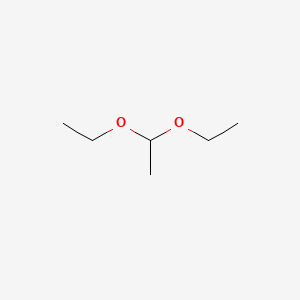
Acetal
Acetal appears as a clear colorless liquid with a pleasant odor. Boiling point 103-104 °C. Flash point -5 °F. Density 0.831 g / cm3. Slightly soluble in water. Vapors heavier than air. Moderately toxic and narcotic in high concentrations. — CAMEO Chemicals
- IUPAC-Name
- 1,1-diethoxyethane
- Summenformel
- C6H14O2
- Molekulargewicht
- 118.17 g/mol
- Exakte Masse
- 118.099379685 Da
- XLogP3
- 0,8
- Topologische polare Oberfläche
- 18,5 Ų
- Wasserstoffbrücken-Donoren
- 0
- Wasserstoffbrücken-Akzeptoren
- 2
- Kovalente Einheiten
- 1
- Definierte Stereozentren
- 0
Auch bekannt als
16 weitere gemeldete Namen
Kennungen in externen Datenbanken
- ChEBI:CHEBI:179533
- ChEMBL:CHEMBL1338583
- EPA DTXSID:DTXSID6030607
- PubMed:22649934
- PubMed:21375340
- PubMed:21211062
- PubMed:21053928
- PubMed:20735852
- PubMed:20689702
- PubMed:19662831
- PubMed:18783210
- PubMed:18498170
- PubMed:18367362
- PubMed:17497014
- PubMed:16704220
Belege aus weiteren wissenschaftlichen Datenbanken
EMBL-EBI ChEBI
1,1-Diethoxyethane
- Rezeptur
- C6H14O2
- Durchschnittsmasse
- 118.176 g/mol
- Monoisotopische Masse
- 118.09938 Da
- Formale Ladung
- 0
- acetal — is a (CHEBI:59769)
- acetal — is a (CHEBI:59769)
Weitere kuratierte Namen
Querverweise aus dieser Quelle
- CAS: 105-57-7 — ChemIDplus
- MANUAL_X_REF: 13835836 — ChemSpider
- MANUAL_X_REF: HMDB0031644 — HMDB
Zugeordnet durch: Exact CAS cross-reference in the ChEBI compound record. Abgerufen: 2026-08-31. Quelleneintrag öffnen
NIH PubChem PUG-View
Attributed physical-property, hazard, environmental and use annotations.
- Autoignition Temperature: 446 °F (USCG, 1999) Quelle: CAMEO Chemicals
- Autoignition Temperature: 446 °F (230 °C) Quelle: Hazardous Substances Data Bank (HSDB)
- Autoignition Temperature: 230 °C Quelle: ILO-WHO International Chemical Safety Cards (ICSCs)
- Boiling Point: 216 °F at 760 mmHg (USCG, 1999) Quelle: CAMEO Chemicals
- Boiling Point: 102.7 °C AT 760 MM HG; 66.3 °C AT 200 MM HG; 39.8 °C AT 60 MM HG; 31.9 °C AT 40 MM HG; 19.6 °C AT 20 MM HG; +8.0 °C AT 10 MM HG; -2.3 °C AT 5 MM HG; -23 °C AT 1.0 MM HG Quelle: Hazardous Substances Data Bank (HSDB)
- Boiling Point: 102.00 to 104.00 °C. @ 760.00 mm Hg Quelle: Human Metabolome Database (HMDB)
- Boiling Point: 103 °C Quelle: ILO-WHO International Chemical Safety Cards (ICSCs)
- Boiling Point: 102 °C Quelle: Joint FAO/WHO Expert Committee on Food Additives (JECFA)
- Color/Form: COLORLESS LIQUID Quelle: Hazardous Substances Data Bank (HSDB)
- Density: 0.831 at 68 °F (USCG, 1999) - Less dense than water; will float Quelle: CAMEO Chemicals
- Density: 0.8254 AT 20 °C/4 °C Quelle: Hazardous Substances Data Bank (HSDB)
- Density: Relative density (water = 1): 0.83 Quelle: ILO-WHO International Chemical Safety Cards (ICSCs)
- Density: 0.822-0.831 Quelle: Joint FAO/WHO Expert Committee on Food Additives (JECFA)
- Flash Point: -5 °F (USCG, 1999) Quelle: CAMEO Chemicals
- Flash Point: -20.5 °C Quelle: Haz-Map, Information on Hazardous Chemicals and Occupational Diseases
- Flash Point: -5 °F (-21 °C) (CLOSED CUP) Quelle: Hazardous Substances Data Bank (HSDB)
- Flash Point: -21 °C c.c. Quelle: ILO-WHO International Chemical Safety Cards (ICSCs)
- LogP: Log Kow = 0.84 Quelle: Hazardous Substances Data Bank (HSDB)
- LogP: 0.84 Quelle: Human Metabolome Database (HMDB)
- LogP: 0.84 Quelle: ILO-WHO International Chemical Safety Cards (ICSCs)
- Melting Point: -148 °F (USCG, 1999) Quelle: CAMEO Chemicals
- Melting Point: -100 °C Quelle: Hazardous Substances Data Bank (HSDB)
- Melting Point: -100 °C Quelle: Human Metabolome Database (HMDB)
- Melting Point: -100 °C Quelle: ILO-WHO International Chemical Safety Cards (ICSCs)
- Odor: PUNGENT, GREEN, WOODY SOLVENT ODOR Quelle: Hazardous Substances Data Bank (HSDB)
- Physical Description: Acetal appears as a clear colorless liquid with a pleasant odor. Boiling point 103-104 °C. Flash point -5 °F. Density 0.831 g / cm3. Slightly soluble in water. Vapors heavier than air. Moderately toxic and narcotic in high concentrations. Quelle: CAMEO Chemicals
- Physical Description: Colorless, volatile liquid with an agreeable odor; [Hawley] Quelle: Haz-Map, Information on Hazardous Chemicals and Occupational Diseases
- Physical Description: Liquid Quelle: Human Metabolome Database (HMDB)
- Physical Description: COLOURLESS LIQUID WITH PUNGENT ODOUR. Quelle: ILO-WHO International Chemical Safety Cards (ICSCs)
- Physical Description: volatile colourless liquid with a refreshing, pleasant, fruity-green odour Quelle: Joint FAO/WHO Expert Committee on Food Additives (JECFA)
- Refractive Index: INDEX OF REFRACTION: 1.38193 AT 20 °C/D Quelle: Hazardous Substances Data Bank (HSDB)
- Refractive Index: 1.378-1.386 Quelle: Joint FAO/WHO Expert Committee on Food Additives (JECFA)
- Solubility: MISCIBLE WITH ALCOHOL, 60% ALCOHOL, ETHER; SOL IN HEPTANE, METHYLCYCLOHEXANE, ETHYL ACETATE; PROPYL, ISOPROPYL, BUTYL & ISOBUTYL ALCOHOLS; 100 G WATER DISSOLVE 5 G ACETAL Quelle: Hazardous Substances Data Bank (HSDB)
- Solubility: SOL IN CHLOROFORM Quelle: Hazardous Substances Data Bank (HSDB)
- Solubility: sol in acetone Quelle: Hazardous Substances Data Bank (HSDB)
- Solubility: Water Solubility = 4.4X10+4 mg/L at 25 °C Quelle: Hazardous Substances Data Bank (HSDB)
- Solubility: 44 mg/mL at 25 °C Quelle: Human Metabolome Database (HMDB)
- Solubility: Solubility in water, g/100ml: 5.0 Quelle: ILO-WHO International Chemical Safety Cards (ICSCs)
- Solubility: slightly soluble in water; miscible with most organic solvents, oils Quelle: Joint FAO/WHO Expert Committee on Food Additives (JECFA)
- Solubility: miscible (in ethanol) Quelle: Joint FAO/WHO Expert Committee on Food Additives (JECFA)
- Vapor Pressure: 56.87 mmHg (USCG, 1999) Quelle: CAMEO Chemicals
- Vapor Pressure: 27.6 [mmHg] Quelle: Haz-Map, Information on Hazardous Chemicals and Occupational Diseases
- Vapor Pressure: 27.6 mm Hg at 25 °C /from experimentally derived coefficients/ Quelle: Hazardous Substances Data Bank (HSDB)
- Vapor Pressure: Vapor pressure, kPa at 20 °C: 2.7 Quelle: ILO-WHO International Chemical Safety Cards (ICSCs)
- Viscosity: Liquid viscosity = 2.1531X10⁻³ Pa.s @ 200 deg K Quelle: Hazardous Substances Data Bank (HSDB)
- Exposure Routes: The substance can be absorbed into the body by inhalation of its vapour and by ingestion. Quelle: ILO-WHO International Chemical Safety Cards (ICSCs)
- First Aid: INGESTION: Call a physician. Keep victim warm.; EYES: Flush with running water for at least 15 minutes.; SKIN: Remove contaminated clothing and shoes. Flush affected areas with plenty of water. Wash with soap and water.; INHALATION: Move victim to fresh air. If breathing has stopped, give artificial respiration. If breathing is difficult, give oxygen. (USCG, 1999) Quelle: CAMEO Chemicals
- ERG2024, Guide 127 (Acetal): General First Aid:; · Call 911 or emergency medical service.; · Ensure that medical personnel are aware of the material(s) involved, take precautions to protect themselves and avoid contamination.; · Move victim to fresh air if it can be done safely.; · Administer oxygen if breathing is difficult.; · If victim is not breathing:; -- DO NOT perform mouth-to-mouth resuscitation; the victim may have ingested or inhaled the substance.; -- If equipped and pulse detected, wash face and mouth, then give artificial respiration using a proper respiratory medical device (bag-valve mask, pocket mask equipped with a one-way valve or other device).; -- If no pulse detected or no respiratory medical device available, provide continuous compressions. Conduct a pulse check every two minutes or monitor for any signs of spontaneous respirations.; · Remove and isolate contaminated clothing and shoes.; · For minor skin contact, avoid spreading material on unaffected skin.; · In case of contact with substance, remove immediately by flushing skin or eyes with running water for at least 20 minutes.; · For severe burns, immediate medical attention is required.; · Effects of exposure (inhalation, ingestion, Quelle: Emergency Response Guidebook (ERG)
- Signal: Danger Quelle: Regulation (EC) No 1272/2008 of the European Parliament and of the Council
- GHS Hazard Statements: H225: Highly Flammable liquid and vapor [Danger Flammable liquids]; H315: Causes skin irritation [Warning Skin corrosion/irritation]; H319: Causes serious eye irritation [Warning Serious eye damage/eye irritation] Quelle: Regulation (EC) No 1272/2008 of the European Parliament and of the Council
- Precautionary Statement Codes: P210, P233, P240, P241, P242, P243, P264, P264+P265, P280, P302+P352, P303+P361+P353, P305+P351+P338, P321, P332+P317, P337+P317, P362+P364, P370+P378, P403+P235, and P501 (click each P-code to see the statement) Quelle: Regulation (EC) No 1272/2008 of the European Parliament and of the Council
- Signal: Danger Quelle: European Chemicals Agency (ECHA)
- GHS Hazard Statements: H225 (98.7%): Highly Flammable liquid and vapor [Danger Flammable liquids]; H315 (> 99.9%): Causes skin irritation [Warning Skin corrosion/irritation]; H319 (97.3%): Causes serious eye irritation [Warning Serious eye damage/eye irritation] Quelle: European Chemicals Agency (ECHA)
- Precautionary Statement Codes: P210, P233, P240, P241, P242, P243, P264, P264+P265, P280, P302+P352, P303+P361+P353, P305+P351+P338, P321, P332+P317, P337+P317, P362+P364, P370+P378, P403+P235, and P501 (click each P-code to see the statement) Quelle: European Chemicals Agency (ECHA)
- ECHA C&L Notifications Summary: Aggregated GHS information provided per 1842 reports by companies from 8 notifications to the ECHA C&L Inventory. Each notification may be associated with multiple companies.; Information may vary between notifications depending on impurities, additives, and other factors. The percentage value in parenthesis indicates the notified classification ratio from companies that provide hazard codes. Only hazard codes with percentage values above 10% are shown. For more detailed information, please visit ECHA C&L website. Quelle: European Chemicals Agency (ECHA)
- Signal: Danger Quelle: NITE-CMC
- GHS Hazard Statements: H318: Causes serious eye damage [Danger Serious eye damage/eye irritation] Quelle: NITE-CMC
- Precautionary Statement Codes: P264+P265, P280, P305+P354+P338, and P317 (click each P-code to see the statement) Quelle: NITE-CMC
- GHS Hazard Statements: H225: Highly Flammable liquid and vapor [Danger Flammable liquids]; H320: Causes eye irritation [Warning Serious eye damage/eye irritation]; H335: May cause respiratory irritation [Warning Specific target organ toxicity, single exposure; Respiratory tract irritation]; H336: May cause drowsiness or dizziness [Warning Specific target organ toxicity, single exposure; Narcotic effects] Quelle: NITE-CMC
- Precautionary Statement Codes: P210, P233, P240, P241, P242, P243, P261, P264+P265, P271, P280, P303+P361+P353, P304+P340, P305+P351+P338, P319, P337+P317, P370+P378, P403+P233, P403+P235, P405, and P501 (click each P-code to see the statement) Quelle: NITE-CMC
- NFPA Health Rating: 2 - Materials that, under emergency conditions, can cause temporary incapacitation or residual injury. Quelle: Hazardous Substances Data Bank (HSDB)
- NFPA Fire Rating: 3 - Liquids and solids that can be ignited under almost all ambient temperature conditions. Materials produce hazardous atmospheres with air under almost all ambient temperatures or, though unaffected by ambient temperatures, are readily ignited under almost all conditions. Quelle: Hazardous Substances Data Bank (HSDB)
- NFPA Instability Rating: 0 - Materials that in themselves are normally stable, even under fire conditions. Quelle: Hazardous Substances Data Bank (HSDB)
- Environmental Bioconcentration: An estimated BCF value of 2.6 was calculated for acetal(SRC), using an experimental log Kow of 0.84(1) and a recommended regression-derived equation(2). According to a recommended classification scheme(3), this BCF value suggests that bioconcentration in aquatic organisms will be low(SRC). Quelle: Hazardous Substances Data Bank (HSDB)
- Environmental Fate: TERRESTRIAL FATE: Based on a recommended classification scheme(1), an estimated Koc value of 68(SRC), determined from an experimental log Kow(2) and a recommended regression-derived equation(3), indicates that acetal will have high mobility in soil(SRC). Volatilization of acetal may be important from moist soil surfaces(SRC) given an estimated Henry's Law constant of 9.75X10⁻⁵ atm-cu m/mole(SRC), calculated from experimental values for vapor pressure(4) and water solubility(5), and from dry soil surfaces(SRC) based on an experimental vapor pressure of 27.6 mm Hg(5). Insufficient data are available to determine the rate or importance of biodegradation of acetal in soil(SRC). Quelle: Hazardous Substances Data Bank (HSDB)
- Environmental Fate: AQUATIC FATE: Based on a recommended classification scheme(1), an estimated Koc value of 68(SRC), determined from an experimental log Kow(2) and a recommended regression-derived equation(3), indicates that acetal would not adsorb to suspended solids and sediment(SRC) in the water. Acetal would volatilize from water surfaces based on an estimated Henry's Law constant of 9.75X10⁻⁵ atm-cu m/mole(SRC), calculated from experimental values for vapor pressure(4) and water solubility(5). Estimated half-lives for a model river and model lake are 13 hours and 7.3 days, respectively(3,SRC). An estimated BCF value of 2.6(3,SRC), from an experimental log Kow(2), suggests that acetal will not bioconcentrate in aquatic organisms(SRC) according to a recommended classification scheme(6). Acetals are easily cleaved by dilute acids by the SN1 mechanism(7). However, they are extremely resistant to hydrolysis by bases(7). Therefore, hydrolysis of acetal is expected to be an important fate process in acidic water conditions(SRC). Insufficient data are available to determine the rate or importance of biodegradation of acetal in water(SRC). Quelle: Hazardous Substances Data Bank (HSDB)
- Environmental Fate: ATMOSPHERIC FATE: According to a suggested classification scheme(1), an experimental vapor pressure of 27.6 mm Hg at 25 °C(2) indicates that acetal will exist in the vapor phase in the ambient atmosphere. Vapor-phase acetal is degraded in the atmosphere by reaction with photochemically produced hydroxyl radicals(SRC); the half-life for this reaction in air is estimated to be about 19.6 hours(3,SRC). Quelle: Hazardous Substances Data Bank (HSDB)
- Sources/Uses: Used as a solvent for perfumes, flavors, and cosmetics; [HSDB] Used as an herbicide; [eChemPortal: ERMA] Quelle: Haz-Map, Information on Hazardous Chemicals and Occupational Diseases
- Industrial Processes with risk of exposure: Farming (Pesticides) [Category: Industry] Quelle: Haz-Map, Information on Hazardous Chemicals and Occupational Diseases
- Uses: SOLVENT; IN ORGANIC SYNTHESES; /SRP: FORMERLY/ HYPNOTIC Quelle: Hazardous Substances Data Bank (HSDB)
- Uses: SOLVENT IN PERFUMES Quelle: Hazardous Substances Data Bank (HSDB)
- Uses: SYNTHETIC FLAVORING INGREDIENT Quelle: Hazardous Substances Data Bank (HSDB)
- Uses: Used in cosmetics Quelle: Hazardous Substances Data Bank (HSDB)
Zugeordnet durch: Existing checksum-valid CAS to unique PubChem CID match. Abgerufen: 2026-08-31. Quelleneintrag öffnen
Wissenschaftliche Klassifizierungen und Gefahrenannotationen liefern Kontext und ersetzen nicht die oben gezeigte marktspezifische regulatorische Entscheidung.
Weitere Quellenabdeckung und Trefferstatus
| Quelle | Ergebnis | Geprüft |
|---|---|---|
| EMBL-EBI ChEBI | Exakter Treffer | 2026-08-31 |
| NIH PubChem PUG-View | Exakter Treffer | 2026-08-31 |
Ein erfasster Nicht-Treffer ist ein nützlicher Beleg dafür, dass die Quelle geprüft wurde; er ist keine Behauptung, dass der Stoff anderswo nicht existiert.
Am 2026-08-31 von NIH PubChem durch prüfsummengültigen CAS-Abgleich abgerufen. Chemische Eigenschaften ersetzen nicht die regulatorische Entscheidung auf dieser Seite.