
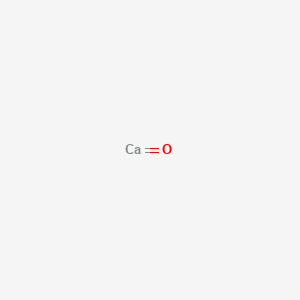
Calcium Oxide
Calcium oxide appears as an odorless, white or gray-white solid in the form of hard lumps. A strong irritant to skin, eyes and mucous membranes. Used in insecticides and fertilizers. — CAMEO Chemicals
- IUPAC-Name
- oxocalcium
- Summenformel
- CaO
- Molekulargewicht
- 56.08 g/mol
- Exakte Masse
- 55.9575055 Da
- Topologische polare Oberfläche
- 17,1 Ų
- Wasserstoffbrücken-Donoren
- 0
- Wasserstoffbrücken-Akzeptoren
- 1
- Kovalente Einheiten
- 1
- Definierte Stereozentren
- 0
Auch bekannt als
16 weitere gemeldete Namen
Kennungen in externen Datenbanken
- ChEBI:CHEBI:31344
- PubMed:15302423
Belege aus weiteren wissenschaftlichen Datenbanken
NIH PubChem PUG-View
Attributed physical-property, hazard, environmental and use annotations.
- Autoignition Temperature: Not flammable (USCG, 1999) Quelle: CAMEO Chemicals
- Boiling Point: 5162 °F at 760 mmHg (NIOSH, 2024) Quelle: CAMEO Chemicals
- Boiling Point: 2850 °C Quelle: Hazardous Substances Data Bank (HSDB)
- Boiling Point: 2850 °C Quelle: ILO-WHO International Chemical Safety Cards (ICSCs)
- Boiling Point: 5162 °F Quelle: Occupational Safety and Health Administration (OSHA)
- Boiling Point: 2850 °C @760 [mm Hg] Quelle: PAC Chemical Database, U.S. Department of Energy
- Boiling Point: 5162 °F Quelle: The National Institute for Occupational Safety and Health (NIOSH)
- Color/Form: Grey-white, cubic crystals Quelle: Hazardous Substances Data Bank (HSDB)
- Color/Form: Colorless, cubic, white crystals Quelle: Hazardous Substances Data Bank (HSDB)
- Color/Form: Crystals, white or grayish white lumps, or granular powder Quelle: Hazardous Substances Data Bank (HSDB)
- Color/Form: Greyish-yellow, hydroscopic lumps Quelle: Hazardous Substances Data Bank (HSDB)
- Density: 3.3 at 68 °F (USCG, 1999) - Denser than water; will sink Quelle: CAMEO Chemicals
- Density: 3.34 g/cu cm Quelle: Hazardous Substances Data Bank (HSDB)
- Density: Relative density (water = 1): 3.3-3.4 Quelle: ILO-WHO International Chemical Safety Cards (ICSCs)
- Density: 3.34 Quelle: Occupational Safety and Health Administration (OSHA)
- Density: 3.37 @25 °C Quelle: PAC Chemical Database, U.S. Department of Energy
- Density: 3.34 Quelle: The National Institute for Occupational Safety and Health (NIOSH)
- Flash Point: Not flammable Quelle: Hazardous Substances Data Bank (HSDB)
- Melting Point: 4662 °F (NIOSH, 2024) Quelle: CAMEO Chemicals
- Melting Point: 2613 °C Quelle: Hazardous Substances Data Bank (HSDB)
- Melting Point: Lime becomes incandescent when heated to near its melting point (2500 °C) Quelle: Hazardous Substances Data Bank (HSDB)
- Melting Point: 2570 °C Quelle: ILO-WHO International Chemical Safety Cards (ICSCs)
- Melting Point: 4662 °F Quelle: Occupational Safety and Health Administration (OSHA)
- Melting Point: 2613 °C Quelle: PAC Chemical Database, U.S. Department of Energy
- Melting Point: 4662 °F Quelle: The National Institute for Occupational Safety and Health (NIOSH)
- Odor: Odorless Quelle: Hazardous Substances Data Bank (HSDB)
- Physical Description: Calcium oxide appears as an odorless, white or gray-white solid in the form of hard lumps. A strong irritant to skin, eyes and mucous membranes. Used in insecticides and fertilizers. Quelle: CAMEO Chemicals
- Physical Description: Dry Powder; Wet Solid; Other Solid; Large Crystals; CBI; Dry Powder; Large Crystals; Liquid; Dry Powder; Large Crystals; Other Solid Quelle: EPA Chemical Data Reporting (CDR)
- Physical Description: Odourless, hard, white or greyish white masses of granules, or white to greyish powder Quelle: EU Food Improvement Agents
- Physical Description: White or gray, odorless lumps or granular powder; [NIOSH] Quelle: Haz-Map, Information on Hazardous Chemicals and Occupational Diseases
- Physical Description: WHITE HYGROSCOPIC CRYSTALLINE POWDER. Quelle: ILO-WHO International Chemical Safety Cards (ICSCs)
- Physical Description: White or gray, odorless lumps or granular powder. Quelle: Occupational Safety and Health Administration (OSHA)
- Physical Description: White or gray, odorless lumps or granular powder. Quelle: The National Institute for Occupational Safety and Health (NIOSH)
- Solubility: Reacts with water (NIOSH, 2024) Quelle: CAMEO Chemicals
- Solubility: Slightly soluble in water. Insoluble in ethanol. Soluble in glycerol Quelle: EU Food Improvement Agents
- Solubility: Reacts with water Quelle: Hazardous Substances Data Bank (HSDB)
- Solubility: Soluble in water forming calcium hydroxide and generating large a quantity of heat. Quelle: Hazardous Substances Data Bank (HSDB)
- Solubility: Soluble in acids, glycerol, sugar solution; practically insoluble in alcohol Quelle: Hazardous Substances Data Bank (HSDB)
- Solubility: 1 g is sol in about 840 mL water and 1740 mL boiling water Quelle: Hazardous Substances Data Bank (HSDB)
- Solubility: Solubility in water: reaction Quelle: ILO-WHO International Chemical Safety Cards (ICSCs)
- Solubility: Reacts Quelle: The National Institute for Occupational Safety and Health (NIOSH)
- Vapor Pressure: 0 mmHg (approx) (NIOSH, 2024) Quelle: CAMEO Chemicals
- Vapor Pressure: 0 mmHg (approx) Quelle: Occupational Safety and Health Administration (OSHA)
- Vapor Pressure: 0 mmHg (approx) Quelle: The National Institute for Occupational Safety and Health (NIOSH)
- pH: SATURATED SOLN IN WATER IS ABOUT 12.8 Quelle: Hazardous Substances Data Bank (HSDB)
- Exposure Routes: The substance can be absorbed into the body by inhalation of its aerosol and by ingestion. Quelle: ILO-WHO International Chemical Safety Cards (ICSCs)
- Exposure Routes: inhalation, ingestion, skin and/or eye contact Quelle: The National Institute for Occupational Safety and Health (NIOSH)
- First Aid: Excerpt from NIOSH Pocket Guide for Calcium oxide:; Eye: IRRIGATE IMMEDIATELY - If this chemical contacts the eyes, immediately wash (irrigate) the eyes with large amounts of water, occasionally lifting the lower and upper lids. Get medical attention immediately.; Skin: WATER FLUSH IMMEDIATELY - If this chemical contacts the skin, immediately flush the contaminated skin with water. If this chemical penetrates the clothing, immediately remove the clothing and flush the skin with water. Get medical attention promptly.; Breathing: RESPIRATORY SUPPORT - If a person breathes large amounts of this chemical, move the exposed person to fresh air at once. If breathing has stopped, perform artificial respiration. Keep the affected person warm and at rest. Get medical attention as soon as possible.; Swallow: MEDICAL ATTENTION IMMEDIATELY - If this chemical has been swallowed, get medical attention immediately. (NIOSH, 2024) Quelle: CAMEO Chemicals
- ERG2024, Guide 157 (Calcium oxide): General First Aid:; · Call 911 or emergency medical service.; · Ensure that medical personnel are aware of the material(s) involved, take precautions to protect themselves and avoid contamination.; · Move victim to fresh air if it can be done safely.; · Administer oxygen if breathing is difficult.; · If victim is not breathing:; -- DO NOT perform mouth-to-mouth resuscitation; the victim may have ingested or inhaled the substance.; -- If equipped and pulse detected, wash face and mouth, then give artificial respiration using a proper respiratory medical device (bag-valve mask, pocket mask equipped with a one-way valve or other device).; -- If no pulse detected or no respiratory medical device available, provide continuous compressions. Conduct a pulse check every two minutes or monitor for any signs of spontaneous respirations.; · Remove and isolate contaminated clothing and shoes.; · For minor skin contact, avoid spreading material on unaffected skin.; · In case of contact with substance, remove immediately by flushing skin or eyes with running water for at least 20 minutes.; · For severe burns, immediate medical attention is required.; · Effects of exposure (inhalation, ingestion, Quelle: Emergency Response Guidebook (ERG)
- First Aid: (General first aid procedures); Eye: Irrigate immediately - If this chemical contacts the eyes, immediately wash (irrigate) the eyes with large amounts of water, occasionally lifting the lower and upper lids. Get medical attention immediately.; Skin: Water flush immediately - If this chemical contacts the skin, immediately flush the contaminated skin with water. If this chemical penetrates the clothing, immediately remove the clothing and flush the skin with water. Get medical attention promptly.; Breathing: Respiratory support; Swallow: Medical attention immediately - If this chemical has been swallowed, get medical attention immediately. Quelle: The National Institute for Occupational Safety and Health (NIOSH)
- Note: This chemical does not meet GHS hazard criteria for 5.1% (130 of 2552) of reports. Quelle: European Chemicals Agency (ECHA)
- Signal: Danger Quelle: European Chemicals Agency (ECHA)
- GHS Hazard Statements: H302 (18.2%): Harmful if swallowed [Warning Acute toxicity, oral]; H314 (25.8%): Causes severe skin burns and eye damage [Danger Skin corrosion/irritation]; H315 (63.8%): Causes skin irritation [Warning Skin corrosion/irritation]; H318 (92.8%): Causes serious eye damage [Danger Serious eye damage/eye irritation]; H335 (63%): May cause respiratory irritation [Warning Specific target organ toxicity, single exposure; Respiratory tract irritation] Quelle: European Chemicals Agency (ECHA)
- Precautionary Statement Codes: P260, P261, P264, P264+P265, P270, P271, P280, P301+P317, P301+P330+P331, P302+P352, P302+P361+P354, P304+P340, P305+P354+P338, P316, P317, P319, P321, P330, P332+P317, P362+P364, P363, P403+P233, P405, and P501 (click each P-code to see the statement) Quelle: European Chemicals Agency (ECHA)
- ECHA C&L Notifications Summary: Aggregated GHS information provided per 2552 reports by companies from 66 notifications to the ECHA C&L Inventory. Each notification may be associated with multiple companies.; Reported as not meeting GHS hazard criteria per 130 of 2552 reports by companies.; There are 65 notifications provided by 2422 of 2552 reports by companies with hazard statement code(s).; Information may vary between notifications depending on impurities, additives, and other factors. The percentage value in parenthesis indicates the notified classification ratio from companies that provide hazard codes. Only hazard codes with percentage values above 10% are shown. For more detailed information, please visit ECHA C&L website. Quelle: European Chemicals Agency (ECHA)
- GHS Hazard Statements: Not Classified; Reported as not meeting GHS hazard criteria by 1 of 1 companies. For more detailed information, please visit ECHA C&L website. Quelle: European Chemicals Agency (ECHA)
- Signal: Danger Quelle: NITE-CMC
- GHS Hazard Statements: H315: Causes skin irritation [Warning Skin corrosion/irritation]; H318: Causes serious eye damage [Danger Serious eye damage/eye irritation]; H370: Causes damage to organs [Danger Specific target organ toxicity, single exposure]; H372: Causes damage to organs through prolonged or repeated exposure [Danger Specific target organ toxicity, repeated exposure] Quelle: NITE-CMC
- Precautionary Statement Codes: P260, P264, P264+P265, P270, P280, P302+P352, P305+P354+P338, P308+P316, P317, P319, P321, P332+P317, P362+P364, P405, and P501 (click each P-code to see the statement) Quelle: NITE-CMC
- GHS Hazard Statements: H303: May be harmful if swallowed [Warning Acute toxicity, oral]; H304: May be fatal if swallowed and enters airways [Danger Aspiration hazard]; H314: Causes severe skin burns and eye damage [Danger Skin corrosion/irritation]; H318: Causes serious eye damage [Danger Serious eye damage/eye irritation]; H370: Causes damage to organs [Danger Specific target organ toxicity, single exposure]; H371: May cause damage to organs [Warning Specific target organ toxicity, single exposure]; H372: Causes damage to organs through prolonged or repeated exposure [Danger Specific target organ toxicity, repeated exposure] Quelle: NITE-CMC
- Precautionary Statement Codes: P260, P264, P264+P265, P270, P280, P301+P316, P301+P317, P301+P330+P331, P302+P361+P354, P304+P340, P305+P354+P338, P308+P316, P316, P317, P319, P321, P331, P363, P405, and P501 (click each P-code to see the statement) Quelle: NITE-CMC
- Signal: Danger Quelle: Hazardous Chemical Information System (HCIS), Safe Work Australia
- Target Organs: Eyes, skin, respiratory system Quelle: The National Institute for Occupational Safety and Health (NIOSH)
- Consumer Uses: Other; Binder; Abrasives; Processing aids not otherwise specified; Not Known or Reasonably Ascertainable; Filler; Catalyst; Soil amendments (fertilizers); Dehydrating agent (desiccant); Adsorbent; Intermediate Quelle: EPA Chemical Data Reporting (CDR)
- Industry Uses: Other; Binder; Processing aids not otherwise specified; Antioxidant; pH regulating agent; Dust suppressant; Abrasives; Chemical reaction regulator; Dehydrating agent (desiccant); Absorbent; Flux agent; Soil amendments (fertilizers); Catalyst; Thickening agent; Waterproofing agent; Corrosion inhibitor; Filler; Not Known or Reasonably Ascertainable; Stabilizing agent; Sealant (barrier); Intermediate; Processing aids, specific to petroleum production; Adhesion/cohesion promoter; Drier; Solids separation (precipitating) agent, not otherwise specified; Chelating agent; Oxidizing agent; Adsorbent; Humectant Quelle: EPA Chemical Data Reporting (CDR)
- Sources/Uses: Used in building materials (bricks, plaster, mortar, and stucco); to make aluminum, magnesium, calcium salts, and glass; to dehair hides; to process non-ferrous ores; to produce paper pulp; and to clarify cane and beet sugar juices; Also used in drilling fluids, lubricants, and water treatment; [HSDB] Quelle: Haz-Map, Information on Hazardous Chemicals and Occupational Diseases
- Industrial Processes with risk of exposure: Aluminum Producing [Category: Industry]; Pulp and Paper Processing [Category: Industry]; Sewer and Wastewater Treatment [Category: Industry]; Leather Tanning and Processing [Category: Industry]; Cement Producing [Category: Industry]; Glass Manufacturing [Category: Industry]; Metal Extraction and Refining [Category: Industry] Quelle: Haz-Map, Information on Hazardous Chemicals and Occupational Diseases
- Uses: For calcium oxide (USEPA/OPP Pesticide Code: 075604) ACTIVE products with label matches. /SRP: Registered for use in the USA but approved pesticide uses may change periodically and so federal, state and local authorities must be consulted for currently approved uses./ Quelle: Hazardous Substances Data Bank (HSDB)
- Uses: In construction applications incl finishing & masons lime; in metallurgy, principally as a flux in steel prodn; kraft paper pulp prodn; ammonia recovery in solvay process for sodium carbonate; treatment of sewage and trade waste; water purification and softening; misc applications Quelle: Hazardous Substances Data Bank (HSDB)
- Uses: In bricks, plaster, mortar, stucco, building materials; manufacture of steel, aluminum, magnesium, and flotation of non-ferrous ores; manufacture of glass, paper, Na2CO3 (Solvay process), calcium salts and many other industrial chemicals; dehairing hides; clarification of cane and beet sugar juices; in fungicides, insecticides, drilling fluids, lubricants; in water and sewage treatment; in laboratory to absorb carbon dioxide (the combination with NaOH is known as soda-lime ...) Quelle: Hazardous Substances Data Bank (HSDB)
- Uses: In making chlorinated lime; dehydrating agent Quelle: Hazardous Substances Data Bank (HSDB)
- Uses: For more Uses (Complete) data for CALCIUM OXIDE (6 total), please visit the HSDB record page. Quelle: Hazardous Substances Data Bank (HSDB)
Zugeordnet durch: Existing checksum-valid CAS to unique PubChem CID match. Abgerufen: 2026-08-31. Quelleneintrag öffnen
Wissenschaftliche Klassifizierungen und Gefahrenannotationen liefern Kontext und ersetzen nicht die oben gezeigte marktspezifische regulatorische Entscheidung.
Weitere Quellenabdeckung und Trefferstatus
| Quelle | Ergebnis | Geprüft |
|---|---|---|
| NIH PubChem PUG-View | Exakter Treffer | 2026-08-31 |
Ein erfasster Nicht-Treffer ist ein nützlicher Beleg dafür, dass die Quelle geprüft wurde; er ist keine Behauptung, dass der Stoff anderswo nicht existiert.
Am 2026-08-31 von NIH PubChem durch prüfsummengültigen CAS-Abgleich abgerufen. Chemische Eigenschaften ersetzen nicht die regulatorische Entscheidung auf dieser Seite.