
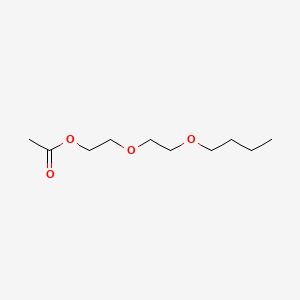
Diethylene glycol monobutyl ether acetate
Diethylene glycol monobutyl ether acetate is a colorless liquid with a mild odor. Floats and mixes slowly with water. (USCG, 1999) — CAMEO Chemicals
- IUPAC-Name
- 2-(2-butoxyethoxy)ethyl acetate
- Summenformel
- C10H20O4
- Molekulargewicht
- 204.26 g/mol
- Exakte Masse
- 204.13615911 Da
- XLogP3
- 1,1
- Topologische polare Oberfläche
- 44,8 Ų
- Wasserstoffbrücken-Donoren
- 0
- Wasserstoffbrücken-Akzeptoren
- 4
- Kovalente Einheiten
- 1
- Definierte Stereozentren
- 0
Auch bekannt als
16 weitere gemeldete Namen
Kennungen in externen Datenbanken
- ChEMBL:CHEMBL1892052
- EPA DTXSID:DTXSID9027021
- PubMed:27633901
- PubMed:15705492
Belege aus weiteren wissenschaftlichen Datenbanken
NIH PubChem PUG-View
Attributed physical-property, hazard, environmental and use annotations.
- Autoignition Temperature: 563 °F (USCG, 1999) Quelle: CAMEO Chemicals
- Autoignition Temperature: 536 °F (295 °C) Quelle: Hazardous Substances Data Bank (HSDB)
- Autoignition Temperature: 290 °C Quelle: ILO-WHO International Chemical Safety Cards (ICSCs)
- Boiling Point: 475 °F at 760 mmHg (USCG, 1999) Quelle: CAMEO Chemicals
- Boiling Point: 245 °C Quelle: Hazardous Substances Data Bank (HSDB)
- Boiling Point: 245-247 °C Quelle: ILO-WHO International Chemical Safety Cards (ICSCs)
- Boiling Point: 475 °F Quelle: Occupational Safety and Health Administration (OSHA)
- Color/Form: Colorless liquid Quelle: Hazardous Substances Data Bank (HSDB)
- Density: 0.985 at 68 °F (USCG, 1999) - Less dense than water; will float Quelle: CAMEO Chemicals
- Density: 0.985 g/cu cm at 20 °C Quelle: Hazardous Substances Data Bank (HSDB)
- Density: Relative density (water = 1): 0.98 Quelle: ILO-WHO International Chemical Safety Cards (ICSCs)
- Density: 0.985 Quelle: Occupational Safety and Health Administration (OSHA)
- Flash Point: 240 °F (USCG, 1999) Quelle: CAMEO Chemicals
- Flash Point: 241 °F (116 °C) (OPEN CUP) Quelle: Hazardous Substances Data Bank (HSDB)
- Flash Point: 105 °C c.c. Quelle: ILO-WHO International Chemical Safety Cards (ICSCs)
- Flash Point: 240 °F Quelle: Occupational Safety and Health Administration (OSHA)
- LogP: 2.9 Quelle: ILO-WHO International Chemical Safety Cards (ICSCs)
- Melting Point: -27 °F (USCG, 1999) Quelle: CAMEO Chemicals
- Melting Point: -32 °C Quelle: Hazardous Substances Data Bank (HSDB)
- Melting Point: -32 °C Quelle: ILO-WHO International Chemical Safety Cards (ICSCs)
- Melting Point: -27 °F Quelle: Occupational Safety and Health Administration (OSHA)
- Odor: MILD, NOT UNPLEASANT ODOR Quelle: Hazardous Substances Data Bank (HSDB)
- Physical Description: Diethylene glycol monobutyl ether acetate is a colorless liquid with a mild odor. Floats and mixes slowly with water. (USCG, 1999) Quelle: CAMEO Chemicals
- Physical Description: CBI; Liquid Quelle: EPA Chemical Data Reporting (CDR)
- Physical Description: Colorless liquid; [Hawley] Quelle: Haz-Map, Information on Hazardous Chemicals and Occupational Diseases
- Physical Description: COLOURLESS LIQUID. Quelle: ILO-WHO International Chemical Safety Cards (ICSCs)
- Physical Description: Colorless liquid with a mild odor. Floats and mixes slowly with water. Quelle: Occupational Safety and Health Administration (OSHA)
- Refractive Index: Index of refraction: 1.4262 at 20 °C/D Quelle: Hazardous Substances Data Bank (HSDB)
- Solubility: Very soluble in acetone, ethyl ether, ethanol Quelle: Hazardous Substances Data Bank (HSDB)
- Solubility: Miscible with most organic liquids. Quelle: Hazardous Substances Data Bank (HSDB)
- Solubility: In water, 3.10X10+4 mg/L at 25 °C Quelle: Hazardous Substances Data Bank (HSDB)
- Solubility: In water, 65,000 mg/L at 20 °C Quelle: Hazardous Substances Data Bank (HSDB)
- Solubility: Solubility in water, g/100ml at 20 °C: 6.5 Quelle: ILO-WHO International Chemical Safety Cards (ICSCs)
- Vapor Pressure: 0.04 [mmHg] Quelle: Haz-Map, Information on Hazardous Chemicals and Occupational Diseases
- Vapor Pressure: 0.04 mm Hg at 20 °C Quelle: Hazardous Substances Data Bank (HSDB)
- Vapor Pressure: Vapor pressure, Pa at 20 °C: 5.3 Quelle: ILO-WHO International Chemical Safety Cards (ICSCs)
- Viscosity: 0.056 poise at 20 °C Quelle: Hazardous Substances Data Bank (HSDB)
- First Aid: INHALATION: move victim to fresh air; if breathing has stopped, administer artificial respiration.; EYES: flush with water for at least 15 min.; SKIN: wash skin with large amounts of water for 15 min.; call physician if needed.; INGESTION: induce vomiting; get medical attention. (USCG, 1999) Quelle: CAMEO Chemicals
- Note: This chemical does not meet GHS hazard criteria for 87.2% (321 of 368) of all reports. Quelle: European Chemicals Agency (ECHA)
- Signal: Warning Quelle: European Chemicals Agency (ECHA)
- GHS Hazard Statements: H319 (12.2%): Causes serious eye irritation [Warning Serious eye damage/eye irritation] Quelle: European Chemicals Agency (ECHA)
- Precautionary Statement Codes: P264+P265, P280, P305+P351+P338, and P337+P317 (click each P-code to see the statement) Quelle: European Chemicals Agency (ECHA)
- ECHA C&L Notifications Summary: Aggregated GHS information provided per 368 reports by companies from 14 notifications to the ECHA C&L Inventory.; Reported as not meeting GHS hazard criteria per 321 of 368 reports by companies.; There are 12 notifications provided by 47 of 368 reports by companies with hazard statement code(s).; Information may vary between notifications depending on impurities, additives, and other factors. The percentage value in parenthesis indicates the notified classification ratio from companies that provide hazard codes. Only hazard codes with percentage values above 10% are shown. For more detailed information, please visit ECHA C&L website. Quelle: European Chemicals Agency (ECHA)
- NFPA Health Rating: 1 - Materials that, under emergency conditions, can cause significant irritation. Quelle: Hazardous Substances Data Bank (HSDB)
- NFPA Fire Rating: 1 - Materials that must be preheated before ignition can occur. Materials require considerable preheating, under all ambient temperature conditions, before ignition and combustion can occur. Quelle: Hazardous Substances Data Bank (HSDB)
- NFPA Instability Rating: 0 - Materials that in themselves are normally stable, even under fire conditions. Quelle: Hazardous Substances Data Bank (HSDB)
- Environmental Bioconcentration: An estimated BCF of 2 was calculated in fish for diethyleneglycol monobutyl ether acetate(SRC), using an estimated log Kow of 1.30(1) and a regression-derived equation(2). According to a classification scheme(3), this BCF suggests the potential for bioconcentration in aquatic organisms is low(SRC). Quelle: Hazardous Substances Data Bank (HSDB)
- Environmental Fate: TERRESTRIAL FATE: Based on a classification scheme(1), an estimated Koc value of 10(SRC), determined from a structure estimation method(2), indicates that diethyleneglycol monobutyl ether acetate is expected to have very high mobility in soil(SRC). Volatilization of diethyleneglycol monobutyl ether acetate from moist soil surfaces is not expected to be an important fate process(SRC) given an estimated Henry's Law constant of 3.5X10⁻⁷ atm-cu m/mole(SRC) based upon its vapor pressure, 0.04 mm Hg(3), and water solubility, 31,000 mg/L(4). Diethyleneglycol monobutyl ether acetate is not expected to volatilize from dry soil surfaces(SRC) based upon its vapor pressure(3). Diethyleneglycol monobutyl ether acetate may biodegrade quickly in soil based on four screening biodegradation studies(4-7). Quelle: Hazardous Substances Data Bank (HSDB)
- Environmental Fate: AQUATIC FATE: Based on a classification scheme(1), an estimated Koc value of 10(SRC), determined from a structure estimation method(2), indicates that diethyleneglycol monobutyl ether acetate is not expected to adsorb to suspended solids and sediment(SRC). Volatilization from water surfaces is not expected(3) based upon an estimated Henry's Law constant of 3.5X10⁻⁷ atm-cu m/mole(SRC), derived from its vapor pressure, 0.04 mm Hg(4), and water solubility, 31,000 mg/L(5). According to a classification scheme(6), an estimated BCF of 2(SRC), from an estimated log Kow of 1.30(7) and a regression-derived equation(8), suggests the potential for bioconcentration in aquatic organisms is low(SRC). Diethyleneglycol monobutyl ether acetate is expected to biodegrade quickly in water based on four biodegradation studies(5,9-11). Quelle: Hazardous Substances Data Bank (HSDB)
- Environmental Fate: ATMOSPHERIC FATE: According to a model of gas/particle partitioning of semivolatile organic compounds in the atmosphere(1), diethyleneglycol monobutyl ether acetate, which has a vapor pressure of 0.04 mm Hg at 20 °C(2), is expected to exist solely as a vapor in the ambient atmosphere. Vapor-phase diethyleneglycol monobutyl ether acetate is degraded in the atmosphere by reaction with photochemically-produced hydroxyl radicals(SRC); the half-life for this reaction in air is estimated to be 11 hours(SRC), calculated from its rate constant of 3.5X10⁻¹¹ cu cm/molecule-sec at 25 °C(SRC) that was derived using a structure estimation method(3). Quelle: Hazardous Substances Data Bank (HSDB)
- Consumer Uses: Other; Solvent; Not Known or Reasonably Ascertainable; Adhesion/cohesion promoter Quelle: EPA Chemical Data Reporting (CDR)
- Industry Uses: Coalescing agent; Plasticizer; Cleaning agent; Not Known or Reasonably Ascertainable; Solvent; Dispersing agent; Other Quelle: EPA Chemical Data Reporting (CDR)
- Sources/Uses: Used as a solvent for oils, resins, lacquers, gums, antibiotic extractions, cellulose acetate, polyvinyl acetate, printing inks, high-bake enamels, cellulose nitrate, and polymeric coatings; Also used as a plasticizer in lacquers and coatings, a coalescing aid for emulsions and latex paints, an extracting agent for separating alcohols and ketones, a solvent in silk-screen inks, and a component in polystyrene coatings for decals; Formerly used as an insect repellant; [HSDB] Quelle: Haz-Map, Information on Hazardous Chemicals and Occupational Diseases
- Industrial Processes with risk of exposure: Painting (Solvents) [Category: Paint]; Painting (Pigments, Binders, and Biocides) [Category: Paint]; Working with Glues and Adhesives [Category: Other]; Silk-Screen Printing [Category: Other] Quelle: Haz-Map, Information on Hazardous Chemicals and Occupational Diseases
- Uses: Solvent for oils, resins, gums, also for cellulose nitrate and polymeric coatings; plasticizer in lacquers and coatings Quelle: Hazardous Substances Data Bank (HSDB)
- Uses: SOLVENT FOR LACQUERS AND OTHER COATINGS, ANTIBIOTIC EXTRACTIONS; COALESCING AID FOR EMULSION PAINTS Quelle: Hazardous Substances Data Bank (HSDB)
- Uses: SOLVENT FOR CELLULOSE ACETATE, ESTER GUM, POLYVINYL ACETATE; IN PAINT & LACQUER INDUST Quelle: Hazardous Substances Data Bank (HSDB)
- Uses: As a solvent in printing inks and high-bake enamels, as a coalescing aid in latex paints, in silk screen inks and as a component in polystyrene coatings for decals. Also a selective solvent in the separation of alcohols and ketones by distillation. Quelle: Hazardous Substances Data Bank (HSDB)
Zugeordnet durch: Existing checksum-valid CAS to unique PubChem CID match. Abgerufen: 2026-08-31. Quelleneintrag öffnen
Wissenschaftliche Klassifizierungen und Gefahrenannotationen liefern Kontext und ersetzen nicht die oben gezeigte marktspezifische regulatorische Entscheidung.
Weitere Quellenabdeckung und Trefferstatus
| Quelle | Ergebnis | Geprüft |
|---|---|---|
| NIH PubChem PUG-View | Exakter Treffer | 2026-08-31 |
Ein erfasster Nicht-Treffer ist ein nützlicher Beleg dafür, dass die Quelle geprüft wurde; er ist keine Behauptung, dass der Stoff anderswo nicht existiert.
Am 2026-08-31 von NIH PubChem durch prüfsummengültigen CAS-Abgleich abgerufen. Chemische Eigenschaften ersetzen nicht die regulatorische Entscheidung auf dieser Seite.