
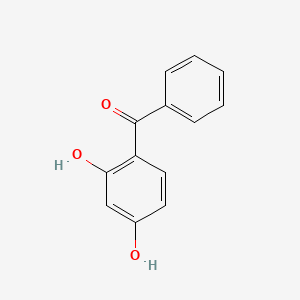
2,4-Dihydroxybenzophenone
2,4-Dihydroxybenzophenone is a member of benzophenones. — ChEBI
- IUPAC-Name
- (2,4-dihydroxyphenyl)-phenylmethanone
- Summenformel
- C13H10O3
- Molekulargewicht
- 214.22 g/mol
- Exakte Masse
- 214.062994177 Da
- XLogP3
- 3,2
- Topologische polare Oberfläche
- 57,5 Ų
- Wasserstoffbrücken-Donoren
- 2
- Wasserstoffbrücken-Akzeptoren
- 3
- Kovalente Einheiten
- 1
- Definierte Stereozentren
- 0
Auch bekannt als
16 weitere gemeldete Namen
Kennungen in externen Datenbanken
- ChEBI:CHEBI:34240
- ChEMBL:CHEMBL1392
- EPA DTXSID:DTXSID8022406
- PubMed:37217011
- PubMed:33684284
- PubMed:33049310
- PubMed:30245359
- PubMed:28927721
- PubMed:27145024
- PubMed:26884060
- PubMed:25349334
- PubMed:23328252
- PubMed:23064701
- PubMed:23037998
- PubMed:22749456
Belege aus weiteren wissenschaftlichen Datenbanken
NIH PubChem PUG-View
Attributed physical-property, hazard, environmental and use annotations.
- Boiling Point: BP: 194 °C at 1 mm Hg Quelle: Hazardous Substances Data Bank (HSDB)
- Color/Form: Needles from hot water Quelle: Hazardous Substances Data Bank (HSDB)
- Color/Form: Light-yellow, crystalline solid Quelle: Hazardous Substances Data Bank (HSDB)
- Density: Density: 5.8 lb/gallon at 20 °C Quelle: Hazardous Substances Data Bank (HSDB)
- Melting Point: 144 °C Quelle: Hazardous Substances Data Bank (HSDB)
- Physical Description: Light-yellow solid; [HSDB] Yellow powder; [MSDSonline] Quelle: Haz-Map, Information on Hazardous Chemicals and Occupational Diseases
- Solubility: Practically insoluble in cold water Quelle: Hazardous Substances Data Bank (HSDB)
- Solubility: Insoluble in water Quelle: Hazardous Substances Data Bank (HSDB)
- Solubility: Easily soluble in alcohol, ether, glacial acetic acid; scarcely soluble in cold benzene Quelle: Hazardous Substances Data Bank (HSDB)
- Solubility: Soluble in ethanol, methanol, methyl ethyl ketone, and ethyl acetate Quelle: Hazardous Substances Data Bank (HSDB)
- Note: This chemical does not meet GHS hazard criteria for 5.6% (109 of 1938) of reports. Quelle: European Chemicals Agency (ECHA)
- Signal: Warning Quelle: European Chemicals Agency (ECHA)
- GHS Hazard Statements: H315 (69.3%): Causes skin irritation [Warning Skin corrosion/irritation]; H319 (93.6%): Causes serious eye irritation [Warning Serious eye damage/eye irritation]; H335 (68.8%): May cause respiratory irritation [Warning Specific target organ toxicity, single exposure; Respiratory tract irritation] Quelle: European Chemicals Agency (ECHA)
- Precautionary Statement Codes: P261, P264, P264+P265, P271, P280, P302+P352, P304+P340, P305+P351+P338, P319, P321, P332+P317, P337+P317, P362+P364, P403+P233, P405, and P501 (click each P-code to see the statement) Quelle: European Chemicals Agency (ECHA)
- ECHA C&L Notifications Summary: Aggregated GHS information provided per 1938 reports by companies from 18 notifications to the ECHA C&L Inventory. Each notification may be associated with multiple companies.; Reported as not meeting GHS hazard criteria per 109 of 1938 reports by companies.; There are 16 notifications provided by 1829 of 1938 reports by companies with hazard statement code(s).; Information may vary between notifications depending on impurities, additives, and other factors. The percentage value in parenthesis indicates the notified classification ratio from companies that provide hazard codes. Only hazard codes with percentage values above 10% are shown. For more detailed information, please visit ECHA C&L website. Quelle: European Chemicals Agency (ECHA)
- Signal: Warning Quelle: Hazardous Substances Data Bank (HSDB)
- GHS Hazard Statements: H319: Causes serious eye irritation [Warning Serious eye damage/eye irritation] Quelle: Hazardous Substances Data Bank (HSDB)
- Precautionary Statement Codes: P264+P265, P280, P305+P351+P338, and P337+P317 (click each P-code to see the statement) Quelle: Hazardous Substances Data Bank (HSDB)
- Cosmetic Ingredient Review Finding(s): Safe in the present practices of use and concentration. Ingredient, concentration, and use information are available in documents discoverable at https://cir-reports.cir-safety.org Quelle: Cosmetic Ingredient Review (CIR)
- Toxicity Summary: IDENTIFICATION AND USE: 2,4-Dihydroxybenzophenone (BP1) is a solid. It is used as an ultraviolet light absorber, especially in paints and plastics. HUMAN STUDIES: Benzophenone (BP) derivatives show anti-androgenic activity. Treatment with BP1 (10(-5) - 10(-7) M) promoted proliferation of MCF-7 breast cancer cells by regulating cell cycle-related genes. BP1 may enhance the progression of prostate cancer by regulating cell cycle and metastasis-related genes via androgen receptor signaling pathway. ANIMAL STUDIES: It was minimally irritating when applied to the intact and abraded skin of albino rabbits and slightly to moderately irritating when applied to the eyes of rabbits. BP1 fed to 40 rats at doses of 0-1.9 g/kg for 90 days produced depressed growth and liver and kidney lesions in animals at doses of 0.6 and 1.9 g/kg. BP1 is a weak estrogenic compound based on an ovariectomized rat uterotrophic assay. It was nonmutagenic in Salmonella typhimurium strains TA100, TA98, TA1535, TA1537, and TA1538. ECOTOXICITY STUDIES: BP1 was estrogenic in fish and acted as pure- or partial estrogen receptor alpha agonists. Quelle: Hazardous Substances Data Bank (HSDB)
- Environmental Bioconcentration: An estimated BCF of 11 was calculated in fish for 2,4-dihydroxybenzophenone(SRC), using an estimated log Kow of 2.96(1) and a regression-derived equation(1). According to a classification scheme(2), this BCF suggests the potential for bioconcentration in aquatic organisms is low(SRC). Quelle: Hazardous Substances Data Bank (HSDB)
- Environmental Fate: TERRESTRIAL FATE: Based on a classification scheme(1), an estimated Koc value of 1900(SRC), determined from a structure estimation method(2), indicates that 2,4-dihydroxybenzophenone is expected to have low mobility in soil(SRC). The pKa1 and pKa2 values of 2,4-dihydroxybenzophenone are estimated at 7.1 and 8.0(3), respectively, indicating that this compound will exist partially in the anion form in the environment and anions generally do not adsorb as strongly to soils containing organic carbon and clay relative to their neutral counterparts(4). Volatilization of the neutral species of 2,4-dihydroxybenzophenone from moist soil surfaces is not expected to be an important fate process(SRC) given an estimated Henry's Law constant of 2.7X10⁻¹¹ atm-cu m/mole(SRC), using a fragment constant estimation method(5). Additionally, adsorption to soil is expected to attenuate volatilization(SRC). 2,4-Dihydroxybenzophenone is not expected to volatilize from dry soil surfaces(SRC) based upon an estimated vapor pressure of 1.4X10⁻⁷ mm Hg at 25 °C(SRC), determined from a fragment constant method(2). A 0% of theoretical BOD using activated sludge in an aqueous screening test(6) suggests that biodeg Quelle: Hazardous Substances Data Bank (HSDB)
- Environmental Fate: AQUATIC FATE: Based on a classification scheme(1), an estimated Koc value of 1900(SRC), determined from a structure estimation method(2), indicates that 2,4-dihydroxybenzophenone is expected to adsorb to suspended solids and sediment(SRC). Volatilization of the neutral species from water surfaces is not expected(3) based upon an estimated Henry's Law constant of 2.7X10⁻¹¹ atm-cu m/mole(SRC), developed using a fragment constant estimation method(4). Additionally, the estimated pKa1 and pKa2 values of 7.1 and 8.0(5), respectively, indicate 2,4-dihydroxybenzophenone will exist partially in the anion form at pH values of 5 to 9 and, therefore, volatilization from water surfaces is not expected to be an important fate process(SRC). According to a classification scheme(6), an estimated BCF of 11(SRC), from an estimated log Kow of 2.96(2) and a regression-derived equation(2), suggests the potential for bioconcentration in aquatic organisms is low(SRC). A 0% of theoretical BOD using activated sludge in an aqueous screening test(7) suggests that biodegradation is not an important environmental fate process in water(SRC). Quelle: Hazardous Substances Data Bank (HSDB)
- Environmental Fate: ATMOSPHERIC FATE: According to a model of gas/particle partitioning of semivolatile organic compounds in the atmosphere(1), 2,4-dihydroxybenzophenone, which has an estimated vapor pressure of 1.4X10⁻⁷ mm Hg at 25 °C(SRC), determined from a fragment constant method(2), will exist in both the vapor and particulate phases in the ambient atmosphere. Vapor-phase 2,4-dihydroxybenzophenone is degraded in the atmosphere by reaction with photochemically-produced hydroxyl radicals(SRC); the half-life for this reaction in air is estimated to be 2 hours(SRC), calculated from its rate constant of 2.0X10⁻¹⁰ cu cm/molecule-sec at 25 °C(SRC) that was derived using a structure estimation method(3). Particulate-phase 2,4-dihydroxybenzophenone may be removed from the air by wet and dry deposition(SRC). 2,4-Dihydroxybenzophenone absorbs light in the environmental spectrum, with reported maximum near 292 nm(4) and 323 nm(4,5) and, therefore, is susceptible to direct photolysis by sunlight(SRC). Quelle: Hazardous Substances Data Bank (HSDB)
- Cosmetic Ingredient Review Link: CIR ingredient: Benzophenone-1 Quelle: Cosmetic Ingredient Review (CIR)
- Sources/Uses: Used as an ultraviolet absorber in polymers, sunscreening agent, and ultraviolet stabilizer for polymers; [HSDB] Used as an ultraviolet light absorber in paints; [Merck Index] Quelle: Haz-Map, Information on Hazardous Chemicals and Occupational Diseases
- Industrial Processes with risk of exposure: Painting (Pigments, Binders, and Biocides) [Category: Paint]; Plastic Composites Manufacturing [Category: Industry] Quelle: Haz-Map, Information on Hazardous Chemicals and Occupational Diseases
- Uses: Ultraviolet light absorber, especially in paints and plastics. Quelle: Hazardous Substances Data Bank (HSDB)
- Uses: Ultraviolet absorber in polymers Quelle: Hazardous Substances Data Bank (HSDB)
- Uses: Used as sunscreening agent. /SRP: Former use/ Quelle: Hazardous Substances Data Bank (HSDB)
Zugeordnet durch: Existing checksum-valid CAS to unique PubChem CID match. Abgerufen: 2026-08-31. Quelleneintrag öffnen
Wissenschaftliche Klassifizierungen und Gefahrenannotationen liefern Kontext und ersetzen nicht die oben gezeigte marktspezifische regulatorische Entscheidung.
Weitere Quellenabdeckung und Trefferstatus
| Quelle | Ergebnis | Geprüft |
|---|---|---|
| NIH PubChem PUG-View | Exakter Treffer | 2026-08-31 |
Ein erfasster Nicht-Treffer ist ein nützlicher Beleg dafür, dass die Quelle geprüft wurde; er ist keine Behauptung, dass der Stoff anderswo nicht existiert.
Am 2026-08-31 von NIH PubChem durch prüfsummengültigen CAS-Abgleich abgerufen. Chemische Eigenschaften ersetzen nicht die regulatorische Entscheidung auf dieser Seite.