
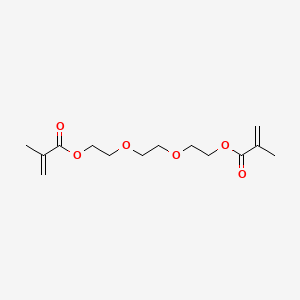
Triethylene Glycol Dimethacrylate
Based on available data, the CIR Expert Panel concluded that...Triethylene Glycol Dimethacrylate is safe as used in nail enhancement products when skin contact is avoided. Products containing these ingredients should be accompanied with directions to avoid skin contact, because of the sensitizing potential of Methacrylates. — Cosmetic Ingredient Review (CIR)
- IUPAC-Name
- 2-[2-[2-(2-methylprop-2-enoyloxy)ethoxy]ethoxy]ethyl 2-methylprop-2-enoate
- Summenformel
- C14H22O6
- Molekulargewicht
- 286.32 g/mol
- Exakte Masse
- 286.14163842 Da
- XLogP3
- 1,6
- Topologische polare Oberfläche
- 71,1 Ų
- Wasserstoffbrücken-Donoren
- 0
- Wasserstoffbrücken-Akzeptoren
- 6
- Kovalente Einheiten
- 1
- Definierte Stereozentren
- 0
Auch bekannt als
16 weitere gemeldete Namen
Kennungen in externen Datenbanken
Belege aus weiteren wissenschaftlichen Datenbanken
NIH PubChem PUG-View
Attributed physical-property, hazard, environmental and use annotations.
- Boiling Point: 155 °C @ 0.13 kPa Quelle: Hazardous Substances Data Bank (HSDB)
- Density: 1.072 at 25 °C Quelle: Hazardous Substances Data Bank (HSDB)
- Density: 1.09 @ 20°C Quelle: PAC Chemical Database, U.S. Department of Energy
- LogP: log Kow = 1.88 Quelle: Hazardous Substances Data Bank (HSDB)
- Physical Description: Liquid Quelle: EPA Chemical Data Reporting (CDR)
- Physical Description: Liquid; [Aldrich MSDS] Quelle: Haz-Map, Information on Hazardous Chemicals and Occupational Diseases
- Refractive Index: Index of refraction: 1.4595 at 25 °C Quelle: Hazardous Substances Data Bank (HSDB)
- Solubility: > 10% in acetone Quelle: Hazardous Substances Data Bank (HSDB)
- Solubility: > 10% in ethanol Quelle: Hazardous Substances Data Bank (HSDB)
- Solubility: > 10% in ether Quelle: Hazardous Substances Data Bank (HSDB)
- Solubility: > 10% in petroleum ether Quelle: Hazardous Substances Data Bank (HSDB)
- Vapor Pressure: 0.00094 [mmHg] Quelle: Haz-Map, Information on Hazardous Chemicals and Occupational Diseases
- Signal: Warning Quelle: Regulation (EC) No 1272/2008 of the European Parliament and of the Council
- GHS Hazard Statements: H317: May cause an allergic skin reaction [Warning Sensitization, Skin] Quelle: Regulation (EC) No 1272/2008 of the European Parliament and of the Council
- Precautionary Statement Codes: P261, P272, P280, P302+P352, P321, P333+P317, P362+P364, and P501 (click each P-code to see the statement) Quelle: Regulation (EC) No 1272/2008 of the European Parliament and of the Council
- Note: This chemical does not meet GHS hazard criteria for 49% (262 of 535) of reports. Quelle: European Chemicals Agency (ECHA)
- Signal: Warning Quelle: European Chemicals Agency (ECHA)
- GHS Hazard Statements: H315 (21.1%): Causes skin irritation [Warning Skin corrosion/irritation]; H317 (43.7%): May cause an allergic skin reaction [Warning Sensitization, Skin]; H319 (21.1%): Causes serious eye irritation [Warning Serious eye damage/eye irritation]; H335 (16.1%): May cause respiratory irritation [Warning Specific target organ toxicity, single exposure; Respiratory tract irritation] Quelle: European Chemicals Agency (ECHA)
- Precautionary Statement Codes: P261, P264, P264+P265, P271, P272, P280, P302+P352, P304+P340, P305+P351+P338, P319, P321, P332+P317, P333+P317, P337+P317, P362+P364, P403+P233, P405, and P501 (click each P-code to see the statement) Quelle: European Chemicals Agency (ECHA)
- ECHA C&L Notifications Summary: Aggregated GHS information provided per 535 reports by companies from 12 notifications to the ECHA C&L Inventory. Each notification may be associated with multiple companies.; Reported as not meeting GHS hazard criteria per 262 of 535 reports by companies.; There are 10 notifications provided by 273 of 535 reports by companies with hazard statement code(s).; Information may vary between notifications depending on impurities, additives, and other factors. The percentage value in parenthesis indicates the notified classification ratio from companies that provide hazard codes. Only hazard codes with percentage values above 10% are shown. For more detailed information, please visit ECHA C&L website. Quelle: European Chemicals Agency (ECHA)
- Signal: Warning Quelle: NITE-CMC
- GHS Hazard Statements: H317: May cause an allergic skin reaction [Warning Sensitization, Skin]; H402: Harmful to aquatic life [Hazardous to the aquatic environment, acute hazard] Quelle: NITE-CMC
- Precautionary Statement Codes: P261, P272, P273, P280, P302+P352, P321, P333+P317, P362+P364, and P501 (click each P-code to see the statement) Quelle: NITE-CMC
- Cosmetic Ingredient Review Conclusion: Based on available data, the CIR Expert Panel concluded that...Triethylene Glycol Dimethacrylate is safe as used in nail enhancement products when skin contact is avoided. Products containing these ingredients should be accompanied with directions to avoid skin contact, because of the sensitizing potential of Methacrylates. Quelle: Cosmetic Ingredient Review (CIR)
- Cosmetic Ingredient Review Finding(s): Safe for use in cosmetics, with qualifications Quelle: Cosmetic Ingredient Review (CIR)
- Environmental Bioconcentration: An estimated BCF value of 16 was calculated for triethylene glycol dimethacrylate(SRC), using an experimental log Kow of 1.88(1) and a recommended regression-derived equation(2). According to a classification scheme(3), this BCF value suggests that bioconcentration in aquatic organisms is low(SRC). Quelle: Hazardous Substances Data Bank (HSDB)
- Environmental Fate: TERRESTRIAL FATE: Based on a recommended classification scheme(1), an estimated Koc value of 250(SRC), determined from an experimental log Kow(2) and a recommended regression-derived equation(3), indicates that triethylene glycol dimethacrylate will have moderate mobility in soil(SRC). Volatilization of triethylene glycol dimethacrylate should not be important from moist soil surfaces(SRC) given an estimated Henry's Law constant of 1.7X10⁻¹² atm-cu m/mole(SRC), using a recommended regression equation(4). Volatilization from dry soil surfaces(SRC) is not expected based on an estimated vapor pressure of 9.4X10⁻⁴ mm Hg(SRC), determined from a fragment constant method(5). Insufficient data are available to determine the rate or importance of biodegradation of triethylene glycol methacrylate in soil(SRC). Quelle: Hazardous Substances Data Bank (HSDB)
- Environmental Fate: AQUATIC FATE: Based on a recommended classification scheme(1), an estimated Koc value of 250(SRC), determined from an experimental log Kow(2) and a recommended regression-derived equation(1), indicates that triethylene glycol dimethacrylate may adsorb to suspended solids and sediment in the water(SRC). Triethylene glycol dimethacrylate will be non-volatile from water surfaces(1,SRC) based on an estimated Henry's Law constant of 1.7X10⁻¹² atm-cu m/mole(SRC), developed using a fragment constant estimation method(3). According to a classification scheme(4), an estimated BCF value of 16(1,SRC), from an experimental log Kow(2), suggests that bioconcentration in aquatic organisms is low(SRC). Base catalyzed half-lives for triethylene glcycol dimethacrylate have been estimated(SRC), through a structure estimation method(5), to be 1.6 years and 16 years at pHs of 8 and 7, respectively(5,SRC). Insufficient data are available to determine the rate or importance of biodegradation of triethylene glycol methacrylate in water(SRC). Quelle: Hazardous Substances Data Bank (HSDB)
- Environmental Fate: ATMOSPHERIC FATE: According to a model of gas/particle partitioning of semivolatile organic compounds in the atmosphere(1), triethylene glycol dimethacrylate, which has an estimated vapor pressure of 9.4X10⁻⁴ mm Hg at 25 °C(2,SRC), would exist in both the vapor and particulate phases in the ambient atmosphere. Vapor-phase triethylene glycol dimethacrylate is degraded in the atmosphere by reaction with photochemically produced hydroxyl radicals(SRC); the half-life for this reaction in air is estimated to be about 5.7 hours(3,SRC). Vapor-phase triethylene glycol dimethacrylate is also degraded in the atmosphere by reaction with atmospheric ozone(SRC); the half-life for this reaction in air is estimated to be about 12 hours(3,SRC). Particulate-phase triethylene glycol dimethacrylate may be physically removed from the air by wet and dry deposition(SRC). Quelle: Hazardous Substances Data Bank (HSDB)
- Consumer Uses: Monomers Quelle: EPA Chemical Data Reporting (CDR)
- Industry Uses: Adhesives and sealant chemicals; Sealant (barrier); Intermediate; Monomers Quelle: EPA Chemical Data Reporting (CDR)
- Cosmetic Ingredient Review Link: CIR ingredient: Triethylene Glycol Dimethacrylate Quelle: Cosmetic Ingredient Review (CIR)
- Cosmetic Ingredient Review Link: CIR ingredient: Triethylene glycol dimethacrylate Quelle: Cosmetic Ingredient Review (CIR)
- Sources/Uses: Crosslinking agent for hard contact lenses, dental materials, thermoset and UV curable acrylics and vinyls; [HSDB] Quelle: Haz-Map, Information on Hazardous Chemicals and Occupational Diseases
- Industrial Processes with risk of exposure: Plastic Composites Manufacturing [Category: Industry]; Silk-Screen Printing [Category: Other] Quelle: Haz-Map, Information on Hazardous Chemicals and Occupational Diseases
- Uses: Crosslinking agent for hard contact lenses. Quelle: Hazardous Substances Data Bank (HSDB)
- Uses: Crosslinking agent for dental materials. Quelle: Hazardous Substances Data Bank (HSDB)
- Uses: CROSSLINKING /AGENT/ FOR THERMOSET & UV CURABLE ACRYLICS. Quelle: Hazardous Substances Data Bank (HSDB)
- Uses: CROSSLINKING /AGENT/ FOR THERMOSET & UV CURABLE VINYLS. Quelle: Hazardous Substances Data Bank (HSDB)
Zugeordnet durch: Existing checksum-valid CAS to unique PubChem CID match. Abgerufen: 2026-08-31. Quelleneintrag öffnen
Wissenschaftliche Klassifizierungen und Gefahrenannotationen liefern Kontext und ersetzen nicht die oben gezeigte marktspezifische regulatorische Entscheidung.
Weitere Quellenabdeckung und Trefferstatus
| Quelle | Ergebnis | Geprüft |
|---|---|---|
| NIH PubChem PUG-View | Exakter Treffer | 2026-08-31 |
Ein erfasster Nicht-Treffer ist ein nützlicher Beleg dafür, dass die Quelle geprüft wurde; er ist keine Behauptung, dass der Stoff anderswo nicht existiert.
Am 2026-08-31 von NIH PubChem durch prüfsummengültigen CAS-Abgleich abgerufen. Chemische Eigenschaften ersetzen nicht die regulatorische Entscheidung auf dieser Seite.