
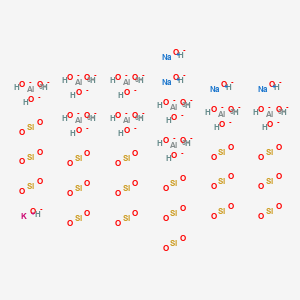
silicic acid, aluminum potassium sodium salt
The Expert Panel for Cosmetic Ingredient Safety concluded that the following 24 silicate ingredients are safe in cosmetics in the present practices of use and concentration described in this safety assessment when formulated to be non-irritating, with the exception that the available data are insufficient to make a determination of safety for the use of naturally-sourced (i.e., mined) silicate ingredients in products that may be incidentally inhaled: Sodium Potassium Aluminum Silicate. — Cosmetic Ingredient Review (CIR)
- IUPAC-Name
- nonaaluminum;potassium;tetrasodium;octadecakis(dioxosilane);dotriacontahydroxide
- Summenformel
- Al9H32KNa4O68Si18
- Molekulargewicht
- 1999.6 g/mol
- Exakte Masse
- 1997.245902 Da
- Topologische polare Oberfläche
- 647,0 Ų
- Wasserstoffbrücken-Donoren
- 32
- Wasserstoffbrücken-Akzeptoren
- 68
- Kovalente Einheiten
- 64
- Definierte Stereozentren
- 0
Auch bekannt als
1 weiterer gemeldeter Name
Belege aus weiteren wissenschaftlichen Datenbanken
NIH PubChem PUG-View
Attributed physical-property, hazard, environmental and use annotations.
- Physical Description: Dry Powder Quelle: EPA Chemical Data Reporting (CDR)
- Note: This chemical does not meet GHS hazard criteria for 5.2% (9 of 173) of reports. Quelle: European Chemicals Agency (ECHA)
- Signal: Warning Quelle: European Chemicals Agency (ECHA)
- GHS Hazard Statements: H315 (27.7%): Causes skin irritation [Warning Skin corrosion/irritation]; H319 (27.7%): Causes serious eye irritation [Warning Serious eye damage/eye irritation]; H335 (94.8%): May cause respiratory irritation [Warning Specific target organ toxicity, single exposure; Respiratory tract irritation] Quelle: European Chemicals Agency (ECHA)
- Precautionary Statement Codes: P261, P264, P264+P265, P271, P280, P302+P352, P304+P340, P305+P351+P338, P319, P321, P332+P317, P337+P317, P362+P364, P403+P233, P405, and P501 (click each P-code to see the statement) Quelle: European Chemicals Agency (ECHA)
- ECHA C&L Notifications Summary: Aggregated GHS information provided per 173 reports by companies from 5 notifications to the ECHA C&L Inventory. Each notification may be associated with multiple companies.; Reported as not meeting GHS hazard criteria per 9 of 173 reports by companies.; There are 4 notifications provided by 164 of 173 reports by companies with hazard statement code(s).; Information may vary between notifications depending on impurities, additives, and other factors. The percentage value in parenthesis indicates the notified classification ratio from companies that provide hazard codes. Only hazard codes with percentage values above 10% are shown. For more detailed information, please visit ECHA C&L website. Quelle: European Chemicals Agency (ECHA)
- Cosmetic Ingredient Review Conclusion: The Expert Panel for Cosmetic Ingredient Safety concluded that the following 24 silicate ingredients are safe in cosmetics in the present practices of use and concentration described in this safety assessment when formulated to be non-irritating, with the exception that the available data are insufficient to make a determination of safety for the use of naturally-sourced (i.e., mined) silicate ingredients in products that may be incidentally inhaled: Sodium Potassium Aluminum Silicate. Quelle: Cosmetic Ingredient Review (CIR)
- Cosmetic Ingredient Review Finding(s): Safe for use in cosmetics, with qualifications; The available data are insufficient to support safety Quelle: Cosmetic Ingredient Review (CIR)
- Industry Uses: Adsorbent Quelle: EPA Chemical Data Reporting (CDR)
- Cosmetic Ingredient Review Link: CIR ingredient: Sodium Potassium Aluminum Silicate Quelle: Cosmetic Ingredient Review (CIR)
Zugeordnet durch: Existing checksum-valid CAS to unique PubChem CID match. Abgerufen: 2026-08-31. Quelleneintrag öffnen
Wissenschaftliche Klassifizierungen und Gefahrenannotationen liefern Kontext und ersetzen nicht die oben gezeigte marktspezifische regulatorische Entscheidung.
Weitere Quellenabdeckung und Trefferstatus
| Quelle | Ergebnis | Geprüft |
|---|---|---|
| NIH PubChem PUG-View | Exakter Treffer | 2026-08-31 |
Ein erfasster Nicht-Treffer ist ein nützlicher Beleg dafür, dass die Quelle geprüft wurde; er ist keine Behauptung, dass der Stoff anderswo nicht existiert.
Am 2026-08-31 von NIH PubChem durch prüfsummengültigen CAS-Abgleich abgerufen. Chemische Eigenschaften ersetzen nicht die regulatorische Entscheidung auf dieser Seite.