
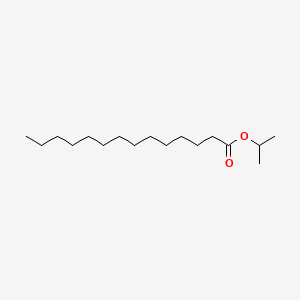
Isopropyl Myristate
Isopropyl tetradecanoate is a fatty acid ester. — ChEBI
- IUPAC-Name
- propan-2-yl tetradecanoate
- Summenformel
- C17H34O2
- Molekulargewicht
- 270.5 g/mol
- Exakte Masse
- 270.255880323 Da
- XLogP3
- 7,2
- Topologische polare Oberfläche
- 26,3 Ų
- Wasserstoffbrücken-Donoren
- 0
- Wasserstoffbrücken-Akzeptoren
- 2
- Kovalente Einheiten
- 1
- Definierte Stereozentren
- 0
Auch bekannt als
16 weitere gemeldete Namen
Kennungen in externen Datenbanken
- ChEBI:CHEBI:90027
- ChEMBL:CHEMBL207602
- EPA DTXSID:DTXSID0026838
- PubMed:28132900
- PubMed:24254630
- PubMed:23118537
- PubMed:23066214
- PubMed:23066212
- PubMed:22976326
- PubMed:22972714
- PubMed:22943314
- PubMed:22928552
- PubMed:22779009
- PubMed:22713517
- PubMed:22692080
Belege aus weiteren wissenschaftlichen Datenbanken
NIH PubChem PUG-View
Attributed physical-property, hazard, environmental and use annotations.
- Boiling Point: 588 K (315 °C) at 760 mm Hg Quelle: Hazardous Substances Data Bank (HSDB)
- Boiling Point: 192.00 to 193.00 °C. @ 20.00 mm Hg Quelle: Human Metabolome Database (HMDB)
- Boiling Point: 192 °C (22 mmHg) Quelle: Joint FAO/WHO Expert Committee on Food Additives (JECFA)
- Color/Form: Liquid of low viscosity Quelle: Hazardous Substances Data Bank (HSDB)
- Color/Form: Colorless oil Quelle: Hazardous Substances Data Bank (HSDB)
- Density: 0.8532 g/cu cm at 20 °C Quelle: Hazardous Substances Data Bank (HSDB)
- Density: 0.847 - 0.855 Quelle: Joint FAO/WHO Expert Committee on Food Additives (JECFA)
- Density: 0.8532 @ 20°C Quelle: PAC Chemical Database, U.S. Department of Energy
- Melting Point: Approximately 3 °C Quelle: Hazardous Substances Data Bank (HSDB)
- Melting Point: 3 °C Quelle: Human Metabolome Database (HMDB)
- Odor: Practically odorless Quelle: Hazardous Substances Data Bank (HSDB)
- Physical Description: Dry Powder; Liquid; Liquid; CBI; Other Solid Quelle: EPA Chemical Data Reporting (CDR)
- Physical Description: Colorless liquid; [Hawley] Quelle: Haz-Map, Information on Hazardous Chemicals and Occupational Diseases
- Physical Description: Liquid Quelle: Human Metabolome Database (HMDB)
- Physical Description: colourless to pale yellow, odourless liquid Quelle: Joint FAO/WHO Expert Committee on Food Additives (JECFA)
- Refractive Index: Index of refraction: 1.432-1.434 at 25 °C/D Quelle: Hazardous Substances Data Bank (HSDB)
- Refractive Index: 1.432 - 1.437 Quelle: Joint FAO/WHO Expert Committee on Food Additives (JECFA)
- Solubility: Soluble in castor oil, cottonseed oil, acetone, chloroform, ethyl acetate, ethanol, toluene, and mineral oil; practically insoluble in glycerol, propylene glycol Quelle: Hazardous Substances Data Bank (HSDB)
- Solubility: Soluble in ether, very soluble in acetone, benzene; insoluble in water Quelle: Hazardous Substances Data Bank (HSDB)
- Solubility: insoluble in water and glycerol; soluble in alcohol Quelle: Joint FAO/WHO Expert Committee on Food Additives (JECFA)
- Solubility: (in ethanol) Quelle: Joint FAO/WHO Expert Committee on Food Additives (JECFA)
- Vapor Pressure: 0.0000935 [mmHg] Quelle: Haz-Map, Information on Hazardous Chemicals and Occupational Diseases
- Vapor Pressure: 9.35X10⁻⁵ mm Hg at 25 °C Quelle: Hazardous Substances Data Bank (HSDB)
- Vapor Pressure: 0.0000935 [mm Hg] @25 °C Quelle: PAC Chemical Database, U.S. Department of Energy
- Note: This chemical does not meet GHS hazard criteria for 84.3% (2565 of 3041) of all reports. Quelle: European Chemicals Agency (ECHA)
- Signal: Warning Quelle: European Chemicals Agency (ECHA)
- GHS Hazard Statements: H315 (15.6%): Causes skin irritation [Warning Skin corrosion/irritation] Quelle: European Chemicals Agency (ECHA)
- Precautionary Statement Codes: P264, P280, P302+P352, P321, P332+P317, and P362+P364 (click each P-code to see the statement) Quelle: European Chemicals Agency (ECHA)
- ECHA C&L Notifications Summary: Aggregated GHS information provided per 3041 reports by companies from 10 notifications to the ECHA C&L Inventory.; Reported as not meeting GHS hazard criteria per 2565 of 3041 reports by companies.; There are 8 notifications provided by 476 of 3041 reports by companies with hazard statement code(s).; Information may vary between notifications depending on impurities, additives, and other factors. The percentage value in parenthesis indicates the notified classification ratio from companies that provide hazard codes. Only hazard codes with percentage values above 10% are shown. For more detailed information, please visit ECHA C&L website. Quelle: European Chemicals Agency (ECHA)
- Cosmetic Ingredient Review Finding(s): Safe in the present practices of use and concentration. Ingredient, concentration, and use information are available in documents discoverable at https://cir-reports.cir-safety.org Quelle: Cosmetic Ingredient Review (CIR)
- Environmental Bioconcentration: An estimated BCF of 2800 was calculated in fish for isopropyl myristate(SRC), using an estimated log Kow of 7.17(1) and a regression-derived equation(2). According to a classification scheme(3), this BCF suggests the potential for bioconcentration in aquatic organisms is very high(SRC), provided the compound is not metabolized by the organism(SRC). Quelle: Hazardous Substances Data Bank (HSDB)
- Environmental Fate: TERRESTRIAL FATE: Based on a classification scheme(1), an estimated Koc value of 1.2X10+4(SRC), determined from a structure estimation method(2), indicates that isopropyl myristate is expected to be immobile in soil(SRC). Volatilization of isopropyl myristate from moist soil surfaces is expected to be an important fate process(SRC) given an estimated Henry's Law constant of 2.34X10⁻² atm-cu m/mole(SRC), using a fragment constant estimation method(3). However, adsorption to soil is expected to attenuate volatilization(SRC). Isopropyl myristate is not expected to volatilize from dry soil surfaces(SRC) based upon a vapor pressure of 9.35X10⁻⁵ mm Hg at 25 °C(4). Isopropyl myristate, present at 100 mg/L, reached 94% of its chemical oxygen demand in 28 days using a municipal waste water inoculum in the closed bottle test(5), suggesting that biodegradation may be an important environmental fate process(SRC). Quelle: Hazardous Substances Data Bank (HSDB)
- Environmental Fate: AQUATIC FATE: Based on a classification scheme(1), an estimated Koc value of 1.2X10+4(SRC), determined from a structure estimation method(2), indicates that isopropyl myristate is expected to adsorb to suspended solids and sediment(SRC). Volatilization from water surfaces is expected(3) based upon an estimated Henry's Law constant of 2.34X10⁻² atm-cu m/mole(SRC), developed using a fragment constant estimation method(4). Using this Henry's Law constant and an estimation method(3), volatilization half-lives for a model river and model lake are 4.9 hours and 6.5 days, respectively(SRC). However, volatilization from water surfaces is expected to be attenuated by adsorption to suspended solids and sediment in the water column(SRC). The volatilization half-life from a model pond is about 99 days when adsorption is considered(5). According to a classification scheme(6), an estimated BCF of 2800(SRC), from an estimated log Kow of 7.17(7) and a regression-derived equation(2), suggests the potential for bioconcentration in aquatic organisms is very high, provided the compound is not metabolized by the organism(SRC). A base-catalyzed second-order hydrolysis rate constant of 2.14X10⁻² L/mole-s Quelle: Hazardous Substances Data Bank (HSDB)
- Environmental Fate: ATMOSPHERIC FATE: According to a model of gas/particle partitioning of semivolatile organic compounds in the atmosphere(1), isopropyl myristate, which has a vapor pressure of 9.35X10⁻⁵ mm Hg at 25 °C(2), is expected to exist in both the vapor and particulate phases in the ambient atmosphere. Vapor-phase isopropyl myristate is degraded in the atmosphere by reaction with photochemically-produced hydroxyl radicals(SRC); the half-life for this reaction in air is estimated to be 20 hours(SRC), calculated from its rate constant of 1.92X10⁻¹¹ cu cm/molecule-sec at 25 °C(SRC) that was derived using a structure estimation method(3). Particulate-phase isopropyl myristate may be removed from the air by wet or dry deposition(SRC). Isopropyl myristate does not contain chromophores that absorb at wavelengths >290 nm(4), and therefore is not expected to be susceptible to direct photolysis by sunlight(SRC). Quelle: Hazardous Substances Data Bank (HSDB)
- Consumer Uses: Surface modifier; Catalyst; Not Known or Reasonably Ascertainable; Fragrance Quelle: EPA Chemical Data Reporting (CDR)
- Industry Uses: Not Known or Reasonably Ascertainable; Fragrance; Humectant; Defoamer; Surface modifier; Softener and conditioner; Intermediate; Chemical reaction regulator Quelle: EPA Chemical Data Reporting (CDR)
- Cosmetic Ingredient Review Link: CIR ingredient: Isopropyl Myristate Quelle: Cosmetic Ingredient Review (CIR)
- Sources/Uses: Used as emollient and emulsifier in cosmetics and topical medicines, parenteral solvent (intravenous solutions), and reagent in tests for sterility; [HSDB] Quelle: Haz-Map, Information on Hazardous Chemicals and Occupational Diseases
- Uses: For isopropyl myristate (USEPA/OPP Pesticide Code: 000207) there are 0 labels match. /SRP: Not registered for current use in the U.S., but approved pesticide uses may change periodically and so federal, state and local authorities must be consulted for currently approved uses./ Quelle: Hazardous Substances Data Bank (HSDB)
- Uses: Isopropyl myristate is an effective agent for solubilizing lanolin; mixtures of up to about 50% lanolin in isopropyl myristate remain stable, free-flowing liquid at room temperature. Therefore, isopropyl myristate is used as a solubilizing, spreading, and penetrating agent in anhydrous skin lubricating lotions with high lanolin content. Isopropyl myristate leaves the skin soft and smooth without an oily surface film. It is used in bath oils, perfumes, creams lotions, lipsticks, hair preparations, shaving lotions, aerosol toiletries, and pharmaceutical ointments. Quelle: Hazardous Substances Data Bank (HSDB)
- Uses: In cosmetic and topical medicinal preparations Quelle: Hazardous Substances Data Bank (HSDB)
- Uses: EMOLLIENT & EMULSIFIER IN COSMETIC OILS, CREAMS & LOTIONS, MAKEUP, LIPSTICK, SKIN LUBRICANTS, DEODORANTS, SUN SCREENS, HAIR PREPARATIONS, NAIL LACQUER REMOVER; PARENTERAL SOLVENT IN MEDICINE; REAGENT IN MEDICAL TEST FOR STERILITY Quelle: Hazardous Substances Data Bank (HSDB)
- Uses: For more Uses (Complete) data for Isopropyl myristate (6 total), please visit the HSDB record page. Quelle: Hazardous Substances Data Bank (HSDB)
Zugeordnet durch: Existing checksum-valid CAS to unique PubChem CID match. Abgerufen: 2026-08-31. Quelleneintrag öffnen
Wissenschaftliche Klassifizierungen und Gefahrenannotationen liefern Kontext und ersetzen nicht die oben gezeigte marktspezifische regulatorische Entscheidung.
Weitere Quellenabdeckung und Trefferstatus
| Quelle | Ergebnis | Geprüft |
|---|---|---|
| NIH PubChem PUG-View | Exakter Treffer | 2026-08-31 |
Ein erfasster Nicht-Treffer ist ein nützlicher Beleg dafür, dass die Quelle geprüft wurde; er ist keine Behauptung, dass der Stoff anderswo nicht existiert.
Am 2026-08-31 von NIH PubChem durch prüfsummengültigen CAS-Abgleich abgerufen. Chemische Eigenschaften ersetzen nicht die regulatorische Entscheidung auf dieser Seite.