
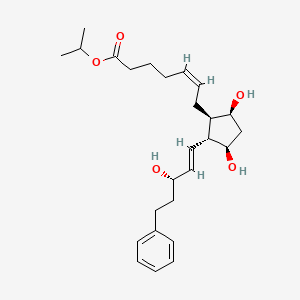
17-phenyl-trinor-PGF2alpha isopropyl ester
17-phenyl-trinor-PGF2alpha isopropyl ester is a prostanoid. — ChEBI
- IUPAC-Name
- propan-2-yl (Z)-7-[(1R,2R,3R,5S)-3,5-dihydroxy-2-[(E,3S)-3-hydroxy-5-phenylpent-1-enyl]cyclopentyl]hept-5-enoate
- Summenformel
- C26H38O5
- Molekulargewicht
- 430.6 g/mol
- Exakte Masse
- 430.27192431 Da
- XLogP3
- 3,8
- Topologische polare Oberfläche
- 87,0 Ų
- Wasserstoffbrücken-Donoren
- 3
- Wasserstoffbrücken-Akzeptoren
- 5
- Kovalente Einheiten
- 1
- Definierte Stereozentren
- 5
Auch bekannt als
16 weitere gemeldete Namen
Kennungen in externen Datenbanken
- ChEBI:CHEBI:137717
- ChEMBL:CHEMBL2111623
- EPA DTXSID:DTXSID801365461
- PubMed:10634944
Belege aus weiteren wissenschaftlichen Datenbanken
NIH PubChem PUG-View
Attributed physical-property, hazard, environmental and use annotations.
- Signal: Danger Quelle: European Chemicals Agency (ECHA)
- GHS Hazard Statements: H302+H312+H332 (100%): Harmful if swallowed, in contact with skin or if inhaled [Warning Acute toxicity, oral; acute toxicity, dermal; acute toxicity, inhalation]; H302 (100%): Harmful if swallowed [Warning Acute toxicity, oral]; H312 (100%): Harmful in contact with skin [Warning Acute toxicity, dermal]; H332 (100%): Harmful if inhaled [Warning Acute toxicity, inhalation]; H360 (100%): May damage fertility or the unborn child [Danger Reproductive toxicity] Quelle: European Chemicals Agency (ECHA)
- Precautionary Statement Codes: P203, P261, P264, P270, P271, P280, P301+P317, P302+P352, P304+P340, P317, P318, P321, P330, P362+P364, P405, and P501 (click each P-code to see the statement) Quelle: European Chemicals Agency (ECHA)
- ECHA C&L Notifications Summary: The GHS information provided by 1 company from 1 notification to the ECHA C&L Inventory. Quelle: European Chemicals Agency (ECHA)
Zugeordnet durch: Existing checksum-valid CAS to unique PubChem CID match. Abgerufen: 2026-08-31. Quelleneintrag öffnen
Wissenschaftliche Klassifizierungen und Gefahrenannotationen liefern Kontext und ersetzen nicht die oben gezeigte marktspezifische regulatorische Entscheidung.
Weitere Quellenabdeckung und Trefferstatus
| Quelle | Ergebnis | Geprüft |
|---|---|---|
| NIH PubChem PUG-View | Exakter Treffer | 2026-08-31 |
Ein erfasster Nicht-Treffer ist ein nützlicher Beleg dafür, dass die Quelle geprüft wurde; er ist keine Behauptung, dass der Stoff anderswo nicht existiert.
Am 2026-09-02 von NIH PubChem durch prüfsummengültigen CAS-Abgleich abgerufen. Chemische Eigenschaften ersetzen nicht die regulatorische Entscheidung auf dieser Seite.