
CAS
1 Eintrag
CAS 128-62-1
CAS 128-62-1 entspricht 1 EU-Anhangseintrag in den Anhängen II–VI der Verordnung (EG) Nr. 1223/2009.
Einträge zu CAS 128-62-1
1 insgesamtChemische Identität und Eigenschaften
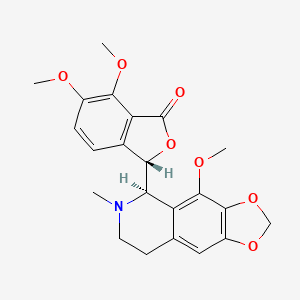
CAS 128-62-1PubChem CID 275196
Noscapine
(-)-noscapine is a benzylisoquinoline alkaloid that is 1,2,3,4-tetrahydroisoquinoline which is substituted by a 4,5-dimethoxy-3-oxo-1,3-dihydro-2-benzofuran-1-yl group at position 1, a methylenedioxy group at positions 6-7 and a methoxy group at position 8. Obtained from plants of the Papaveraceae family, it lacks significant painkilling properties and is primarily used for its antitussive (cough-suppressing) effects. It has a role as an antineoplastic agent, an antitussive, an apoptosis inducer and a plant metabolite. It is a benzylisoquinoline alkaloid, an organic heterotricyclic compound, an organic heterobicyclic compound, an aromatic ether, a tertiary amino compound, an isobenzofuranone and a cyclic acetal. It is functionally related to a (-)-noscapine hemiacetal. — ChEBI
- IUPAC-Name
- (3S)-6,7-dimethoxy-3-[(5R)-4-methoxy-6-methyl-7,8-dihydro-5H-[1,3]dioxolo[4,5-g]isoquinolin-5-yl]-3H-2-benzofuran-1-one
- Summenformel
- C22H23NO7
- Molekulargewicht
- 413.4 g/mol
- Exakte Masse
- 413.14745207 Da
- XLogP3
- 2,7
- Topologische polare Oberfläche
- 75,7 Ų
- Wasserstoffbrücken-Donoren
- 0
- Wasserstoffbrücken-Akzeptoren
- 8
- Kovalente Einheiten
- 1
- Definierte Stereozentren
- 2
Auch bekannt als
NARCOTINETusscapineMethoxyhydrastineTerbenolCoscopinNarcomprenNarcosineVadebex
16 weitere gemeldete Namen
NoscapalinLongatinOpianine(-)-NarcotineNarcotinNarcotussinNectadonNicolaneNoscapinLyobexNipaxonOpianinOpianCoscotabsalpha-NarcotineKey-tusscapine
Kennungen in externen Datenbanken
- ChEBI:CHEBI:73237
- ChEMBL:CHEMBL364713
- EPA DTXSID:DTXSID4023385
- EPA DTXSID:DTXSID901032089
- PubMed:22999177
- PubMed:22921420
- PubMed:22917039
- PubMed:22848370
- PubMed:22745410
- PubMed:22733149
- PubMed:22671862
- PubMed:22655227
- PubMed:22653730
- PubMed:22649926
- PubMed:22574013
- PubMed:22546556
Belege aus weiteren wissenschaftlichen Datenbanken
NIH PubChem PUG-View
Exakter Kennungstreffer275196
Attributed physical-property, hazard, environmental and use annotations.
- Color/Form: ORTHORHOMBIC BISPHENOIDAL PRISMS Quelle: Hazardous Substances Data Bank (HSDB)
- Color/Form: FINE, WHITE, OR PRACTICALLY WHITE, CRYSTALLINE POWDER Quelle: Hazardous Substances Data Bank (HSDB)
- Density: 1.395 Quelle: Hazardous Substances Data Bank (HSDB)
- Dissociation Constants: PK 7.8; KB 1.5X10⁻⁸ Quelle: Hazardous Substances Data Bank (HSDB)
- Melting Point: 176 °C Quelle: Hazardous Substances Data Bank (HSDB)
- Melting Point: 176 °C Quelle: Human Metabolome Database (HMDB)
- Odor: ODORLESS Quelle: Hazardous Substances Data Bank (HSDB)
- Physical Description: Solid Quelle: Human Metabolome Database (HMDB)
- Refractive Index: INDEX OF REFRACTION: 1.5403 Quelle: Hazardous Substances Data Bank (HSDB)
- Solubility: PKA 6.24; FREELY SOL IN ETHANOL; INSOL IN DIETHYL ETHER /HYDROCHLORIDE/ Quelle: Hazardous Substances Data Bank (HSDB)
- Solubility: FINE, WHITE, OR PRACTICALLY WHITE, CRYSTALLINE POWDER; ODORLESS OR HAS SLIGHT ODOR OF ETHANOL; FREELY SOL IN CHLOROFORM & METHANOL; SOL IN ALCOHOL; SPARINGLY SOL IN ACETONE; PRACTICALLY INSOL IN ETHER; SOLN IN WATER IS DEXTROROTATORY; PH OF SOLN (1 IN 20) BETWEEN 2.5 & 3.5 /HYDROCHLORIDE/ Quelle: Hazardous Substances Data Bank (HSDB)
- Solubility: HEMIHYDRATE TO TETRAHYDRATE, CRYSTALS; VERY SOL IN WATER /HYDROCHLORIDE/ Quelle: Hazardous Substances Data Bank (HSDB)
- Solubility: CRYSTALS; FREELY SOL IN WATER; SOL IN METHANOL, ETHANOL; SLIGHTLY SOL IN ETHYL ACETATE; PRACTICALLY INSOL IN ETHER /CAMPHORSULFONATE/ Quelle: Hazardous Substances Data Bank (HSDB)
- Solubility: PRACTICALLY INSOL IN VEGETABLE OILS; SLIGHTLY SOL IN NH4OH, HOT SOLN OF KOH & NAOH Quelle: Hazardous Substances Data Bank (HSDB)
- Solubility: SLIGHTLY SOL IN ALCOHOL & ETHER Quelle: Hazardous Substances Data Bank (HSDB)
- Solubility: INSOL IN WATER; SOL IN BENZENE & ACETONE Quelle: Hazardous Substances Data Bank (HSDB)
- Solubility: 0.3 mg/mL at 30 °C Quelle: Human Metabolome Database (HMDB)
- pH: NEUTRAL TO LITMUS Quelle: Hazardous Substances Data Bank (HSDB)
- Signal: Warning Quelle: European Chemicals Agency (ECHA)
- GHS Hazard Statements: H302 (100%): Harmful if swallowed [Warning Acute toxicity, oral] Quelle: European Chemicals Agency (ECHA)
- Precautionary Statement Codes: P264, P270, P301+P317, P330, and P501 (click each P-code to see the statement) Quelle: European Chemicals Agency (ECHA)
- ECHA C&L Notifications Summary: Aggregated GHS information provided per 140 reports by companies from 4 notifications to the ECHA C&L Inventory.; Information may vary between notifications depending on impurities, additives, and other factors. The percentage value in parenthesis indicates the notified classification ratio from companies that provide hazard codes. Only hazard codes with percentage values above 10% are shown. For more detailed information, please visit ECHA C&L website. Quelle: European Chemicals Agency (ECHA)
- Signal: Warning Quelle: NITE-CMC
- GHS Hazard Statements: H302: Harmful if swallowed [Warning Acute toxicity, oral] Quelle: NITE-CMC
- Precautionary Statement Codes: P264, P270, P301+P317, P330, and P501 (click each P-code to see the statement) Quelle: NITE-CMC
- Uses: MEDICATION Quelle: Hazardous Substances Data Bank (HSDB)
- Uses: Use (kg; approx.) in Germany (2009): >1000; Consumption (g per capita; approx.) in Germany (2009): 0.0122; Excretion rate: 1; Calculated removal (%): 46.5 Quelle: NORMAN Suspect List Exchange
Zugeordnet durch: Existing checksum-valid CAS to unique PubChem CID match. Abgerufen: 2026-08-31. Quelleneintrag öffnen
Wissenschaftliche Klassifizierungen und Gefahrenannotationen liefern Kontext und ersetzen nicht die oben gezeigte marktspezifische regulatorische Entscheidung.
Weitere Quellenabdeckung und Trefferstatus
| Quelle | Ergebnis | Geprüft |
|---|---|---|
| NIH PubChem PUG-View | Exakter Treffer | 2026-08-31 |
Ein erfasster Nicht-Treffer ist ein nützlicher Beleg dafür, dass die Quelle geprüft wurde; er ist keine Behauptung, dass der Stoff anderswo nicht existiert.
Am 2026-09-02 von NIH PubChem durch prüfsummengültigen CAS-Abgleich abgerufen. Chemische Eigenschaften ersetzen nicht die regulatorische Entscheidung auf dieser Seite.
Wie CAS 128-62-1 auf dieser Website verwendet wird
CAS 128-62-1 ist die Kennung des Chemical Abstracts Service, mit der diese Seite einem bestimmten Stoff zugeordnet wird. Im aktuellen Datenbestand hat 1 EU-Anhangseintrag diese Kennung; so können Sie gegenprüfen, ob derselbe Stoff in einem oder in mehreren regulatorischen Zusammenhängen auftaucht.
Nutzen Sie diese Seite, wenn eine Lieferantenspezifikation, ein Sicherheitsdatenblatt oder ein Rohstoffdossier CAS 128-62-1 nennt und Sie alle verknüpften Einträge der Anhänge II–VI an einem Ort sehen möchten. Die Eintragskarten oben sind der schnellste Weg zu Konzentrationsgrenzen, Warnhinweisen, Anhangszuordnung und Produktartbedingungen.
Häufig gestellte Fragen
Ein durch CAS 128-62-1 identifizierter Stoff kann in mehreren Anhängen der EU-Kosmetikverordnung vorkommen, wenn er in unterschiedlichen Zusammenhängen unterschiedlichen Bedingungen unterliegt. Ein Stoff kann beispielsweise nach Anhang III mit bestimmten Bedingungen beschränkt sein, und dieselbe CAS-Nummer kann auch in Anhang IV als zugelassener Farbstoff unter eigenen Eintragsbedingungen erscheinen. Jeder Eintrag muss einzeln geprüft werden.
Gleichen Sie die CAS-Nummer mit den Spezifikationsblättern und Analysenzertifikaten Ihrer Rohstoffe ab. Erscheint eine CAS-Nummer in Anhang II, prüfen Sie die Abwesenheit des Stoffs. Erscheint sie in Anhang III, prüfen Sie, ob Konzentrationsgrenzen und Produktartbedingungen in Ihrer Rezeptur eingehalten werden. Alle Anhangseinträge mit dieser CAS-Nummer sind oben aufgeführt.
Eine CAS-Nummer wird vom Chemical Abstracts Service (USA) vergeben und ist weltweit anerkannt. Eine EC-Nummer ist eine Kennung der Europäischen Kommission aus Verzeichnissen wie EINECS, ELINCS oder der NLP-Liste. Beide Kennungen können in Einträgen der EU-Kosmetikanhänge vorkommen. Manche Stoffe haben beide, manche nur eine, und einige ältere Einträge haben möglicherweise keine von beiden.
Der INCI-Checker akzeptiert Inhaltsstoffnamen, CAS-Nummern und EC-Nummern. Prüfen Sie diese CAS-Nummer direkt und gleichen Sie das Ergebnis anschließend mit den Spezifikationsblättern der Lieferanten und allen verknüpften Anhangsbedingungen ab.
Werkzeuge und nächste Schritte
Rezeptur prüfen
Eine vollständige INCI-Liste prüfen und anschließend mit CAS 128-62-1 Lieferantendokumente zu den gefundenen Stoffen gegenprüfen.
INCI-CheckerNach Name suchen
Nach INCI-Namen, Aliasen oder verwandten Kennungen suchen, die in Ihrer Dokumentation neben CAS 128-62-1 stehen.
Suche