
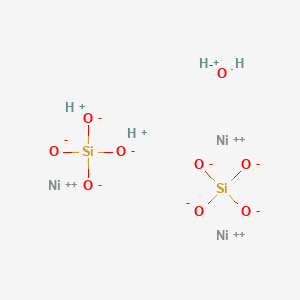
CAS 12519-85-6PubChem CID 73357725
Trihydrogen hydroxybis[orthosilicato(4-)]trinickelate(3-)
- IUPAC-Name
- hydron;tris(nickel(2+));hydroxide;disilicate
- Summenformel
- H4Ni3O9Si2
- Molekulargewicht
- 380.28 g/mol
- Exakte Masse
- 379.740853 Da
- Topologische polare Oberfläche
- 185,0 Ų
- Wasserstoffbrücken-Donoren
- 4
- Wasserstoffbrücken-Akzeptoren
- 9
- Kovalente Einheiten
- 9
- Definierte Stereozentren
- 0
Auch bekannt als
EINECS 235-688-3Trihydrogen hydroxybis(orthosilicato(4-))trinickelate(3-)RefChem:191676235-688-3
Kennungen in externen Datenbanken
- EPA DTXSID:DTXSID601028875
Belege aus weiteren wissenschaftlichen Datenbanken
NIH PubChem PUG-View
Exakter Kennungstreffer73357725
Attributed physical-property, hazard, environmental and use annotations.
- Signal: Danger Quelle: Regulation (EC) No 1272/2008 of the European Parliament and of the Council
- GHS Hazard Statements: H317: May cause an allergic skin reaction [Warning Sensitization, Skin]; H350i: May cause cancer by inhalation [Danger Carcinogenicity]; H372 **: Causes damage to organs through prolonged or repeated exposure [Danger Specific target organ toxicity, repeated exposure]; H400: Very toxic to aquatic life [Warning Hazardous to the aquatic environment, acute hazard]; H410: Very toxic to aquatic life with long lasting effects [Warning Hazardous to the aquatic environment, long-term hazard] Quelle: Regulation (EC) No 1272/2008 of the European Parliament and of the Council
- Precautionary Statement Codes: P203, P260, P261, P264, P270, P272, P273, P280, P302+P352, P318, P319, P321, P333+P317, P362+P364, P391, P405, and P501 (click each P-code to see the statement) Quelle: Regulation (EC) No 1272/2008 of the European Parliament and of the Council
Zugeordnet durch: Existing checksum-valid CAS to unique PubChem CID match. Abgerufen: 2026-08-31. Quelleneintrag öffnen
Wissenschaftliche Klassifizierungen und Gefahrenannotationen liefern Kontext und ersetzen nicht die oben gezeigte marktspezifische regulatorische Entscheidung.
Weitere Quellenabdeckung und Trefferstatus
| Quelle | Ergebnis | Geprüft |
|---|---|---|
| NIH PubChem PUG-View | Exakter Treffer | 2026-08-31 |
Ein erfasster Nicht-Treffer ist ein nützlicher Beleg dafür, dass die Quelle geprüft wurde; er ist keine Behauptung, dass der Stoff anderswo nicht existiert.
Am 2026-09-02 von NIH PubChem durch prüfsummengültigen CAS-Abgleich abgerufen. Chemische Eigenschaften ersetzen nicht die regulatorische Entscheidung auf dieser Seite.