
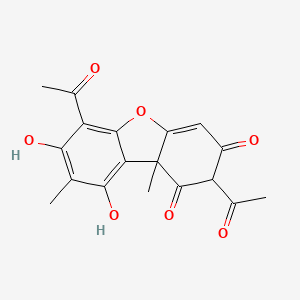
Usnic Acid
Usnic acid is a furandione found uniquely in lichen that is used widely in cosmetics, deodorants, toothpaste and medicinal creams as well as some herbal products. Taken orally, usnic acid can be toxic and has been linked to instances of clinically apparent, acute liver injury. — LiverTox
- IUPAC-Name
- 2,6-diacetyl-7,9-dihydroxy-8,9b-dimethyldibenzofuran-1,3-dione
- Summenformel
- C18H16O7
- Molekulargewicht
- 344.3 g/mol
- Exakte Masse
- 344.08960285 Da
- XLogP3
- 1,4
- Topologische polare Oberfläche
- 118,0 Ų
- Wasserstoffbrücken-Donoren
- 2
- Wasserstoffbrücken-Akzeptoren
- 7
- Kovalente Einheiten
- 1
- Definierte Stereozentren
- 0
Auch bekannt als
16 weitere gemeldete Namen
Kennungen in externen Datenbanken
- ChEBI:CHEBI:2264
- ChEMBL:CHEMBL1375951
- EPA DTXSID:DTXSID0040123
- PubMed:38724177
- PubMed:37840363
- PubMed:32508146
- PubMed:31715134
- PubMed:27497765
- PubMed:27369375
- PubMed:25870318
- PubMed:25078063
- PubMed:23686521
- PubMed:23422721
- PubMed:23099095
- PubMed:22777745
Belege aus weiteren wissenschaftlichen Datenbanken
NIH PubChem PUG-View
Attributed physical-property, hazard, environmental and use annotations.
- Color/Form: ... yellowish /colored/ pigment. Quelle: Hazardous Substances Data Bank (HSDB)
- Color/Form: Yellow orthorombic prisms from acetone Quelle: Hazardous Substances Data Bank (HSDB)
- Color/Form: Crystalline yellow solid Quelle: Hazardous Substances Data Bank (HSDB)
- LogP: log Kow = 2.88 Quelle: Hazardous Substances Data Bank (HSDB)
- Melting Point: 204 °C Quelle: Hazardous Substances Data Bank (HSDB)
- Physical Description: Yellow solid; [Merck Index] Yellow crystalline solid; [MSDSonline] Quelle: Haz-Map, Information on Hazardous Chemicals and Occupational Diseases
- Solubility: Solubility at 25 °C (g/100 ml): acetone, 0.77; ethyl acetate, 0.88; fural, 7.32; furfuryl alcohol, 1.21 Quelle: Hazardous Substances Data Bank (HSDB)
- Solubility: Solubility at 25 °C (g/100 ml): water, <0.01 Quelle: Hazardous Substances Data Bank (HSDB)
- Signal: Danger Quelle: European Chemicals Agency (ECHA)
- GHS Hazard Statements: H301 (70.2%): Toxic if swallowed [Danger Acute toxicity, oral]; H302 (29.8%): Harmful if swallowed [Warning Acute toxicity, oral]; H400 (70.2%): Very toxic to aquatic life [Warning Hazardous to the aquatic environment, acute hazard]; H410 (70.2%): Very toxic to aquatic life with long lasting effects [Warning Hazardous to the aquatic environment, long-term hazard] Quelle: European Chemicals Agency (ECHA)
- Precautionary Statement Codes: P264, P270, P273, P301+P316, P301+P317, P321, P330, P391, P405, and P501 (click each P-code to see the statement) Quelle: European Chemicals Agency (ECHA)
- ECHA C&L Notifications Summary: Aggregated GHS information provided per 94 reports by companies from 5 notifications to the ECHA C&L Inventory. Each notification may be associated with multiple companies.; Information may vary between notifications depending on impurities, additives, and other factors. The percentage value in parenthesis indicates the notified classification ratio from companies that provide hazard codes. Only hazard codes with percentage values above 10% are shown. For more detailed information, please visit ECHA C&L website. Quelle: European Chemicals Agency (ECHA)
- Sources/Uses: Antibacterial compound present in lichens; [Merck Index] Used as preservative and antibiotic (folk remedy); [HSDB] Used as a topical antibiotic; Workers exposed to lichens (forestry and horticulture) may develop allergic contact dermatitis. [Kanerva, p. 1845] Quelle: Haz-Map, Information on Hazardous Chemicals and Occupational Diseases
- Activities with risk of exposure: Ingesting herbal remedies [Category: Food & Drugs] Quelle: Haz-Map, Information on Hazardous Chemicals and Occupational Diseases
- Uses: Medicine: antibiotic /SRP: folk remedy/ Quelle: Hazardous Substances Data Bank (HSDB)
- Uses: Preservative Quelle: Hazardous Substances Data Bank (HSDB)
- Uses: Usnic acid is effective in vitro against ...anerobic bacteria. Quelle: Hazardous Substances Data Bank (HSDB)
Zugeordnet durch: Existing checksum-valid CAS to unique PubChem CID match. Abgerufen: 2026-08-31. Quelleneintrag öffnen
Wissenschaftliche Klassifizierungen und Gefahrenannotationen liefern Kontext und ersetzen nicht die oben gezeigte marktspezifische regulatorische Entscheidung.
Weitere Quellenabdeckung und Trefferstatus
| Quelle | Ergebnis | Geprüft |
|---|---|---|
| NIH PubChem PUG-View | Exakter Treffer | 2026-08-31 |
Ein erfasster Nicht-Treffer ist ein nützlicher Beleg dafür, dass die Quelle geprüft wurde; er ist keine Behauptung, dass der Stoff anderswo nicht existiert.
Am 2026-09-02 von NIH PubChem durch prüfsummengültigen CAS-Abgleich abgerufen. Chemische Eigenschaften ersetzen nicht die regulatorische Entscheidung auf dieser Seite.