
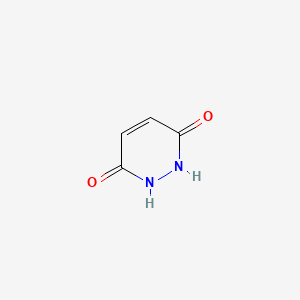
Maleic Hydrazide
Maleic hydrazide is an odorless white solid. Sinks in water. (USCG, 1999) — CAMEO Chemicals
- IUPAC-Name
- 1,2-dihydropyridazine-3,6-dione
- Summenformel
- C4H4N2O2
- Molekulargewicht
- 112.09 g/mol
- Exakte Masse
- 112.027277375 Da
- XLogP3
- -0,8
- Topologische polare Oberfläche
- 58,2 Ų
- Wasserstoffbrücken-Donoren
- 2
- Wasserstoffbrücken-Akzeptoren
- 2
- Kovalente Einheiten
- 1
- Definierte Stereozentren
- 0
Auch bekannt als
16 weitere gemeldete Namen
Kennungen in externen Datenbanken
- ChEBI:CHEBI:81771
- ChEMBL:CHEMBL1489913
- EPA DTXSID:DTXSID9020792
- PubMed:25028461
- PubMed:18758103
- PubMed:18376580
- PubMed:16915827
- PubMed:15225073
- PubMed:14737342
- PubMed:11574726
- PubMed:11370715
- PubMed:8687997
- PubMed:4725
Belege aus weiteren wissenschaftlichen Datenbanken
NIH PubChem PUG-View
Attributed physical-property, hazard, environmental and use annotations.
- Boiling Point: Decomposes (NTP, 1992) Quelle: CAMEO Chemicals
- Color/Form: Crystals from water Quelle: Hazardous Substances Data Bank (HSDB)
- Color/Form: COLORLESS CRYSTALLINE SOLID Quelle: Hazardous Substances Data Bank (HSDB)
- Density: 1.6 at 77 °F (USCG, 1999) - Denser than water; will sink Quelle: CAMEO Chemicals
- Density: 1.60 at 25 °C Quelle: Hazardous Substances Data Bank (HSDB)
- Density: 1.6 @25 °C Quelle: PAC Chemical Database, U.S. Department of Energy
- Dissociation Constants: pKa = 5.62 at 20 °C Quelle: Hazardous Substances Data Bank (HSDB)
- Flash Point: 572 °F (300 °C) (Closed cup) Quelle: Hazardous Substances Data Bank (HSDB)
- LogP: log Kow= -0.68 pH = 5; -1.96 at pH = 7; -2.41 at pH = 9 Quelle: Hazardous Substances Data Bank (HSDB)
- Melting Point: greater than 572 °F (decomposes) (NTP, 1992) Quelle: CAMEO Chemicals
- Melting Point: 298-300 °C Quelle: Hazardous Substances Data Bank (HSDB)
- Odor: Odorless Quelle: Hazardous Substances Data Bank (HSDB)
- Physical Description: Maleic hydrazide is an odorless white solid. Sinks in water. (USCG, 1999) Quelle: CAMEO Chemicals
- Physical Description: Colorless, crystalline solid; [HSDB] White solid; Formulated as emulsifiable concentrate and soluble concentrate (liquid and solid); [Reference #1] Quelle: Haz-Map, Information on Hazardous Chemicals and Occupational Diseases
- Solubility: less than 0.1 mg/mL at 68 °F (NTP, 1992) Quelle: CAMEO Chemicals
- Solubility: Solubility at 25 °C: water 0.6%, ethanol 0.1%, DMF 2.4% /Technical maleic hydrazide/ Quelle: Hazardous Substances Data Bank (HSDB)
- Solubility: Solubility in water at 25 °C, 300,000 mg/L at 20 °C and 340,000 mg/L at 25 °C /Maleic hydrazide potassium salt/ Quelle: Hazardous Substances Data Bank (HSDB)
- Solubility: Solubility in water at 25 °C, 200 g/kg /Maleic hydrazide sodium salt/ Quelle: Hazardous Substances Data Bank (HSDB)
- Solubility: Slightly sol in hot alcohol, more sol in hot water Quelle: Hazardous Substances Data Bank (HSDB)
- Solubility: SOL IN AQ ALKALI & CERTAIN ORG BASES Quelle: Hazardous Substances Data Bank (HSDB)
- Solubility: Sol @ 25 °C in acetone, 1000 ppm; water, 6000 ppm; dimethylformamide, 20400 ppm; dimethyl sulfoxide, 90000 ppm; xylene <1000 ppm Quelle: Hazardous Substances Data Bank (HSDB)
- Solubility: In water, 4,507 mg/L at 25 °C Quelle: Hazardous Substances Data Bank (HSDB)
- Vapor Pressure: 0.00000277 [mmHg] Quelle: Haz-Map, Information on Hazardous Chemicals and Occupational Diseases
- Vapor Pressure: 7.5X10⁻⁸ mm Hg at 25 °C Quelle: Hazardous Substances Data Bank (HSDB)
- IARC Carcinogenic Agent: Maleic hydrazide Quelle: International Agency for Research on Cancer (IARC)
- IARC Carcinogenic Classes: Group 3: Not classifiable as to its carcinogenicity to humans Quelle: International Agency for Research on Cancer (IARC)
- IARC Monographs: Volume 4: (1974) Some Aromatic Amines, Hydrazine and Related Substances, N-Nitroso Compounds and Miscellaneous Alkylating Agents; Volume Sup 7: Overall Evaluations of Carcinogenicity: An Updating of IARC Monographs Volumes 1 to 42, 1987; 440 pages; ISBN 92-832-1411-0 (out of print) Quelle: International Agency for Research on Cancer (IARC)
- Publication Year: 1987 Quelle: International Agency for Research on Cancer (IARC)
- Evaluation Year: 1987 Quelle: International Agency for Research on Cancer (IARC)
- Carcinogen Classification: 3, not classifiable as to its carcinogenicity to humans. (L135) Quelle: Toxin and Toxin Target Database (T3DB)
- First Aid: EYES: First check the victim for contact lenses and remove if present. Flush victim's eyes with water or normal saline solution for 20 to 30 minutes while simultaneously calling a hospital or poison control center. Do not put any ointments, oils, or medication in the victim's eyes without specific instructions from a physician. IMMEDIATELY transport the victim after flushing eyes to a hospital even if no symptoms (such as redness or irritation) develop.; SKIN: IMMEDIATELY flood affected skin with water while removing and isolating all contaminated clothing. Gently wash all affected skin areas thoroughly with soap and water. If symptoms such as redness or irritation develop, IMMEDIATELY call a physician and be prepared to transport the victim to a hospital for treatment.; INHALATION: IMMEDIATELY leave the contaminated area; take deep breaths of fresh air. If symptoms (such as wheezing, coughing, shortness of breath, or burning in the mouth, throat, or chest) develop, call a physician and be prepared to transport the victim to a hospital. Provide proper respiratory protection to rescuers entering an unknown atmosphere. Whenever possible, Self-Contained Breathing Apparatus (SCBA) shou Quelle: CAMEO Chemicals
- Note: This chemical does not meet GHS hazard criteria for 42.5% (34 of 80) of reports. Quelle: European Chemicals Agency (ECHA)
- Signal: Warning Quelle: European Chemicals Agency (ECHA)
- GHS Hazard Statements: H315 (57.5%): Causes skin irritation [Warning Skin corrosion/irritation]; H319 (57.5%): Causes serious eye irritation [Warning Serious eye damage/eye irritation]; H335 (56.2%): May cause respiratory irritation [Warning Specific target organ toxicity, single exposure; Respiratory tract irritation]; H341 (56.2%): Suspected of causing genetic defects [Warning Germ cell mutagenicity] Quelle: European Chemicals Agency (ECHA)
- Precautionary Statement Codes: P203, P261, P264, P264+P265, P271, P280, P302+P352, P304+P340, P305+P351+P338, P318, P319, P321, P332+P317, P337+P317, P362+P364, P403+P233, P405, and P501 (click each P-code to see the statement) Quelle: European Chemicals Agency (ECHA)
- ECHA C&L Notifications Summary: Aggregated GHS information provided per 80 reports by companies from 7 notifications to the ECHA C&L Inventory. Each notification may be associated with multiple companies.; Reported as not meeting GHS hazard criteria per 34 of 80 reports by companies.; There are 6 notifications provided by 46 of 80 reports by companies with hazard statement code(s).; Information may vary between notifications depending on impurities, additives, and other factors. The percentage value in parenthesis indicates the notified classification ratio from companies that provide hazard codes. Only hazard codes with percentage values above 10% are shown. For more detailed information, please visit ECHA C&L website. Quelle: European Chemicals Agency (ECHA)
- GHS Hazard Statements: H302 (100%): Harmful if swallowed [Warning Acute toxicity, oral]; H315 (100%): Causes skin irritation [Warning Skin corrosion/irritation]; H319 (100%): Causes serious eye irritation [Warning Serious eye damage/eye irritation]; H335 (100%): May cause respiratory irritation [Warning Specific target organ toxicity, single exposure; Respiratory tract irritation] Quelle: European Chemicals Agency (ECHA)
- Precautionary Statement Codes: P261, P264, P264+P265, P270, P271, P280, P301+P317, P302+P352, P304+P340, P305+P351+P338, P319, P321, P330, P332+P317, P337+P317, P362+P364, P403+P233, P405, and P501 (click each P-code to see the statement) Quelle: European Chemicals Agency (ECHA)
- ECHA C&L Notifications Summary: The GHS information provided by 1 company from 1 notification to the ECHA C&L Inventory. Quelle: European Chemicals Agency (ECHA)
- Target Organs: Urinary Quelle: EPA Integrated Risk Information System (IRIS)
- Environmental Bioconcentration: An estimated BCF of 3 was calculated for maleic hydrazide(SRC), using a log Kow of -1.96 (1) and a regression-derived equation(2). According to a classification scheme(3), this BCF suggests the potential for bioconcentration in aquatic organisms is low(SRC). Quelle: Hazardous Substances Data Bank (HSDB)
- Environmental Fate: TERRESTRIAL FATE: Based on a classification scheme(1), measured Koc values of 264 for a clay soil, and 23 for a sandy loam(2), indicate that maleic hydrazide is expected to have very high to moderate mobility in soil. Maleic hydrazide exists in equilibrium with its tautomer 6-hydroxy-3(2H)-pyridazinone that has a pKa of 5.62(2), which indicates that this compound will primarily exist as an anion in moist soils and anions do not volatilize. The neutral species of maleic hydrazide is not expected to volatilize based on a Henry's Law constant of 8.1X10⁻⁹ atm-cu m/mole(2). Maleic hydrazide is not expected to volatilize from dry soils(SRC) based on a vapor pressure of 7.5X10⁻⁸ mm Hg at 25 °C(2). Biodegradation has been shown to be an important environmental fate process for maleic hydrazide in soils(2). The half-life of maleic hydrazide was reported as 2-3 days in a sandy loam used for growing potatoes, 6 days in a turfed sandy loam, and 7 days in a tobacco growing loam(2). Quelle: Hazardous Substances Data Bank (HSDB)
- Environmental Fate: AQUATIC FATE: Based on a classification scheme(1), measured Koc values of 264 for a clay soil, and 23 for a sandy loam(3), indicates that maleic hydrazide is not expected to adsorb to suspended solids and sediment(SRC). Maleic hydrazide exists in equilibrium with its tautomer 6-hydroxy-3(2H)-pyridazinone that has a pKa of 5.62(2), which indicates that this compound will primarily exist as an anion in water and anions do not volatilize. The neutral species of maleic hydrazide is not expected to volatilize based on a Henry's Law constant of 8.1X10⁻⁹ atm-cu m/mole(3). According to a classification scheme(4), an estimated BCF of 3(SRC), from a log Kow of -1.96(3) and a regression-derived equation(5), suggests the potential for bioconcentration in aquatic organisms is low(SRC). Maleic hydrazide is stable to hydrolysis, but may undergo photochemical decomposition in sunlit surface waters(6). Maleic hydrazide (as the potassium salt) was irradiated with simulated sunlight in aqueous solutions at pH 5, 7 and 9 with calculated half-lives of 58, 58 and 34 days, respectively(6). The major product was maleate(6). Based on the rapid rate of biodegradation in soil(7), maleic hydrazide is expected Quelle: Hazardous Substances Data Bank (HSDB)
- Environmental Fate: ATMOSPHERIC FATE: According to a model of gas/particle partitioning of semivolatile organic compounds in the atmosphere(1), maleic hydrazide, which has a vapor pressure of 7.5X10⁻⁸ mm Hg at 25 °C(2), is expected to exist primarily in the particulate phase. Particulate-phase maleic hydrazide may be removed from the air by wet and dry deposition(SRC). Although maleic hydrazide absorbs light greater than 290 nm and photolyzes in aqueous solution(3), it exists primarily in the particulate phase in the atmosphere and it is unclear whether direct photolysis will be an important environmental fate process(SRC). Quelle: Hazardous Substances Data Bank (HSDB)
- Sources/Uses: Used as a herbicide and plant growth inhibitor, e.g., to control sucker growth on tobacco and to inhibit sprouting of potatoes and onions; [HSDB] A plant growth regulator and herbicide used to control sprouting of potatoes and onions, suckers in tobacco, and weeds, grasses, and trees in and along turf, ornamentals, public easements, and industrial and commercial land; [Reference #1] Quelle: Haz-Map, Information on Hazardous Chemicals and Occupational Diseases
- Industrial Processes with risk of exposure: Farming (Pesticides) [Category: Industry] Quelle: Haz-Map, Information on Hazardous Chemicals and Occupational Diseases
- Uses: For maleic hydrazide (USEPA/OPP Pesticide Code: 051501) ACTIVE products with label matches. /SRP: Registered for use in the U.S. but approved pesticide uses may change periodically and so federal, state and local authorities must be consulted for currently approved uses./ Quelle: Hazardous Substances Data Bank (HSDB)
- Uses: Experimentally in horticulture and agriculture. ...In synthesis of pyridazine. Quelle: Hazardous Substances Data Bank (HSDB)
- Uses: Post-harvest sprouting inhibitor; weed control; sugar content stabilizer in beets. Quelle: Hazardous Substances Data Bank (HSDB)
- Uses: Use as over-the-top foliar spray Quelle: Hazardous Substances Data Bank (HSDB)
- Uses: For more Uses (Complete) data for MALEIC HYDRAZIDE (13 total), please visit the HSDB record page. Quelle: Hazardous Substances Data Bank (HSDB)
- Uses: This is a man-made compound that is used as a pesticide. Quelle: Toxin and Toxin Target Database (T3DB)
Zugeordnet durch: Existing checksum-valid CAS to unique PubChem CID match. Abgerufen: 2026-08-31. Quelleneintrag öffnen
Wissenschaftliche Klassifizierungen und Gefahrenannotationen liefern Kontext und ersetzen nicht die oben gezeigte marktspezifische regulatorische Entscheidung.
Weitere Quellenabdeckung und Trefferstatus
| Quelle | Ergebnis | Geprüft |
|---|---|---|
| NIH PubChem PUG-View | Exakter Treffer | 2026-08-31 |
Ein erfasster Nicht-Treffer ist ein nützlicher Beleg dafür, dass die Quelle geprüft wurde; er ist keine Behauptung, dass der Stoff anderswo nicht existiert.
Am 2026-08-31 von NIH PubChem durch prüfsummengültigen CAS-Abgleich abgerufen. Chemische Eigenschaften ersetzen nicht die regulatorische Entscheidung auf dieser Seite.