
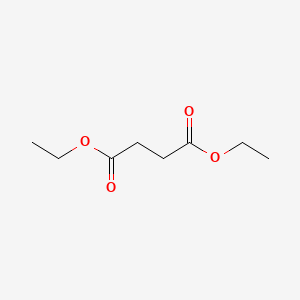
- IUPAC-Name
- diethyl butanedioate
- Summenformel
- C8H14O4
- Molekulargewicht
- 174.19 g/mol
- Exakte Masse
- 174.08920892 Da
- XLogP3
- 1,2
- Topologische polare Oberfläche
- 52,6 Ų
- Wasserstoffbrücken-Donoren
- 0
- Wasserstoffbrücken-Akzeptoren
- 4
- Kovalente Einheiten
- 1
- Definierte Stereozentren
- 0
Auch bekannt als
Ethyl succinateButanedioic acid, diethyl esterSuccinic acid diethyl ester1,4-diethyl butanedioateSuccinic acid, diethyl esterButanedioic acid, 1,4-diethyl esterDiethylester kyseliny jantaroveFEMA No. 2377
16 weitere gemeldete Namen
ELP55C13DRNSC-8875RefChem:571068204-612-07071-15-0DIETHYLSUCCINATEDiethyl ethanedicarboxylateDiethylester kyseliny jantarove [Czech]Succinic acid-diethyl esterDIETHYL SUCCINATE [FHFI]Diethyl ester of butanedioic acidTox21_300286Diethyl succinate, ReagentPlus(R), 99%EN300-18004diethyl butane-1,4-dioatebutanedioic acid diethyl ester
Kennungen in externen Datenbanken
- ChEBI:CHEBI:169507
- ChEMBL:CHEMBL369243
- EPA DTXSID:DTXSID2038732
- PubMed:22393353
- PubMed:22265473
- PubMed:22146049
- PubMed:22139757
- PubMed:22120647
- PubMed:21814490
- PubMed:21589360
- PubMed:21535802
- PubMed:21384346
- PubMed:21313821
- PubMed:21227435
- PubMed:20162000
Belege aus weiteren wissenschaftlichen Datenbanken
NIH PubChem PUG-View
Exakter Kennungstreffer31249
Attributed physical-property, hazard, environmental and use annotations.
- Boiling Point: 217.00 to 218.00 °C. @ 760.00 mm Hg Quelle: Human Metabolome Database (HMDB)
- Boiling Point: 217 °C Quelle: ILO-WHO International Chemical Safety Cards (ICSCs)
- Boiling Point: 216-218 °C Quelle: Joint FAO/WHO Expert Committee on Food Additives (JECFA)
- Boiling Point: 217.7 °C @760 [mm Hg] Quelle: PAC Chemical Database, U.S. Department of Energy
- Density: 1.04 g/cm³ Quelle: ILO-WHO International Chemical Safety Cards (ICSCs)
- Density: 1.031-1.041 Quelle: Joint FAO/WHO Expert Committee on Food Additives (JECFA)
- Flash Point: 90 °C c.c. Quelle: ILO-WHO International Chemical Safety Cards (ICSCs)
- LogP: 1.20 Quelle: Human Metabolome Database (HMDB)
- Melting Point: -21 °C Quelle: Human Metabolome Database (HMDB)
- Melting Point: -21 °C Quelle: ILO-WHO International Chemical Safety Cards (ICSCs)
- Melting Point: -21 °C Quelle: PAC Chemical Database, U.S. Department of Energy
- Physical Description: Colorless liquid; [ICSC] Quelle: Haz-Map, Information on Hazardous Chemicals and Occupational Diseases
- Physical Description: Liquid Quelle: Human Metabolome Database (HMDB)
- Physical Description: COLOURLESS LIQUID WITH CHARACTERISTIC ODOUR. Quelle: ILO-WHO International Chemical Safety Cards (ICSCs)
- Physical Description: colourless mobile liquid with faint pleasant odour Quelle: Joint FAO/WHO Expert Committee on Food Additives (JECFA)
- Refractive Index: 1.418-1.423 Quelle: Joint FAO/WHO Expert Committee on Food Additives (JECFA)
- Solubility: 19.1 mg/mL at 25 °C Quelle: Human Metabolome Database (HMDB)
- Solubility: Solubility in water, g/100ml at 25 °C: 0.2 Quelle: ILO-WHO International Chemical Safety Cards (ICSCs)
- Solubility: 1 mL in 50 mL water; miscible in alcohol, ether, oils Quelle: Joint FAO/WHO Expert Committee on Food Additives (JECFA)
- Solubility: (in ethanol) Quelle: Joint FAO/WHO Expert Committee on Food Additives (JECFA)
- Vapor Pressure: 0.04 [mmHg] Quelle: Haz-Map, Information on Hazardous Chemicals and Occupational Diseases
- Vapor Pressure: Vapor pressure, kPa at 55 °C: 0.133 Quelle: ILO-WHO International Chemical Safety Cards (ICSCs)
- Note: This chemical does not meet GHS hazard criteria for 99.5% (405 of 407) of all reports. Quelle: European Chemicals Agency (ECHA)
- GHS Hazard Statements: Not Classified; Reported as not meeting GHS hazard criteria by 405 of 407 companies (only 0.5% companies provided GHS information). For more detailed information, please visit ECHA C&L website. Quelle: European Chemicals Agency (ECHA)
- ECHA C&L Notifications Summary: Aggregated GHS information provided per 407 reports by companies from 4 notifications to the ECHA C&L Inventory.; Reported as not meeting GHS hazard criteria per 405 of 407 reports by companies.; There are 2 notifications provided by 2 of 407 reports by companies with hazard statement code(s).; Information may vary between notifications depending on impurities, additives, and other factors. The percentage value in parenthesis indicates the notified classification ratio from companies that provide hazard codes. Only hazard codes with percentage values above 10% are shown. For more detailed information, please visit ECHA C&L website. Quelle: European Chemicals Agency (ECHA)
- Cosmetic Ingredient Review Finding(s): Safe in the present practices of use and concentration. Ingredient, concentration, and use information are available in documents discoverable at https://cir-reports.cir-safety.org Quelle: Cosmetic Ingredient Review (CIR)
- Cosmetic Ingredient Review Link: CIR ingredient: Diethyl Succinate Quelle: Cosmetic Ingredient Review (CIR)
- Sources/Uses: Permitted for use as an inert ingredient in non-food pesticide products; [EPA] Used as flavoring agent or adjuvant; [FDA] Quelle: Haz-Map, Information on Hazardous Chemicals and Occupational Diseases
Zugeordnet durch: Existing checksum-valid CAS to unique PubChem CID match. Abgerufen: 2026-08-31. Quelleneintrag öffnen
Wissenschaftliche Klassifizierungen und Gefahrenannotationen liefern Kontext und ersetzen nicht die oben gezeigte marktspezifische regulatorische Entscheidung.
Weitere Quellenabdeckung und Trefferstatus
| Quelle | Ergebnis | Geprüft |
|---|---|---|
| NIH PubChem PUG-View | Exakter Treffer | 2026-08-31 |
Ein erfasster Nicht-Treffer ist ein nützlicher Beleg dafür, dass die Quelle geprüft wurde; er ist keine Behauptung, dass der Stoff anderswo nicht existiert.
Am 2026-08-31 von NIH PubChem durch prüfsummengültigen CAS-Abgleich abgerufen. Chemische Eigenschaften ersetzen nicht die regulatorische Entscheidung auf dieser Seite.