
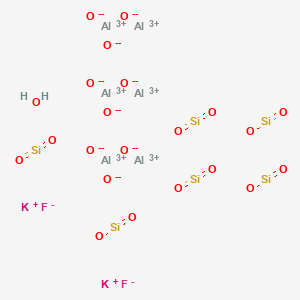
Mica-group minerals
MICA, a generic term, refers to any of a group of approximately 30 silicate minerals occurring as non-fibrous plates. Muscovite (hydrated aluminium potassium silicate[KAl2(AlSi3O10)(F, OH)2 ])and phlogopite (potassium magnesium aluminum silicate hydroxide) are the two major micas of commerce. Micas are commonly found in ordinary rocks. Inhalation of mica dust presents an occupational hazard. — CAMEO Chemicals
- IUPAC-Name
- hexaaluminum;dipotassium;hexakis(dioxosilane);nonakis(oxygen(2-));difluoride;hydrate
- Summenformel
- Al6F2H2K2O22Si6
- Molekulargewicht
- 800.60 g/mol
- Exakte Masse
- 799.578781 Da
- Topologische polare Oberfläche
- 215,0 Ų
- Wasserstoffbrücken-Donoren
- 1
- Wasserstoffbrücken-Akzeptoren
- 24
- Kovalente Einheiten
- 26
- Definierte Stereozentren
- 0
Auch bekannt als
16 weitere gemeldete Namen
Kennungen in externen Datenbanken
- PubMed:24946801
Belege aus weiteren wissenschaftlichen Datenbanken
NIH PubChem PUG-View
Attributed physical-property, hazard, environmental and use annotations.
- Color/Form: Light gray to dark flakes or particles Quelle: Hazardous Substances Data Bank (HSDB)
- Color/Form: Soft, translucent solid; colorless to slight red (ruby), brown to greenish yellow (amber)... thin sheets that are flexible and elastic Quelle: Hazardous Substances Data Bank (HSDB)
- Color/Form: Colorless flakes or sheets of hydrous silicates Quelle: Hazardous Substances Data Bank (HSDB)
- Density: 2.6 to 3.2 (NIOSH, 2024) Quelle: CAMEO Chemicals
- Density: 2.6-3.2 Quelle: Hazardous Substances Data Bank (HSDB)
- Density: 2.6-3.2 Quelle: Occupational Safety and Health Administration (OSHA)
- Density: 2.6-3.2 @25 °C Quelle: PAC Chemical Database, U.S. Department of Energy
- Density: 2.6-3.2 Quelle: The National Institute for Occupational Safety and Health (NIOSH)
- Melting Point: 1500 °C Quelle: Hazardous Substances Data Bank (HSDB)
- Melting Point: Melting point = 1387 °C /Synthetic fluorophlogopite/ Quelle: Hazardous Substances Data Bank (HSDB)
- Melting Point: 1387 °C Quelle: PAC Chemical Database, U.S. Department of Energy
- Odor: Odorless Quelle: Hazardous Substances Data Bank (HSDB)
- Physical Description: MICA, a generic term, refers to any of a group of approximately 30 silicate minerals occurring as non-fibrous plates. Muscovite (hydrated aluminium potassium silicate[KAl2(AlSi3O10)(F, OH)2 ])and phlogopite (potassium magnesium aluminum silicate hydroxide) are the two major micas of commerce. Micas are commonly found in ordinary rocks. Inhalation of mica dust presents an occupational hazard. Quelle: CAMEO Chemicals
- Physical Description: Dry Powder; Large Crystals; CBI Quelle: EPA Chemical Data Reporting (CDR)
- Physical Description: Colorless, odorless flakes or sheets of hydrous silicates; [NIOSH] Crystalline silica not bound to other minerals is "free" silica. Silicates are minerals in which silicon and oxygen are combined with other elements. [Rom, p. 364] Quelle: Haz-Map, Information on Hazardous Chemicals and Occupational Diseases
- Physical Description: Colorless, odorless flakes or sheets of hydrous silicates. Quelle: Occupational Safety and Health Administration (OSHA)
- Physical Description: Colorless, odorless flakes or sheets of hydrous silicates. Quelle: The National Institute for Occupational Safety and Health (NIOSH)
- Refractive Index: Refractive index: 1.56-1.60 Quelle: Hazardous Substances Data Bank (HSDB)
- Solubility: Insoluble (NIOSH, 2024) Quelle: CAMEO Chemicals
- Solubility: Insoluble in water Quelle: Hazardous Substances Data Bank (HSDB)
- Solubility: Insoluble Quelle: The National Institute for Occupational Safety and Health (NIOSH)
- Vapor Pressure: 0 mmHg (approx) (NIOSH, 2024) Quelle: CAMEO Chemicals
- Vapor Pressure: 0 mm Hg (approximate) Quelle: Hazardous Substances Data Bank (HSDB)
- Vapor Pressure: 0 mmHg (approx) Quelle: Occupational Safety and Health Administration (OSHA)
- Vapor Pressure: 0 mmHg (approx) Quelle: The National Institute for Occupational Safety and Health (NIOSH)
- Exposure Routes: inhalation, skin and/or eye contact Quelle: The National Institute for Occupational Safety and Health (NIOSH)
- First Aid: Excerpt from NIOSH Pocket Guide for Mica (containing less than 1% quartz):; Eye: IRRIGATE IMMEDIATELY - If this chemical contacts the eyes, immediately wash (irrigate) the eyes with large amounts of water, occasionally lifting the lower and upper lids. Get medical attention immediately.; Breathing: FRESH AIR - If a person breathes large amounts of this chemical, move the exposed person to fresh air at once. Other measures are usually unnecessary. (NIOSH, 2024) Quelle: CAMEO Chemicals
- First Aid: (General first aid procedures); Eye: Irrigate immediately - If this chemical contacts the eyes, immediately wash (irrigate) the eyes with large amounts of water, occasionally lifting the lower and upper lids. Get medical attention immediately.; Breathing: Fresh air Quelle: The National Institute for Occupational Safety and Health (NIOSH)
- Note: This chemical does not meet GHS hazard criteria for 71.3% (600 of 841) of all reports. Quelle: European Chemicals Agency (ECHA)
- Signal: Danger Quelle: European Chemicals Agency (ECHA)
- GHS Hazard Statements: H319 (17.5%): Causes serious eye irritation [Warning Serious eye damage/eye irritation]; H335 (17.5%): May cause respiratory irritation [Warning Specific target organ toxicity, single exposure; Respiratory tract irritation]; H372 (11.5%): Causes damage to organs through prolonged or repeated exposure [Danger Specific target organ toxicity, repeated exposure]; H373 (12.5%): May causes damage to organs through prolonged or repeated exposure [Warning Specific target organ toxicity, repeated exposure] Quelle: European Chemicals Agency (ECHA)
- Precautionary Statement Codes: P260, P261, P264, P264+P265, P270, P271, P280, P304+P340, P305+P351+P338, P319, P337+P317, P403+P233, P405, and P501 (click each P-code to see the statement) Quelle: European Chemicals Agency (ECHA)
- ECHA C&L Notifications Summary: Aggregated GHS information provided per 841 reports by companies from 22 notifications to the ECHA C&L Inventory. Each notification may be associated with multiple companies.; Reported as not meeting GHS hazard criteria per 600 of 841 reports by companies.; There are 20 notifications provided by 241 of 841 reports by companies with hazard statement code(s).; Information may vary between notifications depending on impurities, additives, and other factors. The percentage value in parenthesis indicates the notified classification ratio from companies that provide hazard codes. Only hazard codes with percentage values above 10% are shown. For more detailed information, please visit ECHA C&L website. Quelle: European Chemicals Agency (ECHA)
- Signal: Danger Quelle: NITE-CMC
- GHS Hazard Statements: H372: Causes damage to organs through prolonged or repeated exposure [Danger Specific target organ toxicity, repeated exposure] Quelle: NITE-CMC
- Precautionary Statement Codes: P260, P264, P270, P319, and P501 (click each P-code to see the statement) Quelle: NITE-CMC
- Target Organs: respiratory system Quelle: The National Institute for Occupational Safety and Health (NIOSH)
- Consumer Uses: Filler; Not Known or Reasonably Ascertainable; Pigment; Lubricating agent Quelle: EPA Chemical Data Reporting (CDR)
- Industry Uses: Other; Lubricating agent; Filler; Not Known or Reasonably Ascertainable; Pigment Quelle: EPA Chemical Data Reporting (CDR)
- Sources/Uses: Mica, mainly muscovite and phlogopite, contains less than 1% quartz. Other species of mica are biotite, lepidolite, zimmwaldite, and roscoelite. Used as a filler for paint, cement, asphalt, and insulation material for electrical cables; Also used in drilling muds, cosmetics, and vacuum tubes/condensers; [ACGIH] Sericite is a variety of white mica; it is similar to muscovite and is used as a filler, carrier, and lubricant; [Reference #1] Quelle: Haz-Map, Information on Hazardous Chemicals and Occupational Diseases
- Industrial Processes with risk of exposure: Petroleum Production and Refining [Category: Industry]; Mining [Category: Industry] Quelle: Haz-Map, Information on Hazardous Chemicals and Occupational Diseases
- Uses: In aircraft construction Quelle: Hazardous Substances Data Bank (HSDB)
- Uses: PAPER & PAINT MANUFACTURE, & IN ELECTRIC INDUSTRY Quelle: Hazardous Substances Data Bank (HSDB)
- Uses: Electrical equipment, vacuum tubes, incandescent lamps, dusting agent, lubricant, windows in high-temperature equipment, filler in exterior paints, cosmetics, glass and ceramic flux, roofing, rubber, mold-release- agent, specialty paper for insulation and filtration, wallpaper and wallboard joint cement, oil-well drilling muds. Quelle: Hazardous Substances Data Bank (HSDB)
- Uses: Large transparent sheets used to serve as window panes...still used for slow combustion stoves, lanterns or peep-hole furnances...mica powder is used in the mfg of electric cables, pneumatic tyres, welding electrodes, bitmunized cardboard, paints and plastics, dielectric dressings, and flameproof insulators; it is often compacted with alkyd resins; vermiculite is widely used as an insulating material in the building industry; lepidolite is used in the glass and ceramic industries Quelle: Hazardous Substances Data Bank (HSDB)
- Uses: For more Uses (Complete) data for MICA (6 total), please visit the HSDB record page. Quelle: Hazardous Substances Data Bank (HSDB)
Zugeordnet durch: Existing checksum-valid CAS to unique PubChem CID match. Abgerufen: 2026-08-31. Quelleneintrag öffnen
Wissenschaftliche Klassifizierungen und Gefahrenannotationen liefern Kontext und ersetzen nicht die oben gezeigte marktspezifische regulatorische Entscheidung.
Weitere Quellenabdeckung und Trefferstatus
| Quelle | Ergebnis | Geprüft |
|---|---|---|
| NIH PubChem PUG-View | Exakter Treffer | 2026-08-31 |
Ein erfasster Nicht-Treffer ist ein nützlicher Beleg dafür, dass die Quelle geprüft wurde; er ist keine Behauptung, dass der Stoff anderswo nicht existiert.
Am 2026-09-02 von NIH PubChem durch prüfsummengültigen CAS-Abgleich abgerufen. Chemische Eigenschaften ersetzen nicht die regulatorische Entscheidung auf dieser Seite.