
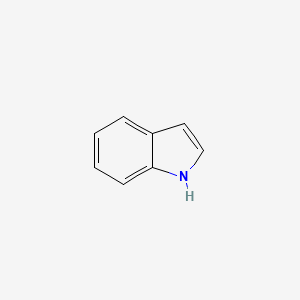
Indole
1H-indole is an indole and a polycyclic heteroarene. It has a role as an Escherichia coli metabolite. It is a tautomer of a 3H-indole. — ChEBI
- IUPAC-Name
- 1H-indole
- Summenformel
- C8H7N
- Molekulargewicht
- 117.15 g/mol
- Exakte Masse
- 117.057849228 Da
- XLogP3
- 2,1
- Topologische polare Oberfläche
- 15,8 Ų
- Wasserstoffbrücken-Donoren
- 1
- Wasserstoffbrücken-Akzeptoren
- 0
- Kovalente Einheiten
- 1
- Definierte Stereozentren
- 0
Auch bekannt als
16 weitere gemeldete Namen
Kennungen in externen Datenbanken
- ChEBI:CHEBI:16881
- ChEMBL:CHEMBL15844
- EPA DTXSID:DTXSID0020737
- PubMed:23449869
- PubMed:23125706
- PubMed:23122407
- PubMed:23114508
- PubMed:23109863
- PubMed:23106081
- PubMed:23094066
- PubMed:23090023
- PubMed:23079493
- PubMed:23074901
- PubMed:23072812
- PubMed:23065612
Belege aus weiteren wissenschaftlichen Datenbanken
NIH PubChem PUG-View
Attributed physical-property, hazard, environmental and use annotations.
- Boiling Point: 254 °C Quelle: DrugBank
- Boiling Point: 253 °C @ 762 mm Hg; 128-133 °C @ 28 mm Hg Quelle: Hazardous Substances Data Bank (HSDB)
- Boiling Point: 253.00 to 254.00 °C. @ 760.00 mm Hg Quelle: Human Metabolome Database (HMDB)
- Color/Form: LEAFLETS (WATER, PETROLEUM), CRYSTALS (ETHER) Quelle: Hazardous Substances Data Bank (HSDB)
- Color/Form: Colorless to yellowish scales, turning red on exposure to light and air. Quelle: Hazardous Substances Data Bank (HSDB)
- Color/Form: WHITE CRYSTALLINE SOLID Quelle: Hazardous Substances Data Bank (HSDB)
- Color/Form: Colorless, shiny flakes Quelle: Hazardous Substances Data Bank (HSDB)
- Density: 1.22 g/cu cm at 25 °C Quelle: Hazardous Substances Data Bank (HSDB)
- Dissociation Constants: pKa (basic)= -2.4 Quelle: Hazardous Substances Data Bank (HSDB)
- LogP: 2.14 Quelle: DrugBank
- LogP: Log P= 2.14 Quelle: Hazardous Substances Data Bank (HSDB)
- LogP: 2.14 Quelle: Human Metabolome Database (HMDB)
- Melting Point: 52.5 °C Quelle: DrugBank
- Melting Point: 52 °C Quelle: Hazardous Substances Data Bank (HSDB)
- Melting Point: Heat of Formation= 1.5660X10+8 J/kmol; Heat of Fusion at the Melting Point= 9.0000X10+6 J/kmol Quelle: Hazardous Substances Data Bank (HSDB)
- Melting Point: 52.5 °C Quelle: Human Metabolome Database (HMDB)
- Odor: ALMOST FLORAL ODOR WHEN HIGHLY PURIFIED, OTHERWISE EXHIBITS CHARACTERISTIC ODOR OF FECES Quelle: Hazardous Substances Data Bank (HSDB)
- Odor: Unpleasant odor in high concentration but pleasant in dilute solution. Quelle: Hazardous Substances Data Bank (HSDB)
- Odor: Light jasmine odor Quelle: Hazardous Substances Data Bank (HSDB)
- Physical Description: Dry Powder; Liquid Quelle: EPA Chemical Data Reporting (CDR)
- Physical Description: White to yellowish solid with an unpleasant odor; Pleasant odor in dilute solutions; Turns red when exposed to light or air; [Hawley] White or yellow crystalline powder; [MSDSonline] Quelle: Haz-Map, Information on Hazardous Chemicals and Occupational Diseases
- Physical Description: Solid Quelle: Human Metabolome Database (HMDB)
- Physical Description: White lustrous, flakey crystalline solid; Unpleasant odour at high concentration, odour becomes floral at higher dilutions Quelle: Joint FAO/WHO Expert Committee on Food Additives (JECFA)
- Solubility: 3560 mg/L (at 25 °C) Quelle: DrugBank
- Solubility: SOL IN HOT WATER, HOT ALC, ETHER, BENZENE Quelle: Hazardous Substances Data Bank (HSDB)
- Solubility: 1 G IN 2 ML OF 70% ALC Quelle: Hazardous Substances Data Bank (HSDB)
- Solubility: SOL IN TOLUENE Quelle: Hazardous Substances Data Bank (HSDB)
- Solubility: Soluble in fixed oils; insoluble in mineral oil and glycerol. Quelle: Hazardous Substances Data Bank (HSDB)
- Solubility: For more Solubility (Complete) data for INDOLE (6 total), please visit the HSDB record page. Quelle: Hazardous Substances Data Bank (HSDB)
- Solubility: 3.56 mg/mL Quelle: Human Metabolome Database (HMDB)
- Solubility: Soluble in fixed oils and propylene glycol; Insoluble in glycerol Quelle: Joint FAO/WHO Expert Committee on Food Additives (JECFA)
- Solubility: Soluble (in ethanol) Quelle: Joint FAO/WHO Expert Committee on Food Additives (JECFA)
- Vapor Pressure: 0.01 [mmHg] Quelle: Haz-Map, Information on Hazardous Chemicals and Occupational Diseases
- Vapor Pressure: 0.0122 mm Hg at 25 °C Quelle: Hazardous Substances Data Bank (HSDB)
- Signal: Danger Quelle: European Chemicals Agency (ECHA)
- GHS Hazard Statements: H302 (100%): Harmful if swallowed [Warning Acute toxicity, oral]; H311 (99%): Toxic in contact with skin [Danger Acute toxicity, dermal]; H318 (11.6%): Causes serious eye damage [Danger Serious eye damage/eye irritation] Quelle: European Chemicals Agency (ECHA)
- Precautionary Statement Codes: P262, P264, P264+P265, P270, P280, P301+P317, P302+P352, P305+P354+P338, P316, P317, P321, P330, P361+P364, P405, and P501 (click each P-code to see the statement) Quelle: European Chemicals Agency (ECHA)
- ECHA C&L Notifications Summary: Aggregated GHS information provided per 1996 reports by companies from 22 notifications to the ECHA C&L Inventory. Each notification may be associated with multiple companies.; Information may vary between notifications depending on impurities, additives, and other factors. The percentage value in parenthesis indicates the notified classification ratio from companies that provide hazard codes. Only hazard codes with percentage values above 10% are shown. For more detailed information, please visit ECHA C&L website. Quelle: European Chemicals Agency (ECHA)
- Signal: Danger Quelle: NITE-CMC
- GHS Hazard Statements: H302: Harmful if swallowed [Warning Acute toxicity, oral]; H311: Toxic in contact with skin [Danger Acute toxicity, dermal]; H319: Causes serious eye irritation [Warning Serious eye damage/eye irritation] Quelle: NITE-CMC
- Precautionary Statement Codes: P262, P264, P264+P265, P270, P280, P301+P317, P302+P352, P305+P351+P338, P316, P321, P330, P337+P317, P361+P364, P405, and P501 (click each P-code to see the statement) Quelle: NITE-CMC
- Environmental Bioconcentration: An estimated BCF value of 25 was calculated for indole(SRC), using a measured log Kow of 2.14(1) and a recommended regression-derived equation(2). According to a classification scheme(3), this BCF value suggests that bioconcentration in aquatic organisms is low(SRC). Quelle: Hazardous Substances Data Bank (HSDB)
- Environmental Fate: TERRESTRIAL FATE: Based on a recommended classification scheme(1), an estimated Koc value of 350(SRC), determined from a measured log Kow(2) and a recommended regression-derived equation(3), and a measured Koc of 187 from a synthetic soil with 0-2% added humic acid(4), indicate that indole will have moderate mobility in soil(SRC). Volatilization of indole should not be important from moist soil surfaces(SRC) given an estimated Henry's Law constant of 5.3X10⁻⁷ atm-cu m/mole(SRC), calculated from experimental values for vapor pressure(5) and water solubility(6). Indole is expected to readily biodegrade under both aerobic and anaerobic conditions in soil(SRC). Indole, added to Chernozem soil at 1 and 10 g/kg soil, was completely biodegraded in 19 and 135 days, respectively(7). Indole was completely biodegraded by suspensions of an organic soil (Carlisle muck) under methanogenic and denitrifying conditions within 67 and 144 days, respectively; oxindole was reported as a metabolite of this process(8). Quelle: Hazardous Substances Data Bank (HSDB)
- Environmental Fate: AQUATIC FATE: Based on a recommended classification scheme(1), an estimated Koc value of 350(SRC), determined from a measured log Kow(2) and a recommended regression-derived equation(1), and a measured Koc value of 187(3) indicate that indole may adsorb to suspended solids and sediment in water(SRC). Indole is not expected to volatilize from water surfaces(1,SRC) based on an estimated Henry's Law constant of 5.3X10⁻⁷ atm-cu m/mole(SRC), calculated from experimental values for vapor pressure(4) and water solubility(5). According to a classification scheme(6), an estimated BCF value of 25(1,SRC), from a measured log Kow(2), suggests that bioconcentration in aquatic organisms is low(SRC). Indole is expected to readily biodegrade under both aerobic and anaerobic conditions in water(SRC). At 10 °C, aerobic groundwater containing a mixture of aromatic compounds completely biodegraded indole in 310 hours, including an acclimation period of 130 hours(7). Complete metabolism of indole by methanogenic sediments from the shore, edge, and bottom of Buffalo Run stream, PA, occurred within 33 days; oxindole was formed during this process(8). Indole was completely biodegraded under denitrifying c Quelle: Hazardous Substances Data Bank (HSDB)
- Environmental Fate: ATMOSPHERIC FATE: According to a model of gas/particle partitioning of semivolatile organic compounds in the atmosphere(1), indole, which has a measured vapor pressure of 0.0122 mm Hg at 25 °C(2), will exist solely as a vapor in the ambient atmosphere. Vapor-phase indole is degraded in the atmosphere by reaction with photochemically-produced hydroxyl radicals, nitrate radicals, and ozone(SRC); the half-lives for these reactions in air are estimated to be about 2 to 3 hours, < 1 minute, and 6 hours, respectively(3,SRC). Quelle: Hazardous Substances Data Bank (HSDB)
- Consumer Uses: Fragrance Quelle: EPA Chemical Data Reporting (CDR)
- Industry Uses: Laboratory chemicals Quelle: EPA Chemical Data Reporting (CDR)
- Sources/Uses: Found in feces, neroli oil, jasmine oil, orange-blossom oil, certain flowers, tobacco smoke, and coal tar; Used in perfumery, flavoring, and as chemical reagent, intermediate, and feedstock; [HSDB] Quelle: Haz-Map, Information on Hazardous Chemicals and Occupational Diseases
- Uses: USED IN PERFUMERY Quelle: Hazardous Substances Data Bank (HSDB)
- Uses: SYNTHETIC FLAVOR Quelle: Hazardous Substances Data Bank (HSDB)
- Uses: Chemical reagent Quelle: Hazardous Substances Data Bank (HSDB)
- Uses: Used as a chemical intermediate for the synthesis of indol-3-ylacetic acid; 4-indol-3-ylbutyric acid; L-tryptophan. Quelle: Hazardous Substances Data Bank (HSDB)
- Uses: For more Uses (Complete) data for INDOLE (6 total), please visit the HSDB record page. Quelle: Hazardous Substances Data Bank (HSDB)
Zugeordnet durch: Existing checksum-valid CAS to unique PubChem CID match. Abgerufen: 2026-08-31. Quelleneintrag öffnen
Wissenschaftliche Klassifizierungen und Gefahrenannotationen liefern Kontext und ersetzen nicht die oben gezeigte marktspezifische regulatorische Entscheidung.
Weitere Quellenabdeckung und Trefferstatus
| Quelle | Ergebnis | Geprüft |
|---|---|---|
| NIH PubChem PUG-View | Exakter Treffer | 2026-08-31 |
Ein erfasster Nicht-Treffer ist ein nützlicher Beleg dafür, dass die Quelle geprüft wurde; er ist keine Behauptung, dass der Stoff anderswo nicht existiert.
Am 2026-08-31 von NIH PubChem durch prüfsummengültigen CAS-Abgleich abgerufen. Chemische Eigenschaften ersetzen nicht die regulatorische Entscheidung auf dieser Seite.