
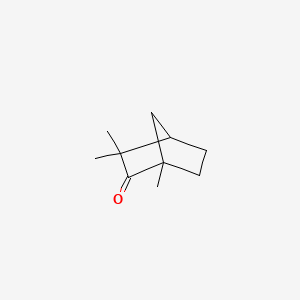
(+-)-Fenchone
Fenchone is a carbobicyclic compound that is fenchane in which the hydrogens at position 2 are replaced by an oxo group. It is a component of essential oil from fennel (Foeniculum vulgare). It has a role as a plant metabolite. It is a cyclic terpene ketone, a fenchane monoterpenoid and a carbobicyclic compound. — ChEBI
- IUPAC-Name
- 1,3,3-trimethylbicyclo[2.2.1]heptan-2-one
- Summenformel
- C10H16O
- Molekulargewicht
- 152.23 g/mol
- Exakte Masse
- 152.120115130 Da
- XLogP3
- 2,3
- Topologische polare Oberfläche
- 17,1 Ų
- Wasserstoffbrücken-Donoren
- 0
- Wasserstoffbrücken-Akzeptoren
- 1
- Kovalente Einheiten
- 1
- Definierte Stereozentren
- 0
Auch bekannt als
16 weitere gemeldete Namen
Kennungen in externen Datenbanken
- ChEBI:CHEBI:4999
- ChEMBL:CHEMBL2268554
- EPA DTXSID:DTXSID9025324
- PubMed:27633901
- PubMed:25636489
- PubMed:22953886
- PubMed:22500428
- PubMed:22493561
- PubMed:22448964
- PubMed:22351439
- PubMed:22219581
- PubMed:22171719
- PubMed:22117129
- PubMed:22099672
- PubMed:21870762
Belege aus weiteren wissenschaftlichen Datenbanken
NIH PubChem PUG-View
Attributed physical-property, hazard, environmental and use annotations.
- Boiling Point: 192.00 to 194.00 °C. @ 760.00 mm Hg Quelle: Human Metabolome Database (HMDB)
- LogP: 3.52 Quelle: Human Metabolome Database (HMDB)
- Melting Point: 5-6 °C Quelle: Human Metabolome Database (HMDB)
- Physical Description: Colorless liquid with a camphor-like odor; mp = 5 deg C; [Chem Service MSDS] Quelle: Haz-Map, Information on Hazardous Chemicals and Occupational Diseases
- Physical Description: Liquid Quelle: Human Metabolome Database (HMDB)
- Note: This chemical does not meet GHS hazard criteria for 83% (269 of 324) of all reports. Quelle: European Chemicals Agency (ECHA)
- Signal: Warning Quelle: European Chemicals Agency (ECHA)
- GHS Hazard Statements: H226 (13%): Flammable liquid and vapor [Warning Flammable liquids] Quelle: European Chemicals Agency (ECHA)
- Precautionary Statement Codes: P210, P233, P240, P241, P242, P243, P280, P303+P361+P353, P370+P378, P403+P235, and P501 (click each P-code to see the statement) Quelle: European Chemicals Agency (ECHA)
- ECHA C&L Notifications Summary: Aggregated GHS information provided per 324 reports by companies from 3 notifications to the ECHA C&L Inventory.; Reported as not meeting GHS hazard criteria per 269 of 324 reports by companies.; There are 2 notifications provided by 55 of 324 reports by companies with hazard statement code(s).; Information may vary between notifications depending on impurities, additives, and other factors. The percentage value in parenthesis indicates the notified classification ratio from companies that provide hazard codes. Only hazard codes with percentage values above 10% are shown. For more detailed information, please visit ECHA C&L website. Quelle: European Chemicals Agency (ECHA)
- Uses: Use (kg; approx.) in Germany (2009): >10; Consumption (g per capita; approx.) in Germany (2009): 0.000122; Calculated removal (%): 69.2 Quelle: NORMAN Suspect List Exchange
Zugeordnet durch: Existing checksum-valid CAS to unique PubChem CID match. Abgerufen: 2026-08-31. Quelleneintrag öffnen
Wissenschaftliche Klassifizierungen und Gefahrenannotationen liefern Kontext und ersetzen nicht die oben gezeigte marktspezifische regulatorische Entscheidung.
Weitere Quellenabdeckung und Trefferstatus
| Quelle | Ergebnis | Geprüft |
|---|---|---|
| NIH PubChem PUG-View | Exakter Treffer | 2026-08-31 |
Ein erfasster Nicht-Treffer ist ein nützlicher Beleg dafür, dass die Quelle geprüft wurde; er ist keine Behauptung, dass der Stoff anderswo nicht existiert.
Am 2026-08-31 von NIH PubChem durch prüfsummengültigen CAS-Abgleich abgerufen. Chemische Eigenschaften ersetzen nicht die regulatorische Entscheidung auf dieser Seite.