
CAS 119446-68-3
CAS 119446-68-3 entspricht 1 EU-Anhangseintrag in den Anhängen II–VI der Verordnung (EG) Nr. 1223/2009.
Einträge zu CAS 119446-68-3
1 insgesamtChemische Identität und Eigenschaften
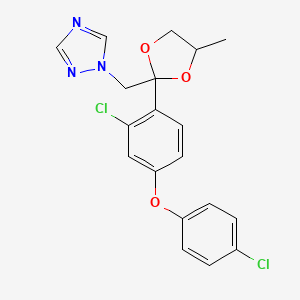
Difenoconazole
Difenoconazole is a member of the class of dioxolanes that is 1,3-dioxolane substituted at position 2 by 2-chloro-4-(4-chlorophenoxy)phenyl and 1,2,4-triazol-1-ylmethyl groups. A broad spectrum fungicide with novel broad-range activity used as a spray or seed treatment. It is moderately toxic to humans, mammals, birds and most aquatic organisms. It has a role as a xenobiotic, an EC 1.14.13.70 (sterol 14alpha-demethylase) inhibitor, an environmental contaminant and an antifungal agrochemical. It is an aromatic ether, a member of triazoles, a dioxolane, a cyclic ketal, a conazole fungicide and a triazole fungicide. — ChEBI
- IUPAC-Name
- 1-[[2-[2-chloro-4-(4-chlorophenoxy)phenyl]-4-methyl-1,3-dioxolan-2-yl]methyl]-1,2,4-triazole
- Summenformel
- C19H17Cl2N3O3
- Molekulargewicht
- 406.3 g/mol
- Exakte Masse
- 405.0646968 Da
- XLogP3
- 4,0
- Topologische polare Oberfläche
- 58,4 Ų
- Wasserstoffbrücken-Donoren
- 0
- Wasserstoffbrücken-Akzeptoren
- 5
- Kovalente Einheiten
- 1
- Definierte Stereozentren
- 0
Auch bekannt als
16 weitere gemeldete Namen
Kennungen in externen Datenbanken
- ChEBI:CHEBI:81760
- ChEMBL:CHEMBL466426
- EPA DTXSID:DTXSID4032372
- PubMed:39365753
- PubMed:39137466
- PubMed:36965607
- PubMed:36403845
- PubMed:34519103
- PubMed:34425431
- PubMed:33575850
- PubMed:32278787
- PubMed:32194361
- PubMed:30763314
- PubMed:29621561
- PubMed:29337257
Belege aus weiteren wissenschaftlichen Datenbanken
NIH PubChem PUG-View
Attributed physical-property, hazard, environmental and use annotations.
- Boiling Point: 100.8 °C (3.7 mPa) Quelle: Hazardous Substances Data Bank (HSDB)
- Color/Form: White crystalline solid Quelle: Hazardous Substances Data Bank (HSDB)
- Color/Form: White to light beige crystals Quelle: Hazardous Substances Data Bank (HSDB)
- Color/Form: Beige-grayish crystalline solid Quelle: Hazardous Substances Data Bank (HSDB)
- Density: 1.5 g/cu cm at 20 °C Quelle: Hazardous Substances Data Bank (HSDB)
- Dissociation Constants: pKa = 1.1 at 20 °C Quelle: Hazardous Substances Data Bank (HSDB)
- LogP: log Kow = 4.4 at 25 °C Quelle: Hazardous Substances Data Bank (HSDB)
- Melting Point: 78.6 °C Quelle: Hazardous Substances Data Bank (HSDB)
- Odor: Odorless Quelle: Hazardous Substances Data Bank (HSDB)
- Odor: Sweetish odor Quelle: Hazardous Substances Data Bank (HSDB)
- Solubility: In water, 15 mg/L at 25 °C Quelle: Hazardous Substances Data Bank (HSDB)
- Solubility: In water, 5 mg/L at 20 °C Quelle: Hazardous Substances Data Bank (HSDB)
- Solubility: Very soluble in most organic solvents Quelle: Hazardous Substances Data Bank (HSDB)
- Solubility: Soluble in acetone, dichloromethane, toluene, methanol and ethyl acetate >500 g/L, hexane 3 g/L, octanol 110 g/L (at 25 °C) Quelle: Hazardous Substances Data Bank (HSDB)
- Vapor Pressure: VP: 1.2X10⁻⁷ Pa at 20 °C (9.0X10⁻¹⁰ mm Hg) Quelle: Hazardous Substances Data Bank (HSDB)
- Vapor Pressure: 2.5X10⁻¹⁰ mm Hg at 25 °C (3.3X10⁻⁵ mPa) Quelle: Hazardous Substances Data Bank (HSDB)
- Viscosity: 529 cP at 25 °C Quelle: Hazardous Substances Data Bank (HSDB)
- Carcinogen Classification: No indication of carcinogenicity to humans (not listed by IARC). Quelle: Toxin and Toxin Target Database (T3DB)
- Signal: Warning Quelle: Regulation (EC) No 1272/2008 of the European Parliament and of the Council
- GHS Hazard Statements: H302: Harmful if swallowed [Warning Acute toxicity, oral]; H319: Causes serious eye irritation [Warning Serious eye damage/eye irritation]; H351: Suspected of causing cancer [Warning Carcinogenicity]; H400: Very toxic to aquatic life [Warning Hazardous to the aquatic environment, acute hazard]; H410: Very toxic to aquatic life with long lasting effects [Warning Hazardous to the aquatic environment, long-term hazard] Quelle: Regulation (EC) No 1272/2008 of the European Parliament and of the Council
- Precautionary Statement Codes: P203, P264, P264+P265, P270, P273, P280, P301+P317, P305+P351+P338, P318, P330, P337+P317, P391, P405, and P501 (click each P-code to see the statement) Quelle: Regulation (EC) No 1272/2008 of the European Parliament and of the Council
- Signal: Warning Quelle: European Chemicals Agency (ECHA)
- GHS Hazard Statements: H302+H332 (29.5%): Harmful if swallowed or if inhaled [Warning Acute toxicity, oral; acute toxicity, inhalation]; H302 (100%): Harmful if swallowed [Warning Acute toxicity, oral]; H319 (52.7%): Causes serious eye irritation [Warning Serious eye damage/eye irritation]; H332 (31%): Harmful if inhaled [Warning Acute toxicity, inhalation]; H400 (96.9%): Very toxic to aquatic life [Warning Hazardous to the aquatic environment, acute hazard]; H410 (96.9%): Very toxic to aquatic life with long lasting effects [Warning Hazardous to the aquatic environment, long-term hazard] Quelle: European Chemicals Agency (ECHA)
- Precautionary Statement Codes: P261, P264, P264+P265, P270, P271, P273, P280, P301+P317, P304+P340, P305+P351+P338, P317, P330, P337+P317, P391, and P501 (click each P-code to see the statement) Quelle: European Chemicals Agency (ECHA)
- ECHA C&L Notifications Summary: Aggregated GHS information provided per 129 reports by companies from 16 notifications to the ECHA C&L Inventory. Each notification may be associated with multiple companies.; Information may vary between notifications depending on impurities, additives, and other factors. The percentage value in parenthesis indicates the notified classification ratio from companies that provide hazard codes. Only hazard codes with percentage values above 10% are shown. For more detailed information, please visit ECHA C&L website. Quelle: European Chemicals Agency (ECHA)
- Signal: Warning Quelle: NITE-CMC
- GHS Hazard Statements: H302: Harmful if swallowed [Warning Acute toxicity, oral]; H320: Causes eye irritation [Warning Serious eye damage/eye irritation]; H351: Suspected of causing cancer [Warning Carcinogenicity]; H371: May cause damage to organs [Warning Specific target organ toxicity, single exposure]; H373: May causes damage to organs through prolonged or repeated exposure [Warning Specific target organ toxicity, repeated exposure]; H400: Very toxic to aquatic life [Warning Hazardous to the aquatic environment, acute hazard]; H410: Very toxic to aquatic life with long lasting effects [Warning Hazardous to the aquatic environment, long-term hazard] Quelle: NITE-CMC
- Precautionary Statement Codes: P203, P260, P264, P264+P265, P270, P273, P280, P301+P317, P305+P351+P338, P308+P316, P318, P319, P330, P337+P317, P391, P405, and P501 (click each P-code to see the statement) Quelle: NITE-CMC
- GHS Hazard Statements: H302: Harmful if swallowed [Warning Acute toxicity, oral]; H320: Causes eye irritation [Warning Serious eye damage/eye irritation]; H332: Harmful if inhaled [Warning Acute toxicity, inhalation] Quelle: NITE-CMC
- Precautionary Statement Codes: P261, P264, P264+P265, P270, P271, P301+P317, P304+P340, P305+P351+P338, P317, P330, P337+P317, and P501 (click each P-code to see the statement) Quelle: NITE-CMC
- Toxicity Summary: IDENTIFICATION AND USE: Difenoconazole is a white crystalline solid. It is used as fungicide, insecticide, seed treatment/protectant. HUMAN EXPOSURE AND TOXICITY: Harmful if inhaled or absorbed through skin. Causes moderate eye irritation. It did not cause chromosomal aberrations in human lymphocytes. One case of allergic reaction to a formulated product was reported. ANIMAL STUDIES: Difenoconazole was moderately and transiently irritating to the eyes of rabbits. It was very slightly and transiently irritating to the skin of rabbits. Difenoconazole was considered to be essentially non-toxic when applied topically under occlusion to intact rabbit skin. In rats treated dermally for 28 days there was an increased incidence of minimal centrilobular hepatocellular hypertrophy in males and females at 1000 mg/kg bw. In the thyroid, the incidence of minimal to moderate severity grades of hypertrophy of the follicular epithelium was slightly increased in the group of rats at 1000 mg/kg bw. The liver appeared to be the target organ for toxicity. There was no evidence for carcinogenicity or oncogenicity in rats. There were no indications of embryotoxicity, fetotoxicity or teratogenicity at a Quelle: Hazardous Substances Data Bank (HSDB)
- Environmental Bioconcentration: Following an EPA guideline study, a whole body BCF of 330 was reported for difenoconazole in bluegill fish (Lepomic macrochirus) exposed for 28 days(1), this BCF suggests that bioconcentration in aquatic organisms is high(SRC). Quelle: Hazardous Substances Data Bank (HSDB)
- Environmental Fate: TERRESTRIAL FATE: Based on a classification scheme(1), reported Koc values ranging from 3200 to 7734(2,3) indicate that difenoconazole is expected to be slightly mobile to immobile in soil(SRC). Volatilization of difenoconazole from moist soil surfaces is not expected to be an important fate process(SRC) given an estimated Henry's Law constant of 8.9X10⁻¹² atm-cu m/mole(SRC), based upon its vapor pressure, 2.5X10⁻¹⁰ mm Hg(4), and water solubility, 15 mg/L(4). Difenoconazole is not expected to volatilize from dry soil surfaces(SRC) based upon its vapor pressure(4). Slow biodegradation of difenoconazole may occur under certain conditions; however, may be limited by its bioavailability(4,5). Quelle: Hazardous Substances Data Bank (HSDB)
- Environmental Fate: AQUATIC FATE: Based on a classification scheme(1), reported Koc values ranging from 3200 to 7734(2,3) indicate that difenoconazole is not expected to adsorb to suspended solids and sediment(SRC). Volatilization from water surfaces is not expected(4) based upon an estimated Henry's Law constant of 8.9X10⁻¹² atm-cu m/mole(SRC) derived from its vapor pressure, 2.5X10⁻¹⁰ mm Hg(5), and water solubility, 15 mg/L(5). According to a classification scheme(6), a BCF of 330(7), suggests that bioconcentration in aquatic organisms is high(SRC). Slow biodegradation of difenoconazole may occur under certain conditions; however, may be limited by its bioavailability(5,8). Quelle: Hazardous Substances Data Bank (HSDB)
- Environmental Fate: ATMOSPHERIC FATE: According to a model of gas/particle partitioning of semivolatile organic compounds in the atmosphere(1), difenoconazole, which has a vapor pressure of 2.5X10⁻¹⁰ mm Hg at 25 °C(2), is expected to exist solely in the particulate phase in the ambient atmosphere. Particulate-phase difenoconazole may be removed from the air by wet and dry deposition(SRC). Difenoconazole contains chromophores that absorb at wavelengths >290 nm(3) and, therefore, may be susceptible to direct photolysis by sunlight(SRC). Quelle: Hazardous Substances Data Bank (HSDB)
- Uses: For difenoconazole (USEPA/OPP Pesticide Code: 128847) ACTIVE products with label matches. /SRP: Registered for use in the USA but approved pesticide uses may change periodically and so federal, state and local authorities must be consulted for currently approved uses./[ Quelle: Hazardous Substances Data Bank (HSDB)
- Uses: Difenoconazole... is a systemic triazole fungicide that controls a broad spectrum of foliar, seed and soil-borne diseases caused by Ascomycetes, Basidiomycetes and Deuteromycetes in cereals, soya, rice, grapes, pome fruit, stone fruit, potatoes, sugar beet and several vegetable and ornamental crops. Quelle: Hazardous Substances Data Bank (HSDB)
- Uses: Fungicide, insecticide, seed treatment/protectant. Quelle: Hazardous Substances Data Bank (HSDB)
- Uses: This is a man-made compound that is used as a pesticide. Quelle: Toxin and Toxin Target Database (T3DB)
Zugeordnet durch: Existing checksum-valid CAS to unique PubChem CID match. Abgerufen: 2026-08-31. Quelleneintrag öffnen
Wissenschaftliche Klassifizierungen und Gefahrenannotationen liefern Kontext und ersetzen nicht die oben gezeigte marktspezifische regulatorische Entscheidung.
Weitere Quellenabdeckung und Trefferstatus
| Quelle | Ergebnis | Geprüft |
|---|---|---|
| NIH PubChem PUG-View | Exakter Treffer | 2026-08-31 |
Ein erfasster Nicht-Treffer ist ein nützlicher Beleg dafür, dass die Quelle geprüft wurde; er ist keine Behauptung, dass der Stoff anderswo nicht existiert.
Am 2026-09-02 von NIH PubChem durch prüfsummengültigen CAS-Abgleich abgerufen. Chemische Eigenschaften ersetzen nicht die regulatorische Entscheidung auf dieser Seite.
Wie CAS 119446-68-3 auf dieser Website verwendet wird
CAS 119446-68-3 ist die Kennung des Chemical Abstracts Service, mit der diese Seite einem bestimmten Stoff zugeordnet wird. Im aktuellen Datenbestand hat 1 EU-Anhangseintrag diese Kennung; so können Sie gegenprüfen, ob derselbe Stoff in einem oder in mehreren regulatorischen Zusammenhängen auftaucht.
Nutzen Sie diese Seite, wenn eine Lieferantenspezifikation, ein Sicherheitsdatenblatt oder ein Rohstoffdossier CAS 119446-68-3 nennt und Sie alle verknüpften Einträge der Anhänge II–VI an einem Ort sehen möchten. Die Eintragskarten oben sind der schnellste Weg zu Konzentrationsgrenzen, Warnhinweisen, Anhangszuordnung und Produktartbedingungen.
Häufig gestellte Fragen
Werkzeuge und nächste Schritte
Rezeptur prüfen
Eine vollständige INCI-Liste prüfen und anschließend mit CAS 119446-68-3 Lieferantendokumente zu den gefundenen Stoffen gegenprüfen.
INCI-CheckerNach Name suchen
Nach INCI-Namen, Aliasen oder verwandten Kennungen suchen, die in Ihrer Dokumentation neben CAS 119446-68-3 stehen.
Suche