
CAS
1 Eintrag
CAS 119-47-1
CAS 119-47-1 entspricht 1 EU-Anhangseintrag in den Anhängen II–VI der Verordnung (EG) Nr. 1223/2009.
Einträge zu CAS 119-47-1
1 insgesamtChemische Identität und Eigenschaften
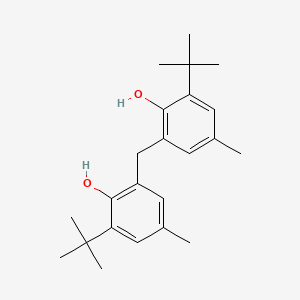
CAS 119-47-1PubChem CID 8398
2,2'-Methylenebis(4-methyl-6-tert-butylphenol)
2,2'-Methylenebis(4-methyl-6-tert-butylphenol) is a diarylmethane. — ChEBI
- IUPAC-Name
- 2-tert-butyl-6-[(3-tert-butyl-2-hydroxy-5-methylphenyl)methyl]-4-methylphenol
- Summenformel
- C23H32O2
- Molekulargewicht
- 340.5 g/mol
- Exakte Masse
- 340.240230259 Da
- XLogP3
- 7,2
- Topologische polare Oberfläche
- 40,5 Ų
- Wasserstoffbrücken-Donoren
- 2
- Wasserstoffbrücken-Akzeptoren
- 2
- Kovalente Einheiten
- 1
- Definierte Stereozentren
- 0
Auch bekannt als
2,2'-Methylenebis(6-tert-butyl-p-cresol)Antioxidant 2246Antioxidant BKFAntioxidant 1Anti OxCyanox 2246Advastab 405Lederle 2246
16 weitere gemeldete Namen
Chemanox 21Catolin 14Vulkanox bkfNocrac NS 6Plastanox 2246Bisaklofen BPSumilizer MDPAO 1 (Antioxidant)Synox 5ltAlterungsschutzmittel BKFCalco 2246Antioxidant OMBAntage W 400CAO 5Plastanox 2246 AntioxidantCAO 14
Kennungen in externen Datenbanken
- ChEBI:CHEBI:172336
- ChEMBL:CHEMBL460648
- EPA DTXSID:DTXSID4020870
- PubMed:40228673
- PubMed:38160208
- PubMed:33352258
- PubMed:22796571
- PubMed:16749692
- PubMed:16497524
- PubMed:16238337
- PubMed:16231125
- PubMed:15811949
- PubMed:15252483
- PubMed:12816477
- PubMed:11266322
Belege aus weiteren wissenschaftlichen Datenbanken
NIH PubChem PUG-View
Exakter Kennungstreffer8398
Attributed physical-property, hazard, environmental and use annotations.
- Color/Form: Off-white powder Quelle: Hazardous Substances Data Bank (HSDB)
- Density: 1.07-1.10 kg/L Quelle: Hazardous Substances Data Bank (HSDB)
- LogP: Log Kow = 6.25 Quelle: Hazardous Substances Data Bank (HSDB)
- Melting Point: 118-128 °C Quelle: Hazardous Substances Data Bank (HSDB)
- Physical Description: Liquid; Dry Powder; Other Solid; Dry Powder Quelle: EPA Chemical Data Reporting (CDR)
- Physical Description: Off-white solid; [HSDB] Quelle: Haz-Map, Information on Hazardous Chemicals and Occupational Diseases
- Solubility: Soluble in oxygen and aromatic solvents. Quelle: Hazardous Substances Data Bank (HSDB)
- Solubility: Water solubility = 0.02 mg/l. Quelle: Hazardous Substances Data Bank (HSDB)
- Signal: Danger Quelle: Regulation (EC) No 1272/2008 of the European Parliament and of the Council
- GHS Hazard Statements: H360F: May damage fertility [Danger Reproductive toxicity] Quelle: Regulation (EC) No 1272/2008 of the European Parliament and of the Council
- Precautionary Statement Codes: P203, P280, P318, P405, and P501 (click each P-code to see the statement) Quelle: Regulation (EC) No 1272/2008 of the European Parliament and of the Council
- Note: This chemical does not meet GHS hazard criteria for 15.4% (153 of 995) of reports. Quelle: European Chemicals Agency (ECHA)
- Signal: Danger Quelle: European Chemicals Agency (ECHA)
- GHS Hazard Statements: H360F (25.2%): May damage fertility [Danger Reproductive toxicity]; H361 (46.2%): Suspected of damaging fertility or the unborn child [Warning Reproductive toxicity]; H413 (47.4%): May cause long lasting harmful effects to aquatic life [Hazardous to the aquatic environment, long-term hazard] Quelle: European Chemicals Agency (ECHA)
- Precautionary Statement Codes: P203, P273, P280, P318, P405, and P501 (click each P-code to see the statement) Quelle: European Chemicals Agency (ECHA)
- ECHA C&L Notifications Summary: Aggregated GHS information provided per 995 reports by companies from 33 notifications to the ECHA C&L Inventory. Each notification may be associated with multiple companies.; Reported as not meeting GHS hazard criteria per 153 of 995 reports by companies.; There are 32 notifications provided by 842 of 995 reports by companies with hazard statement code(s).; Information may vary between notifications depending on impurities, additives, and other factors. The percentage value in parenthesis indicates the notified classification ratio from companies that provide hazard codes. Only hazard codes with percentage values above 10% are shown. For more detailed information, please visit ECHA C&L website. Quelle: European Chemicals Agency (ECHA)
- Signal: Danger Quelle: NITE-CMC
- GHS Hazard Statements: H360: May damage fertility or the unborn child [Danger Reproductive toxicity]; H373: May causes damage to organs through prolonged or repeated exposure [Warning Specific target organ toxicity, repeated exposure]; H413: May cause long lasting harmful effects to aquatic life [Hazardous to the aquatic environment, long-term hazard] Quelle: NITE-CMC
- Precautionary Statement Codes: P203, P260, P273, P280, P318, P319, P405, and P501 (click each P-code to see the statement) Quelle: NITE-CMC
- Signal: Danger Quelle: Hazardous Chemical Information System (HCIS), Safe Work Australia
- Environmental Bioconcentration: An estimated BCF value of 33100 was calculated for bis(2-hydroxy-3-tert-butyl-5-methylphenyl)methane(SRC), using an experimental log Kow of 6.25(1) and a recommended regression-derived equation(2). Bioconcentration factors of 23-37 and 60-125 were obtained during an 8 week bioconcentration study using carp and bis(2-hydroxy-3-tert-butyl-5-methylphenyl)methane concentrations of 1 and 0.1 mg/l, respectively(1). According to a recommended classification scheme(3), the experimental BCF values suggest that bioconcentration in aquatic organisms will be moderate to high(SRC). Quelle: Hazardous Substances Data Bank (HSDB)
- Environmental Fate: TERRESTRIAL FATE: Based on a recommended classification scheme(1), an estimated Koc value of 59800(SRC), determined from an experimental log Kow(2) and a recommended regression-derived equation(3), indicates that bis(2-hydroxy-3-tert-butyl-5-methylphenyl)methane will have no mobility in soil(SRC). Volatilization of bis(2-hydroxy-3-tert-butyl-5-methylphenyl)methane may not be important from moist soil surfaces(SRC) given an estimated Henry's Law constant of 7.9X10⁻¹² atm-cu m/mole(4,SRC), or from dry soil surfaces(SRC) based on an estimated vapor pressure of 2.5X10⁻⁹ mm Hg(5,SRC). Based on a MITI biodegradation test, bis(2-hydroxy-3-tert-butyl-5-methylphenyl)methane will not biodegrade in soil(2). Quelle: Hazardous Substances Data Bank (HSDB)
- Environmental Fate: AQUATIC FATE: Based on a recommended classification scheme(1), an estimated Koc value of 59800(SRC), determined from an experimental log Kow(2) and a recommended regression-derived equation(3), indicates that bis(2-hydroxy-3-tert-butyl-5-methylphenyl)methane will adsorb to suspended solids and sediment(SRC) in the water. Bis(2-hydroxy-3-tert-butyl-5-methylphenyl)methane should not volatilize from water surfaces based on an estimated Henry's Law constant of 7.9X10⁻¹² atm-cu m/mole(SRC), developed using a fragment constant estimation method(4). Experimental BCF values of 23-37 and 60-125 at 1 and 0.1 mg/L(2), suggest that bis(2-hydroxy-3-tert-butyl-5-methylphenyl)methane will bioconcentrate in aquatic organisms(SRC) according to a recommended classification scheme(5). Based on a MITI biodegradation test, bis(2-hydroxy-3-tert-butyl-5-methylphenyl)methane will not biodegrade in water(2). Quelle: Hazardous Substances Data Bank (HSDB)
- Environmental Fate: ATMOSPHERIC FATE: According to a suggested classification scheme(1), an estimated vapor pressure of 2.5X10⁻⁹ mm Hg at 25 °C(2,SRC) indicates that bis(2-hydroxy-3-tert-butyl-5-methylphenyl)methane will exist in the particulate phase in the ambient atmosphere. Particulate-phase bis(2-hydroxy-3-tert-butyl-5-methylphenyl)methane may be physically removed from the air by wet and dry deposition(SRC). Quelle: Hazardous Substances Data Bank (HSDB)
- Consumer Uses: Antioxidant Quelle: EPA Chemical Data Reporting (CDR)
- Industry Uses: Not Known or Reasonably Ascertainable; UV stabilizer; Processing aids not otherwise specified; Antioxidant Quelle: EPA Chemical Data Reporting (CDR)
- Sources/Uses: Used as an antioxidant and stabilizer for polymers (ABS, polypropylene, polyacetal, rubber, latex, and adhesives); [HSDB] Quelle: Haz-Map, Information on Hazardous Chemicals and Occupational Diseases
- Industrial Processes with risk of exposure: Plastic Composites Manufacturing [Category: Industry] Quelle: Haz-Map, Information on Hazardous Chemicals and Occupational Diseases
- Uses: Stabilizer used in styrenic and olefin polymers and polyoxymethylene homo and copolymers. Quelle: Hazardous Substances Data Bank (HSDB)
- Uses: Antioxidant (ABS, polypropylene, polyacetal, rubber, latex, adhesives). Quelle: Hazardous Substances Data Bank (HSDB)
- Uses: Plastics -> Typical concentration range in plastic materials -> 0.5% Quelle: NORMAN Suspect List Exchange
Zugeordnet durch: Existing checksum-valid CAS to unique PubChem CID match. Abgerufen: 2026-08-31. Quelleneintrag öffnen
Wissenschaftliche Klassifizierungen und Gefahrenannotationen liefern Kontext und ersetzen nicht die oben gezeigte marktspezifische regulatorische Entscheidung.
Weitere Quellenabdeckung und Trefferstatus
| Quelle | Ergebnis | Geprüft |
|---|---|---|
| NIH PubChem PUG-View | Exakter Treffer | 2026-08-31 |
Ein erfasster Nicht-Treffer ist ein nützlicher Beleg dafür, dass die Quelle geprüft wurde; er ist keine Behauptung, dass der Stoff anderswo nicht existiert.
Am 2026-09-02 von NIH PubChem durch prüfsummengültigen CAS-Abgleich abgerufen. Chemische Eigenschaften ersetzen nicht die regulatorische Entscheidung auf dieser Seite.
Wie CAS 119-47-1 auf dieser Website verwendet wird
CAS 119-47-1 ist die Kennung des Chemical Abstracts Service, mit der diese Seite einem bestimmten Stoff zugeordnet wird. Im aktuellen Datenbestand hat 1 EU-Anhangseintrag diese Kennung; so können Sie gegenprüfen, ob derselbe Stoff in einem oder in mehreren regulatorischen Zusammenhängen auftaucht.
Nutzen Sie diese Seite, wenn eine Lieferantenspezifikation, ein Sicherheitsdatenblatt oder ein Rohstoffdossier CAS 119-47-1 nennt und Sie alle verknüpften Einträge der Anhänge II–VI an einem Ort sehen möchten. Die Eintragskarten oben sind der schnellste Weg zu Konzentrationsgrenzen, Warnhinweisen, Anhangszuordnung und Produktartbedingungen.
Häufig gestellte Fragen
Ein durch CAS 119-47-1 identifizierter Stoff kann in mehreren Anhängen der EU-Kosmetikverordnung vorkommen, wenn er in unterschiedlichen Zusammenhängen unterschiedlichen Bedingungen unterliegt. Ein Stoff kann beispielsweise nach Anhang III mit bestimmten Bedingungen beschränkt sein, und dieselbe CAS-Nummer kann auch in Anhang IV als zugelassener Farbstoff unter eigenen Eintragsbedingungen erscheinen. Jeder Eintrag muss einzeln geprüft werden.
Gleichen Sie die CAS-Nummer mit den Spezifikationsblättern und Analysenzertifikaten Ihrer Rohstoffe ab. Erscheint eine CAS-Nummer in Anhang II, prüfen Sie die Abwesenheit des Stoffs. Erscheint sie in Anhang III, prüfen Sie, ob Konzentrationsgrenzen und Produktartbedingungen in Ihrer Rezeptur eingehalten werden. Alle Anhangseinträge mit dieser CAS-Nummer sind oben aufgeführt.
Eine CAS-Nummer wird vom Chemical Abstracts Service (USA) vergeben und ist weltweit anerkannt. Eine EC-Nummer ist eine Kennung der Europäischen Kommission aus Verzeichnissen wie EINECS, ELINCS oder der NLP-Liste. Beide Kennungen können in Einträgen der EU-Kosmetikanhänge vorkommen. Manche Stoffe haben beide, manche nur eine, und einige ältere Einträge haben möglicherweise keine von beiden.
Der INCI-Checker akzeptiert Inhaltsstoffnamen, CAS-Nummern und EC-Nummern. Prüfen Sie diese CAS-Nummer direkt und gleichen Sie das Ergebnis anschließend mit den Spezifikationsblättern der Lieferanten und allen verknüpften Anhangsbedingungen ab.
Werkzeuge und nächste Schritte
Rezeptur prüfen
Eine vollständige INCI-Liste prüfen und anschließend mit CAS 119-47-1 Lieferantendokumente zu den gefundenen Stoffen gegenprüfen.
INCI-CheckerNach Name suchen
Nach INCI-Namen, Aliasen oder verwandten Kennungen suchen, die in Ihrer Dokumentation neben CAS 119-47-1 stehen.
Suche