
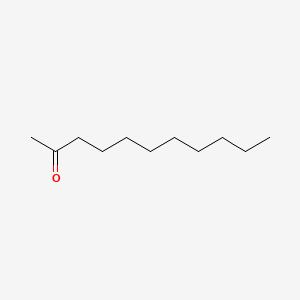
2-Undecanone
Undecan-2-one is a dialkyl ketone with methyl and nonyl as the two alkyl groups. It has a role as a rodenticide and a plant metabolite. It is a dialkyl ketone and a methyl ketone. — ChEBI
- IUPAC-Name
- undecan-2-one
- Summenformel
- C11H22O
- Molekulargewicht
- 170.29 g/mol
- Exakte Masse
- 170.167065321 Da
- XLogP3
- 4,1
- Topologische polare Oberfläche
- 17,1 Ų
- Wasserstoffbrücken-Donoren
- 0
- Wasserstoffbrücken-Akzeptoren
- 1
- Kovalente Einheiten
- 1
- Definierte Stereozentren
- 0
Auch bekannt als
16 weitere gemeldete Namen
Kennungen in externen Datenbanken
- ChEBI:CHEBI:17700
- ChEMBL:CHEMBL1236582
- EPA DTXSID:DTXSID2021943
- PubMed:35285579
- PubMed:27633901
- PubMed:22967641
- PubMed:22850984
- PubMed:22619691
- PubMed:22563356
- PubMed:22477025
- PubMed:22438717
- PubMed:22384116
- PubMed:22346620
- PubMed:22289669
- PubMed:22174627
Belege aus weiteren wissenschaftlichen Datenbanken
NIH PubChem PUG-View
Attributed physical-property, hazard, environmental and use annotations.
- Boiling Point: 231.5 °C Quelle: Hazardous Substances Data Bank (HSDB)
- Boiling Point: BP: 231.5 to 232.5 °C at 761 mm Hg; 99 °C at 7 mm Hg Quelle: Hazardous Substances Data Bank (HSDB)
- Boiling Point: 231.00 to 232.00 °C. @ 760.00 mm Hg Quelle: Human Metabolome Database (HMDB)
- Boiling Point: 231-232 °C Quelle: Joint FAO/WHO Expert Committee on Food Additives (JECFA)
- Boiling Point: 223 °C @760 [mm Hg] Quelle: PAC Chemical Database, U.S. Department of Energy
- Color/Form: Oily liquid Quelle: Hazardous Substances Data Bank (HSDB)
- Color/Form: Colorless liquid Quelle: Hazardous Substances Data Bank (HSDB)
- Density: 0.8260 to 0.8263 at 20 °C/4 °C Quelle: Hazardous Substances Data Bank (HSDB)
- Density: 0.822 -0.826 Quelle: Joint FAO/WHO Expert Committee on Food Additives (JECFA)
- Density: 0.829 @ 30°C Quelle: PAC Chemical Database, U.S. Department of Energy
- Flash Point: 192 °F (89 °C) (Closed cup) Quelle: Hazardous Substances Data Bank (HSDB)
- LogP: log Kow = 4.09 Quelle: Hazardous Substances Data Bank (HSDB)
- LogP: 4.09 Quelle: Human Metabolome Database (HMDB)
- Melting Point: 15 °C Quelle: Hazardous Substances Data Bank (HSDB)
- Melting Point: 15 °C Quelle: Human Metabolome Database (HMDB)
- Melting Point: 12 °C Quelle: PAC Chemical Database, U.S. Department of Energy
- Odor: Strong odor Quelle: Hazardous Substances Data Bank (HSDB)
- Physical Description: Liquid Quelle: EPA Chemical Data Reporting (CDR)
- Physical Description: Colorless, oily liquid; [HSDB] Colorless liquid; mp = 11-13 deg C; [MSDSonline] Quelle: Haz-Map, Information on Hazardous Chemicals and Occupational Diseases
- Physical Description: Liquid Quelle: Human Metabolome Database (HMDB)
- Physical Description: colourless to pale yellow liquid with a citrus, fatty, rue-like odour Quelle: Joint FAO/WHO Expert Committee on Food Additives (JECFA)
- Refractive Index: Index of refraction = 1.4291 at 20 °C/D Quelle: Hazardous Substances Data Bank (HSDB)
- Refractive Index: 1.428-1.432 Quelle: Joint FAO/WHO Expert Committee on Food Additives (JECFA)
- Solubility: Insoluble in water. Soluble in ethanol, ether, acetone, benzene, carbon tetrachloride, chloroform. Quelle: Hazardous Substances Data Bank (HSDB)
- Solubility: soluble in alcohol and oil; insoluble in water Quelle: Joint FAO/WHO Expert Committee on Food Additives (JECFA)
- Solubility: 1 ml in 1 ml 95% alcohol (in ethanol) Quelle: Joint FAO/WHO Expert Committee on Food Additives (JECFA)
- Vapor Pressure: 0.04 [mmHg] Quelle: Haz-Map, Information on Hazardous Chemicals and Occupational Diseases
- Vapor Pressure: 4.1X10⁻² mm Hg Quelle: Hazardous Substances Data Bank (HSDB)
- Note: This chemical does not meet GHS hazard criteria for 15.2% (271 of 1781) of reports. Quelle: European Chemicals Agency (ECHA)
- Signal: Warning Quelle: European Chemicals Agency (ECHA)
- GHS Hazard Statements: H400 (84.3%): Very toxic to aquatic life [Warning Hazardous to the aquatic environment, acute hazard] Quelle: European Chemicals Agency (ECHA)
- Precautionary Statement Codes: P273, P391, and P501 (click each P-code to see the statement) Quelle: European Chemicals Agency (ECHA)
- ECHA C&L Notifications Summary: Aggregated GHS information provided per 1781 reports by companies from 16 notifications to the ECHA C&L Inventory.; Reported as not meeting GHS hazard criteria per 271 of 1781 reports by companies.; There are 15 notifications provided by 1510 of 1781 reports by companies with hazard statement code(s).; Information may vary between notifications depending on impurities, additives, and other factors. The percentage value in parenthesis indicates the notified classification ratio from companies that provide hazard codes. Only hazard codes with percentage values above 10% are shown. For more detailed information, please visit ECHA C&L website. Quelle: European Chemicals Agency (ECHA)
- NFPA Health Rating: 1 - Materials that, under emergency conditions, can cause significant irritation. Quelle: Hazardous Substances Data Bank (HSDB)
- NFPA Fire Rating: 2 - Materials that must be moderately heated or exposed to relatively high ambient temperatures before ignition can occur. Materials would not under normal conditions form hazardous atmospheres with air, but under high ambient temperatures or under moderate heating could release vapor in sufficient quantities to produce hazardous atmospheres with air. Quelle: Hazardous Substances Data Bank (HSDB)
- NFPA Instability Rating: 0 - Materials that in themselves are normally stable, even under fire conditions. Quelle: Hazardous Substances Data Bank (HSDB)
- Environmental Bioconcentration: An estimated BCF of 28 was calculated for 2-undecanone(SRC), using a log Kow of 4.09(1) and a regression-derived equation(2). According to a classification scheme(3), this BCF suggests the potential for bioconcentration in aquatic organisms is low(SRC). Quelle: Hazardous Substances Data Bank (HSDB)
- Environmental Fate: TERRESTRIAL FATE: Based on a classification scheme(1), an estimated Koc value of 280(SRC), determined from a structure estimation method(2), indicates that 2-undecanone is expected to have moderate mobility in soil(SRC). Volatilization of 2-undecanone from moist soil surfaces may be expected to be an important fate process(SRC) given a Henry's Law constant of 6.36X10⁻⁵ atm-cu m/mole(3). 2-Undecanone is not expected to volatilize from dry soil surfaces(SRC) based upon a vapor pressure of 4.1X10⁻² mm Hg(4). 2-Undecanone had a theoretical biological oxygen demand (BOD) of 1%, 6.5% and 21.8% after 6, 12 and 24 hr, respectively, when incubated with an activated sludge seed at an initial concentration of 500 ppm(5) suggesting that biodegradation in the soil may be fast(SRC). Quelle: Hazardous Substances Data Bank (HSDB)
- Environmental Fate: ATMOSPHERIC FATE: According to a model of gas/particle partitioning of semivolatile organic compounds in the atmosphere(1), 2-undecanone, which has a vapor pressure of 4.1X10⁻² mm Hg at 25 °C(2), is expected to exist solely as a vapor in the ambient atmosphere. Vapor-phase 2-undecanone is degraded in the atmosphere by reaction with photochemically-produced hydroxyl radicals(SRC); the half-life for this reaction in air is estimated to be 1.2 days(SRC), calculated from its rate constant of 1.38X10⁻¹¹ cu cm/molecule-sec at 25 °C(SRC) that was derived using a structure estimation method(3). Quelle: Hazardous Substances Data Bank (HSDB)
- Sources/Uses: Used as a solvent in the production of vinyl resins, nitrocellulose, and synthetic rubber; as a flavoring agent; as a dog and cat repellent; [HSDB] Used to make some synthetic essential oils and as a fragrance in soaps, detergents, creams, lotions, and perfumes; [Merck Index] Used as a dog/cat repellent and iris borer deterrent; [Reference #1] Quelle: Haz-Map, Information on Hazardous Chemicals and Occupational Diseases
- Uses: For methyl nonyl ketone (USEPA/OPP Pesticide Code: 044102) ACTIVE products with label matches. /SRP: Registered for use in the U.S. but approved pesticide uses may change periodically and so federal, state and local authorities must be consulted for currently approved uses./ Quelle: Hazardous Substances Data Bank (HSDB)
- Uses: Used as a solvent in the production of vinyl resins, nitrocellulose, and synthetic rubber. Quelle: Hazardous Substances Data Bank (HSDB)
- Uses: ... Flavoring Quelle: Hazardous Substances Data Bank (HSDB)
- Uses: Dog and cat repellent/training aid and iris borer deterrent. Quelle: Hazardous Substances Data Bank (HSDB)
- Uses: Perfumery, flavoring, animal repellent. Quelle: Hazardous Substances Data Bank (HSDB)
Zugeordnet durch: Existing checksum-valid CAS to unique PubChem CID match. Abgerufen: 2026-08-31. Quelleneintrag öffnen
Wissenschaftliche Klassifizierungen und Gefahrenannotationen liefern Kontext und ersetzen nicht die oben gezeigte marktspezifische regulatorische Entscheidung.
Weitere Quellenabdeckung und Trefferstatus
| Quelle | Ergebnis | Geprüft |
|---|---|---|
| NIH PubChem PUG-View | Exakter Treffer | 2026-08-31 |
Ein erfasster Nicht-Treffer ist ein nützlicher Beleg dafür, dass die Quelle geprüft wurde; er ist keine Behauptung, dass der Stoff anderswo nicht existiert.
Am 2026-08-31 von NIH PubChem durch prüfsummengültigen CAS-Abgleich abgerufen. Chemische Eigenschaften ersetzen nicht die regulatorische Entscheidung auf dieser Seite.